So I did it. Last week, on Tuesday to be precise. I emailed Mountain Madness, our trekking company, and just said yes to the Chimborazo extension. Now I recognize that some of you were pushing for the Galopagos Islands, but I simply couldn’t escape the fact that there will be no other point at which husband J and I stand a better chance of actually climbing a 20,000 foot mountain. I think I can manage the Galopagos in future years.
As I continue the grueling process of forcing myself to run at ever faster paces and climb stairs with increasing amounts of weight – and of finding the time to do so – it occurs to me that I have not really described the two mountains that are engendering such passion (or foolhardiness). I’ve referred to them by name, but without much explanation.
Here’s what is inspiring me.
Both mountains are part of Ecuador’s Avenue of Volcanoes, named by 19th century German scientist Alexander Van Humboldt. Due to a location just above and below the equator, the scenery is supposed to be reminiscent of the Scottish highlands or the Arctic tundra, at least according to our trekking company. Both were first summited (at least by westerners) in 1882 by Edward Whymper, for whom some of the passes are named.
Cotopaxi last erupted in 1940 and some consider it the world’s highest active volcano. It stands at 19,347 feet (5897 meters) and is located near Quito, which at 9400 feet is itself one of the world’s highest cities. Cotopaxi has been worshipped as a sacred mountain, a bringer of rain and fertility.
We will acclimatize for the altitude first with a climb up Guagua Pichincha (just outside Quito, standing at 15,696 feet, last eruption 2004) and then what is described as an “enjoyable rock scramble” up Illiniza Norte (16,818 feet), with trekking, camping and stays at haciendas in between. Mules are supposed to help at certain points as we travel between and up the various mountains. Once we are at Cotopaxi, summit day (summit night is a more accurate description) begins at 15,749 feet, where we will have been staying at the Jose Ribas Hut. The glacier starts at about 17,000 feet, and according to Mountain Madness, we will be crossing snow bridges, avoiding large crevasses, and climbing “short, steep sections.” Once at the summit of Cotopaxi, we should be able to peer into a perfectly round caldera, the origin of the steam you apparently can sometimes see boiling up.
I have found a lot less written about Chimborazo. It is famous for being the point closest to the sun, due to the bulge of the earth at the equator. As I mentioned before, I hope our attempt to climb it is not too Icarus like. It is currently inactive, with a last eruption in 550 A.D. or so. It reaches a whopping 20,564 feet (6268 meters) and is the highest mountain in Ecuador. Chimborazo can sometimes be in very bad condition – with unstable snow, big crevasses and high risk of rock fall. The itinerary states that if Chimborazo is not climable, we are to attempt Antisana. It’s only 18,714 feet high, but from what I’ve read is even more technically challenging, as it is completely covered by glaciers, and is not climbed very frequently.
Despite all this, you may still be left wondering – but “why?” Well, a summit goal, for me at least, gives me something to focus on, look forward to, and lifts me out of the drab tension of the day to day working world. And the other reason is simply a variation of the “because it’s there” phrase – because there is something about standing on a summit that gives a high that doesn’t come from anything else.
In passing, I’ve previously mentioned a fear of heights – in fact, it played a role in the decision not to climb the Grand Teton. I’ve downplayed it to avoid the inevitable queries about why someone with any such concern would decide mountain climbing was for them. But occasionally that fear rears its head again, like the proverbial dragon waking up in its cave. And I realize that each time I set off for a new summit, vertical drops provide their own very special form of challenge (or torture). It goes back to kindergarten when on my way to the second floor of the building I somehow slipped between the steps of the fire escape style metal staircase, just catching myself before I fell. I was a skinny child. I didn’t say much to anyone about it, but I remember it to this day.
Year later, when I was about 13, my family made a trip to Grandfather Mountain in North Carolina, where my father walked my brother and me over the swinging bridge that crosses a gorge several hundred feet below. I still have never told anyone how completely paralyzed I felt on that bridge, but one of my repeated anxiety dreams (aside from the one where you have to take an exam in a class that you forgot to attend) is of being on a high, narrow bridge with no rails, unable to move forward or back.
So, yesterday when my husband (now known as J) and I decided the time had come to clean the skylights on our house, I clambered up the ladder after him. (The roof really is a bit steeper than the photo shows.) As soon as I put my foot down on the sloping roof every fear I’d had was triggered – what in the world would prevent me from simply sliding right back down and onto the patio below. I started to think about the angles of Cotopaxi – and, if we do it, Chimborazo – and thought, well, if you’re having a hard time on your own roof top you aren’t going to do very well there. So I took a deep breath, trusted in the grip of my tennis shoes, and bribed myself with the promise of the great view I would have of the neighborhood and everyone else’s backyards.
And it worked. By the time we were done I was skipping around on the roof – if not like a mountain goat at least like one of those mules that go up and down the Grand Canyon.
But, you know what? Last night I still dreamed about walking on a narrow ledge at the very top of a multi-level mall. I had to hold on to some sort of rope and half way along the ledge drop one rope and pick up another. I did really well on one side of the mall, but when I had to cross the ledge on the other side, I found myself saying to the anonymous, but stern, guides, I’d just prefer to do this tomorrow.
As an English major and daughter of two now retired English professors, I was raised in a house filled with thousands of books. We didn’t just have one copy of a book – we would have triplicate, because, I suppose, you can never have too much of a good thing.
But reading has always powered my imagination – and imagination is probably behind my starting this whole mountain climbing thing in the first place. Well, to be more precise, it was a 1991 movie called K2 that I saw on TV. In fact checking for this post, I discovered it was largely panned by the critics, but I still remember the drama of preparation (one of the climbers was a lawyer) and the critical moments on the mountain where one climber had to make the decision to leave his injured companion behind. The husband found the film absolutely appalling. But for some reason, the adrenalin junkie in me found the battle of man versus the elements completely fascinating.
A good book about the mountains – or any adventure travel – brings you that one step closer to making the summit your own reality. Lots of books have given me that little last push up that extra flight of stairs. Here are some of my favorites and I’d like to know yours – I’m currently perfecting my Kindle reading technique for stair climbing.
The Seven Summits by Frank Wells and Dick Bass. This may be where it truly started. A work colleague of mine lent me this book back in the 1990s, and, true confessions, I never returned it. It’s the tale of the original two who climbed the seven summits in one year, 1983, the year I graduated from university. Easy reading and puts the mountains within reach.
Paths of Glory by Jeffrey Archer. The story of George Mallory’s fateful trip to Everest, starting with his days climbing church steeples. The mystery remains – did he or did he not summit?
Mark Horrell’s travel diaries – these are available very inexpensively in Ebook format. He seems to have climbed everything and his very detailed accounts of mountains ranging from Cotopaxi to Elbrus are quite reassuring to a novice climber.
Into Thin Air by Jon Krakauer. Need I say more.
And, to finish up, The Orchid Thief by Susan Orlean. Ok, it’s not about summits but it is about swamps., Possibly the most beautiful prose ever written about the adventure of hiking through the wild Florida of the Fakahatchee swamp and the search for rare orchids. Inspirational for swamp dwellers who want to see more than the concrete of Florida development.
As I sit here on a weekend, waiting for the plumber to take his interminable time to arrive (three hours late, thus far), we have some decision-making to do. As hoped, the work schedule cleared up, freeing the way to commit to some June 2015 dates for our next mountain climbing endeavor. And I’ve already contacted the guide company that successfully led us up Elbrus, so that’s done.
But here’s where the itch of mountain climbing – or you could say hubris – sets in. It turns out for an additional four days and a few more dollars, we not only could climb Cotopaxi, but also climb Chimborazo – the highest mountain in Ecuador and one that reaches my long dreamed of goal of a 20,000 foot mountain. Well, long dreamed of if you count 2011 as a long time ago, since that’s when all this started. This would mean acclimatization hikes up Guagua Pichincha and Illiniza Norte, followed by Cotopaxi at 19,348 feet and three days, later – Chimborazo. At 20,564 feet, Chimborazo is harder than Cotopaxi. It’s one degree south of the equator, and because of the bulge of the earth, is the farthest point away from the earth’s core and the closest point to the sun. Hubris is the right word. Think Icarus.
I hadn’t really considered doing the extension. But then yesterday, in the midst of multiple levels of work related issues and general lawyerly stresses – and perhaps in reaction thereto (what a good, lawyerly phrase) – I suddenly found myself saying, “hell, yes.” Not out loud. But a lawyerly phrase, nonetheless.
If not now, then when? I’ll be 54 by next June. There’s no doubt that if we make this commitment it will require the highest level of training either the husband or I have tried to achieve. Sometimes mountains – and summits of all sorts – whether at work or at play – throw the gauntlet down before you and just ask to be climbed, and climbed hard. But I still think I better have a serious talk with the guide company.
Mountains do not rise up from the earth like isosceles triangles. And most things in life don’t have that perfect equilibrium either. Like this week – everything just a little off.
It started when I unpacked a gigantic box containing a keyboard that had belonged to an uncle and now had wended its way to Central Florida. In reaching down into the thousands of styrofoam peanuts that surrounded said keyboard in order to ensure we had located all its bits and pieces, the husband pulled out a carefully wrapped plastic package. I cut it open, expecting a plug or some similar piece of equipment, only to find – a string of pearls! A visit to the jeweler the next day confirmed they weren’t real, but now I still face the task of contacting UPS to see if they there is any report of missing pearls in peanuts.
That set the tone for the rest of the week.
One of our elderly Westies continues to be profoundly deaf and is proving not very capable of learning sign language. His brother has decided he can only eat dry dog food if scattered on the floor outside of his bowl. And the ancient cat continues to believe he is a mountain lion and to attack dogs.
My dearly beloved ten year old car blew the same fuse for the second time in six weeks. Who knew the same fuse that controls the radio controls the ignition. But combined with a very leaky convertible top, the prospect of having to change fuses on the side of the interstate while driving to an out of town meeting on Monday was enough to cause us to finally buy a new car.
At least events of tomorrow should determine my schedule sufficiently that we can actually book our Cotopaxi trip. At yoga last Wednesday night the moon was full but for a slice off one side, teetering against the black sky. I’m hoping that this next week – with the next summit firmly chosen and set – restores equipoise.
For several years I have had a semi-inflexible yoga schedule. What I call “regular” yoga on Wednesday nights and Sunday afternoons, with some cardio thrown in on the step mill or treadmill, accompanied by Bikram on Saturday afternoons. But all things change, and my long beloved 4 pm Bikram class is, at least for now, no longer. What’s a girl to do?
True, I could go to a 10 am class, which I have occasionally done, but I find my balance is not nearly as good in the morning. Somehow I need the day to be underway before I have the necessary focus.
So, without making any commitments one way or the other to what my new Saturday routine will be, yesterday morning I ventured off to a high end running shoe store. It’s one of those places where customers are called guests, and you’re assigned a salesperson (although I’m sure they call them something else) as soon as you walk in. The process starts with extensive foot measurements, followed by a video of you running along the sidewalk in front of the store so they can frame by frame analyze how your foot strikes.
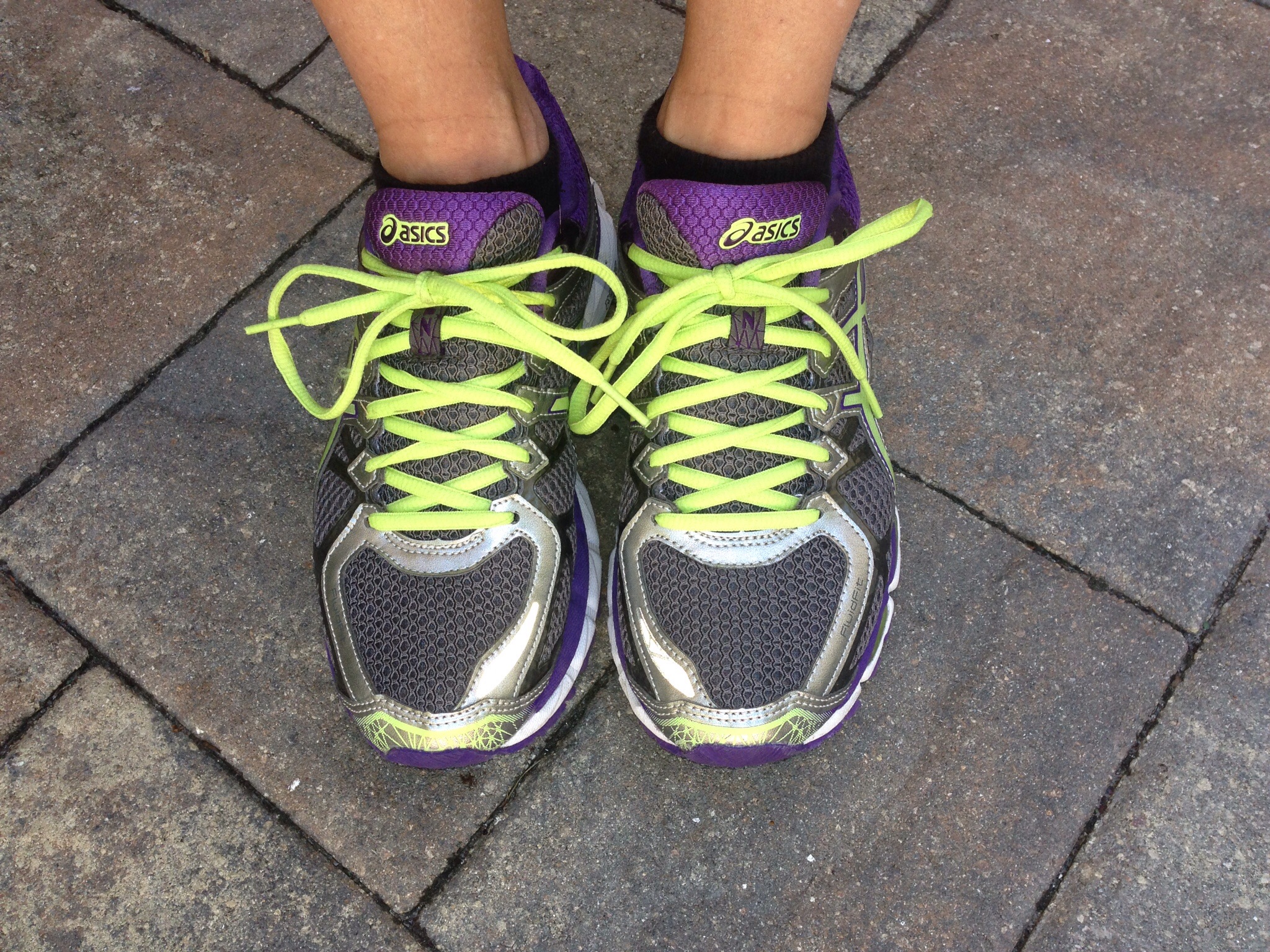
At the end, I was the proud owner of a remarkably expensive pair of Asics, together with super feet insoles. But I don’t mind spending money on those things – the cost of shin splints or otherwise wrecking your feet, legs, or back is way too great when you have mountains to climb.
And it turned out to be worth it. Fall finally fell in Central Florida and my new shoes and I went for a 4 1/4 mile run around the lake we live on. The difference between running in 90 and 65 degrees should have been self-evident, but I was still surprised by it. There was a decent breeze that was behind my back for a bit, not a cloud to be seen, and the pink seed casings of the tabebouia trees served as a very acceptable substitute for fall leaves.
Ok, so my left hip now hurts and maybe I really shouldn’t have used my new insoles for the first time on a four mile run against instructions, but whatever. Letting go of one training routine and opening up some new possibilities – I think that’s the flexibility it’s going to take to get up all 19,500 feet of Cotopaxi.
We are now back in flat Florida following a three day adventure in New Hampshire via Boston (Somerville, to be more exact). After a bumpy flight, we checked into our AirBnB. For those of you not in the know, wannabe hoteliers or innkeepers who have enrolled in the program can let out their spare room – or their whole apartment or house if it’s going to be vacant – for varying lengths of time and at reasonable rates. Our 20 something daughter had urged us to try it. Of course, it’s an app. Once we got used to the idea that we were staying in someone else’s temporarily empty studio apartment – surrounded by all their books and other possessions – it worked out well. I guess we should have tried Uber on this trip as well.
A Portuguese breakfast – climbing food?
After breakfast at a Portuguese restaurant – which involved cod, shrimp and fish cakes, rice and beans – the husband, the older daughter, her boyfriend and I left rainy Boston for the three hour drive to Jackson. Our transportation was the boyfriend’s aged Previa minivan with 168,000 miles, including at least two trans-continental trips. As we got closer to New Hampshire the grey clouds lifted and we entered Jackson under crystal clear blue skies – as well as a city-worthy traffic jam in North Conway. We clearly weren’t the only people with the idea of a long New Hampshire fall weekend.
We stayed at the Inn at Jackson, the former vacation home of the Baldwin family (as in pianos, for you musicians out there). Charming rooms with a very nice communal living room, roaring fire, board games, and all of the things that we Floridians associate with fall in New England. That night we had dinner at The Wentworth, a sprawling hotel coping with what seemed to be an unexpectedly large number of diners.
The Inn at Jackson
Sunday morning was our summit day. Our hosts had kindly put out breakfast food for us since we were hoping for an early departure – but somehow – due more to the husband and me than the other two members of our party – we still didn’t take off until 30 minutes later than planned – a pattern that unfortunately pervaded the entire climb.
We started from Pinkham Notch visitors center. The boyfriend bought me a three dollar map – which my daughter had said would make me happy. It did that, but more importantly, it actually served a much-needed traditional map function later in the day.
Mount Washington – and the Tuckerman Ravine Trail in particular- is rocky. The first couple of miles consisted of a wide path of semi steep ascents over what looked to be a rocky river bed. The half way point was Hermit Lake Shelter. Ironically, that was the windiest point of the whole day and caused us all to don extra layers that we spent the next few hours shedding. We stopped there for a mid morning snack. We may have been the only people climbing the mountain with a loaf of whole wheat bread, a hunk of cheese, a hunk of salami and a full jar of grey poupon mustard. Oh, and we had some left over GUs from Elbrus.
Below Hermit Lake Shelter
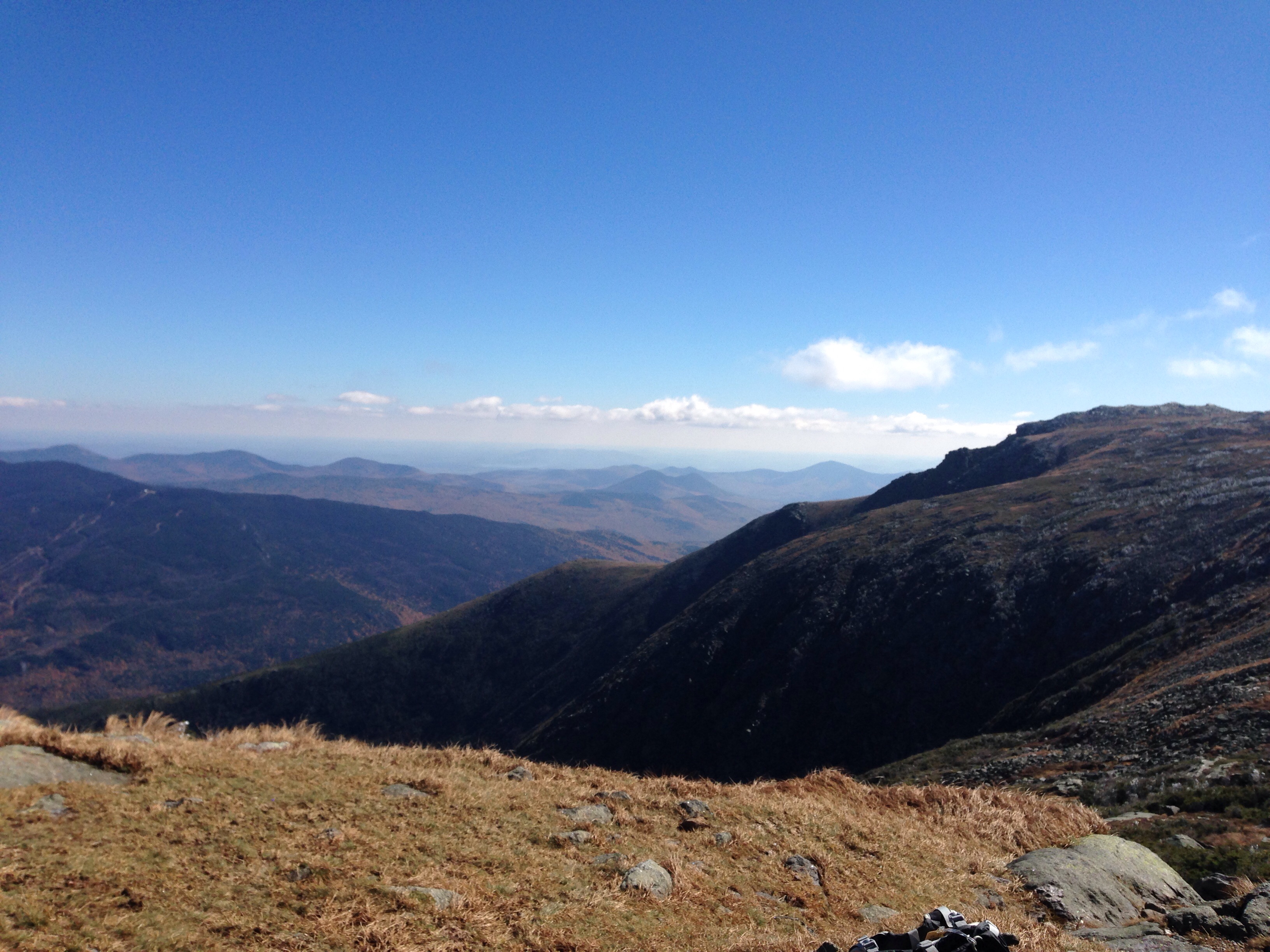
We had spectacular weather. Most of what I had read about Mount Washington had focused primarily on the horrible weather and didn’t spend much time at all on the difficulty of the trail. So while we were very prepared – in fact, over prepared – for the weather, we hadn’t actually taken into account the steepness and rockiness of the trail. After the half way point, we basically spent the next couple of hours scrambling up large boulders, some of which were quite wet from the waterfalls and streams that cross the trail. We were also slowed by the hordes of international tourists speeding up to the summit in terribly coordinated hiking outfits whom we felt compelled to let pass. In retrospect, we might have been better off had we been less polite.
And speaking of clothes – the ill-fated pants with the dysfunctional zipper (see earlier blog entries) reared their ugly legs again. I swear this was their last excursion. About an hour or so from the summit I realized the pants were constricting my left knee every time I stepped up – to the point I had developed a good sized blue bruise right below my knee. Finally I gave in, recognized the pants for what they were and stripped down to my light weight hiking pants that I had the foresight to wear underneath. My mobility increased enormously.
We finally reached the summit about 2 or so – well later than we should have, given that sunset was at 6:05. Nonetheless, we stopped for a while and had some hot tea in addition to our second meal of salami and cheese. The summit is a total tourist area. There’s a train that chugs its way up there. Others drive up on the “auto road,” and of course there are scores of people who actually climbed. There’s a museum, a gift shop and a snack bar. Remote, it is not.
Finally we started back down. We took Tuckerman Ravine Trail for a little bit, then veered left to the Lion Head trail. All of a sudden the crowds thinned, and the landscape grew wilder. It was much steeper than the other trail, and marked almost exclusively by stone cairns. We hiked through tunnels of dwarfed evergreens and slid ourselves down several rock chimneys. A number of the drops were steep enough that the daughter and I resorted to the good old fashioned sit down on your rear method of descent. At a couple of points the trail seemed to disappear into nothingness at the edge of a cliff – and all of a sudden you’d see a tiny little path down.
Lion Head Trail
Eventually that trail arrives back at Hermit Lake Shelter and rejoins Tuckerman Ravine Trail – at which point we realized we were out of water. We’d made a really stupid mistake of not refilling our bottles at tourist central at the summit, thinking we had enough. The boyfriend valiantly volunteered to run what we thought was a short distance to the water pump – only to find it wasn’t a very short distance and the pump required numerous pumps before anything came out of it. By then it was clear the sun was rapidly on its way down and we got out our headlamps to be ready.
We were now off the steeper and more beautiful trail back to the river bed of rocks. Actually there was a real river beside us much of the way. I finally took the lead since down is usually my strong suit – that is, when I am not having to slide down rocks on my rear – and we made extremely good time at first. Still, the only other people on the mountain now seemed to be professional trail runners who literally jumped over the rocks like moths flitting from light to light. Once the sun was down, any pretense we’d had to speed was done – one wrong step and turn of the ankle and that would be it. In the dark it’s easy to question where you are – especially since I had a strong tendency to want to follow the water runoffs – which looked awfully trail like to me – and the daughter seemed to want to turn right regardless of location. The three dollar map became very useful to provide some confirmation we were actually heading in the direction of the lights from the visitors center that occasionally flickered in the distance.
Finally – and almost suddenly – our journey through the night ended and there we were at the Previa. Injuries : some blisters – daughter and boyfriend; bruises – daughter and me (both banging legs on rocks and pants injury). Damaged equipment – somehow the daughter’s hiking pole had flipped open, the bottom part fell off, and she didn’t notice until we were at the bottom! She said it had seemed a little shorter. A Black Diamond, no less. Rewards: meeting a challenge head on with a team that included not just the husband and me but the daughter and boyfriend. When the husband and I are old and grey and sitting by the fire I hope they’ll remember we weren’t always that way.
So, lessons learned. In the broader scheme of things the husband and I remembered we really like sheer mountain climbing better than rock climbing – which can still sometimes trigger my innate fear of heights. We are rethinking the Grand Teton and are now seriously thinking again about Cotopaxi in Ecuador. It’s another almost 20,000 foot glaciated mountain that is awfully appealing.
And on the smaller scale of things we were reminded that you can make stupid mistakes on even 6200 foot mountains and regardless of how many you’ve climbed. You’ve got to be humble in the face of a mountain.
I’ve been meaning to write this post for a long time. Certainly, when I have been training for various climbs and treks, adding cardio to my work out was an essential component of success. But much of climbing or trekking is the sheer grit of simply keeping on going even when every part of you is saying stop right now. And that’s where yoga has made all the difference – and here’s a shout out to my many, many yoga instructors over the years, whose voices were in my head on so many of these hikes. Elbrus on the long slushy slog on the way down. Mt. Hood, where the 60 mile an hour winds were blowing me into the mountain and I couldn’t see because the blinding snow had totally occluded all vision.
I remember my first Bikram yoga class in 2007 or so. At that time, Bikram Yoga Orlando was located next to an elevated expressway in an small old strip center (and I mean old – circa 1960s) next to a pet grooming place. That’s the reason I had seen it – I had dropped off the dogs (who are now 14!) and picked up a schedule from the pile outside the door. I’d been doing yoga for a long time and had heard of Bikram, but had never tried it. But I was then working long hours on an arbitration – the precise contours of which have long escaped me – and I thought, maybe this is just what I need as a break.
Bikram is supposed to be practiced at 105 degrees and 40% humidity – and at the new studio it is. But at that old place down on South Street I swear you could see clouds forming overhead and I am sure there were a couple of times rain drops actually came down.
After my first class – and I didn’t leave the room nor did I lie down, despite the heat – I thought – Ok, I’ll try this every other week. But the next week I was back. And, although I’ve kept “regular” Wednesday and Sunday yoga classes, pretty much every week I’m also at Bikram. For someone whose job is comprised of making decisions, to be in an environment where there is no decision except the one to go on is an incredible luxury. I follow what the instructors say; I know the dialogue; and each class I feel my body respond and become stronger. And there is a particular moment where listening to the dialogue and your own physical presence merge and become one – and for once, you can be in the present – no decisions to make except for the one to keep going.
And I don’t want to dismiss my so-called “regular” yoga classes either. Where else have I learned the ability to literally stretch my body into shapes and places it wouldn’t normally go. The beauty of Bikram is that it’s the same every week – but the beauty of the other yoga is that I’m challenged to see where I can move my body in space and create that extra last dimension around me and fill it with movement.
So why does this relate to summits? I’ve learned to control my breathing. On the mountain, I think – breathe normally, in slowly and out even longer. On Elbrus I recited the Bikram dialogue in my head. I went into that quiet place of the present that allows you to take those last few steps that lead to the summit – and just as importantly – that allow you to descend.
The Swamp – not sure how this translates to climbing granite cliffs –
I’ve been in the saddle the last couple of weeks – that is, the place between summits. Actually, that’s not true at all. Instead I’ve been climbing one of those sudden summits you encounter in your professional world – and, happily – have scaled it.
Which brings me to the point – there may be summits in all parts of our lives – but none quite the same as the true top of a mountain. Once you’ve reached the top of a mountain you have it forever. No one ever, ever, ever can take it away.
But even on mountains there are lots of different summits. When we hiked Kilimanjaro surviving seven straight nights of sleeping in a tent was its own summit. It is remarkable how you can put something down – your headlamp, for example – only for it to disappear 30 seconds later. And that’s not to mention getting up every day knowing you would hike, and hike and then hike some more. Elbrus was different. It was 14 hours of sheer determination and physical exertion. For me it was saying no to those snowmobiles at the very end who were just dying for us to pay them a bunch of money to save the final two hours of hiking. It was the counting in fours the last hour just so I knew I could continue to put one foot in front of the other.
But now we are thinking of a really different sort of summit – climbing the Grand Teton, the highest mountain in the Teton range. It’s only 13,775 feet but it involves rock climbing, not just bouldering, and is a class 5.4 – something we have never done before. And what most don’t know is that I historically have a pretty good case of fear of sheer vertical drops. In 1985 I froze walking down the Eiffel Tower and it was good long time before I made it to the bottom. So, if we really do decide to do this four day, three night trip it will be a summit of a type I haven’t reached before.
The more You Tube videos I watch the more intriguing it seems. There’s a practice rock climbing wall near us. Maybe it’s the next stop?
One reason I am enamored with altitude may well stem back to airplane trips taken early, early in my life. These started in the 1960s, when my mother, sometimes accompanied by my father but frequently on her own, would take my brother and me to England to visit our grandparents. In my earliest memory, I was four and my brother was two. I don’t remember much of that trip but from then on, I have much firmer recall. By the time we were six and four, my brother and I had realized that the coloring books dispensed by the flight attendants – then called stewardesses – made fine swords and the little Pan Am wing pins were potentially even better weapons to use against each other.
But, fast forwarding to the 1970s, my interest in how to torment my brother on long airplane trips had ceased to be my major in-flight activity. In those days you had to pay for headphones, which would enable you to listen to the single movie being projected on a drop down screen or the few “radio” channels assembled by the airline. This was an expenditure my parents saw as completely needless. Undaunted, however, my brother and I soon learned that if you pulled your armrest up to your ear you could actually hear the movie and the music – albeit risking a crick in your neck and not a very good sight line for the movie.
That particular flight – we must have been returning to the United States because it was day – the sun shone through the plane window, there were a few layers of fluffy clouds below us, below all that the Atlantic Ocean stretched as long and blue as my eyes could see, and the Steve Miller Band’s “Fly Like An Eagle” was playing through my armrest. I must have been somewhere in my teens. There above the clouds I felt safe – yet utterly free, unleashed of whatever cares pulled at me from far below. I was conscious, even then, that I would always remember that moment.
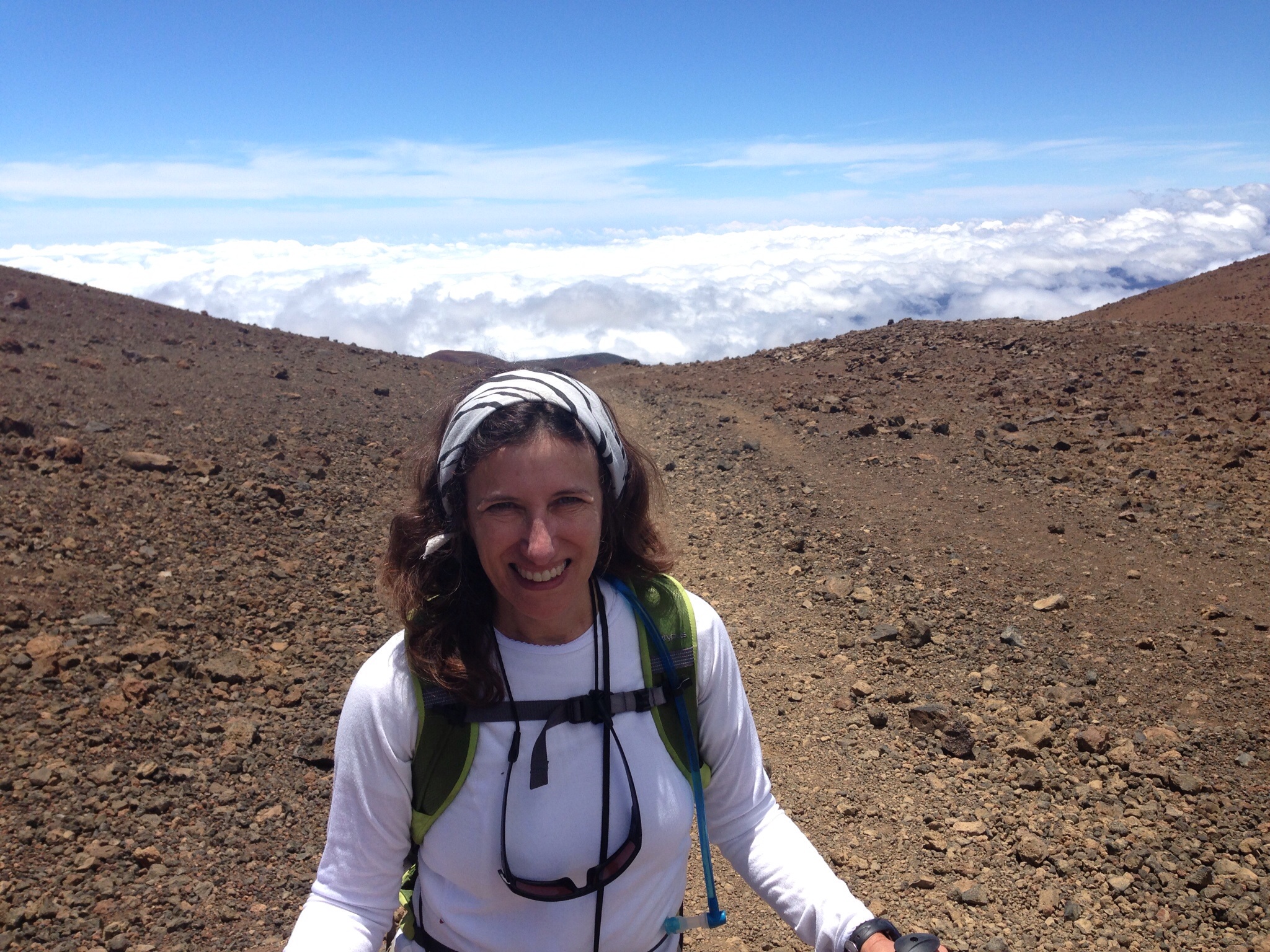
And to this day, when I board an airplane – despite the waits on the Tarmac, the ever narrowing plane seats, and the ever broadening list of things you have to pay for – I still hope that once above the clouds I’ll recapture that same feeling of serenity. Very occasionally I still do. But maybe that’s really why I climb mountains. Looking down from the summit at the rolling surf of clouds below gives a lightness to your soul that rarely happens anywhere else.









 FromSwamptoSummit