Where We Are Going Next – Pico de Orizaba, Veracruz, Mexico

image
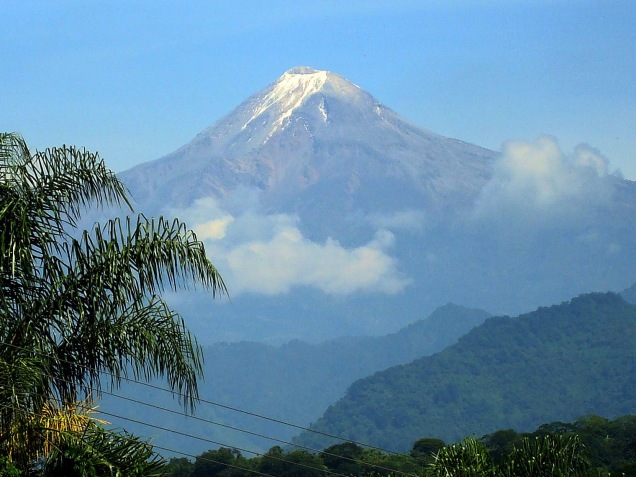
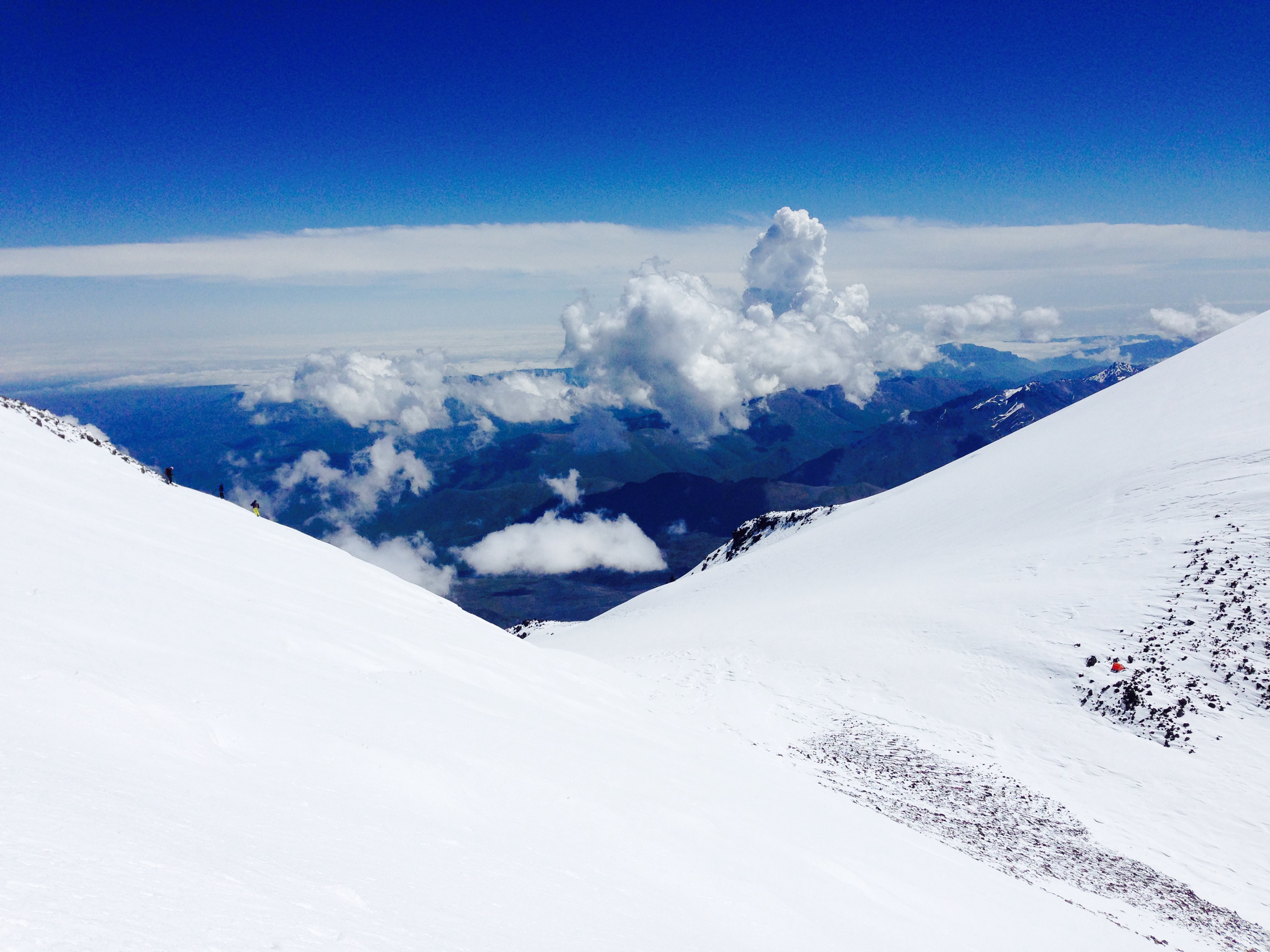
Photo – http://www.sil.org/~tuggyd/Pix – Pico de Orizaba

Over the last few months I’ve been publishing posts that refer to Pico de Orizaba, our next climbing destination, as though it’s a location at the forefront of everyone’s personal geography. That certainly can’t be the case – this particular mountain wasn’t close to the forefront of my mind until we started to try to find a big mountain that could be climbed in winter and in under seven days. When you live in Florida, the choices are limited.

So after looking at our options, we settled on the Orizaba Express trip, again through Mountain  Madness, the company that has successfully and safely led us up Mt. Elbrus in Russia and Cotopaxi, Illiniza Norte and Cayambe in Ecuador.

Pico de Orizaba is a strato volcano 120 miles outside of Mexico City, on the border of Veracruz and Puebla, by the town of Orizaba.  According to Wikipedia, fount of all knowledge, it has gone by a number of names. Non-Nahuatl speakers in the area call it Istaktepetl or “White Mountain.” During  the Pre-Columbian Era it was referred to as Poyautécatl, which means “the ground that reaches the clouds.”

My favorite of its names is  Citlaltépetlas, which is what it was called in the Náhuatl language when the Spanish arrived in this part of the world, and means “Star Mountain.”

During the colonial era, the mountain was known by the rather boring appellation, Cerro de San Andrés, due to the nearby settlement of San Andrés Chalchicomula at its base.

It is the third highest mountain in North America (behind Denali and Mt.  Logan), one of the volcanic Seven Summits, and the second most prominent volcano in the world, after Kilimanjaro. Pico de Orizaba measures 18,491 feet high, a statistic I find particularly notable because one of our teammates on Mt. Elbrus was part of the group that measured the mountain using GPS some years ago.

After arriving on AeroMexico, according to our trip itinerary, we will start acclimatizing in Mexico City, around 7,341 feet. From there we journey to the pyramids of Teotihuacan, and the next day climb Malinche, 14,640 feet. After that we travel to Tlachichuca, and – somewhat ominously – “transfer to four wheel drive” for the trip to the hut at Piedra Grande (13,972′). Our final acclimatization hike is to the toe of the Jamapa glacier at about 16,000′ and back down to the hut.  Summit day involves elevation gain of about 4,500′ – which is a lot, and may be one of the biggest elevation gains we will have done in one day. To reach the summit, you traverse a rocky section named after one of my favorite words, the Labyrinth. The section right below the caldera looks really quite steep – definitely an area for ice axes. If it’s anything like Cotopaxi, I anticipate collapsing at the top – assuming the gods bless us with good weather and the mountain lets us summit.

We’ll have a night in Tlachichuca and one final night in Mexico City – and then it will be back to Orlando on an airline I had never even heard of until yesterday, Volaris. I realized one of the reasons it’s so cheap is that you have to pay to select seats – but they let you have a free checked bag!

I’ve been looking for free images of the Labyrinth, but couldn’t locate any. Perhaps a testament to the comparative obscurity of this mountain.  But I love that it’s a mountain of many names. As I said above, and as many a mountain guide has told me – you don’t climb a mountain; it lets you climb it. And I hope that Pico de Orizaba will look favorably on us in just a few weeks.
 

The Weekly Summit

The saddle of Mt. Elbrus, Caucasus, Russia

I’ve been practicing yoga on Wednesday nights now for at least ten years. Each time I enter the yoga studio at 7:30 I’m struck by the feeling that now I know I’ll make it through the rest of the week. That old “it’s all downhill from here” saying. (Of course, climbing down a mountain can be the hardest part, but somehow that’s not true for surviving Thursdays and Fridays.)

That hour and 15 minute carve out on Wednesdays marks having reached the summit of the week. And it’s interesting how time has a way of recreating those mountain patterns for us, peaks and valleys and traverses – even when we’re not aware of it.

Yesterday I went to go buy a new pair of running shoes. When the very nice person at the store looked me up on the computer he did a double take – it was exactly one year ago to the day since I’d bought my last pair of running shoes. I had no idea. It must have been some internal clock thing. (Or just really worn out shoes.)  I can prove it was a year ago too – just look at https://fromswamptosummit.com/2014/11/02/training-and-the-power-of-the-shoe/ , published on this blog on November 2, 2014! A lot of miles on those shoes, and a lot of highs and lows.

image

I also managed to find a Bikram yoga class to go to yesterday – the first in several months since the studio closed. And you know where it was? In the very same location where I took my very first Bikram class some 10 or so years ago. That was before the new fancy studio, back in the somewhat dingy location down by the expressway, in a terribly humid room – but oh how good the class felt. It almost felt like a full circle….

And finally, another ritual that marks the pattern of time – dear friends whom we met in Lamaze classes (we regarded ourselves as the only normal people in the class!) have been spending Halloween with us for at least the last 22 or 23 years. The four children between us have now moved on, but the Halloween tradition remains, marking the point each year that starts us up the steep incline toward the holidays.

It’s reassuring to sense those patterns. One thing about mountains is that they are predictable in one way. There’s always an up and there’s always a down. As I train for Pico de Orizaba the first week in January 2016, I keep thinking about that.

Observations on a Mountain and Otherwise

Ecuador - Avenue of Volcanoes
Ecuador – Avenue of Volcanoes

Lots of times on the way up a mountain it’s pitch dark. And even if you’re lucky and the path is lit by thousands of silver stars and perhaps the glow of a brilliant white moon, it’s pretty difficult to look around you to take it all in as you trudge up, all senses aimed at planting your feet so as not to take a tumble down hundreds of meters of snow, ignominiously ending up on a pile of rock.

Even in daytime it’s not always easy to take the extra moments to look about. By then you’re worried that the snow is softening, avalanche and rock fall risk getting greater, and you still have to clamber back down.

The last few weeks have presented just enough strange little coincidences that remind me, though, that sometimes it is worth taking those extra moments and noticing those connections you might otherwise miss. One thing about running as part of training – it gives you a lot of time just to observe – and basically to try and focus on anything other than how sore you feel.

I wrote about the first such coincidence a couple of weeks ago. That is, ordering a glass of Malbec at two restaurants over 1000 miles apart, two nights in a row – and being informed at each that was the last Malbec – not of the bottle but at the entire establishment!

This past week, I learned via Facebook on the same day that two unrelated people I know, one through work and one an old college friend, were both making their standup comedy debuts in a very far apart states on exactly the same night. I had not hitherto thought of stand up comedy as something hordes of people were lining up to do.

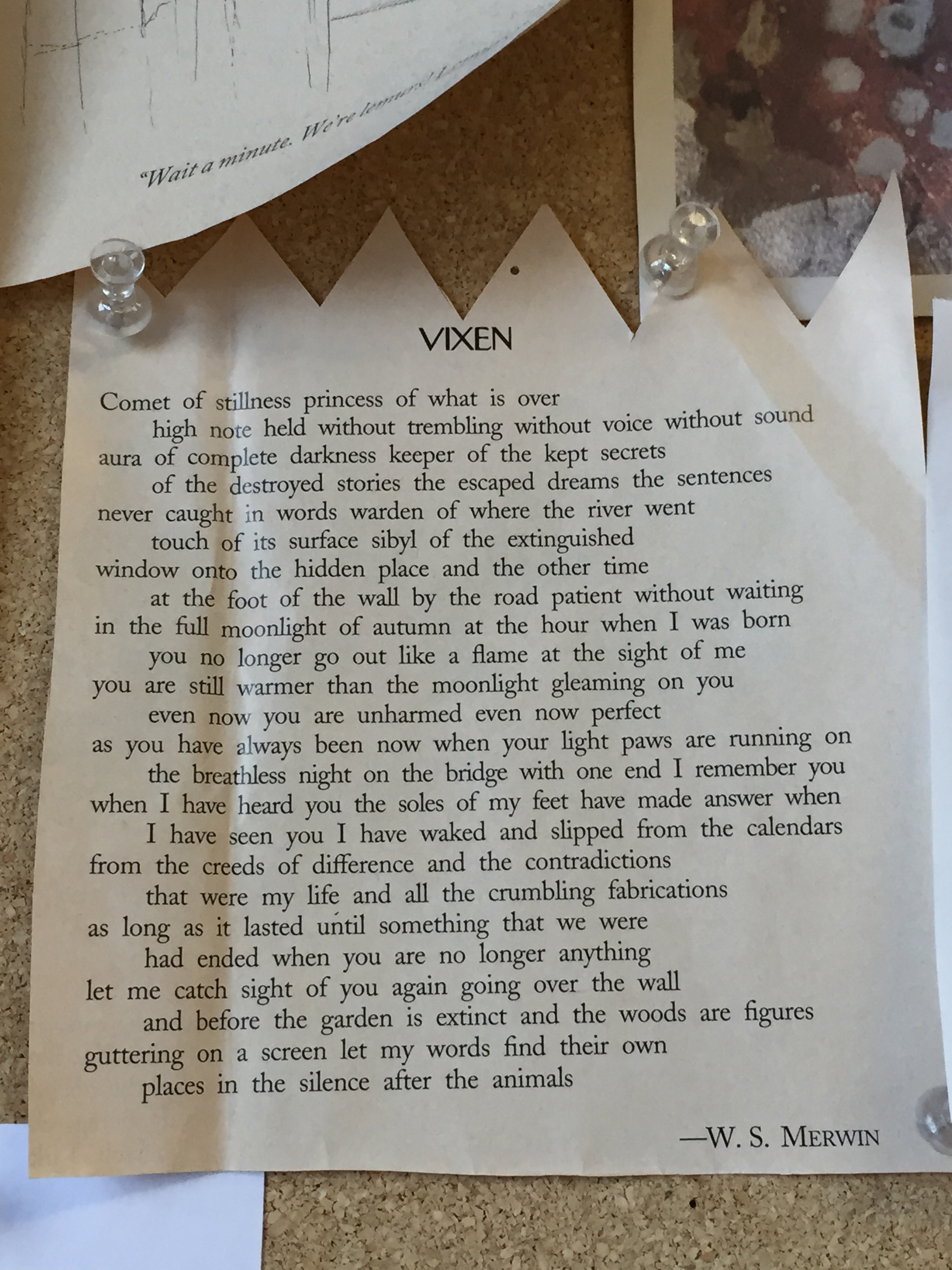
And just recently, while engaging in some unexpected dialogue about the poet W.S. Merwin, again on Facebook, of all places, a friend mentioned her love of his book, Vixen. Back in 1996 or so, I cut that poem out of The New Yorker when it was first published, and it’s been on my work bulletin board ever since. (Somehow I just add to the bulletin board. I never take anything off. It has an archeological feel by now.)

image

Now, any two things can look strangely connected if you examine them hard enough. And it certainly makes life more interesting to do so. But the reality is that there are an awful lot of fun things to look at out there that can liven up any part of a journey.

There was the incredible wild orchid I saw in Ecuador in our hike to see the hummingbirds. And on Friday when I walked home from work I was delighted to find an Italian restaurant that featured Hawaiian pizza and gyros. And as close as my own backyard are some tiny basil plants springing up volunteer. We’ll see how long they last in our Florida “winter.”

Taken through an IPhone rain cover - a little blurry!
Taken through an IPhone rain cover – a little blurry!

We have just over two months before we attempt Pico de Orizaba. There will be a lot to look at before then.

Books for High Places – What to Read at 18,000 Feet

The
The “Old” Library

When most people think of climbing gear, they have in mind ice axes, crampons, helmets, and the other accoutrement needed to maintain life and limb at high altitude. But to me, an equally vital piece of equipment is whatever book I’ve selected to accompany me in whatever arduous spot I find myself in.

Believe it or not, there are a lot of opportunities to read while climbing high mountains. You’re typically going to bed as early as 7, especially if you are aiming for a midnight or 1 am departure for the summit. And that’s just summit day. On a lot of acclimatization days you find yourself collapsed in a hut or hacienda by mid afternoon following your first few forays over 14,000 feet. And, if you’re like me, you can’t sleep unless you’ve first consumed at least a few pages of a novel.

Now books for such trips must meet certain requirements, at least in my mind. First and foremost, they have to be available on a Kindle.  When every ounce you carry can make a difference, lugging paper around doesn’t seem like a particularly wise choice. They have to be of sufficient length to engage you. I love short stories but somehow they seem more suited for an evening jaunt in the neighborhood – not a multi-day expedition. And they have to be engaging. If your goal is to blot out an altitude headache, to forget how cold you are each time a part of you inadvertently slips out of the sleeping bag, and to screen out the assorted snores and noise of your fellow hut dwellers, you need something that transports you into some alternate world. The odd thing is that life on a mountain can be so surreal that the imaginary world of some novels can seem a more likely reality than the one you’re in.

The
The “New” Library

So, what are some of my top choices for high places?

Our first trek, in 2011, to Kilimanjaro, was accompanied by Abraham Verghese’s Cutting For Stone. The story of a doctor and his twin brother it globe trots from Africa to New York, and kept me enthralled at Crater Camp on the Western Breach, where we camped at 18,000 feet. It’s 690 pages long. Of course, I would have been in no shape to write a scholarly analysis of it at that altitude, but it was a good read.

On this summer’s trip to Ecuador I relied on the fantastic creatures and characters of Clive Barker’s Weaveworld to get me up the steep slopes of Cotopaxi. Yes, I do like science fiction and some fantasy, and the alternate reality of Weaveworld and its 768 pages (now you see why a Kindle is essential) fit the bill. Years ago, on a much tamer trip to California I read Barker’s Imagica, and I think it would be a equally suitable high altitude choice.

Some others? Consider:

And the Mountains Echoed by Khaled Hosseini – a story of a family in Afghanistan and elsewhere, covering multiple generations and places.

The Dust series by Hugh Howey – a post apocalyptic world – or is it? Be prepared.

The Flamethrowers: A Novel by Rachel Kushner – I will never forget the opening description of speed racing on the Bonneville salt flats.

These are only a few. What do you take with you on your travels? Let’s share.

Pain and Train – Getting Ready for Orizaba

Rainbow on Cayambe descent

Now that Labor Day has passed, it is time to return to the backbone of any successful summit bid – and that is the long hard slog of training.  I haven’t stopped since Ecuador and our adventures on Cotopaxi, Illiniza Norte and Cayambe, but I have definitely taken it a bit easier.

For example, I treated myself to the luxury of stairs without a 25 pound backpack. I haven’t attempted a seven mile run. And I have not been at all diligent about any weight lifting. It’s been nice.

But, as the Walrus said In Jabberwocky, the time has come. So on Saturday, after much futzing around (you do need to make sure your sunglasses are adjusted just so, headphones properly positioned, etc.), I embarked on a five mile run. I’ve been running four milers, but if we want to have a hope of scaling Mexico’s 18,491 foot Pico de Orizaba in January, I need to be back up there at the seven mile plus level. The run actually felt good. And on Monday, I’m going to reload the pack with the weights from my weight vest and lug it back off to work where my 16 story office building awaits.

In the meantime, I’ve been reading excerpts from a book called Fast After Fifty. It’s aimed at athletes who are trying to maintain or improve after age fifty and emphasizes interval and anaerobic training. But – true confession – I didn’t really do anything particularly athletic until I was almost fifty! So I have some reservations as to how applicable those principles are to me….although that may just be a copout as I have no desire to run as hard as I can for thirty minutes to find my lactic threshold.

At least I can find some inspiration in the movie, Meru, which we saw last night. It’s a documentary based on alpinists Conrad Anker, Jimmy Chin and Renan Ozturk’s two attempts to climb Mt. Meru in the Himalayas – 21,000 feet above the headwaters of the Ganges River. It’s the sort of mountain that makes Everest seem like climbing for dummies. Over the course of the three years between the first failed attempt and the second successful one, one of them was in a near fatal snowboard accident, which resulted in a severely fractured skull, and another narrowly survived an avalanche. But they ultimately made it up what is called the Shark Fin – razer like slabs of granite so unstable Chin said he could feel them move under his fingers.

On the first attempt they got within 500 feet of the summit – but ran out of food due to an unexpected four days waiting out a storm in a small tent half way the mountain.

The physical and mental strength it takes to know when to turn around and when to keep going is huge. I may not be headed to the super high mountains of the Himalayas, but I’m keeping my fingers crossed that my Florida version of training can at least get me ready again for something higher than Mt. Dora. For those of you non-Floridians, that’s what we in Central Florida call a summit – it’s a whopping 184 feet above sea level.

Labor Day – Take a Deep Breath

Taking a deep breath - Mt. Washington 2014
Taking a deep breath – Mt. Washington 2014

Many things just seem to stop on Labor Day. Including my 24 year old refrigerator that has occupied a convenient niche in our garage for the last several years.

Since I started this blog back in May or so of 2014 I have tried to publish posts once a week – I’m old enough that I tend to regard blogs as the digital equivalent of a weekly print magazine. But occasionally those periods occur where labor (aka work) takes over, becomes all consuming, and unfortunately, training, this blog, and yoga all take a back seat.

But all things pass, and it’s appropriate that they do so in time for Labor Day. It’s time to take a deep breath, and look forward to the fall and next adventures. Just like that first gust of cool wind on a fall day. After a summer of Florida heat and humidity, there’s no describing how refreshing that is. Unfortunately, I know from 25 years here that September isn’t much better than August.

So what is upcoming after the excitement of this summer’s trip to Ecuador? Most immediately, a trip to Maine with daughter #1 and the boyfriend N, and a hike up Puzzle Mountain. And after that….God willing and the creek don’t rise – we are seriously considering a trip to Pico de Orizaba in Mexico the first week of January 2016. It’s the third highest mountain in North America at 18,491 feet. And of course, it’s a volcano. Has anyone out there done this trip? We can certainly use all the help we can get.

In the meantime, this year’s Labor Day has involved refrigerator replacement, re-planting the vegetable garden, and a four mile run. I’ve taken a deep breath. Now it’s time to set our sights on the next summit.

Cotopaxi, Ecuador…..And the Volcano Erupted

20150701_074249
Cotopaxi viewed from Illiniza Norte

On July 3, 2015 J, our guide Ossy, and I stood on top on top of Cotopaxi, one of the highest active volcanoes in the world, blithely ignoring the sulfur fumes that had fortunately blown in a direction away from us. And on August 14, 2015, that very same volcano sent a two mile plume of ash, hot glass and fumes into the air, creating an ash shower for all the surrounding villages, some of which are now being evacuated.  (Apparently it is called a “pyroclastic flow.” Great name.)

This same weekend, I’ve read about a mountain guide who suffered a serious spinal injury while rock climbing in Ecuador. I believe that he’s someone we crossed paths with when we were in Ecuador – he was one of the guides working with the Climbing 4 My Donor team that we met both at Rucu Pichincha and Illiniza Norte.  (The Climbing 4 My Donor team consisted of heart/lung transplant recipients from the U.K. who were climbing in honor of their donors.  They were pretty inspirational.) There is a GoFundMe page for his medical expenses (Sebastian Carrasco).

E353138C-B7E6-4867-A66A-74F0156750CE
Rock climbing on Illiniza Norte

But recent dangers don’t appear to be limited to the summit. Down here in the swamp, this past week in Central Florida saw an absolutely horrendous accident — a woman swimming at a popular spot on a local river was pulled under by an alligator and lost her arm.

I tend to ignore the fact that my particular version of swamp to summit carries with it some degree of danger.  Even these recent events really only affect me in the sense of “oh wow, can you believe we were just there” or “we were just doing that.”  I think that’s part of the  journey – the danger is a given and it just becomes part of the landscape.  It certainly helps ratchet up the adrenaline, but when you’re on the mountain, you’re not thinking danger; you’re just thinking the immediacy of the moment and how to handle that which is in front of you.  Rock climbing up Illiniza Norte was a particularly good example of that.  In fact, I usually end up feeling more fear of physical failure than I do of external, more objective dangers.

For various reasons my Saturday run this week took me from downtown Orlando along a service road that parallels the now constantly under construction interstate.  It’s becoming increasingly overgrown, with many vacant lots.  I did briefly wonder whether this was actually the best place to be running by myself.  But the answer wasn’t to turn around.  I simply ran a bit faster.

Cayambe Calling

Checking out this route from outside the hut at Cayambe
Checking out the route from outside the hut at Cayambe

Four mountains, including one at 19,347 feet and another at 18,996 feet, in eight days, is a lot. I knew I was in trouble when I started to cough the night before we attempted Cayambe.  And how did we end up at Cayambe in the first place, you ask? You’ll recall the original plan was to follow our Cotopaxi climb  (second highest peak in Ecuador) with Chimborazo, the highest peak and the point on earth closest to the sun.

Well, the worldwide rise in temperatures is affecting Chimborazo as much as the next glacier. Have you seen photos of Kilimanjaro recently? Very different than 2011 when we were there. Warm glaciers create greater risk of avalanches and rock fall (not to mention the difficulties of slushy snow). Chimborazo is also a long drive from Quito and it’s one heckuva big mountain. So, prudence being the better part of valor we decided, with guidance from Ossy, not to let the wax on our wings melt by attempting to fly too close to the sun and instead to try Cayambe, Ecuador’s third highest peak at just under 19,000 feet, as the final mountain of our Ecuador trip.

After our peak (literally) experience on Cotopaxi — even two weeks later I keep re-living it in my head  — Cayambe was a logical choice. It’s just a little lower than Cotopaxi, perhaps steeper in spots (but for shorter sections), and has some rock to climb at the beginning. We had summited Cotopaxi at 9:05 am on July 3. After a rest day in Quito on July 4, we left the next morning to drive to the hut at Cayambe. Unlike the other huts at which we stayed, at Cayambe you can “drive” – if that’s the right word – right to the door of the hut.

Road to Cayambe hut - and this was the good part!
Road to Cayambe hut – and this was the good part!

The road to Cayambe beats about any road I have ever travelled on for ruts, rocks, and steep precipices.  It doesn’t resemble anything on which any self-respecting automobile should drive. We’d all learned our lesson by then about my issues with winding roads and cars, so I sat in the front. Ossy spent a lot of the time sticking his head out the side window to see exactly which snow, mud or ice covered rut would best create traction for the four wheel drive.

Eventually we made our way to the hut and checked in. For the first time during our trip we were sharing the hut with another team, a large group of nine or so climbers with four guides.  All males and considerably physically larger than I. As we settled in at a table in the main room we traded stories  about what we’d been climbing – and I must say it was 100% satisfying to say “yes” when they asked if we’d summited Cotopaxi, which they hadn’t yet attempted, and to be met with some very bemused looks. For a five foot, one and one-half inch woman (that half inch is very important), I felt a certain instant credibility. As Ossy said though, the pressure on all those guys to summit Cotopaxi had just increased immeasurably!

But Cayambe was the summit that was not to be. I still had not  completely recovered from whatever stomach issues had so gravely affected me the night after we climbed Illiniza Norte and had also developed a nagging cough. Plus I think I was still generally burned out from Cotopaxi. I had put my heart and soul into that climb, and I couldn’t help but regard Cayambe as a latecomer to the party.

We followed a similar routine – packed for the next day, went out and looked at the route we’d be taking, ate soup and something  sweet, and were in our bunkbeds by 6:30. I slept a couple of hours and we were up at 11:30 – this time with other climbers also packing up and getting ready to go. It did change the serenity of the moment. But, as the only woman, I got to have the entire women’s bathroom all to myself!

The night was spectacular; the moon had waned only a bit and there was scarcely any wind. But the downside of all that was that it was quite warm – in fact, we all wore a layer less than we’d originally planned. And the snow was soft, meaning  that once we were on the glacier we were sinking in and exerting a lot more energy than desired. Once we had scaled the rock area – which I had spent way too much time worrying about because it wasn’t that hard – we had to traverse through a scree and rock field and finally reached the glacier, where we could put our crampons on.

But as we roped up and took off I just couldn’t attain the same sort of steady rhythm that I’d been able to manage on Cotopaxi. Although at one point we were among the highest teams I made the mistake of looking up and seeing how incredibly steep and seemingly never ending the slopes above me were, and let myself get distracted by what the other climbers on the mountain were doing. All of which added up to a point where I was feeling dizzy and our pace simply was not what it needed to be if we were to summit early enough to avoid the risk of avalanche as the mountain heated up during the day.

Dawn breaking over Cayambe - photo by Oswaldo Freire
Dawn breaking over Cayambe – photo by Oswaldo Freire

Just then, one of the other teams that had passed us turned around after reaching a ridge line about 400 meters from the summit. We decided to go to the same point and then head back down. It turned out two other teams did make the summit but it took them 8 or so hours – an hour and a half longer than usual, due to the hard climbing conditions.

Our descent went well, even though the scree field we were hoping to slide down instead of rock climb was covered with snow. That meant we had to turn around and walk back up an area we had just hiked down – possibly the most dispiriting moment of the whole climb. But I did well on the rock climbing on the way down, no ropes needed.

Descent down Cayambe - photo by Oswaldo Freire
Descent down Cayambe – photo by Oswaldo Freire

And on the way down we were treated to a rainbow. Clearly a promise of future summits. Cayambe is still calling to me. I think we’ll be back.

Shifting Winds Lead to Cotopaxi Summit

Cotopaxi Summit
Cotopaxi Summit

The wind shifted. I’ve always known the wind is important. After all, Mary Poppins arrived with the east wind, and there’s an old saying that if you make a face when the wind changes your face will get stuck that way. But I’d never really experienced just how important a shift in the wind could be until we were right at the lip of the Cotopaxi crater, just below the summit.

After climbing Illiniza Norte, we spent the night at the Hacienda Chilcabamba. I went to bed at 6:30 and slept for about 12 hours – unable to face anything for dinner. I felt about a hundred times better the next day, and we had an easy morning at the hacienda, followed by a large lunch. J and I had a little thatched cottage all to ourselves, with two bedrooms and a sitting area, heated by a wood stove.

Hacienda Chilcabamba

We left in early afternoon to drive to the parking lot for the Cotopaxi hut. This time I sat in the front seat to avoid the  gastrointestinal dangers associated with the curving cobbled stone roads. From the parking lot we strapped on our backpacks, which contained only what we needed at the hut and for our summit attempt. We were already wearing our base layers, to minimize having to change. The walk up to the hut is about 45 minutes on a steep dirt road – we reached the top, only for Ossy to realize he’d left his phone in the car and had to go down to get it!

The Cotopaxi hut was redone only a few months ago, and although nicely varnished and with new mattresses, it’s really cold and the roof makes an incredible array of noises in the whistling wind. While the Illiniza Norte roof clanged and sounded as though it might blow off, this roof variably screamed, whistled, hooted and howled. Despite all that, after we’d had bowls of quinoa soup, followed by figs, cheese and sweet biscuits, we still managed to sleep a few hours.

Bedroom at the hut at Cotopaxi

We were supposed to awaken at 11:30 pm but  slept through the alarm and ended up getting up at midnight. Just as on Illiniza Norte, we were the only people in the hut.  And we soon found out there were only two other climbers on the entire mountain, besides us.

We stuffed some food into ourselves and started climbing about 1 am. The first part is a 45 minute walk up a relatively steep scree field. Once at the top, you’re on the glacier, which meant it was time to rope up and put on crampons.
The old “normal” route has been closed for 2 or 3 years after a climber was killed on it – too many crevasses. Instead you now use the Rompe Corazones – the heartbreaker. There’s an extremely long 2 plus hour stretch that simply goes up without any sort of break. And it’s a killer. I was trying hard to stay hydrated, so each hour when we stopped, the routine was water, a handful of trail mix, and more water. As we gained altitude, the trail mix became GU, and Ossy was literally tearing the top of the packages and holding them as I sucked the sticky sweet electrolytes out.

We climbed up one sheer icy patch where we had to use the front points of our crampons – as if we were scaling a vertical wall.  Much of the trek up was simple side by side steps, but even there I kept finding my crampons pointing too far uphill, and I quickly realized how much I had to learn in the way of technique.

Sea of Penitentes
Sea of Penitentes

At one point you traverse a sea of Penitentes – formed by the wind, they are peculiar to the Andes in the summer months. Sometimes they are upright, but these were bent by the wind. They look like a field of praying hands, fingers outstretched in supplication. You can walk between or on them, and if on, each step sounds as though you are stepping on a brittle twig – or finger.

The very last bit of Cotopaxi is steep, steep, steep. As we had to do in a couple of prior areas, we used the picks of our ice axes overhand to dig in and help pull ourselves up (normally you’re using your ice axe in your uphill hand like a very sharp ski pole or walking stick).

But just before we reached that point, we saw the only other two climbers on the mountain turn around, apparently overwhelmed by the sulphur fumes spewing out of the crater.  You may recall I mentioned that starting in May or so Cotopaxi had reactivated. It is “degassing” (lovely word) and literally tons of fumes are forming into thick heavy clouds over the crater – which is just below the summit.

Despite the retreat of the other climbers, we kept on going. Although the mountain administered a pretty strong dose of sulphur to us – Ossy and J in their throats and me in my eyes – just at that point….the wind shifted. I heard Ossy say that we might have a window and I kept slogging up the close to vertical slope.

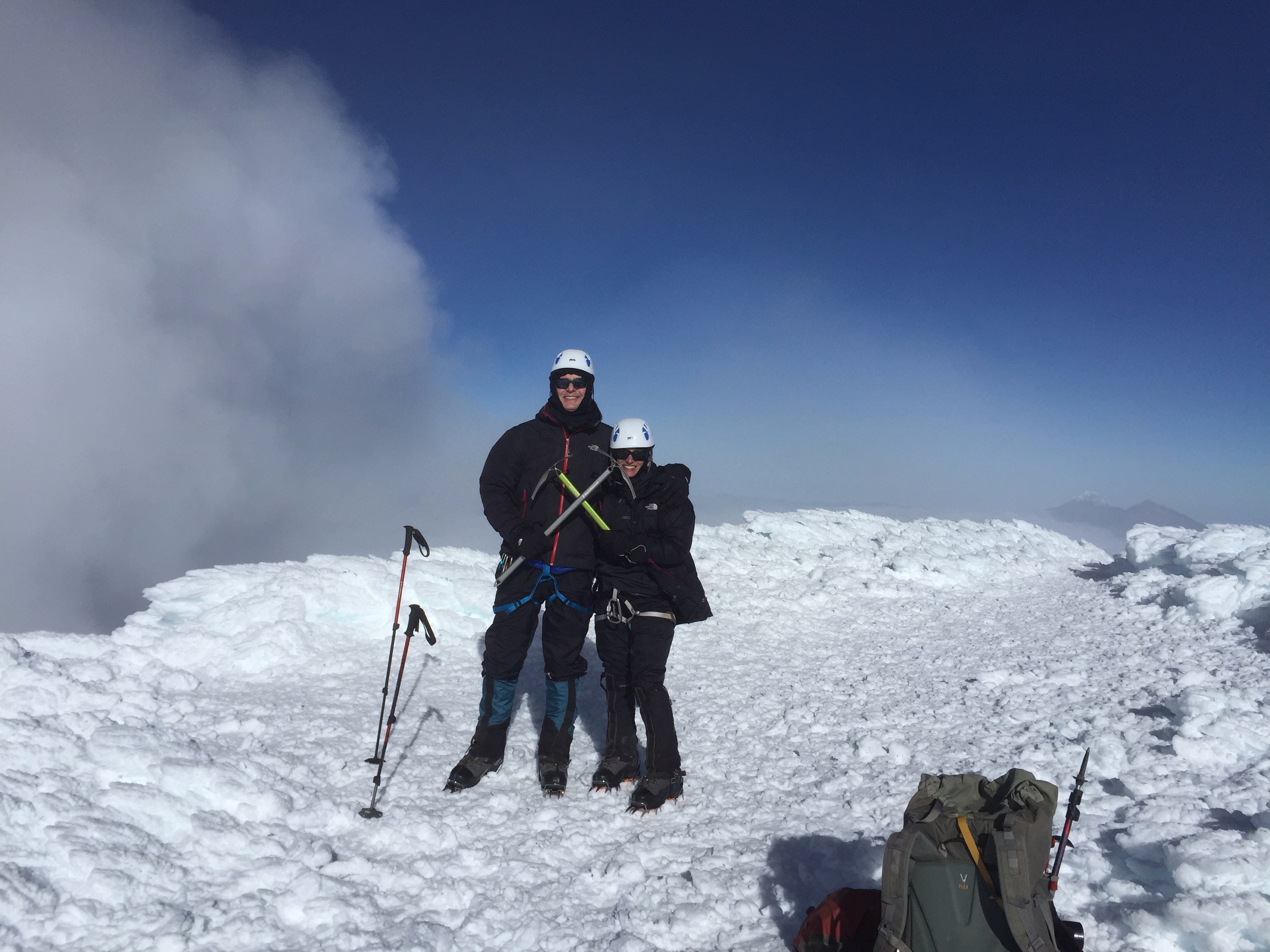
Suddenly I was on a flat area – but surely I couldn’t be there. I was positive there must be another 15 or more minutes of sheer physical and mental pushing left and this was just a fake….but no, I was actually at the summit. There wasn’t anywhere else up to go. I’d seen people on YouTube videos throw themselves down on the ground when they finally arrived, and without even thinking, that’s just what I did too.

Cotopaxi Summit - sulphur cloud in background
Cotopaxi Summit – sulphur cloud in background

We couldn’t stay on the summit for long – just in case the wind shifted again and the crater drenched us with another load of sulphur.

Our descent was noneventful, which is about the best that can be said about descents. We kept up a pretty good pace, with J on the front of the rope, me in the middle, and Ossy bringing up the rear in order to arrest whoever might fall.

It turned out we made it up in 6 hours and 50 minutes, well within the range of normal, and down in 3 hours – also what Ossy wanted us to do.

Once back at the hut the reality of what we had just accomplished finally sank in. All those stairs; all those hot and sweaty runs.  The culmination of all of it was that confluence of ice and snow and blue sky. A perfect summit.

Illiniza Norte Or How I Ended Up Rock Climbing After All

Cotopaxi from the hut at Illiniza Norte

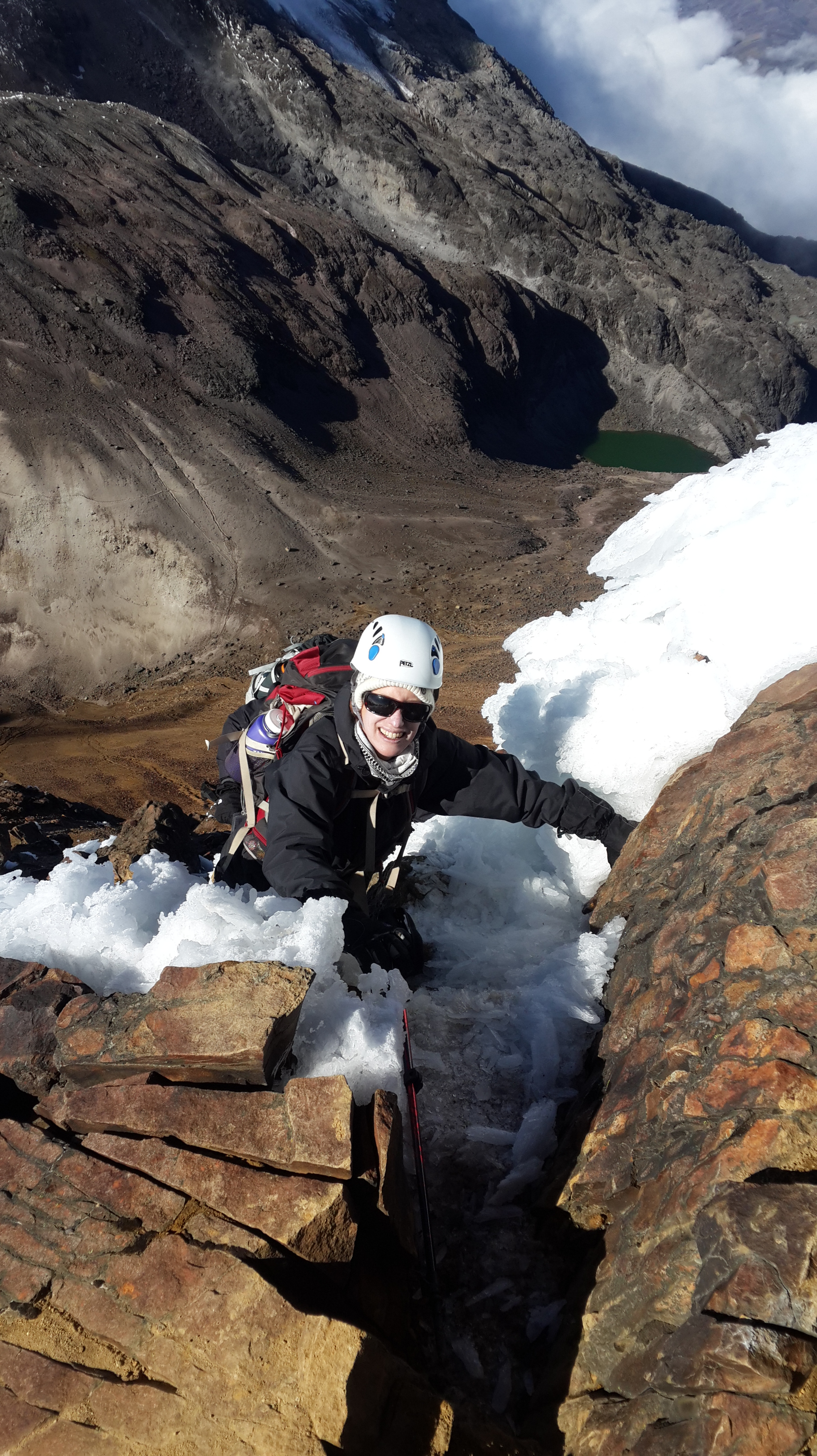
Some of you may remember that one reason we ended up in Ecuador instead of the Grand Teton was our conclusion that we preferred mountaineering to rock climbing. (See “Cotopaxi, Ecuador – 180 Degree Turns.”)  So it was somewhat inexplicable that I nonetheless found myself on July 1 hanging on for dear life to an ice encrusted basalt wall with my left hand, ski pole in my right and nothing but an almost vertical drop of rocks below. Oh, and this was at about 16,000 feet. And did I mention no ropes?

Illiniza Norte is one of the two Illiniza peaks (the other, obviously, is Sud), and is a common acclimatization hike in preparation for Cotopaxi. It reaches about 16,500 feet, and is the taller of the two forked peaks in the right in the photo. Its sister peak, on the left, is much more technical and is covered in snow.

The Illiniza Peaks
The Illiniza Peaks

It was about a three hour hike to the mountain hut where we were to stay for our ascent of Illiniza Norte so we left in early morning. After fighting through Quito traffic, we followed modern highways for a while until we abruptly turned off to cobble stone roads, still in the same condition as in the 1940s when Ossy thought they were originally built. Jaw breaking and winding is an understatement. More on that later.  We passed through several small villages, stopping at one to drop off things we wouldn’t need on the hike. Once we parked the car near the trailhead, we met up with the two men who took our supplies up to the hut on horses. Each day the horses plod up to the hut with full loads and bring trash back.  Despite the routine, they seem quite content with their rather proletariat role in life.
image
The mountain hut is primitive – but there are flushing toilets, even if you do have to go outside to get to them. There’s a series of about four bunk beds, going up to a triple level, a small eating area and a tiny kitchen. No electricity. We were the only people there, and, in fact, the only climbers on the mountain the next day. That night we were treated to a spectacular sunset with a full moon. The entire Avenue of Volcanoes was visible, including the white capped isosceles triangle of Cotopaxi.

We got up at 5 for an early morning departure. The weather cleared as we hiked. There was more snow than normal, and many of the rocks were encrusted with icicles. I was glad of my climbing helmet since I hit my head several times on wide swathes of ice sticking out from the rocks I was trying to hold on to.

There are several sections of rock, the most difficult probably the one right below the summit. We climbed up through a chimney, along exposed ledges – and all without ropes. Ossy very carefully instructed where to place hands and feet and how to balance – and ultimately we did make it to the summit which is marked by a metal cross. But that wasn’t before a bowling ball sized rock hurtled down from the top in J’s general direction, followed by a smaller one in his more specific direction. Fortunately, no injuries. We now know the best way to react to rockfall (besides not experiencing it in the first place!) is to make yourself as small as possible. Sort of an airline crash position.

Summit of Illiniza Norte - that's the summit cross that appears to be sticking out of my head
Summit of Illiniza Norte – that’s the summit cross that appears to be sticking out of my head

Coming down was exhausting and Ossy roped me in after I slipped twice. I think I’d burned up a lot of nervous energy on the ascent – not to mention physical. And we not only had to descend and get back to the hut – there was still the three hour hike back to the parking lot ahead of us, and then a couple of hours to drive to our next stop, the Hacienda Chilcabamba, outside Cotopaxi National Park.

For someone who actually froze on the stairs of the Eiffel Tower and who still has recurring dreams about being stuck on the old swinging bridge on Grandfather Mountain in North Carolina, reaching this summit was huge. But it also reminded me that figuring out how to get down from summits is just as important as going up them.