Jackson Hole may be best known for skiing, but snowless summer months offer plenty of entertainment.
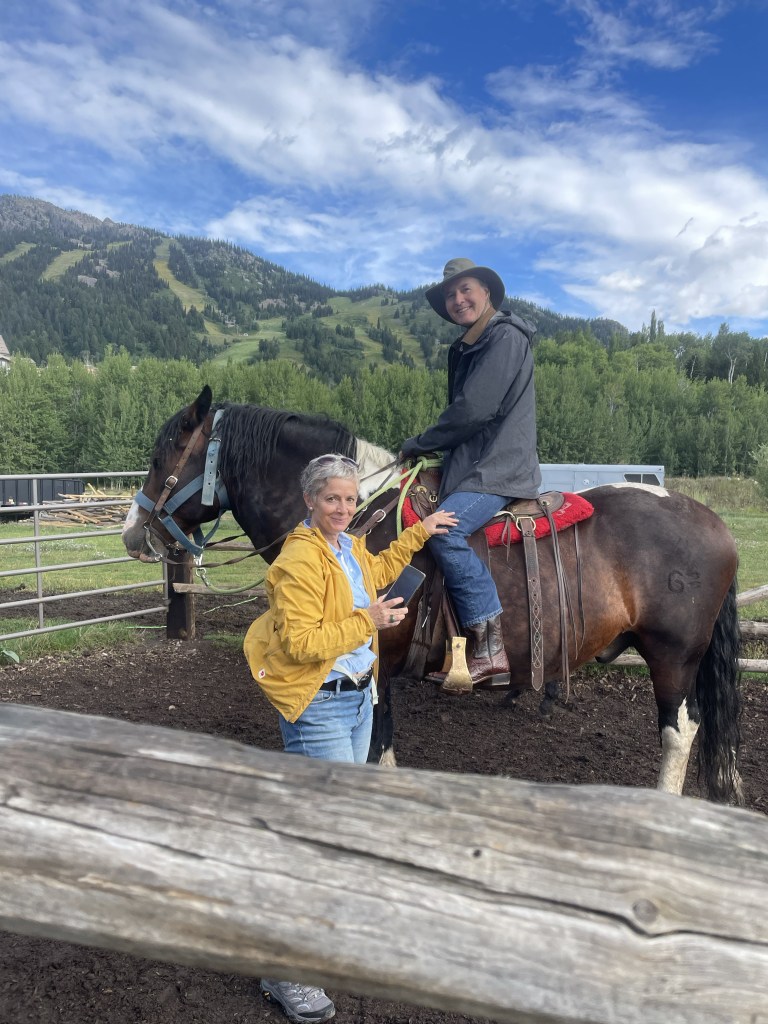
Although we are hardly equestrians, J and I have gone horseback riding during many of our travels. So far we have managed trail rides in South Africa (that one also involved zebras), Hawaii, Russia, Croatia, and Arizona, to name a few. The Tetons seemed an appropriate addition.
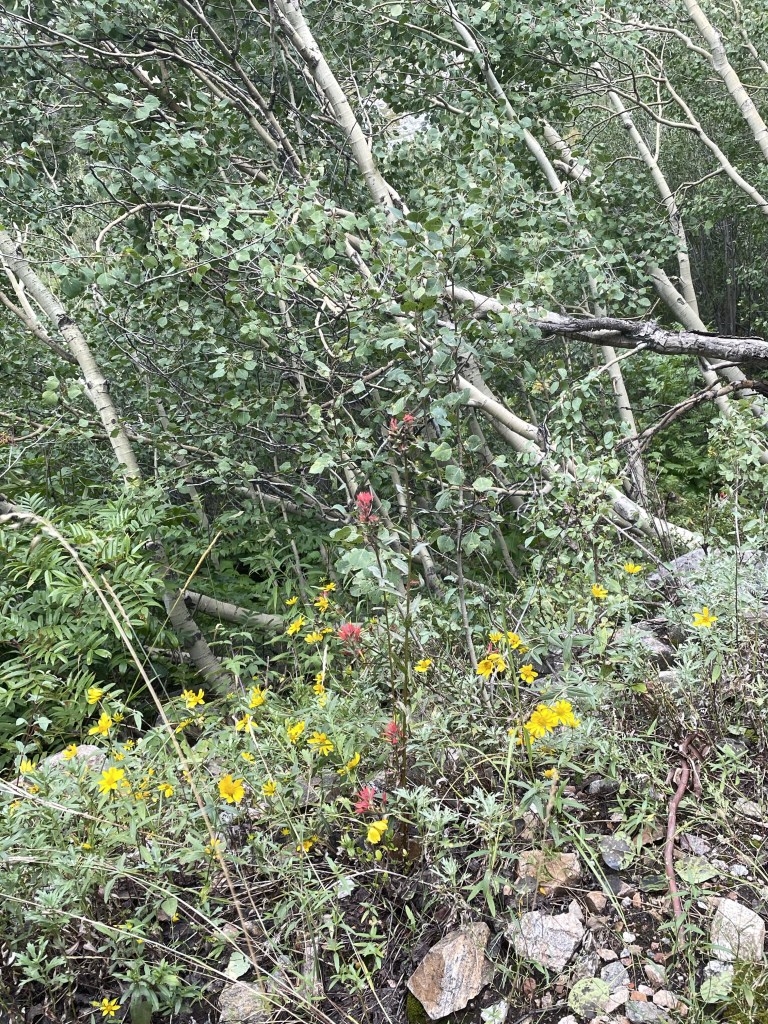
We met up with our niece, F (who really does live near Nice, France), as she was the only of our family group willing to brave the large four legged creatures that were to take us up one of the nearby mountains. She rode a very hungry “Chuckles,” J had a chunky “OT” (for Overtime), and I was blessed with Rhinestone. Apparently the trail company has over a thousand horses between Grand Teton National Park and one other location. Beautiful wildflowers, including lots of Indian Paintbrush, which is the Wyoming state flower. My favorite part was when our guide instructed us to get a move on so our horses weren’t spooked by the nearby bear cub who had climbed a tree, with Mama Bear right below.
Next up was a drive around the beautiful Lake Jennie loop. It was rainy but that didn’t keep us from enjoying sandwiches and a beer at Dornans, a long time Jackson establishment. And saw another bear. Bears were sort of a theme in the Tetons.
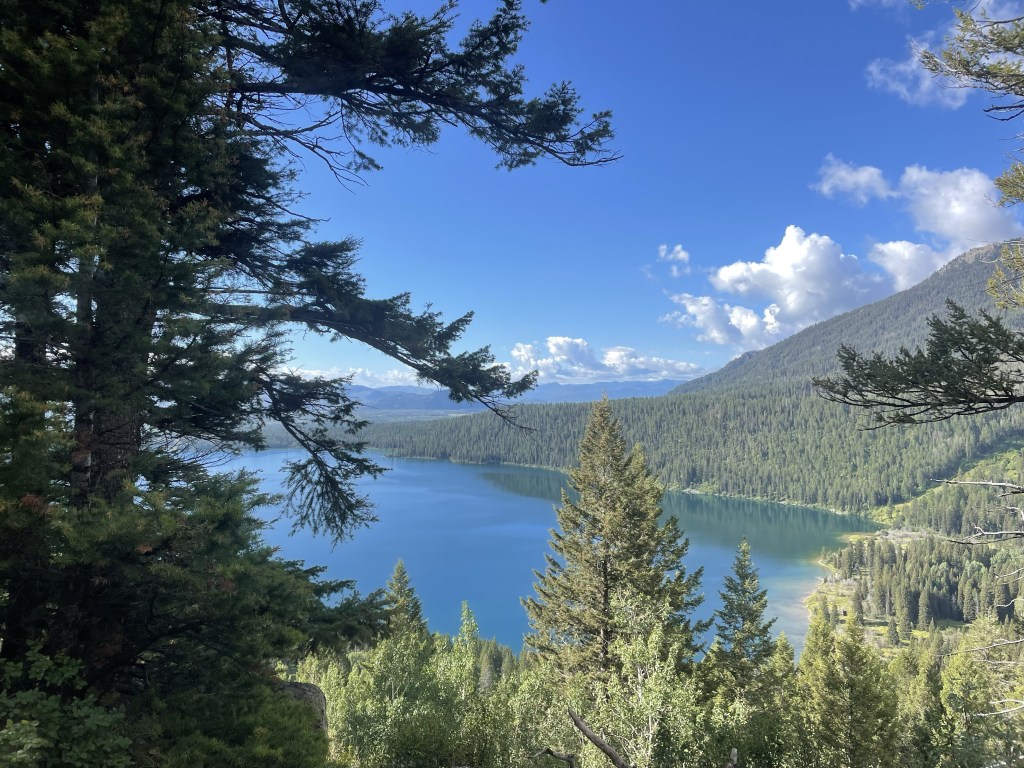
The afternoon saw a short but fun Lake Phelps hike. This part of the park is on the Lawrence Rockefeller Preserve. The Rockefellers, who had built a large estate on the property, donated it all to the park on the condition that all man made structures were to be torn down and the area returned to nature. Towering mountains peering over at a serene mountain lake. And on the way back we encountered a very large moose.
The following day, which was beautifully sunny, our hiking party consisted of my sister in law, T, J and me. I think the others were turned off by the fact the trail bore the auspicious name, Death Canyon. After driving through some of the many road construction sites (it seems as though most of the USA is currently building roads), we entered the park and ventured just beyond Phelps Lake. The trail starts wooded and a bit of an uphill, and then a very steep downhill, which you unfortunately know you will face up on the way back. You cross a number of boulder fields, but the trail is so well constructed you aren’t even aware of the exposure. Meadows of yellow daisies and purple thistles (which are not native, apparently), periwinkle blue flowers that looked like bluebells, and deep purple wild snapdragons. We walked alongside a river that cascaded into waterfalls before encountering a long uphill slog to the saddle right below Static Peak, at the patrol station. We keep going until the IPhone promised us we were at 8000 feet. I’m not sure what our total elevation gain was but it seemed considerable.
We pulled out our Maasai blanket from Tanzania and had a great picnic, which fortified us for a fast downhill followed by the uphill section we knew was coming.
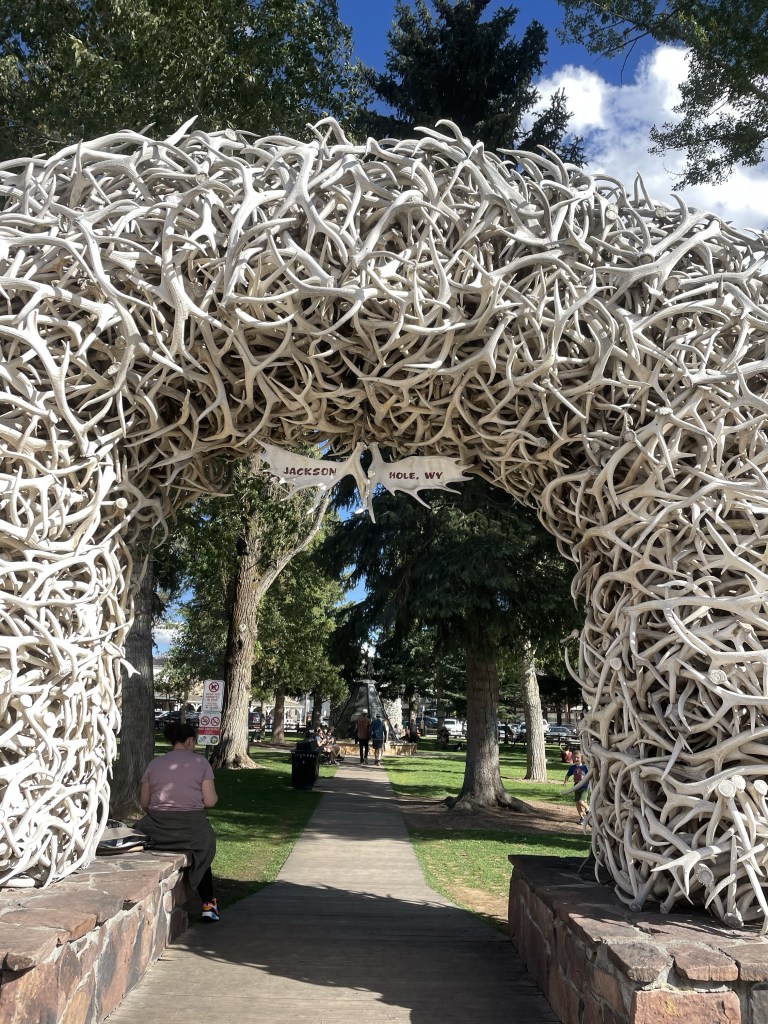
We couldn’t leave Jackson without some exploration of the town. Yes, we did see the iconic antler arches, browsed through a mountaineering store, and took advantage of the Snake River Brewery.
A very fun spot, and even the fact I left a hiking sock in T’s dryer didn’t seem that important. I guess it met up with the hat left in the Yorkshire Dales and the visor left in Hot Springs. I’m considering a blog post called “things I left behind on sabbatical.”
As we’d had several long and steep hiking days, we decided to knock off a couple of miles by avoiding a loop around something called Apedale Moor (which we couldn’t locate on any map anyway) on our way from Reeth to Bolton Castle and on into Aysgarth Falls.
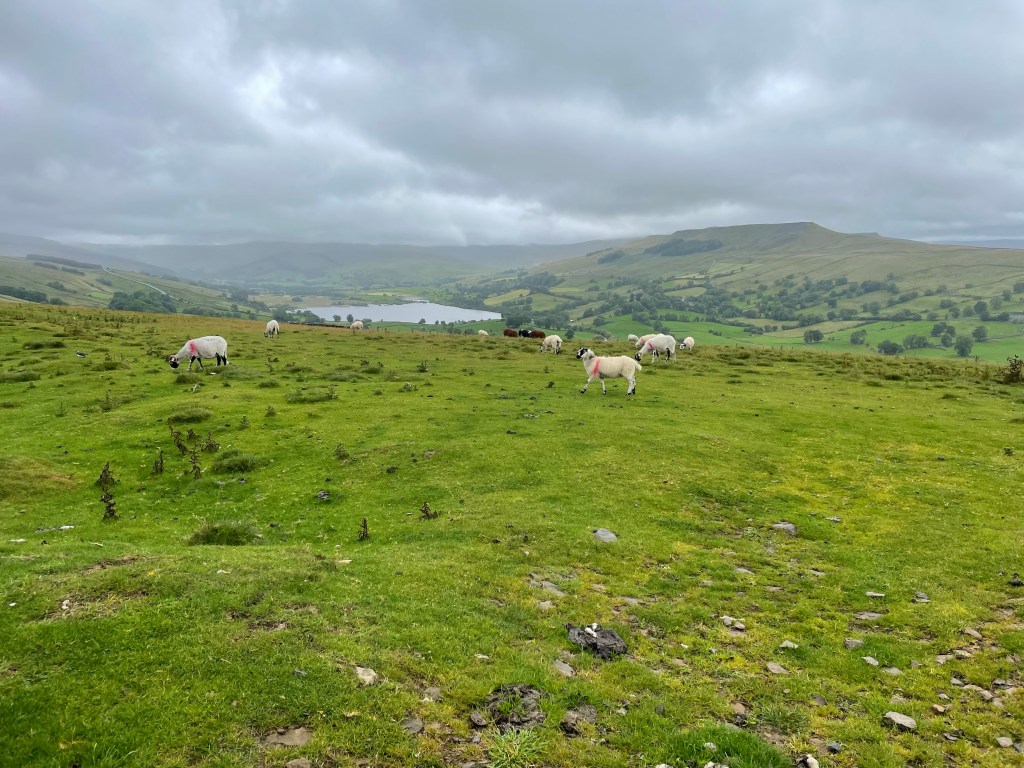
This meant having the nerve to stray from the ever present blue GPS line that was our North Star to take a paved road called Hargill Lane practically the whole way. Just because it was paved, however, did not mean that it didn’t go up and down, and unfortunately, it was a quintessential long slog shin splint generator. Hargill Lane crossed windy, windy moors with absolutely nothing around but sheep and occasional cars that operated at the same speed as all the bus drivers – that is to say, fast.
Eventually the road descended into the conservation area for the Bolton Estate, lands that are still owned by the same family that held them hundreds and hundreds of years ago. There were many beautiful wildflowers, but they were interrupted by lots of warning signs for the quarry works on the other side of the road.
We reached the very well preserved Bolton Castle right at lunch time and had a nice meal in the tea room. The castle, built between 1378 and 1399, is quite intact, and M and I enjoyed the diagram that showed what each level of the structure was used for. There was also a lot of information about the castle’s architect, John Lewyn. Who knew castles had architects!
The walk from the castle to Aysgarth Falls was lovely. We did cross a field with another bull, which was actually starting to lunge at a couple on the other side of a wall who had a dog with them. (Incidentally, everyone in the Dales has dogs, and they are welcome guests in restaurants, pubs, shops, etc.) They had some long story about someone they knew who had recently been charged at by a bull and had to throw his dog over a wall….in any event, it turned out my bull fears were not unwarranted! While the bull was occupied with them, J, M, S and I managed to sneak over another section of the wall, unnoticed.
On the way, we also suddenly heard a huge roar overhead that practically shook the stone walls surrounding the fields. Two Typhoon RAF jets zoomed by, and made several passes. We soon learned that war had not actually broken out while we were in the solitude of the Dales, but that this was a popular location for the RAF to do low altitude training.
The Aysgarth Falls themselves were pretty, but by then we’d seen so many waterfalls, we were somewhat jaded, and just as glad to keep on moving up a steep hill to our next guest house — the newly renovated Aysgarth Falls Hotel. Despite three flights of stairs (thank God for those backpack straps on my suitcase!), it was really nice and we thoroughly enjoyed their pub and dinner and breakfast food.
That was good, because the next and final day turned out to be the most challenging yet.
The plan was to walk from Aysgarth Falls to Kettlewell, where we would meet a taxi at 5:30 that would transport us back to Grassington, for our travel to London the next day. We wisely chose the 12.6 mile route rather than the 15.3…..
We started with some easy walking through fields and what was described as some “unavoidable” road walking. But there was little traffic, and the flowers were pretty as we basically hiked the length of the valley. Despite its remoteness, a number of little cottages bore signs of construction.
Eventually the valley ended, and so did the road. A very nice farmer gave us directions (the blue line becoming somewhat cryptic at that point), and we were able to cross the river and start what was described as a “big up.”
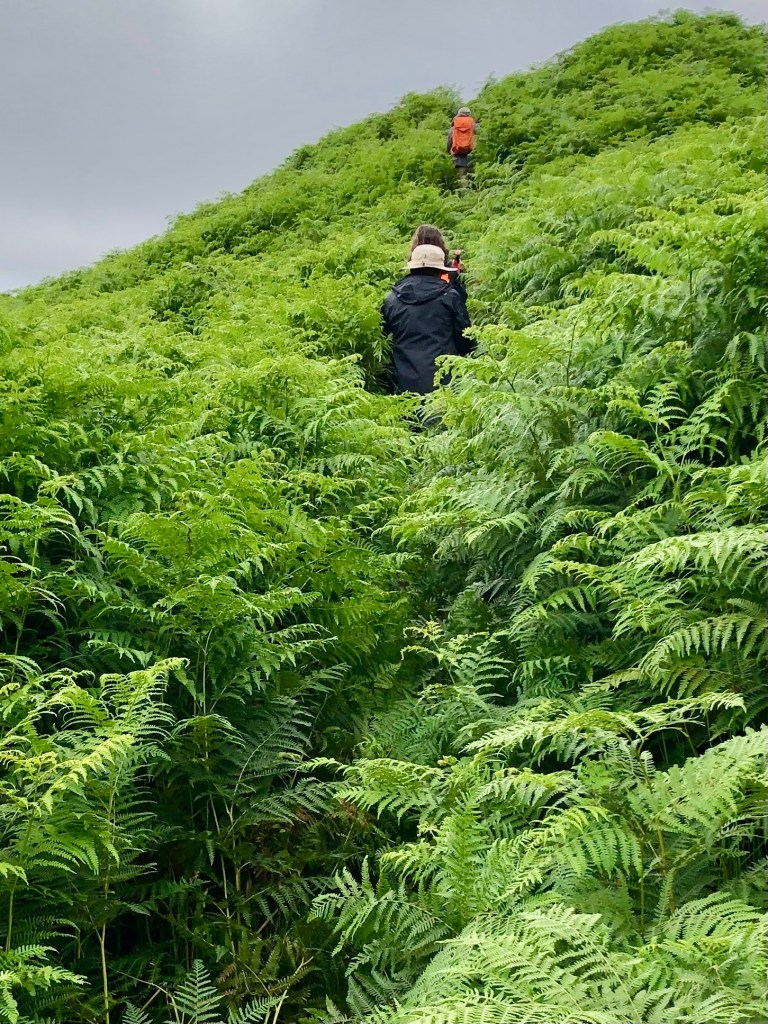
We were completely distracted from the steepness of our ascent because the almost imperceptible trail started to lead us through fields of five plus foot high ferns. They literally towered over us and I found I was using my body as a battering ram to push through. It felt way more like an Amazon jungle than the Yorkshire Dales.
Part of the way up, we realized there may have been a slightly more trodden path, but we were too busy bushwhacking and trying not to be swallowed by the ferns to have seen it.
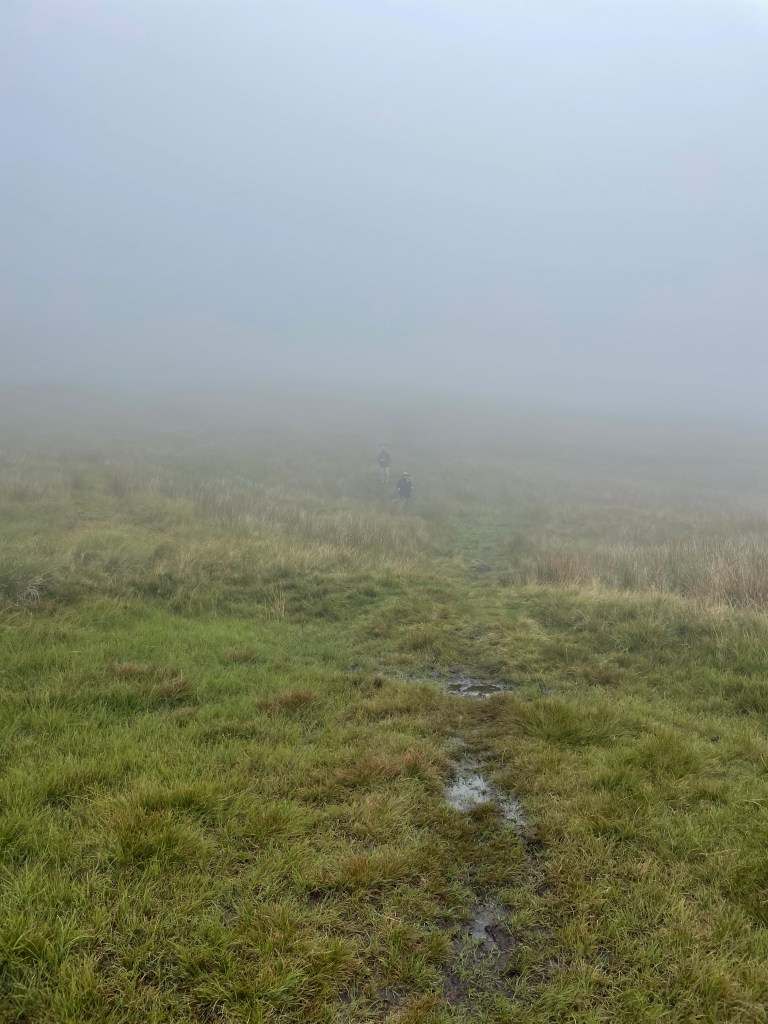
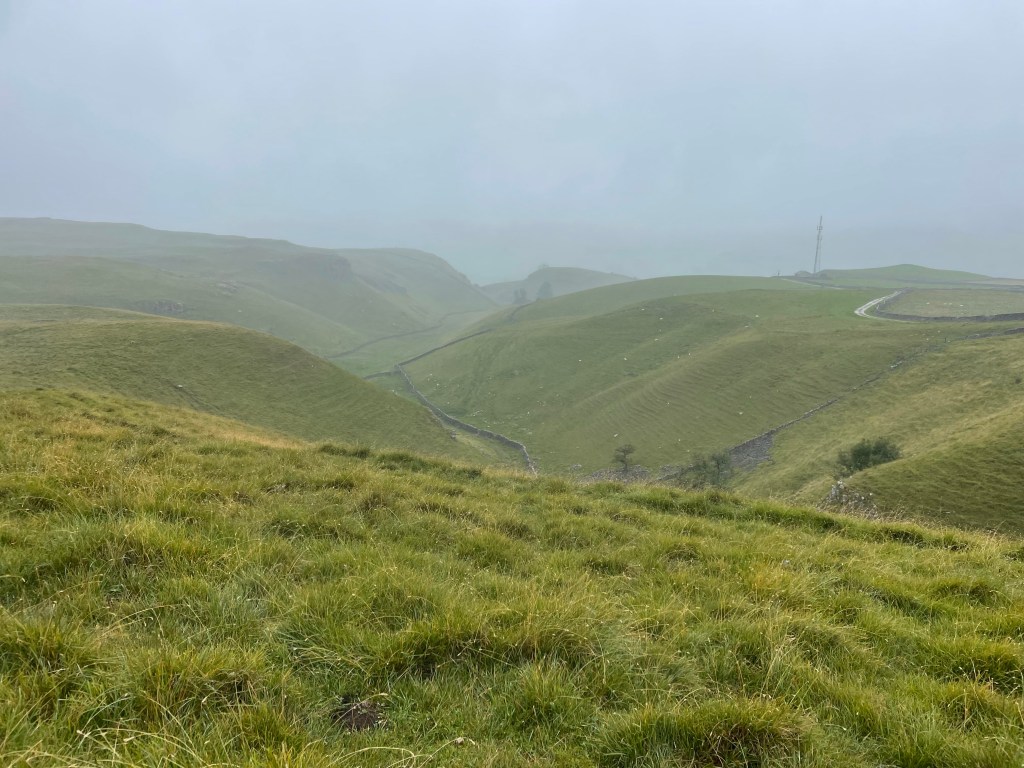
We finally cleared the fern field and continued to ascend. It was a very rapid elevation gain. Suddenly we found that we were no longer below the low hanging cloud we’d been observing all day, but were actually in it!
Yet still we continued to climb up. Visibility was starting to close and navigating the blue line was like flying a plane on instrumentation only. We encountered one group of young scouts using maps who were clearly doing some sort of orienteering exercise….they seemed infinitely better equipped for the challenge than we were.
We had no choice but just to stick to the GPS line as much as we could and aim toward the cairns and waymarkers that we could see. Finally, the scout leader passed us asking if we’d seen his charges anywhere – we were relieved to see him as proof that civilization existed somewhere in the direction we were aimed.
Visibility continued to get worse and the wind was whipping. We stopped for a brief break by a the first stone wall we’d even seen. But by then I was simply dedicated to getting down as fast as we could because it really was starting to feel unsafe. I was beginning to feel like a character in one of those Sierra Club magazine articles about what can go wrong while hiking….they usually end with hypothermia or broken bones.
Anyway, we finally reached what the itinerary termed a “snappy descent.” To the dismay of my fellow hikers, I actually found that part sort of fun – skipping around and over rocks, but with lots of grass cushioning on either side. Plus we were going down.
But we were still in the cloud, and M and S were just dots in the mist. All I could think about was that we had to maintain visual contact. You really could have gotten lost up there.
Finally we were below the cloud, and the world started to come back into focus. We could see the village of Starbotton at the bottom of the peak we were descending, and the wind that had whipped us as we crossed the ridges of the moors died down.
A steep descent down a stone road, and we were back in the valley, only 2 1/2 miles from Kettlewell. We had a quick bite of our sandwiches, and then walked through the fields that lined the valley for a straight shot to Kettlewell.
We had made it – all 77 plus miles! We walked through the village to the Blue Bell Inn where we were to meet the taxi in an hour or so. We had a celebratory drink to toast our most recent adventure. And even the fact that the taxi was an hour and a half late picking us up didn’t really matter.
Rooms at the Herriot Guest House were quite small, but that was by far compensated for by their very good breakfast and homemade jams and marmalade. That provided enough to fortify us for a slightly easier – and hopefully drier – day 3 ahead.
The Mac’s Adventure itinerary called for us to be transported by taxi to Keld, which truly is a blip on the map. The taxi took us through the Buttertubs Pass – a location I was last in with my family in 1972 when we lived in England for my father’s sabbatical.
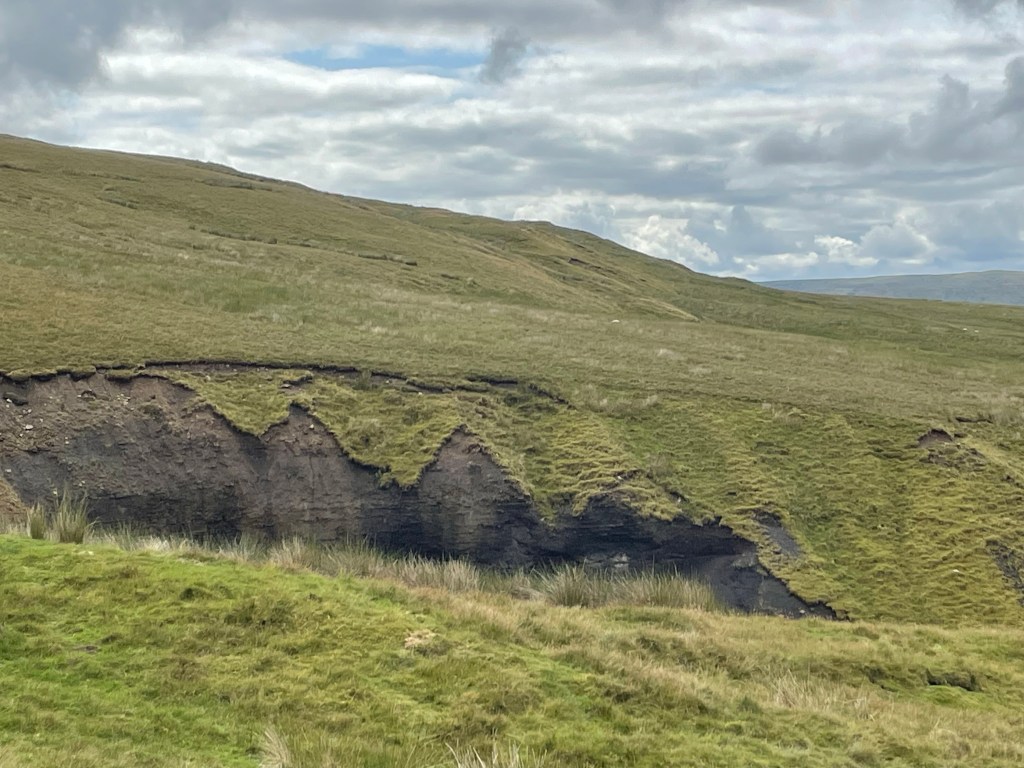
After an early arrival in Keld, we got on the road to walk to the Tan Hill Inn, famous for being the highest pub in England. About a 4.5 mile hike, over lots of moorland and gigantic ravines, where erosion peeled back the top layer of heather to reveal dark soil and rocks. For all of its age, just like the fossilized Jurassic coast in Dorset, this is an ever-changing landscape.
It was rewarding to see the inn suddenly appear in the distance, but the place itself was crowded with day trippers and there was nary a place to sit. Nonetheless, there were picnic tables outside, and we were able to make a nice lunch out of the Double Gloucester cheese and crackers that I had been carrying around since Manchester, alongside the middle aged men’s motorcycle group who were similarly shut out of the pub.
J and I chose to take the longer route back and crossed the valley, which was low and filled with green rushes, over to the next other ridge. The top flattened into a golden prairie-like meadow. We saw at least four or five “bouquets” of pheasants suddenly take off. On the ground they were perfectly camouflaged, soft brown speckles and beige. We would hear five short whistles and suddenly they would take off at top speed, looking for all the world like a group of feather dusters taking flight.
We could never capture a pheasant in flight, but at least I found some feathers!
Our path took us by the rather large farming establishment of of the so-called “Yorkshire Shepherdess” of TV fame (although I’d never heard of her). She’s apparently one of those “leave the city behind, become a farmer, and write about it and develop a TV series” people. We did see two men, one on an ATV, which seems to be the farm vehicle of choice here, herd a group of cows into a barn. We had to wait until they were in before we could pass.
I know these are sheep, not cows, but I didn’t have a pic of the cows!
We were almost back in Keld when we managed to make a critical navigation error and ended up going the wrong way toward the small hamlet of West Stonesdale. It’s a true farming community, with working sheep dogs sleeping in their cages, and big agricultural equipment everywhere. Fortunately, I soon realized I was looking at the famous GPS blue line backwards, and we were able to correct our course and make it back to Keld about 5, just as S and M were starting to question where we were.
View from the Keld Lodge
After an overnight at the Keld Lodge, the next day, Day 4, we were to trek to our next destination of Reeth. We had a choice between the “high” route, which would mostly be on the famous Coast to Coast trail, or the low route, which ran along the river. We fortunately chose the high route – and it did indeed provide some of the best summits and sights of the whole trip.
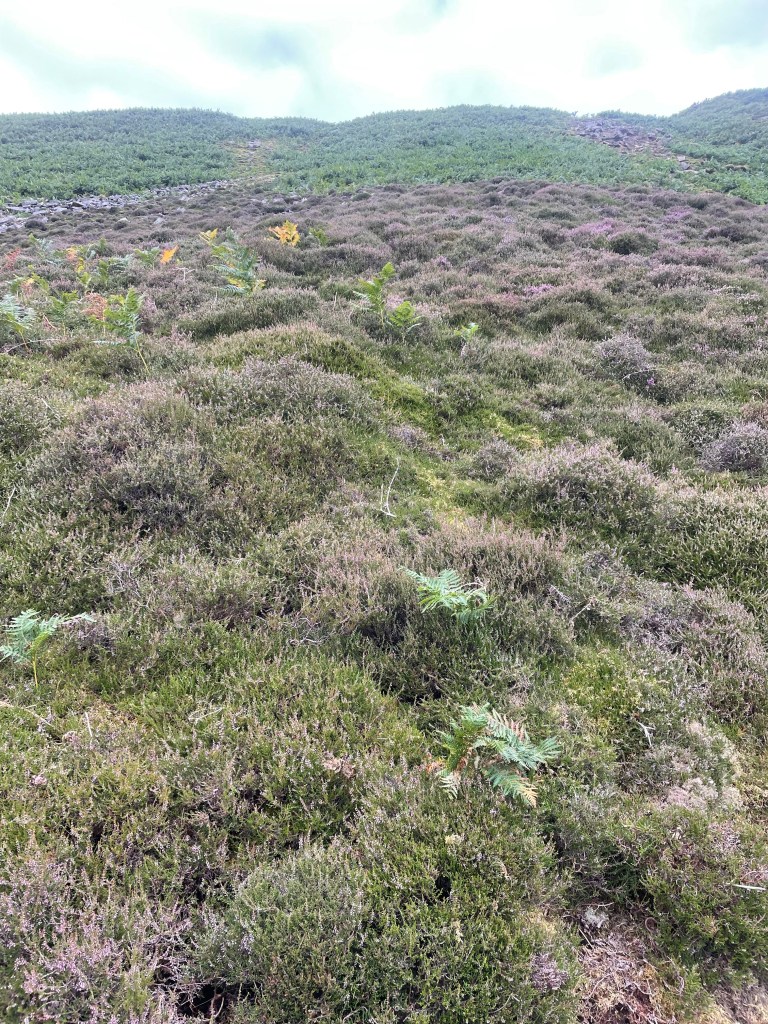
The first part was over moors, which were blanketed in blooming purple and sometimes white heather, waterfalls galore. There were lots of steep sections, including some fun scree fields to scramble through, and I was happy get to use some of my basic mountain skills. They are pretty common sense: always lean into the mountain and your uphill pole.
A steep descent into the valley, and we were in the midst of the ghostly ruins of lead mining works. Lead mining was very big in the Dales back in the 1830s. It’s now just a shadow land, and it’s hard to imagine the hundreds of men that would have lived and commuted to these now remote and desolate areas to work the mines.
It looked like some gravel quarrying still continued and we ascended back up the valley to a moonscape of rock and gravel.
Once we crossed the moonscape, we found a nice spot for lunch, where we chatted with a mother and daughter combo who we had seen in Keld that very morning. They must have been uber athletes based on their speeds up and down.
I bonded with this sheep. It was the cleanest one we saw!
After about 12 miles or so and a few more ascents and descents – and a lot of what we believe to be grouse – we made it to the pretty town of Reeth. As always that final last mile or so is the hardest.
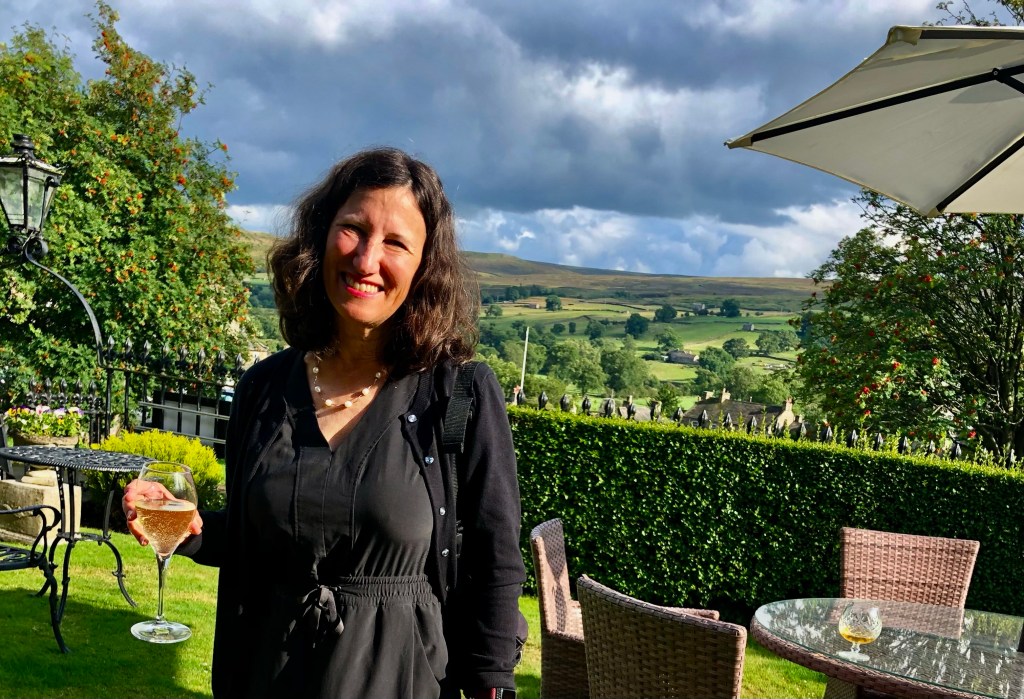
We were staying at the Burgoyne Hotel, which seemed positively opulent after the Herriot Guest House. Nothing like a drink in a front garden after a hard day of hiking.
As foreshadowing, let me start by saying that I spent a lot of time on day 2 of our trek through the Yorkshire Dales thinking of synonyms for the word waterlogged. But I digress.
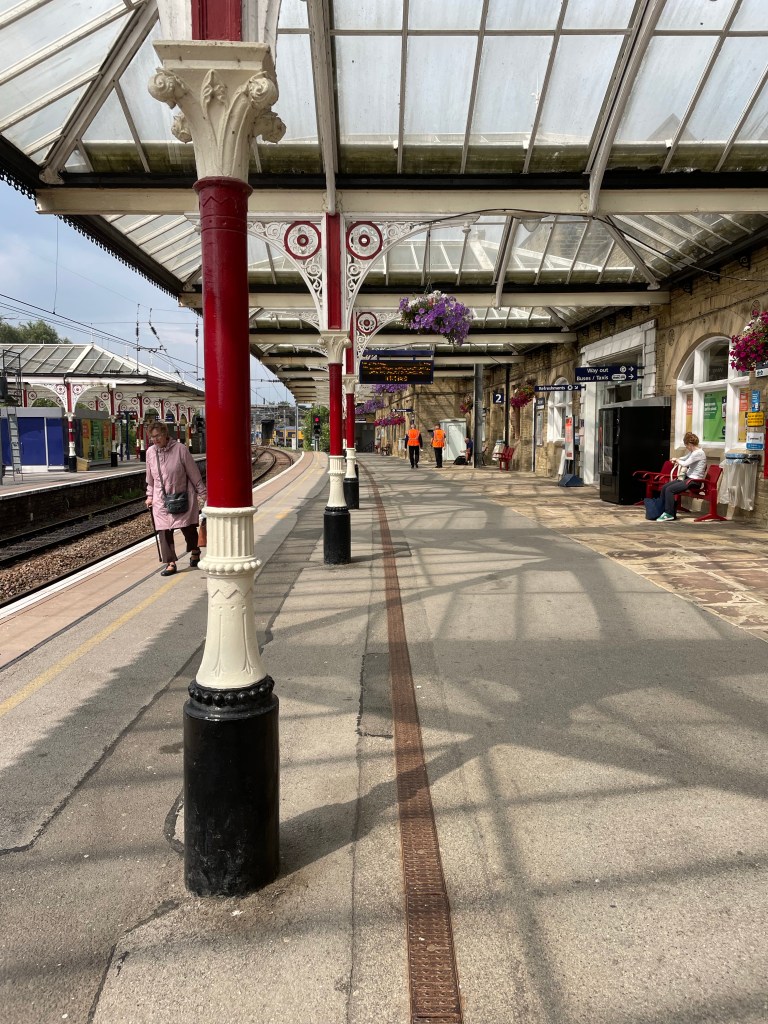
After a two night sojourn in Manchester spent catching up with family friends (by the way, we really liked Manchester and its bustling vibe…), J and I successfully navigated our way to Grassington. This started with two trains, which delivered us to the charming town of Skipton, which had one of the prettiest rail stations we’d seen.
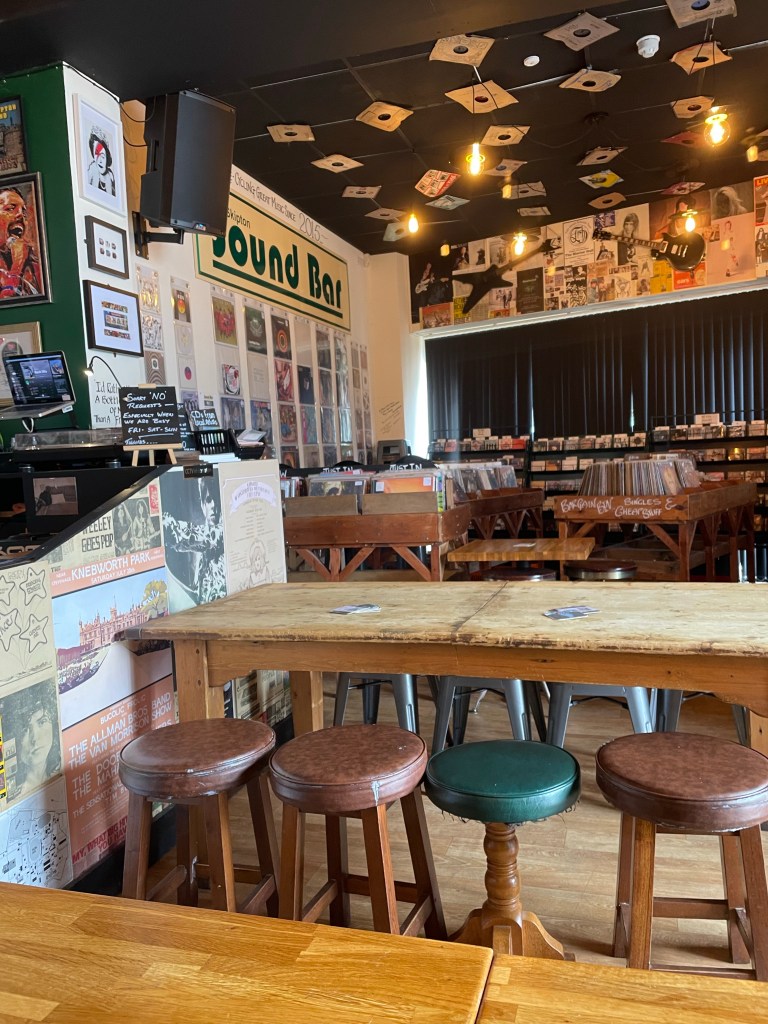
From there we planned a bus ride to Grassington. Of course, the rail station and bus station were not contiguous, so this involved a ten minute jaunt, luggage in tow, but we were able to use our two hours of waiting time to visit the “Sound Bar.” An independently owned combination vinyl record store, coffee shop, and pub that also featured live music on the weekends. The walls were plastered with tickets, posters and other promotional materials for concerts and bands dating back 50 years – really fun spot and not what we expected to find!
Despite the fact that the driver operated the bus to Grassington as though he were auditioning for Mr. Toad’s Wild Ride, he safely delivered us to just outside the Black Horse Hotel where we met up with pals and long time travel partners M and S. They’d arrived a day earlier, fortunately managing to take one of the only trains running on a day of “industrial action” (aka strike day) from London to the north. Unfortunately, the room reserved for J and me had electrical problems. After a couple of hours of waiting around in their very cozy bar, management gave up and sent us across the street to an equally nice inn, the Devonshire, which was graced with a mention somewhere in one of James Herriot’s books.
For those of you not aware, practically all of the Dales is Herriot country – there’s a Herriot Way walk, hotels name their rooms after the characters (both human and animal), and more memorabilia than you can imagine.
After a filling breakfast, the first day of the walk went smoothly. It was only about 11 miles – slightly shorter than the original itinerary because we were to stay in Buckden instead of Cray, which was a couple of miles further down the road. Of course, that did have implications for day 2, as I’m sure any discerning reader will have figured out.
There was a light, misty rain much of the time but it was really nothing more than what you experience with a mister at a Disney theme park. A few steep uphills at the beginning until we reached a ridge line. We then descended through what must have been a planted forest of tall conifers, stripped of their lower branches, and down to a river that was contained in its banks (foreshadowing again – unlike day 2).
We reached the village of Kettlewell where we stopped at the first spot we saw for lunch and an ale (after all, this was billed as an “Ales and Dales” trek). It turned out it was the owner’s first day open, and his manager had quit that very morning. We were happy to support the new endeavor and enjoyed hearing his take on English politics and who should or should not be King….
Much of the rest of the walk was on or near the river. It was edged with fantastic wild flowers, thistles, foxgloves, and bluebells. We crossed open fields, or sometimes were sandwiched on narrow paths running between stone walls, flowers and ripening berry brambles on each side.
We reached the tiny village of Buckden (chief feature, a village store that took cash only) in good time. Home for the night was the lovely Buck Inn.
We knew in advance that the repercussion of our shorter day was a longer one….so were prepared for at least 16.5 miles on day 2, and had ordered packed lunches the night before.
We knew things were not off to a propitious start when, as we were departing, a man in the lobby volunteered that he had just come from Askrigg, and everything on the way was flooded. He also cast some dubious looks at the four Floridians blithely heading off into the Yorkshire Dales….
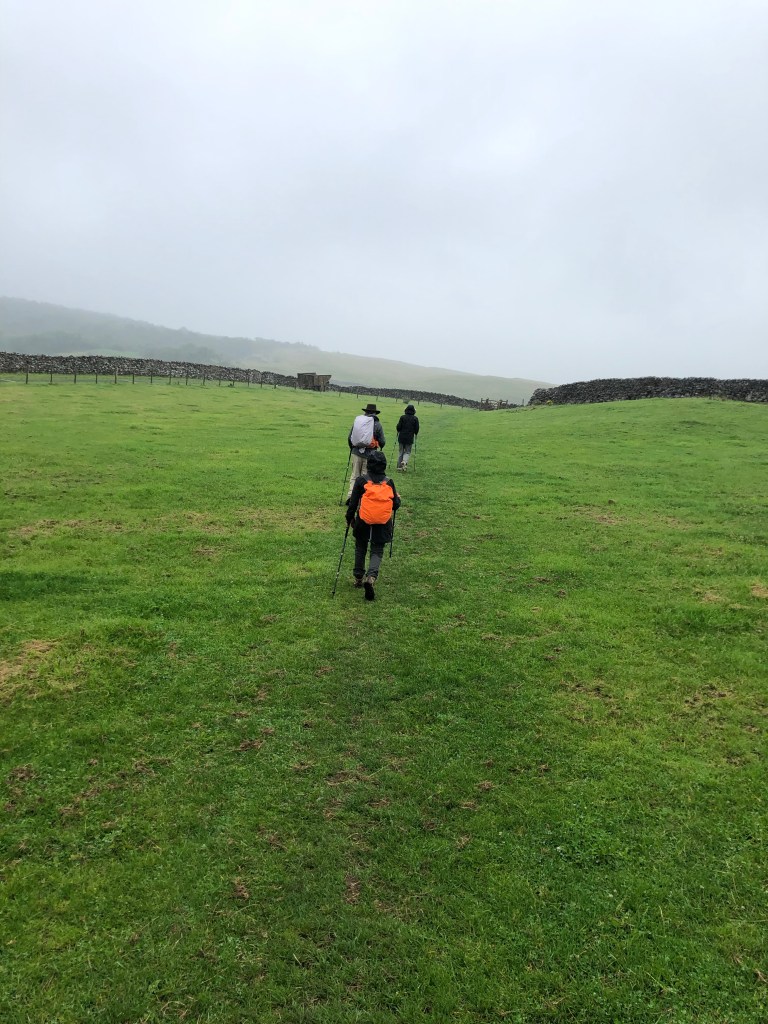
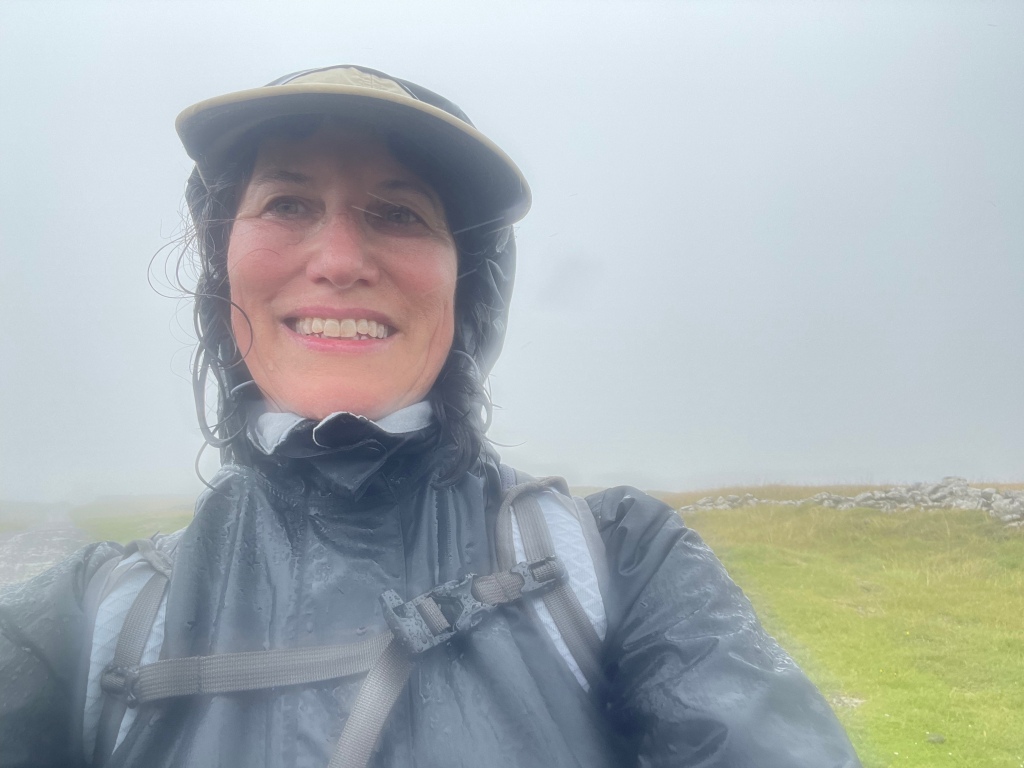
It was indeed raining, and continued to do so for nearly the whole day, veering from light to stinging. We started with a long uphill slog, and learned the first rule of Mac’s Adventure trekking – NEVER veer from the blue GPS line on the app, NO MATTER WHAT. The sign posting (other than for the well-known, main trails) is awful, and that blue line becomes your Bible (or yellow brick road, whichever metaphor you prefer).
Our first issue really started as we descended into Cray, which was where the original itinerary had called for us to spend the night. We reached a roaring river, which we were apparently to cross with the assistance of stepping stones. But the stones were under the white water rapids of a flooded river, and we were not about to start day 2 with an encounter with the river gods. There was a bridge just a few feet away – but to access it we would have to go through private property that lined the river bank.
There was little choice. To the bemusement of the elderly men on the other side of the river who were eating sandwiches and drinking tea from flasks, and having a good time observing our adventure, we all managed to climb a stone wall, scale the wire at the top (avoiding barbed wire on the sides), and make our way to the bridge. (S had ventured along the river edge, clinging to the wall, to see if there was a way to less obviously trespass, but soon gave up the attempt to avoid lawlessness.)
I wish I had pictures, but we were somewhat preoccupied.
We trudged on some more, and reached a turn off that sent us above the fields into bleak and desolate moors, inhabited only by sheep. We did encounter a group of scouts with an older guide who made dire predictions about the water yet to come. More uphill, reached a stretch of paved road, only to find that portions of it were under up to a foot of water. That required another venture into the fields at the side, although by then we were so wet it hardly made a difference.
From the road we were back onto a bridle way running through the moors. As M pointed out – we were experiencing both swamp and summit simultaneously. Many impromptu waterfalls had formed, and it would have been spectacular without the rain, or the wind that had by then kicked up. The conditions defined the word bleak, and the moors were, to use M’s phrase, both desolate and disorienting.
The moor was interspersed by sheep fields every now and then – but my favorite was the pasture guarded by a very large bull with a ring at the end of his nose. I was first in our little parade, and memories of bull running and Pamplona caused me some anxiety as I considered the effect of my orange back pack. But I moved slowly, J edged in close so the back pack wasn’t as visible, and Senor Bull deigned to let us pass without exacting tribute. Nonetheless, once we’d exited his domain, he stood his ground by the gate, staring at us to make sure we really had left.
The rain lightened and we found ourselves on some country lanes, with a couple of houses that seemed to have been built at the edge of the world, so we pulled out our sandwiches and ate on the go. About mid-afternoon, we finally reached the charming village of Askrigg – home to pretty gardens and a 15th (or earlier) century church, St. Oswald’s.
Exiting Askrigg, we hiked through a lovely enchanted forest high above a rushing river. The path ran along the top bank, a stone wall on one side and trees and river below on the other. It was emerald and mossy green, and surely home to a pantheon of forest fairies.
Path finding through the muddy, sodden fields became more difficult and the wind picked up. Things were not helped by the hundreds (thousands?) of sheep we encountered and we spent a lot of time trying to avoid their leavings. Very occasionally we would go through a “clean field,” i.e., one without sheep!
I thought I could see our destination of Hawes in the distance, but couldn’t know for sure. We hiked and hiked through field after field, finally making a left and seeing a sign marked “Hawes Circular Walk.” It was getting late at that point, and I haven’t been so glad to see a town since J and I descended Stok Kangri in Indian in 2018!
We reached the Herriot Guest House in Hawes completely drenched. Both ourselves and our possessions, despite rain pants and back pack covers (turns out passports dry pretty well). To add insult to injury, somehow the luggage that was being transported from inn to inn had managed to get wet as well.
We changed quickly and went the The White Hart for an excellent (and well-deserved) Sunday Roast.
Sodden, waterlogged, drenched, soaking. I’m sure there are a few adjectives that I’m missing but you get the picture. However, you could equally apply: challenging, invigorating, exhausting, stimulating, and most of all – absorbing.
On July 21, 2023 a massive landslide (aka as a “land slip” in England) moved tons and tons of cliff side onto the Seatown beach, dividing it in half. About seven miles away, on Christmas Eve, 1839, the same thing happened; that time dumping 45 acres of meadowland into the ocean at Lyme Regis, creating what is now called the Undercliff. The fallen land has been conserved since the 1960s, and allowed to revert to wilderness, creating a walk way running between the bare chalk walls rising above and the forested ravines below.
It is the area featured in Lyme Regis resident John Fowles’ The French Lieutenant’s Woman. It was Fowles’ description of the Undercliff that drew us to a three night stay at Lyme Regis. Fowles wrote: it is “cut by deep chasms and strange bluffs and towers of chalk and flint, which loom over the lush foliage around them like the walls of ruined castles *** People have been lost in it for hours, and cannot believe, when they see on the map where they have been lost, that their sense of isolation – and if the weather be bad, desolation – could have seemed so great.”
After a first night at the Nag’s Head Inn, whose pub was inhabited by elderly men watching cricket, and dinner at the very nice Royal Lion Hotel (fyi, to get free Wi-Fi you have to sign up for a million mailing lists and my gmail account is paying the price…), the next day was designated for the Undercliff Walk. The Undercliff is also part of the South West Coast Path, so it fit nicely into our theme of walking at least parts of “the greatest hits of English paths.”
The beginning of the walk is very poorly posted. We finally found a small marker by the Lyme Regis Bowling Club, which seemed a popular place to be that particular morning. I had strong memories of my great-uncle taking us to his bowling club in Skegness back in the early 1970s – but now women also get to play! Men and women alike were wearing the requisite (mostly) white outfits.
The walk starts with a never ending series of steps up to what appears to be a top ridge. but at some point you realize that you are really traversing the half way line of the land slip, with cliffs towering both above and below.
After the land slip occurred in 1839, it became a huge tourist attraction. People took boats to gaze upon it from the sea, and a “Landslide Quadrille” was even written in its honor. No one, however, seems to remember the composer!
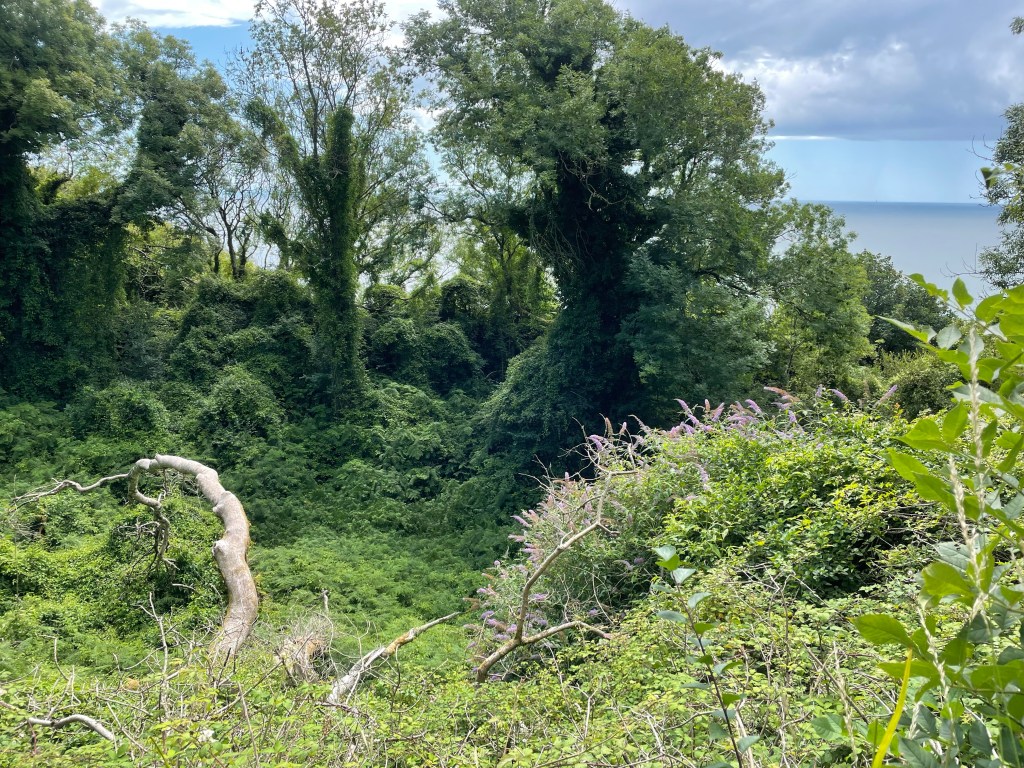
Since then, woodland and grasslands have grown up. The woods are dense and dark and mysterious. Green tunnels formed by arched trees and wild roses run through the woods. Wildflowers, including white bindweed, yellow wild snapdragons, red berries of Italian arum, and simple wild roses create patterns in the deep carpets of ferns.
Now and then the views opened up, either to see the chalk cliffs above or the ravines below and the sparkling English Channel.
It was very steep and muddy, and even though it didn’t rain, beads of water resident on the high hedgerows created their own fairy mist.
After about 7 miles, we entered into an area of very rare grasslands. If you looked closely, you could find lavender chalk fragrant orchids and pink everlasting peas enjoying the sun brushing the golden fields.
The path turns away from the sea, and ends, oddly enough, with a stroll down the middle of golf links and down a steep hill into the very small harbor town of Seaton. Apparently we began with bowls and ended with golf.
We caught the bus back to Lyme Regis. A double decker bus ride whizzing along the narrow hedge lined lanes is an experience not to be missed.
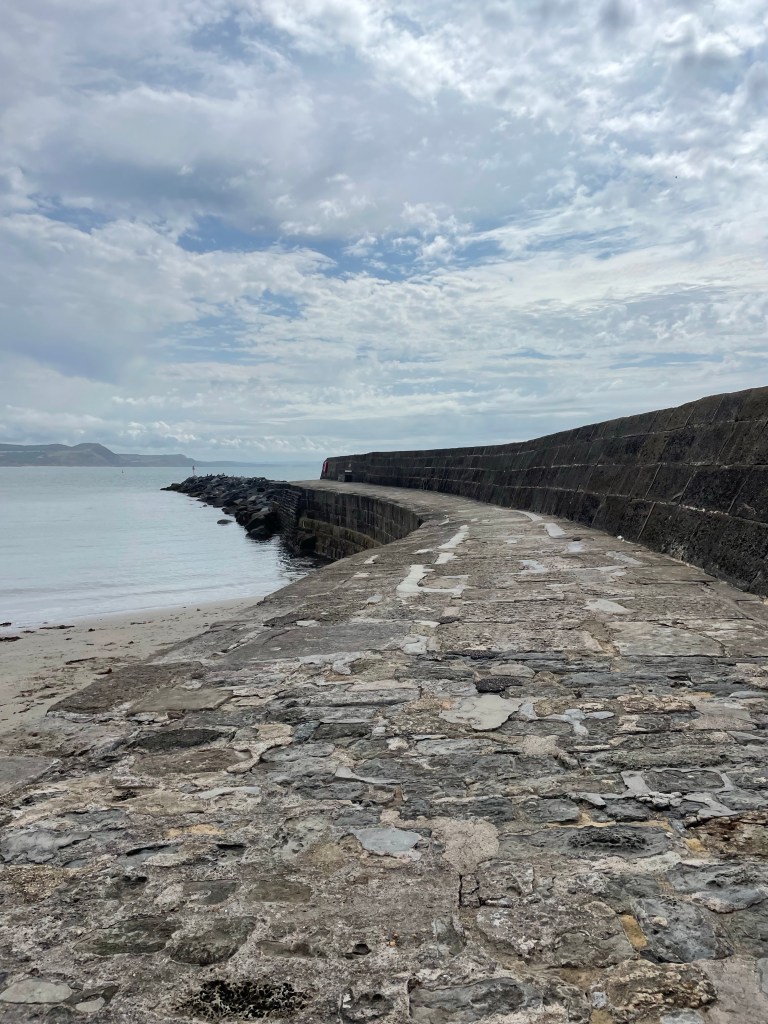
Our final full day in Lyme Regis was dedicated to visiting the Cobb and embarking on a fossil hunt. The Cobb is a stone breakwater that thrusts into the sea to protect the harbor. No one really knows why it is called the Cobb. The first mention of it is in 1294, and after being destroyed on a number of occasions it was almost completely rebuilt in 1817. Fishing boats, mostly for tourist trips, still leave from the Cobb, and we watched fishermen mending their nets.
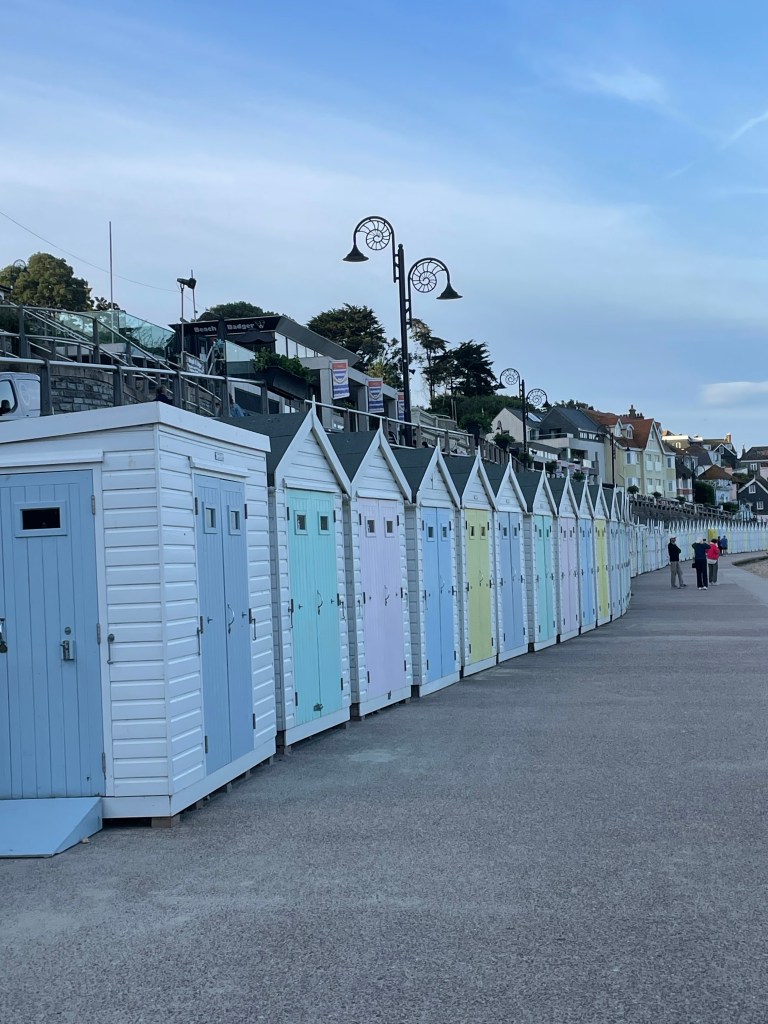
The seaside itself is lined with colorful bathing huts. We were lucky enough to see the interiors of some of them, whose residents had their doors open….featuring kettles for boiling water, shelves for holding snacks, and I’m sure there was local ale somewhere there also. Or at least canned cocktails, which seem to have taken over in England. By the way, look at the lamp posts. They are modeled after fossilized ammonites.
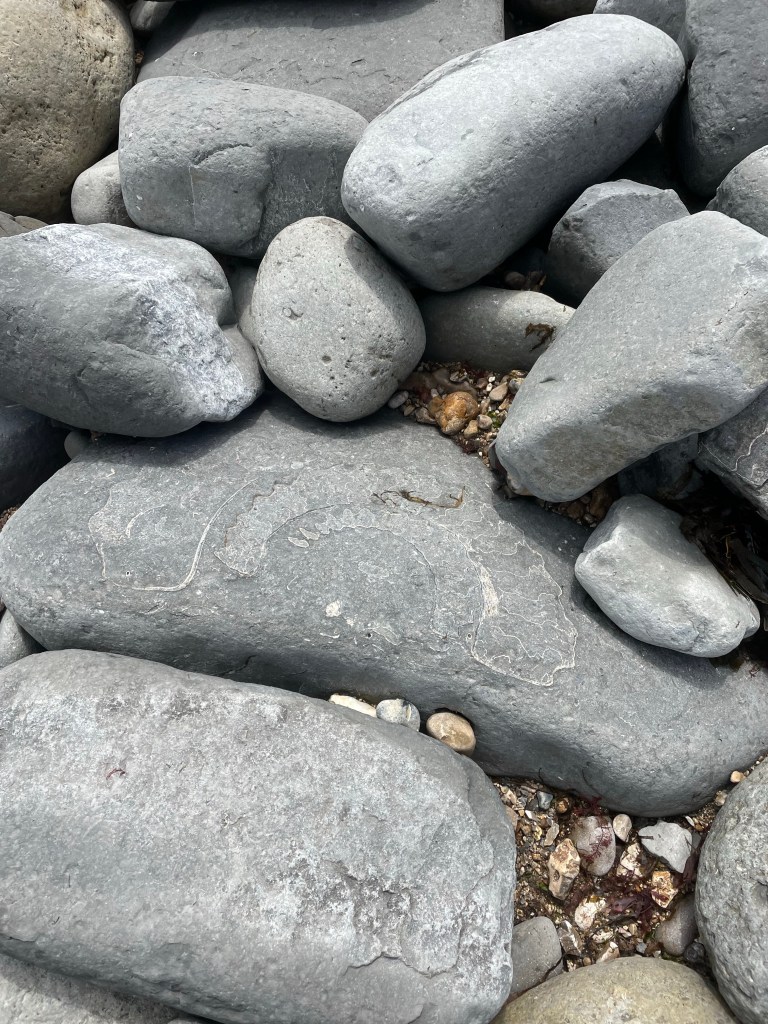
On the other side of the Cobb is rocky Monmouth Beach. Instead of seashell hunters, it is populated by amateur fossil hounds wielding mallets, this being one of the greatest spots to find fossils. Hence the name, Jurassic Coast. (In fact, in the Undercliff the various stone levels are dated, including back to Jurassic times.) Even if you don’t find one yourself (I like to think a half inch, grey ridged rock we found was one), ammonites are etched into all of the big rocks, creating a mural of fossils running along the beach floor.
After a long session of fossil hunting, we walked up the steps to the Jane Austen Garden and the Langmoor and Lister Gardens, which offer stunning sea views. They were surprisingly tropical and and natural – as was the Undercliff itself – as opposed to formal and contained.
Finished up our stay in Lyme Regis with a relaxing afternoon and some great Indian food.
Lyme Regis is full of history and tradition and fossils. But this coast is constantly evolving, as evident from the landslip just a couple of weeks ago. I keep contrasting this natural progression to what’s been happening this summer where much of the coral in parts of South Florida died in two weeks after ocean waters increased to bath water temperatures.
The land slip that formed the Undercliff was a force for creation and change and new life. That’s the sort of evolution that happens when the land is conserved and preserved and allowed to revert back to its raw, beautiful self.
We ended up in Rye because J googled “weekend getaways from London.” And thus we found ourselves on a Friday night along with an abundance of other middle aged merry-makers in the excruciatingly quaint town of Rye, a small town in East Sussex.
It’s only 60 miles or so from London, and easily reached by train, one change only, from St. Pancras. Incidentally, if you’ve reached your 60s, the BritRail pass with the senior discount is a beautiful thing. St. Pancras itself is something to behold. The old Victorian train station I remember as the start of our trips up to Sheffield/Rotherham remains in exteriors only. The ticket office is now a high end restaurant, and the entire station is occupied by shops and cafes – more like an airport than anything else.
We arrived in Rye too early to check in, so found a nice cafe – Jempson’s – where I had a “cheese lattice” and J a chicken and mushroom pie. It was only about his 5th small meal of the day.
The AirBnb was down a narrow alleyway close to Landsgate, a 1339 or so guard tower. It had two rooms, separated by very steep stairs and facing the Queens Head pub. Only downside was late night noise from revelers across the street, and a 5 a.m. wake-up call by screeching gulls that apparently save their party time for early morning.
Rye itself is near the English Channel. It used to be on the English Channel (the “Rye Camber”), but over the centuries, storms and reclamation of the bay have resulted in the water silting up, creating huge salt marshes. Seemed very apropos for the swamp part of this blog. There were a plethora of half-timbered buildings, quaint shops and pubs, and women on week-end breaks all wearing summer dresses and straw hats – and shopping.
J and I had a drink in a garden pub, and then went to the very funky Queens Head across the street. Food was cheap and excellent – ranging from roast chicken (me) to Korean kebabs (J). We waited around for the live music, a very over the top cover band that played everything from ZZTop to John Denver, and brought the mostly middle-aged crowd out onto the dance floor.
I was interested in the intellectually challenged young man who seemed to hang out at the pub on a regular basis. The manager let him help out with everything, and he was clearly a fixture (I saw him there the next morning also from our vantage point across the street). It was nice to see how he was an accepted part of the fabric of everyday life.
Our one full day in Rye was reserved for a hike to the Rye Nature Preserve, the, or one of the, largest coastal preserves in the U.K. After some difficulty finding the beginning point, we finally started the hike. Through narrow corridors lined with hedges, into marshy salt marshes – small islands outlined with rushes.
We made our way to the very new Discovery Center where we ate sandwiches. There was one strip of beautiful long sandy beach (Camber Sands) – that then turned into a shingle beach – what seemed like miles of rock beach, consisting of perfectly round stones that angled sharply into the water. It was like walking over stone sand dunes. It was hard going and we soon returned to the trail.
The skies darkened, grey against white, and we pulled out our rain gear just in time. The trail crossed the marshes and then blended into sheep pastures, with lots of stiles and gates. We were a little unsure of our location on our by then battered and wet brochure map….the Camber Castle, set apart atop a slight plateau, never seemed to get any further away.
But finally we ended up with the Brede River on our left and the Brede Locke straight ahead, the end of our 8 or so mile excursion in sight.
On the way back we stopped at the Waterworks Micropub. It’s been everything from waterworks to public toilets. I had a half pint of a local cider, Tenterden. Cider is a big deal here and I’ve never seen so many real, hand pulled ales.
After washing the grime off, we went to a Turkish restaurant on the High Street for dinner. We walked up to and around St. Mary’s, where we found an absolutely lovely pub, Ypres Castle, nestled in its lower walls. Met a very interesting fellow from Manchester who had been living in Rye but was about to move to Belgium. It was his last night in town, but he was nonetheless as welcoming to two tourists as could be.
Actually, everyone we encountered in Rye was remarkably friendly. It seemed to presage good things to come as we got ready for the next leg of our trip – to the Basque Country in Northern Spain.
From Swamp to Summit is back! There’s been a long hiatus, not because I haven’t been thinking about you, dear readers, but the flotsam and jetsam of ordinary life has simply gotten in the way. But now I’m close to pulling back the curtain on our plans for 2023 – which begin Independence Day – and no, that’s not a coincidence.
But for immediate purposes – this past Saturday, April 29, was the scene of the Mammoth March. I signed us up, over J’s protestations, in January, telling him that was all I really wanted for my 62nd birthday.
Mammoth March is a sponsored 20 mile hike that you are supposed to finish in 8 hours. Doesn’t sound so bad, right? A 20 minute mile pace? But you have to consider the terrain. It’s Florida jungle, out there in the Charles Bronson forest (see Lost in Florida – Staring Down Charles Bronson); it had rained last week and about two miles were nothing but mud.
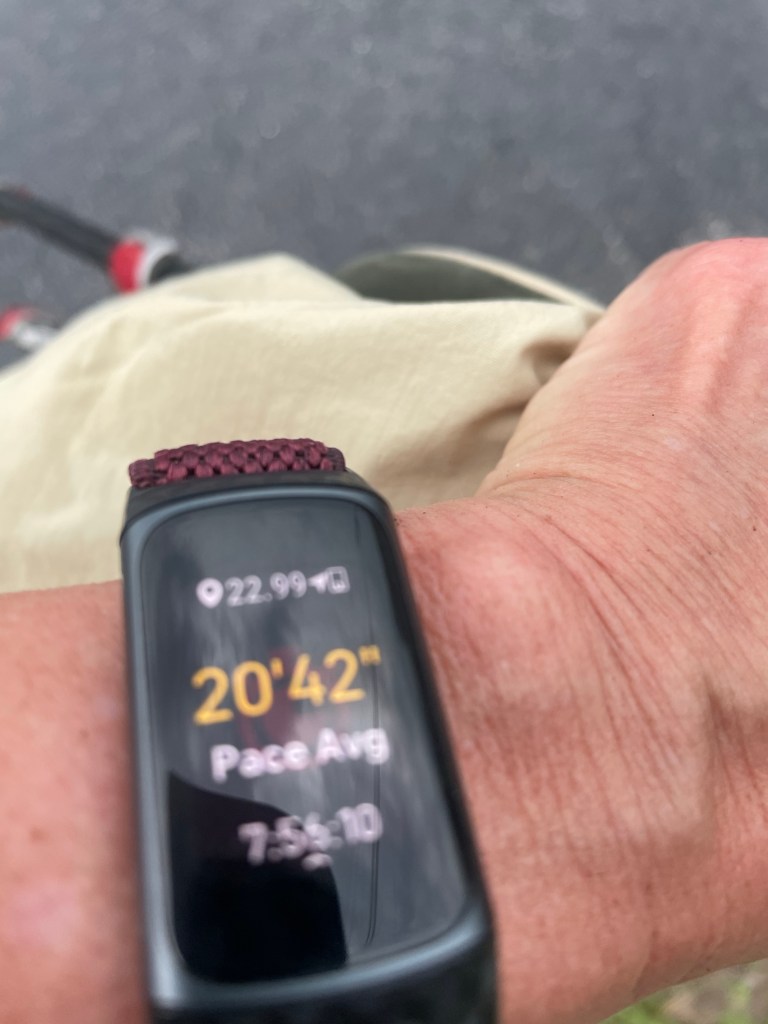
Not only that, the night before the event, the sponsors announced it was really 21 miles, and by the way, everyone with a fitness tracker was convinced it was more like 22. The last couple of miles were on an asphalt road, and it was brutal. Shin split city. Not to mention the fact the wind had whipped up, was blowing in our faces, and it was clear the heavens were about to open – which they did, about 10 minutes after I crossed the finish line.
I was going to do the entire damn thing in 8 hours if it killed me. We had met some great folks out there – PAC man and Ken (turns out PAC man and I had a friend in common) and multiple other people who were equally pleasant and fun. There was every age group, gender, body type – pretty hard to be more diverse unless you were a cellular phone ad. And everyone was pulling for everyone else.
Until next time. We could all do a lot worse than model ourselves after folks who just decide they want to walk 21 miles cooperatively with fellow hikers. Ready for the 2024 event.
They were definitely trying to hide it. We had already been driving 45 minutes or so into the development wilds that is east Orange County these days and apparently had zoomed past Clapp-Simms-Duda Road, the very small byway that allegedly was to take us to our hiking destination, the Split Oak Forest Wildlife and Environmental Area. S finally located the turn off on Google maps. Yes, we were a couple of miles beyond.
This state of affairs necessitated a u-turn in front of one of the ubiquitous chain restaurants (Olive Garden, Long Horn, Lime Mexican, you name it, it’s out there on Narcoosee Road). The Ford Explorer begrudgingly obliged, and finally, driving extremely slowly, we found a sharp, unmarked right turn that took us onto Clapp-Simms-Duda, just past a McDonalds.
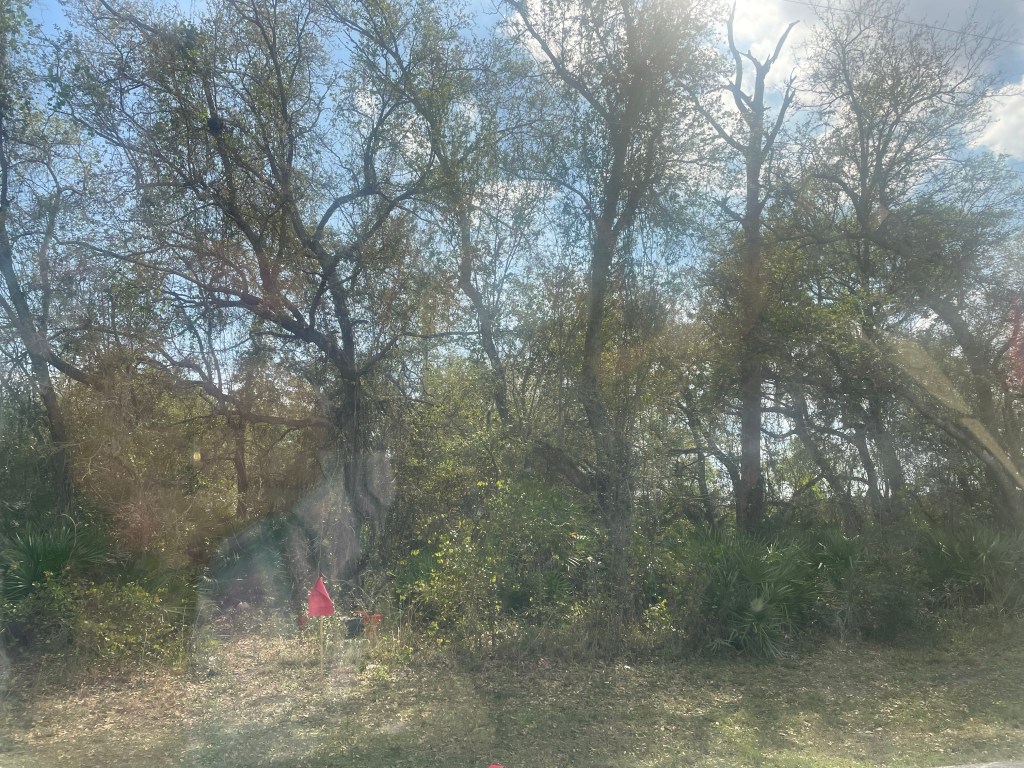
The entrance to the conservation area speaks the story of Florida. One side of the road featured huge armies of earth moving equipment, preparing to clear land for another one of the big housing developments, some of which bear an unfortunate resemblance to the Soviet era apartment complexes we saw in Russian in 2014. But turn your head to the other side of the road, and it was lined with live oak hammocks, palm trees, and Florida prairie. The armies, though, seemingly advancing inexorably into the last of the wild space.
Is that a bat house?
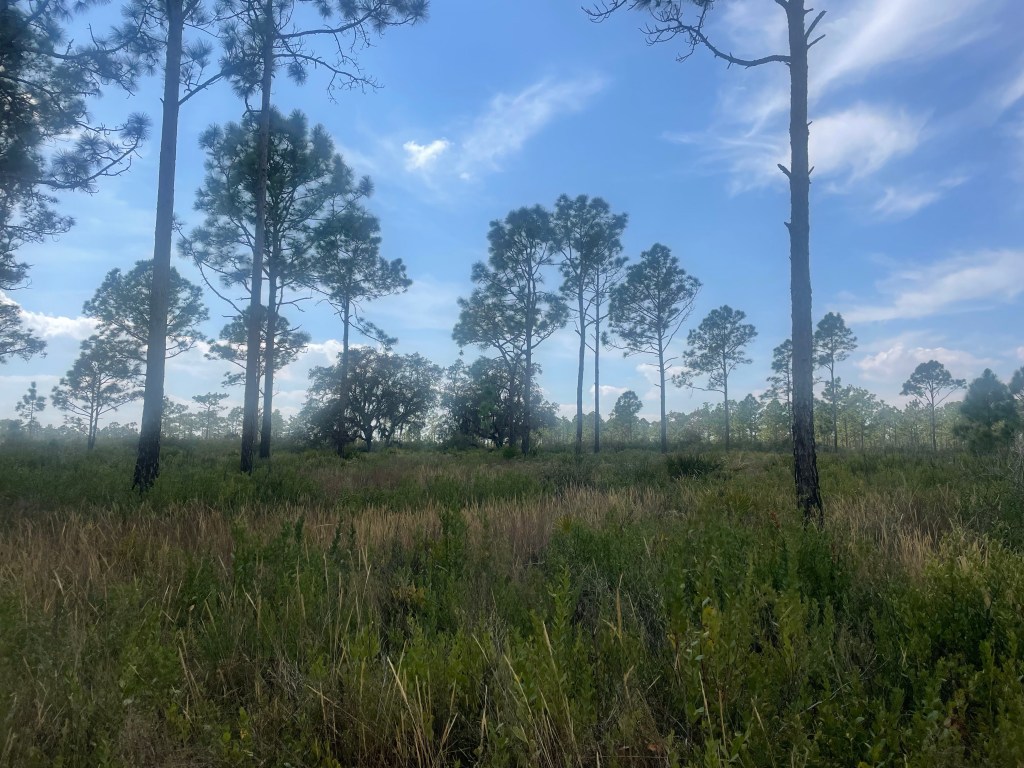
The trail itself starts across an open field, crosses into some palmetto prairies, and then continues for a few miles of very pleasant shaded walking. J, S, and I are now in serious (well, quasi-serious) training for the Marathon March on April 29, so we were undertaking this adventure with great determination. But despite our attempts to keep our pace up, the long leaf pines and peculiarly shaped oaks were a distraction. Most interesting was a trail spur leading to Lake Hart. True to the guidebook’s description, the trail simply turned into a bed of water that drained into the lake. Most trails stop at lakes, but this one appeared to go right into it.
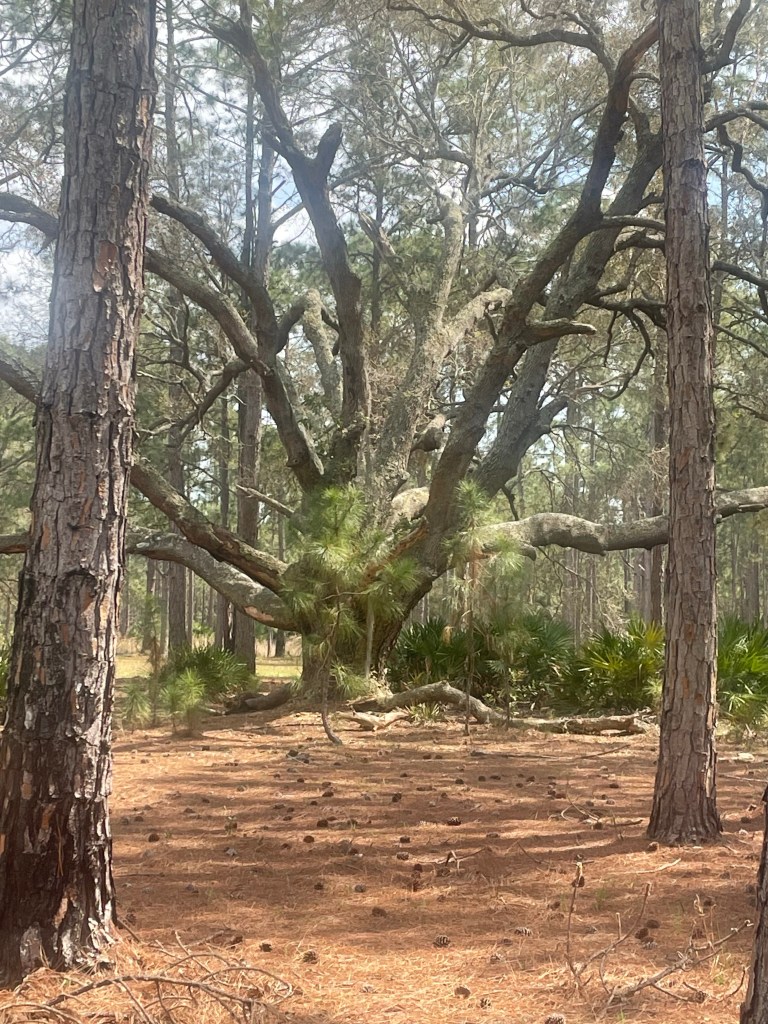
Ultimately you end up in another open meadow, where there’s a different entrance into the park. An interesting, ancient oak tree dominated the area – we decided it should serve as the namesake split oak since apparently we had missed the real thing.
But after the meadow the real training began. The trail was rutted and wide – we saw two different official Orange County vehicles that were apparently the source of the deep crevices – but the main difficulty was that the trails themselves consisted of inches deep white glistening sand. It was unseasonably warm, and the sun’s reflection added a whole different dimension to the effort of sinking down three inches only to have to pull up again.
As we got toward mile 6, the trail mercifully provided a little bit more shade, encouraging us to recall its very pleasant beginning. We reached the meadow where we’d started. Insect life was everywhere – humming, chirping, buzzing – a veritable cacophony.
Getting back on the road, it was a mere half mile to the encroaching development. The insect symphony was quickly subsumed by the drone of cars and roar of the bulldozers.
And welcome 2023! As we leave 2022 in our rear view mirror, the new year is already underway with a vengeance. And what a year this promises to be for FromSwamptoSummit and friends.
It needs to start with seriously getting back into shape – at least the sort of shape that will allow for some regular 15 mile hiking days. To that end, I’m trying to convince J, and our faithful training partners S and M to sign up for something called the Mammoth March.
It’s a serious of hikes held throughout the country – this one is 20 miles to be accomplished in 8 hours and takes place in the Charles H. Bronson State Forest here in Central Florida. We are already familiar with that location – you’ll recall we hiked there in 2020, as recounted in Lost in Florida – Staring Down Charles Bronson (a decent title if I do say so myself). While I think that speed and distance quite doable, it’s definitely going to take some practice. You can see from the below it’s not a straightforward path, and there are a fair amount of saw palmettos and other natural dangers to avoid.
J staring down Charles Bronson
Now, careful readers will have noted the teaser above and will be asking but why the need to train for 15 mile hikes. Well, because the latter half of this year will hold many opportunities for travel – J will be on sabbatical! To take this one step at a time, our plans for July have ranged from Egypt and Morocco to the Shetland Islands….and now we seem to have settled on Edinburgh, a hike through the Yorkshire Dales that includes portions of the Coast to Coast and the Pennine Way, followed by time in London, and then another hike that circumnavigates Guernsey, which is one of the Channel Islands.
The dales hike in particular has some long days, including two 15 milers. It’s time to resurrect the hiking poles and get out there. As I was running errands today I happened by what was once one of the premier malls in Orlando. It can’t even be described as being on death’s doorstep – it’s clearly crossed the threshold. Anchored now by a low end Macys, a Dillard close out store, and some sort of flooring or tile place. I don’t want to end up like that mall – it’s time for some adventure.
While not a mountaintop, I think that the dales can count as a summit and the island of Guernsey as a swamp! Of course, the below isn’t Guernsey; it’s a view of Lake George in New York, taken this past summer.
After our excessively long summit day, I slept soundly, which is not as easy as it sounds when you are overtired and sleeping on a slab of ice in a sleeping bag on an ancient thermarest pad. I’m not exaggerating- when we took the tents down we discovered that’s exactly what we were all camping on. See photo!
After more oatmeal – which I was definitely getting tired of – we reverse hiked our way back to the van, starting with the Railroad Grade. This time, instead of wearing my mountaineering boots I chose to wear my brand new Merrill’s, breaking one of the cardinal rules of hiking – don’t go a long trek in brand new boots. The downward slog caused multiple top of toe blisters and no less than five toenails paid the ultimate price.
But I digress. The real marvel of the Railroad grade, which, you will recall, is a slim reed of a trail with precipices on either side, was my mountaineering boot miracle. T had tied them to the sides of my pack, where they inelegantly protruded out in an apparently not very secured way. At the steepest and narrowest part of the trail, I could feel one fall off. I wisely thought, well that’s it, there’s no way I’m going after it – only to have said boot drop right at my feet with nary a roll to the side. With luck like that I really thought I should buy a lottery ticket.
The other odd part of our hike out was that at one point J, who was still not feeling well, managed to pull ahead of me. It had to do with a river crossing that I took my time at….while another group was well behind. For what I’m sure was a brief few minutes, although it felt longer, the trail started to look terribly unfamiliar. I called out to John to no avail, and started to convince myself I must have taken a wrong turn – not that I even recalled seeing any paths veering off. Finally, some other hikers walked by and assured me I was indeed on the way to the parking lot. I was relatively sure that there could only be one such parking lot on Mt. Baker, so that calmed my frazzled nerves.
We finally all made it back to the parking lot, in a state of bedragglement. After all, we’d been wearing the same clothes for four days, some of us had been ill, and we were all footsore. We were too late for our planned celebratory lunch, so we stopped at a Food Coop in Mount Vernon, where we had a very elegant little picnic sitting on a wall in the store parking lot under the overpass.
After surviving Seattle’s quite notable traffic we made it back to the Mountain Madness office where our little band of adventurers broke up and went our respective ways. We’d all bonded on the trip – one of the great things about mountaineering is the relationships you can form with a good group of people. And another is the relationship you form with the mountain. You don’t climb it – it lets you do so.
I had been apprehensive about putting my crampons back on. But this trip confirmed that thrill is still there. Now we just have to pick our next adventure.





































 FromSwamptoSummit