It looks a bit like I’m under house arrest and am required to wear an electronic monitoring device. A one inch band of synthetic material wrapped around my non-dominant wrist, topped with a large rectangular watch face. A few weeks ago, my firm started reimbursing everyone $100 for the cost of a Fitbit, as long as you promised to participate in one unspecified company “challenge” in a year and generally to be a healthy person. It was unclear exactly how the latter was to be implemented, but given the difficulty of enforcement, the risk of breach didn’t seem too great, and the lure of $100 quite strong.
So now a considerable number of attorneys and staff alike at my office are roaming the hallways, eyes on their devices, exchanging updates on their latest step counts. You can’t tell if they actually have a destination in mind, or are just adding to their steps. I’ll be curious to see what the correlation is between increased steps and billable hours.
As for me, I couldn’t resist splurging on the Surge. It is the top level Fitbit, and not only counts steps and floors, but also monitors heart rate, your sleep cycle, and tracks exercise, ranging from running (it has a GPS tracker) to yoga. I tried the running tracker yesterday for a four mile run and compared it to Map My Walk – they were almost identical, so it seems the accuracy is pretty good. I also loved the fact I didn’t have to run with my phone in hand as I could glance down at any point and see my pace, time and distance.
I’m about to try the Fitbit at yoga – we’ll see. I’m not quite sure what it’s going to track. Number of sun salutations? Downward dogs?
I also wore it climbing stairs the other day. Every 25 floors or so I got a cheery email from the Fitbit people awarding me a new badge. At 125 floors I received the Roller Coaster. I climbed 140, so I’m guessing I need to do 150 to see what comes next. Maybe the Big Eye?
I’ve found the Fitbit at night is a little distracting. As a restless sleeper, I have woken a couple of times with the imprint of the buckle mashed into my wrist and have had to change arms. But it’s still interesting in the morning to have information like “moved 11 times” in a two hour period.
The strangest thing about my electronic bracelet is at all times to have access to information about my own body that was previously the province only of my body and not in any way the business of my brain. But now those mysteries are revealed. You can check at any given time just exactly what makes your heart beat a little stronger. Who know the effect on the dating industry.
Narcissism? Helpful for training? Increasing the scientific understanding of your own body? Maybe a little of all the above. But, as I try to figure out the next mountain summit, I figure I can use all the help I can get.
For a variety of complicated reasons, husband J and I found ourselves this weekend at the luxurious Ponte Vedra Inn, just south of Jacksonville. Founded in 1928, the inn has the same feel as the Santa Maria Inn in Santa Maria, California – big reception room replete with model sail boats, backgammon tables, and overstuffed furniture designed to look like it’s been in some blue blooded family’s estate forever. Over the fireplace, there’s even a spooky painting of two young boys holding recently caught fish — the colors fade toward the bottom so they seem almost to be floating in some netherworld.
Spooky kids….
So with a fancy spa, a golf course, three pools and a beach with servers eager to bring iced drinks with umbrellas, where more logical to end up than on a seven mile hike by an estuary, our only travel companions a variety of biting flies, gigantic spiders, and most unwelcome of all, ticks.
I’d actually looked up the Guana Tolomato Matanzas National Estuarine Research Reserve (what a name) before we left and we’d already committed to ourselves we were going to do this hike on Saturday morning. We almost lured a couple of friends who were attending the same weekend event but at 7:15 am they thought better of it.
The first challenge was finding the darn place. One of the reviews I had read cryptically mentioned the directions in the hiking app were not correct – which we too discovered as we made our way past the opulent Ponte Vedra oceanfront homes into the reserve. Although there are three parking lots, none of them is the location of the trailheads. But persevere we did, and eventually figured out where the loop hike started. We saw a total of three other people on the trail – and then only at the very beginning. An amazingly uninhabited place — at least by humans.
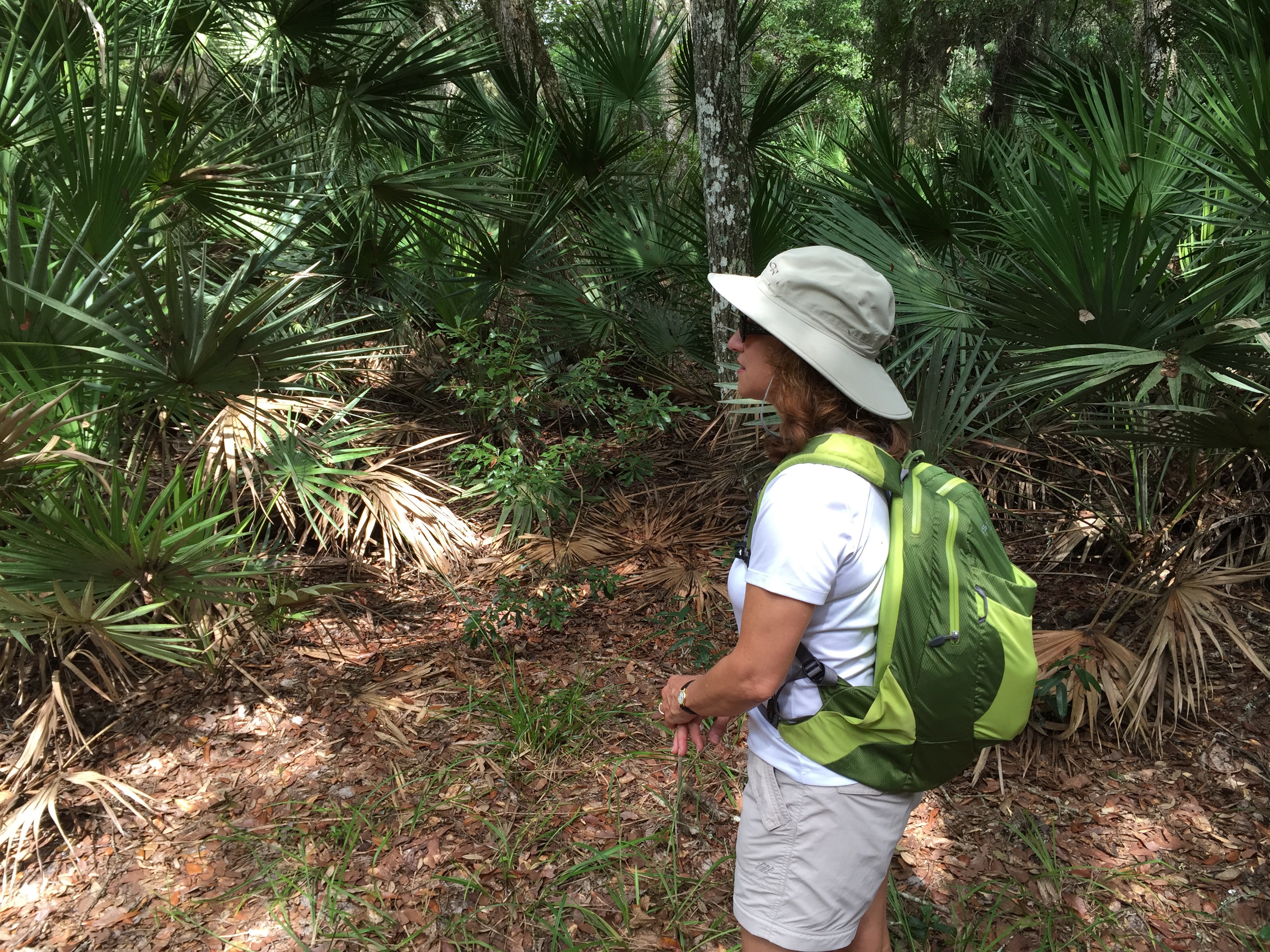
The trail starts off through classic Florida palm hammocks, framed by live oaks and swaying Spanish moss. It was beautifully shady and the temperature wasn’t bad. The shades of green ranged from neon to hunter, and the canopy over the trail made it almost as though we were walking under a pergola in a landscaped park.
We’d covered ourselves in heavy duty bug spray but at a certain point my sweaty body apparently became too much for the flies and ticks to resist and I found myself pursued by an onslaught of flying and jumping creatures. After I literally ran several yards, hiking boots and all, to escape I decided covering up was the only answer. So I dutifully zipped the bottom parts of my hiking pants onto the shorts and donned my long sleeved shirt. I may have looked a bit like one of those eccentric old ladies who wear winter clothes regardless of the season, but the heat was infinitely preferable to the attack of the flies.
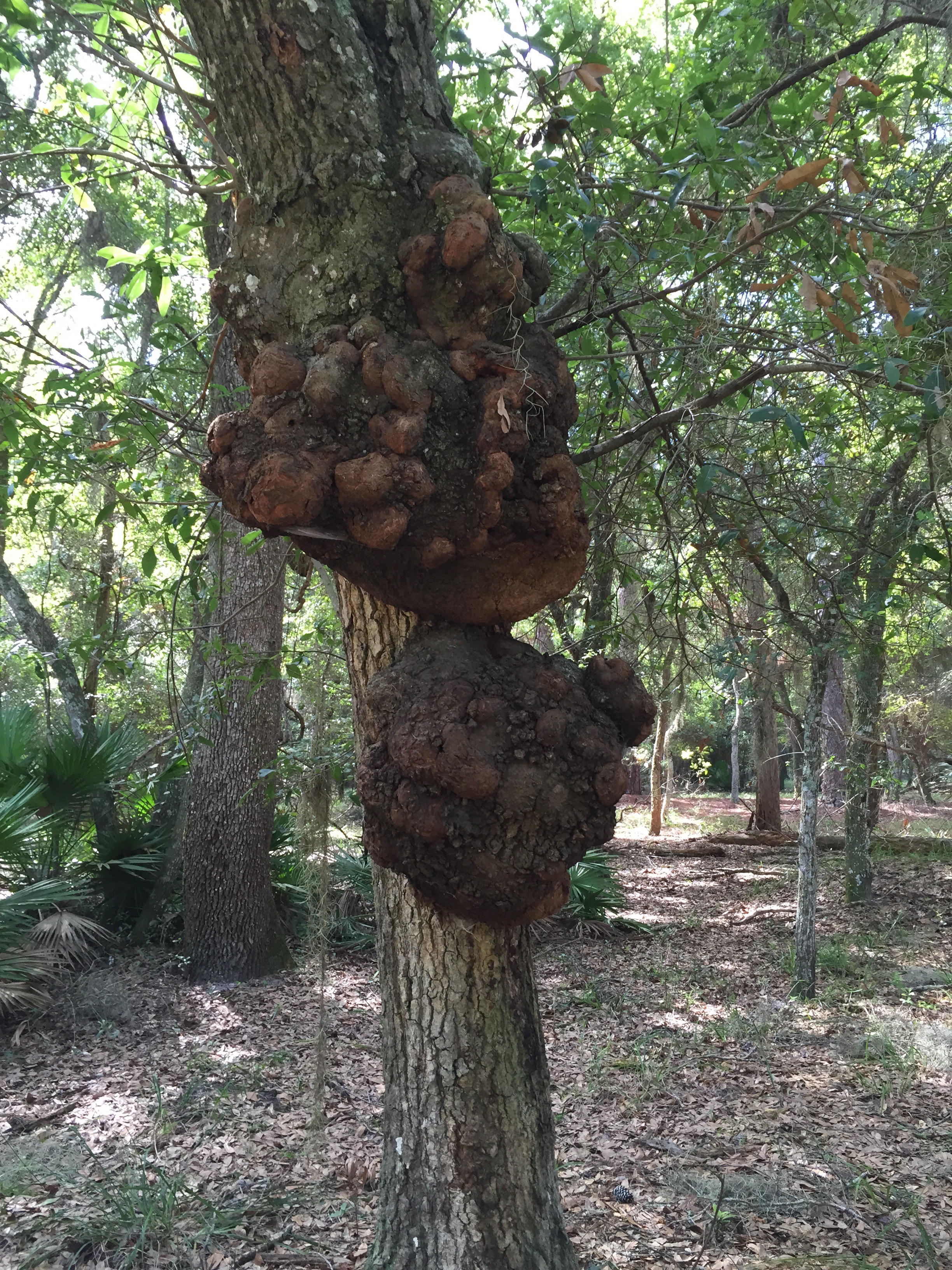
Shortly into the hike we passed a tree with two gigantic growths – if we were in Africa I would have thought they were some sort of termite mound, but here – perhaps overgrown mud dobber nests? Ideas? Photo is below.
The trail then winds its way by the edge of the river – part of the complicated intracoastal waterway system that hugs the east coast from Florida to Maine. The green of the water grasses is pale and you start to see yellow flowers, a welcome sight as summer is not the best time for flowers in the Florida woods.
Most amazing were the huge yellow and black spiders we kept seeing everywhere. Fortunately their elegantly spun webs tended to be set high between the trees, meaning even J only had a few encounters. But the spiders were about two inches in length, and seemed to be quite well fed.
After almost 7 miles there was still a further loop we could have done, but by then the insect wildlife was starting to pursue J, who had made the mistake of hiking without full body armor in his backpack. So we called it a morning and headed back to civilization.
But as I type this on my phone (my iPad having encountered yet another problem that will require a trip to, horror of horrors, the Genius Bar), and look out on the red tile roof of the resort and the sliver of ocean I can see through our window, I do keep thinking how much more I’d really prefer to be looking at the pale green of the river grasses and the deep comforting trunks of the live oaks.
We returned from Cayambe on a Monday, with one day left to eke out every last remaining bit of our Ecuador experience before we returned to hot, humid and flat Florida. Of all the various options Ossy offered, a hike up into the cloud forest in the Pichincha range, into the Yanacocha Reserve, had the most appeal. Plus, he promised hummingbirds.
Now, I’ve had a hummingbird feeder for years. I’ve heard that Florida too has hummingbirds – but each time I spy such a potential winged creature, it turns out to be one of Florida’s special species of gigantic, winged bugs. Of course, the fact I have never bothered to put hummingbird food in the feeder probably doesn’t help.
So off we took, me, husband J, Ossy, and his wife. One fact I hadn’t realized before we left the U.S. was that our trip coincided with Pope Francis’s trip to Ecuador – and specifically Quito. Multiple roads were closed and police were everywhere.
On the way out of Quito we turned on the car radio and heard the Pope saying mass as we looked down on the crowd, half a million strong, in Quito’s Bicentennial Park. A little surreal.
A sea of people at Pope Francis’ visit to Quito
The sunny weather we’d brought from Florida had definitely turned and there was a steady downpour as we drove the winding roads up to the trailhead. Once we arrived at Yanacocha we all donned raingear, and I was profoundly greatful for my absolutely waterproof wind jacket (a Marmot that dates back to 2011) and pants (also Marmlot).
After a mile or so straight uphill through the paramo – the Ecuadorian highlands, we encountered our first swarm of hummingbirds. And I use the word swarm intentionally. There were so many of them darting back and forth to feeders that you could hear their wings. They shot past our heads as if catapulted from some sort of slingshot.
Not only were there small hummingbirds, but we saw several (I think) Great Sapphirewings, one of the largest hummingbirds, about the size of a cardinal, native to Ecuador. We also saw one hummingbird with a needle like beak almost as long as his body.
After we hiked through hummingbird central, we turned a corner – and there, growing on the side, was a fully blooming orchid, exactly (well, bigger and healthier) like one I have at home.
Even though it was still pouring, we ventured up the steeper section of trail as it didn’t seem too slippery. Of course, nothing seems slippery after a glacier. Nonetheless, by this point it had started to hail, and chunks of ice were accumulating and forming small banks of snow. Ossy could have used a machete as there was a fair amount of trail breaking involved as moved further into the dense jungle of cloud forest. Flowers were everywhere, purple lupines, flame colored trumpets, white daisies growing close to the ground, all framed against a canopy of outsized leaves.
We finally reached a turnoff that would have taken us down a steep section to circle back to where we’d started – but that path did seem very muddy and by then we were all pretty well soaked. So we opted for what looked like a wider trail, despite the fact no one present had ever gone on it before. The trail exited the cloud forest and took us back into the highlands – where we continued to climb up and up and up – even though it really seemed we should be going down and down and down. There were ultimately some long switchbacks, and we passed a few people working on the roof of a tumbled down structure of some sort, so we knew that at some point we should rejoin civilization.
Just after that, we suddenly realized we were walking across a field that was surrounded by a barbed wire fence – we were apparently on the wrong side of it. After we scrambled under the barbed wire, we looked back to see a large keep out sign barricading the area we’d been blithely strolling across.
But, our faith in Ossy’s mountain guide instincts was justified. Within another mile of so we hooked up with the “main” road and ended up exiting just a little below the spot we’d parked the car.
It was still raining, and we could all squeeze puddles of water out of everything we had on. J had on his customary too many layers of shirts and was able to lend Ossy one for the drive back. Apparently it’s illegal to drive without a shirt on in Ecuador. And besides, the Pope was there so I suppose it would have been unseemly in any event.
We made a quick pit stop back at the Hacienda Rumiloma to change – and dry off. The next order of business was a trip down into Quito for Chinese food – hot and sour soup never sounded so good. The Pope’s presence and road closings seemed to have resulted in an eerily quiet city, and we were able to park directly in front of the restaurant.
Hummingbirds, orchids, Chinese food, the Pope, and crawling under barbed wire. What better ribbon for wrapping our four Ecuadorean mountains in eight days?
Checking out the route from outside the hut at Cayambe
Four mountains, including one at 19,347 feet and another at 18,996 feet, in eight days, is a lot. I knew I was in trouble when I started to cough the night before we attempted Cayambe. And how did we end up at Cayambe in the first place, you ask? You’ll recall the original plan was to follow our Cotopaxi climb (second highest peak in Ecuador) with Chimborazo, the highest peak and the point on earth closest to the sun.
Well, the worldwide rise in temperatures is affecting Chimborazo as much as the next glacier. Have you seen photos of Kilimanjaro recently? Very different than 2011 when we were there. Warm glaciers create greater risk of avalanches and rock fall (not to mention the difficulties of slushy snow). Chimborazo is also a long drive from Quito and it’s one heckuva big mountain. So, prudence being the better part of valor we decided, with guidance from Ossy, not to let the wax on our wings melt by attempting to fly too close to the sun and instead to try Cayambe, Ecuador’s third highest peak at just under 19,000 feet, as the final mountain of our Ecuador trip.
After our peak (literally) experience on Cotopaxi — even two weeks later I keep re-living it in my head — Cayambe was a logical choice. It’s just a little lower than Cotopaxi, perhaps steeper in spots (but for shorter sections), and has some rock to climb at the beginning. We had summited Cotopaxi at 9:05 am on July 3. After a rest day in Quito on July 4, we left the next morning to drive to the hut at Cayambe. Unlike the other huts at which we stayed, at Cayambe you can “drive” – if that’s the right word – right to the door of the hut.
Road to Cayambe hut – and this was the good part!
The road to Cayambe beats about any road I have ever travelled on for ruts, rocks, and steep precipices. It doesn’t resemble anything on which any self-respecting automobile should drive. We’d all learned our lesson by then about my issues with winding roads and cars, so I sat in the front. Ossy spent a lot of the time sticking his head out the side window to see exactly which snow, mud or ice covered rut would best create traction for the four wheel drive.
Eventually we made our way to the hut and checked in. For the first time during our trip we were sharing the hut with another team, a large group of nine or so climbers with four guides. All males and considerably physically larger than I. As we settled in at a table in the main room we traded stories about what we’d been climbing – and I must say it was 100% satisfying to say “yes” when they asked if we’d summited Cotopaxi, which they hadn’t yet attempted, and to be met with some very bemused looks. For a five foot, one and one-half inch woman (that half inch is very important), I felt a certain instant credibility. As Ossy said though, the pressure on all those guys to summit Cotopaxi had just increased immeasurably!
But Cayambe was the summit that was not to be. I still had not completely recovered from whatever stomach issues had so gravely affected me the night after we climbed Illiniza Norte and had also developed a nagging cough. Plus I think I was still generally burned out from Cotopaxi. I had put my heart and soul into that climb, and I couldn’t help but regard Cayambe as a latecomer to the party.
We followed a similar routine – packed for the next day, went out and looked at the route we’d be taking, ate soup and something sweet, and were in our bunkbeds by 6:30. I slept a couple of hours and we were up at 11:30 – this time with other climbers also packing up and getting ready to go. It did change the serenity of the moment. But, as the only woman, I got to have the entire women’s bathroom all to myself!
The night was spectacular; the moon had waned only a bit and there was scarcely any wind. But the downside of all that was that it was quite warm – in fact, we all wore a layer less than we’d originally planned. And the snow was soft, meaning that once we were on the glacier we were sinking in and exerting a lot more energy than desired. Once we had scaled the rock area – which I had spent way too much time worrying about because it wasn’t that hard – we had to traverse through a scree and rock field and finally reached the glacier, where we could put our crampons on.
But as we roped up and took off I just couldn’t attain the same sort of steady rhythm that I’d been able to manage on Cotopaxi. Although at one point we were among the highest teams I made the mistake of looking up and seeing how incredibly steep and seemingly never ending the slopes above me were, and let myself get distracted by what the other climbers on the mountain were doing. All of which added up to a point where I was feeling dizzy and our pace simply was not what it needed to be if we were to summit early enough to avoid the risk of avalanche as the mountain heated up during the day.
Dawn breaking over Cayambe – photo by Oswaldo Freire
Just then, one of the other teams that had passed us turned around after reaching a ridge line about 400 meters from the summit. We decided to go to the same point and then head back down. It turned out two other teams did make the summit but it took them 8 or so hours – an hour and a half longer than usual, due to the hard climbing conditions.
Our descent went well, even though the scree field we were hoping to slide down instead of rock climb was covered with snow. That meant we had to turn around and walk back up an area we had just hiked down – possibly the most dispiriting moment of the whole climb. But I did well on the rock climbing on the way down, no ropes needed.
Descent down Cayambe – photo by Oswaldo Freire
And on the way down we were treated to a rainbow. Clearly a promise of future summits. Cayambe is still calling to me. I think we’ll be back.
The wind shifted. I’ve always known the wind is important. After all, Mary Poppins arrived with the east wind, and there’s an old saying that if you make a face when the wind changes your face will get stuck that way. But I’d never really experienced just how important a shift in the wind could be until we were right at the lip of the Cotopaxi crater, just below the summit.
After climbing Illiniza Norte, we spent the night at the Hacienda Chilcabamba. I went to bed at 6:30 and slept for about 12 hours – unable to face anything for dinner. I felt about a hundred times better the next day, and we had an easy morning at the hacienda, followed by a large lunch. J and I had a little thatched cottage all to ourselves, with two bedrooms and a sitting area, heated by a wood stove.
Hacienda Chilcabamba
We left in early afternoon to drive to the parking lot for the Cotopaxi hut. This time I sat in the front seat to avoid the gastrointestinal dangers associated with the curving cobbled stone roads. From the parking lot we strapped on our backpacks, which contained only what we needed at the hut and for our summit attempt. We were already wearing our base layers, to minimize having to change. The walk up to the hut is about 45 minutes on a steep dirt road – we reached the top, only for Ossy to realize he’d left his phone in the car and had to go down to get it!
The Cotopaxi hut was redone only a few months ago, and although nicely varnished and with new mattresses, it’s really cold and the roof makes an incredible array of noises in the whistling wind. While the Illiniza Norte roof clanged and sounded as though it might blow off, this roof variably screamed, whistled, hooted and howled. Despite all that, after we’d had bowls of quinoa soup, followed by figs, cheese and sweet biscuits, we still managed to sleep a few hours.
Bedroom at the hut at Cotopaxi
We were supposed to awaken at 11:30 pm but slept through the alarm and ended up getting up at midnight. Just as on Illiniza Norte, we were the only people in the hut. And we soon found out there were only two other climbers on the entire mountain, besides us.
We stuffed some food into ourselves and started climbing about 1 am. The first part is a 45 minute walk up a relatively steep scree field. Once at the top, you’re on the glacier, which meant it was time to rope up and put on crampons.
The old “normal” route has been closed for 2 or 3 years after a climber was killed on it – too many crevasses. Instead you now use the Rompe Corazones – the heartbreaker. There’s an extremely long 2 plus hour stretch that simply goes up without any sort of break. And it’s a killer. I was trying hard to stay hydrated, so each hour when we stopped, the routine was water, a handful of trail mix, and more water. As we gained altitude, the trail mix became GU, and Ossy was literally tearing the top of the packages and holding them as I sucked the sticky sweet electrolytes out.
We climbed up one sheer icy patch where we had to use the front points of our crampons – as if we were scaling a vertical wall. Much of the trek up was simple side by side steps, but even there I kept finding my crampons pointing too far uphill, and I quickly realized how much I had to learn in the way of technique.
Sea of Penitentes
At one point you traverse a sea of Penitentes – formed by the wind, they are peculiar to the Andes in the summer months. Sometimes they are upright, but these were bent by the wind. They look like a field of praying hands, fingers outstretched in supplication. You can walk between or on them, and if on, each step sounds as though you are stepping on a brittle twig – or finger.
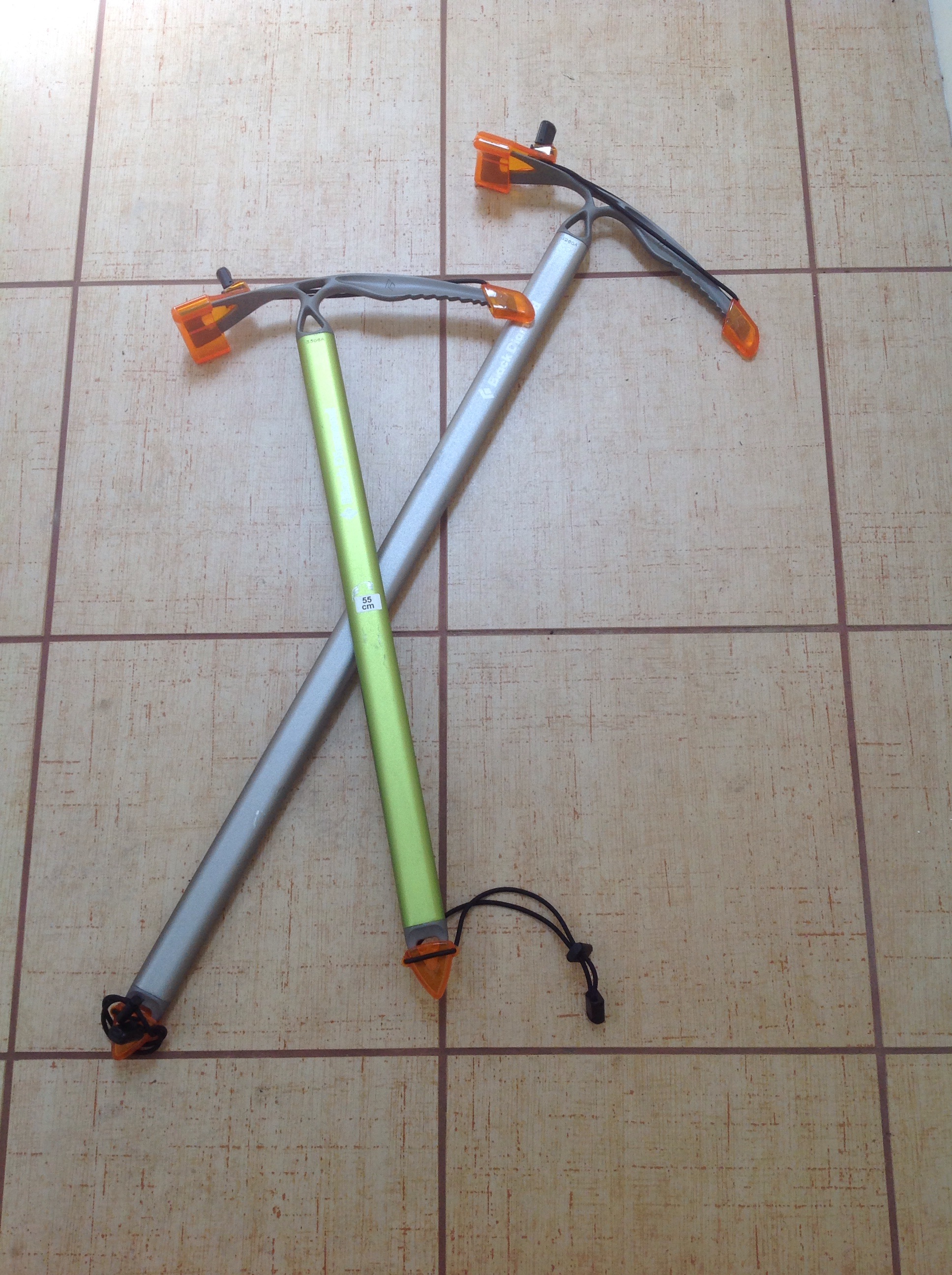
The very last bit of Cotopaxi is steep, steep, steep. As we had to do in a couple of prior areas, we used the picks of our ice axes overhand to dig in and help pull ourselves up (normally you’re using your ice axe in your uphill hand like a very sharp ski pole or walking stick).
But just before we reached that point, we saw the only other two climbers on the mountain turn around, apparently overwhelmed by the sulphur fumes spewing out of the crater. You may recall I mentioned that starting in May or so Cotopaxi had reactivated. It is “degassing” (lovely word) and literally tons of fumes are forming into thick heavy clouds over the crater – which is just below the summit.
Despite the retreat of the other climbers, we kept on going. Although the mountain administered a pretty strong dose of sulphur to us – Ossy and J in their throats and me in my eyes – just at that point….the wind shifted. I heard Ossy say that we might have a window and I kept slogging up the close to vertical slope.
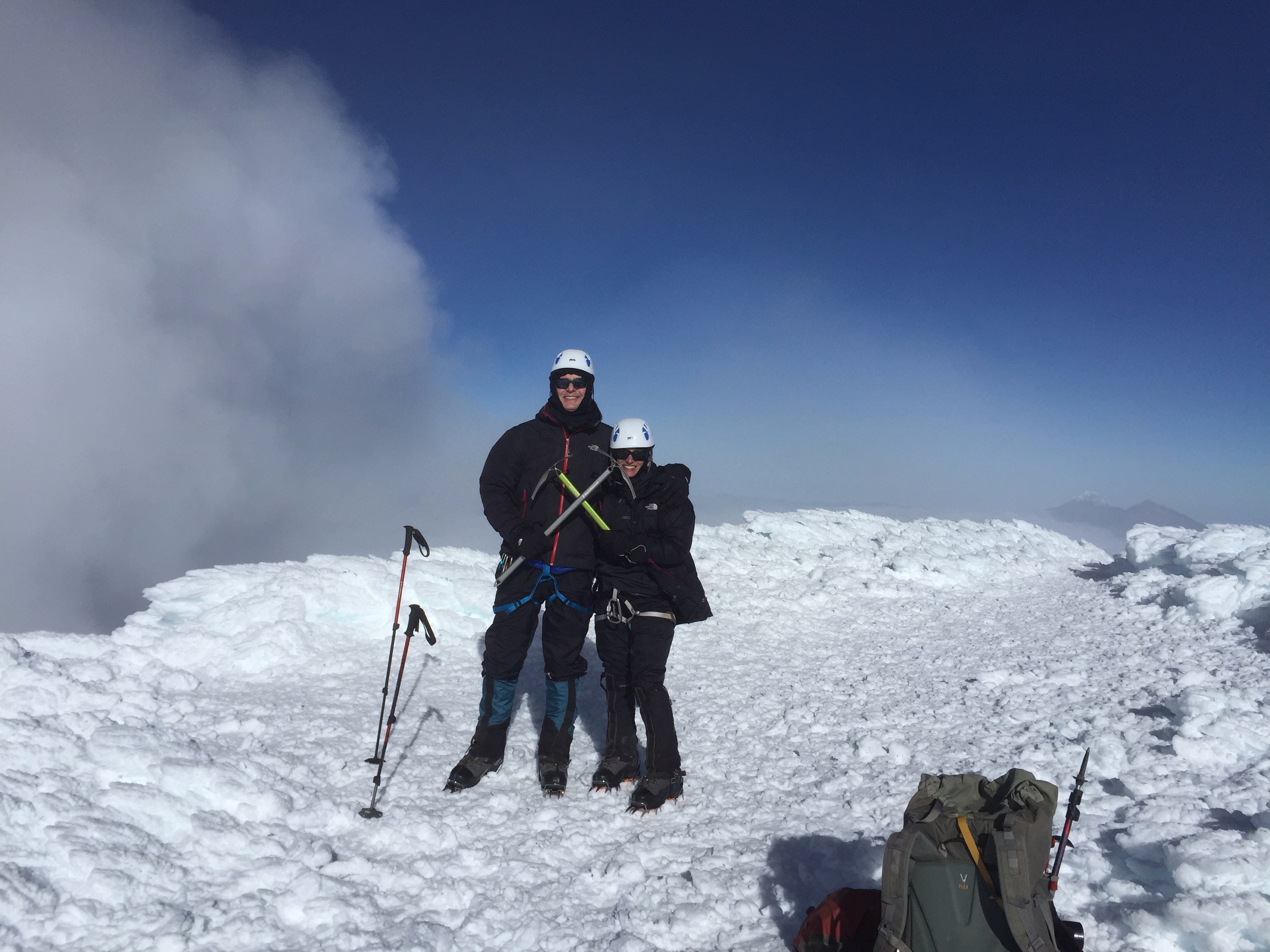
Suddenly I was on a flat area – but surely I couldn’t be there. I was positive there must be another 15 or more minutes of sheer physical and mental pushing left and this was just a fake….but no, I was actually at the summit. There wasn’t anywhere else up to go. I’d seen people on YouTube videos throw themselves down on the ground when they finally arrived, and without even thinking, that’s just what I did too.
Cotopaxi Summit – sulphur cloud in background
We couldn’t stay on the summit for long – just in case the wind shifted again and the crater drenched us with another load of sulphur.
Our descent was noneventful, which is about the best that can be said about descents. We kept up a pretty good pace, with J on the front of the rope, me in the middle, and Ossy bringing up the rear in order to arrest whoever might fall.
It turned out we made it up in 6 hours and 50 minutes, well within the range of normal, and down in 3 hours – also what Ossy wanted us to do.
Once back at the hut the reality of what we had just accomplished finally sank in. All those stairs; all those hot and sweaty runs. The culmination of all of it was that confluence of ice and snow and blue sky. A perfect summit.
Some of you may remember that one reason we ended up in Ecuador instead of the Grand Teton was our conclusion that we preferred mountaineering to rock climbing. (See “Cotopaxi, Ecuador – 180 Degree Turns.”) So it was somewhat inexplicable that I nonetheless found myself on July 1 hanging on for dear life to an ice encrusted basalt wall with my left hand, ski pole in my right and nothing but an almost vertical drop of rocks below. Oh, and this was at about 16,000 feet. And did I mention no ropes?
Illiniza Norte is one of the two Illiniza peaks (the other, obviously, is Sud), and is a common acclimatization hike in preparation for Cotopaxi. It reaches about 16,500 feet, and is the taller of the two forked peaks in the right in the photo. Its sister peak, on the left, is much more technical and is covered in snow.
The Illiniza Peaks
It was about a three hour hike to the mountain hut where we were to stay for our ascent of Illiniza Norte so we left in early morning. After fighting through Quito traffic, we followed modern highways for a while until we abruptly turned off to cobble stone roads, still in the same condition as in the 1940s when Ossy thought they were originally built. Jaw breaking and winding is an understatement. More on that later. We passed through several small villages, stopping at one to drop off things we wouldn’t need on the hike. Once we parked the car near the trailhead, we met up with the two men who took our supplies up to the hut on horses. Each day the horses plod up to the hut with full loads and bring trash back. Despite the routine, they seem quite content with their rather proletariat role in life.
The mountain hut is primitive – but there are flushing toilets, even if you do have to go outside to get to them. There’s a series of about four bunk beds, going up to a triple level, a small eating area and a tiny kitchen. No electricity. We were the only people there, and, in fact, the only climbers on the mountain the next day. That night we were treated to a spectacular sunset with a full moon. The entire Avenue of Volcanoes was visible, including the white capped isosceles triangle of Cotopaxi.
We got up at 5 for an early morning departure. The weather cleared as we hiked. There was more snow than normal, and many of the rocks were encrusted with icicles. I was glad of my climbing helmet since I hit my head several times on wide swathes of ice sticking out from the rocks I was trying to hold on to.
There are several sections of rock, the most difficult probably the one right below the summit. We climbed up through a chimney, along exposed ledges – and all without ropes. Ossy very carefully instructed where to place hands and feet and how to balance – and ultimately we did make it to the summit which is marked by a metal cross. But that wasn’t before a bowling ball sized rock hurtled down from the top in J’s general direction, followed by a smaller one in his more specific direction. Fortunately, no injuries. We now know the best way to react to rockfall (besides not experiencing it in the first place!) is to make yourself as small as possible. Sort of an airline crash position.
Summit of Illiniza Norte – that’s the summit cross that appears to be sticking out of my head
Coming down was exhausting and Ossy roped me in after I slipped twice. I think I’d burned up a lot of nervous energy on the ascent – not to mention physical. And we not only had to descend and get back to the hut – there was still the three hour hike back to the parking lot ahead of us, and then a couple of hours to drive to our next stop, the Hacienda Chilcabamba, outside Cotopaxi National Park.
For someone who actually froze on the stairs of the Eiffel Tower and who still has recurring dreams about being stuck on the old swinging bridge on Grandfather Mountain in North Carolina, reaching this summit was huge. But it also reminded me that figuring out how to get down from summits is just as important as going up them.
On June 29, 2015, at 8:15 am, J, I and our guide, Ossy, left the Hacienda Rumiloma on the outskirts of Quito for Rucu Pichincha. Reminiscent of Mt. Elbrus, you travel up the first section by way of gondola. The gondola was constructed in 2005 as part of an ambitious amusement park, restaurant and hotel complex that failed not long after it opened. The gondola is all that really survived and it’s a bit depressing to see the closed shop fronts below.
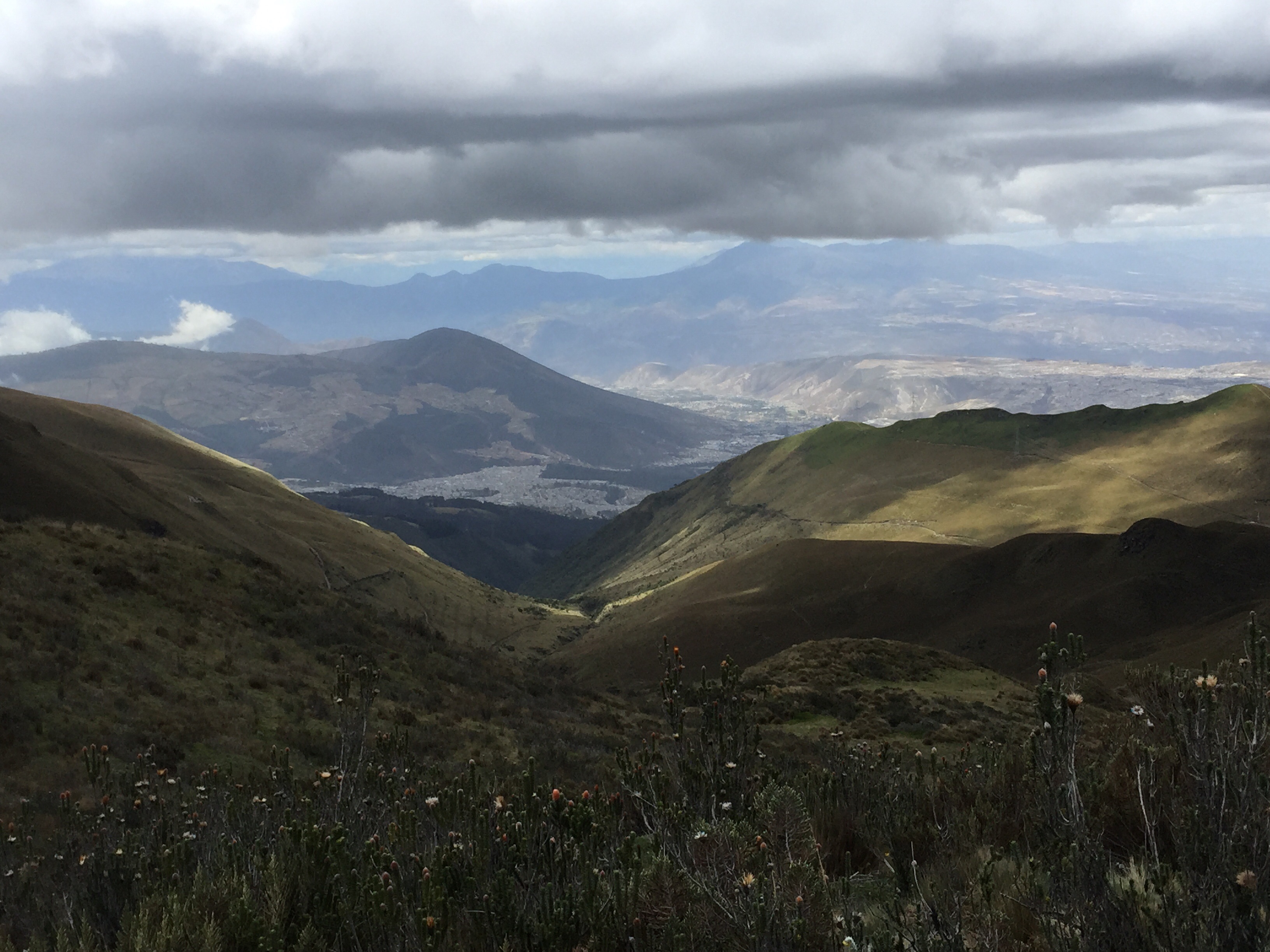
Mountain hikes here start in the paramo – the Ecuadorian highlands. Wild flowers abound – white and yellow daisies that grow flat to the ground, violets, red bell shaped flowers, yellow blooms on bushy shrubs about waist high. Parts of the hike were like walking on a carpet of flowers.
As we neared the summit, there was some class 4 and 5 scrambling – using your hands as you scale the tumbled down rocks. The summit was spectacular. I never feel as totally in the present as on a summit.
J and Ossy on the summit of Rucu Pichincha
Going down was fun. We learned to down climb – facing the rocks, youbcontinuously look down for your next step, as though you’re on a ladder. It was surprisingly similar to the backward stair climbing I had practiced so diligently as part of my training. (I tried to do that part in flights I knew I was the least likely to encounter other people.) The rest of the trail down was runnable – that fantastic feeling of flying where you gather just enough momentum to take you up the next uphill bit.
Of note, as we neared the parking lot we ran into the Climbing 4 My Donor group from the UK – a group of heart- lung transplant patients whose Twitter feed I had been following. So impressive. They had just climbed Rucu, were planning on Ilianza Norte and were substituting Cayambe for Cotopaxi due to the level of sulphur.
We spent another night at Rumiloma and then it was off to Illiniza Norte – our experiences in climbing up Class 5 rock without ropes, the rock that almost hit J and our first mountain hut to be posted shortly. As a preview – sunset from the hut at Illiniza Norte.
Writing from the Hacienda Rumiloma in Quito, where one of the resident peacocks has just perched outside our window. We are in a beautiful large room, filled with antiques and a bathroom with an elaborately tiled sunken tub and a view into the cloud forest. The property on which the hacienda is located has been in our guide’s family for a hundred years. It’s minutes outside of Quito – up tremendously steep hills that are lined with apartments, bodegas, small restaurants and many people, all outside enjoying a beautiful day.
The hacienda is at almost 11,000 feet and we could feel the altitude last night when we arrived after dark. The airport is about an hour from Quito – despite the pilot’s dire warnings of turbulence the descent wasn’t too bad. But it was a bit disconcerting to land looking up at the sides of the mountains.
Today we spent touring the old city of Quito. We started with the Virgin of Quito – an enormous winged Virgin Mary, who is stepping on a serpent, a gift from Spain in 1946.
From there we wandered with our guide, Ossie, through various squares and side streets, and once mass had ended visited the gold encrusted Iglesias de la Campana de Jesus. It’s a baroque-style church, every inch of which is covered by carvings with 18 karat gilt pressed into their surface. The ornamentation is so geometric that were it not for chapels dedicated to multiple saints lining the sides you could almost be in a mosque.
We had lunch at an Ecuadorian restaurant, lots of corn, potatoes, pork, with Ossie and his charming wife and one of his teenaged daughters (who will be in Boston soon on summer science scholarship) – and enjoyed hearing their stories of a six month stay in the deep Amazon jungle.
Then it was off to the Equator line that divides the northern and southern Hemispheres. Funny how until then it never occurred to me that Ecuador is so named because of the equator.
We’ve just returned to the hotel and Ossie checked out equipment. We mostly passed. Tomorrow will be our first acclimatization climb. Instead of Gua Gua Pichincha, due to wind patterns we will be climbing Rucu Pichincha (means shiny). It’s about 15,696 feet high and should be a six hour round trip.
So the climbs are about to begin. Right now they are filming a movie or doing some sort of photo shoot outside my window. There’s a yellow VW bus, sunflowers on the dashboard, decorated with “just married” regalia. A bride and groom are sitting atop the van. Not sure what it all signifies, but it has to be a good omen!
Florida has treated us to some spectacular lightning strikes the last few days – cloud to earth vertical forks so brilliant I was actually blinded when driving on I-4 the other day. I’m hoping they aren’t a portent for our upcoming trip to Ecuador’s Avenue of Volcanoes. It is true that Cotopaxi, which is the highest active volcano in the world, has started to show signs of activity. While I have read that an eruption is not considered imminent, the mountain is degassing, letting off five times the normal amount of sulphur. So, we can add that to the obstacles we’ll have to contend with. I suppose there’s a chance that the mountain could be dicey enough that it is closed to climbers – but there are plenty of other mountains in Ecuador – not to mention the highest peak, Chimborazo, which we are already scheduled to climb. And at least it is a dead volcano.
So when I’m not scouring the Internet with search terms like “latest volcanic activity on Cotopaxi,” husband J and I are in the throes of last minute gear assembly and packing for Saturday’s departure on Copa Air. Our to do list includes items such as “cut 60 feet of rope into two 30 feet lengths,” buy GUs (for me) and those square gel energy things (for J), and “locate long underwear” (it’s amazing how things can get lost in a not particularly large house).
I have also reached that blessed moment where I feel I can finally taper back on the training. I had my “PR” – to use a term of all you Crossfit people out there – on the stairs last week, 9 times up and down the building with a 25 pound pack. I may do more stairs but without the weight, as the pack is soon to be filled with climbing gear. And any really long runs are coming to an end just in time – because I’ve discovered that running in 90 degree heat and 90 percent humidity is no fun and certainly does nothing good for your splits (times for each mile).
As these months of training draw to a close and the days of packing ensue – all I can hope is we’ve done what it will take. And equally important pray that the volcano and mountain gods will look kindly upon these poor mortals as they venture up.
It began yesterday. For those of you who are regular readers of this blog, I’m pretty sure I recounted our August 2012 climb up Mauna Kea, which only occurred because husband J managed to contract one of the few cases of out of season flu in the state of Hawaii, thus putting the kabosh on our plan to backpack the Mulawai trail. I didn’t think something like that could possibly happen again. But yesterday, J announced to me that for a week he’s seen cobwebby things in his left eye, initially accompanied by a flash of light. Now, the only time I’ve heard of “floaters” (J keeps calling them floaties, like the water wings your kids wear when they’re four years old) involves detached retinas, laser surgery and possible blindness.
So, rather than google “floaters,” we – of course – researched retinal detachment, only to discover the surgical repair involved a healing period that would greatly cut into our 13 days from now departure for Ecuador and the Andes. Apparently high altitude is not considered an optimum recovery spot for eye surgery.
In any event, a “quick” visit to our local optometrist today, together with full pupil dilation and photographs of the eyeball innards, reassured all concerned that these floaters were nothing more than part of the normal aging process for people in their fifties. I keep asking why no one has given us an instruction manual. We’re highly aware of the normal wear and tear on the body, but floaters? Really?
While all this was transpiring, I was facing my own Private Idaho – we have long had a pact that if one of us can’t make it up a mountain the other goes forward. And that I would have done – but the idea of scaling Cotopaxi and maybe Chimborazo with just me and a guide was definitely going to push that pact to its furthest limit. I lay awake last night thinking of the worst case scenarios – just to get my mind in gear to accept that it could conceivably be me versus the mountain. I would have done it – but it wouldn’t be optimum.
Yesterday I did a seven mile run in unbelievable heat and humidity. Now I know many of you run further, but believe me, it’s hard when it’s in the 90s at 9 am with an equal percentage of humidity. At one point I realized my shoelace was progressively getting looser and I could feel it flapping on the ground as I ran.
You know what? I actually stopped; paused my Map My Run app; and tied the damn shoelace. All the running in the world isn’t going to do me much good if I trip and break my ankle two weeks before departure.
It’s coming soon now. Please send some good karmic vibes our way.












 FromSwamptoSummit