Shifting Gears – A New Year and A Gear Check: Orizaba Here We Come

image

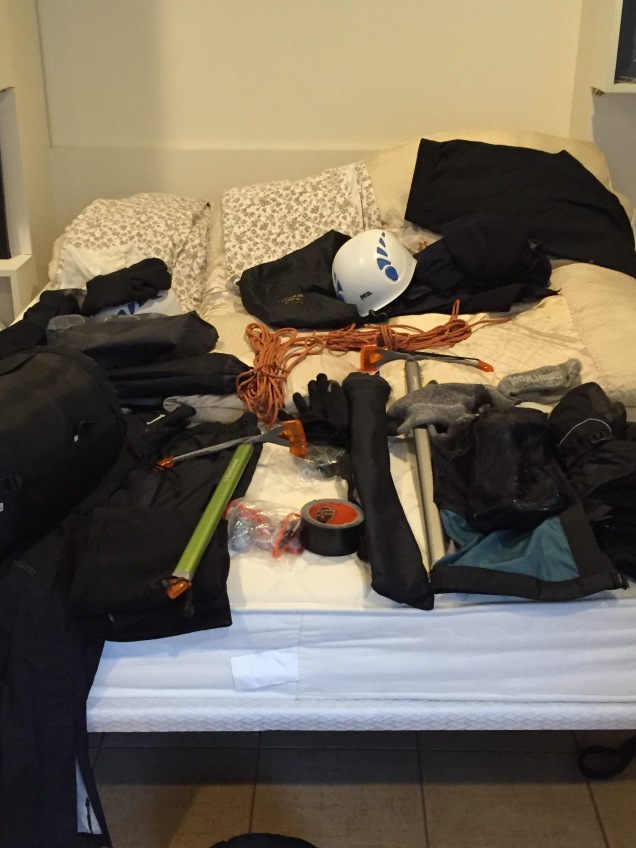
So we leave in two days and I’ve managed to do an unbelievably good job of procrastination with the gear check. It started off as – oh, we did this six months ago, how much more can there be to do – to, well, maybe I need to go to Trak Shack and by more gu’s tomorrow because I’m down to five.

But procrastination – i.e., let’s do anything besides the gear check – enabled me to do just a tiny bit of work this morning to welcome in the new year in appropriate lawyer like fashion. It also helped me take down all the Christmas decorations, mop the kitchen floor, communicate with daughters A and S, and go for one last leisurely walk with pack on. Oh, and there was time for the martini on the porch while watching the sunset.

But while on the porch, I did find myself black thread and needle in hand as I mended my Thermasilk glove liners, which clearly could not be replaced within the next 24 hours of globally warmed Florida. Just before sundowner hour we did venture into our guest room, which is where we do gear assembly, to start the preliminary review. What I hadn’t realized about a gear check after having climbed a number of mountains is that you wear out your equipment. As I pulled out the glove liners and saw each index finger was completely ripped, I suddenly recalled that I’d climbed Illiniza Norte in Ecuador with only my liners – they kept my fingers warm but I could feel the rock, unlike my heavily lined gloves or my even heavier mittens. (But I was very happy to have those mittens on Cotopaxi when I realized my fingers were going numb.)

There’s still an overwhelming amount of stuff to go through in what used to be called the guest room. And only 72 (or is it 48) hours to sort it out.  Are the lithium batteries still good? Is there a leak in my Thermorest pad and does it really make a difference anyway? And will gorilla tape actually work to repair our very ripped up duffel bags?
Any answers to these questions or other tips for climbing Orizaba are more than welcome!

I’m excited. Next post – from Mexico, at altitude.
Topsy Turvy Days of Christmas

image

Anticipation.

That’s a watch word of the holidays. And as true this year as any other. But this year the beacon of Pico de Orizaba is looming ahead of us – our first January climb – and the first time we’ve climbed a big mountain only six months after another (Cotopaxi).

The path to the summit has been anything but straight this last few weeks. It’s been a bit like one of the children’s fairy tales I used to read where the young girl and boy suddenly find themselves in upside down land.

We’ve gone from the perils of party giving (only a few broken wine glasses) to the hurrahs of house guests. I’ve turned my normal cooking routine into a small scale catering operation. And we’ve had and are having a round of visits from both daughters 1 and 2 (now known as A and S), and boyfriends N and P, respectively, not to mention my parents and uncle.

In the midst of it all I keep thinking that in a week we are off to Mexico. And in another ten days or so we will be wending our way up 18,500 feet. I checked the weather and it actually doesn’t look too cold. Probably good, given that we are now acclimatized to 85 degree Orlando Christmases. I celebrated Boxing Day today by deciding to run a 5K in intervals. I probably should have started this particular training endeavor more than a week before the trip. Interesting – even with eight minute runs followed by a walk my times were the same or quicker than my regular long distance training runs. I’m just hoping a little of this will give me that final push that I need for the inevitably and always incredibly steep push up to the crater rim.

Christmas and family and friends. There’s a never ending flow of shared memories. But new ones are created each holiday. Like a river picking up flotsam and jetsam – they form new land – a big muddled complicated island somewhere near the ocean. I wouldn’t change a thing.

Holiday Mountain Part 2


image

Last year at this time, I wrote a post called  “journey up holiday mountain,” not anticipating there’d be a part two. Yet, here I am. And not just at a part two of a blog – a fairly innocuous activity -but also just over 30 days before our next attempt to scale an 18,000 foot moutain. Some may wonder why I do this. Oh, and did I mention that in addition to an extremely busy work schedule I am giving a party for probably close to 100 people next weekend and I am apparently inherently incapable of using a caterer? Somehow I feel it doesn’t count if you (and Costco) haven’t made all the food yourself. Sometimes I feel if you didn’t have to sleep life would be much easier.

No mind. Each time we are preparing for a high altitude climb I feel I must hike at least a few miles in my mountaineering boots just so I remember what they feel like. Today was that day. Just a three mile walk back from the Y following yoga – the day, hot, steamy and sticky. Anyone want to question global warming who lives in Florida? And, as readers of his blog know, I observe coincidences. Last time I did this walk with mountaineering boots, I slipped on the sidewalk, fell,  and cracked my iPhone screen. Today, exiting the Y, the phone slipped from my hand and I did the same thing. At least I had a screen guard and I might be able to glean a few more months of use out of it.

I think that cracked screen is a reminder – we do occasionally need put our iPhones down and just enjoy some of the bright lights around us. Happy Holidays, y’all!

What It Is Like To Start A High Altitude Climb

image
Cotopaxi sunrise

This week I’d planned to write a warm, witty post that would be a detour from swamps and summits and instead would celebrate the fifteenth birthdays of my two West Highland white terriers. Entitled “A Dog’s Life” or some such similar name.

But life overwhelmed, and as I find myself on an evening flight to Cleveland, yes, Cleveland, looking down on the ribbons of light that carve up the great American Midwest, and in the midst of December’s party giving and party going, the present purchasing, and the travails of travel logistics….such plans fell by the wayside.

Instead, I find myself focused completely on the seven days that J and I will have in just four weeks as we take our sea level lungs back up into the clouds, and, I hope, reach the great height of 18,491 feet at the summit of Pico de Orizaba.

In the midst of the December chaos, it’s the anticipation of the complete silence that surrounds you when you start a high altitude climb that’s serving as my reality check. It’s a world unto itself. It’s the period between sentences.

You rise at 1 a.m. or so, struggle into whatever layers you didn’t sleep in, clamber into your climbing harness, and strap on your helmet. You eat as much breakfast as you can force down at that godforsaken time, and hope that instant coffee will have enough caffeine to keep you going. Everyone is always tense. The guides are making quick forays outside the hut to check on conditions and temperature. No one knows exactly what either the mountain or your own body has in store for you.

Finally, hoping you’ve wasted only an hour or so, gear assembled and backpacks on, you venture out into what you hope to be a clear black night. The stars are as sharp as the lights of a laser pointer. If you’re lucky, there’s no wind. Ahead of you is the white glacier and the steep slope up. Eventually it’s time to rope up. It’s still totally silent and you don’t talk except for necessary instruction. You’re high above the clouds and your heart is pumping at a speed it never would normally. But you find a rhythm in the deep silence and time stands still. Minutes pass and you’re surprised when it’s time for the every hour break.

That feeling isn’t always with you on the mountain. Lots of times, and especially as the summit draws closer and you’re at the increasingly vertical slope leading up to a summit ridge, the rhythm goes, and it’s just kick and step and plant ice axe with every muscle of your body calling out loudly. Silent, that’s not.

But much as I love the summit, I treasure those quiet moments in the dark at the beginning.  There’s nothing to do but to climb, one foot in front of another, knowing that sunrise is waiting.

Where We Are Going Next – Pico de Orizaba, Veracruz, Mexico

image
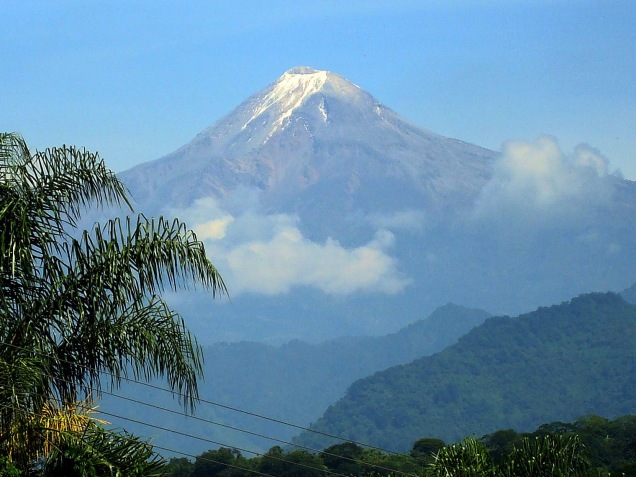
Photo – http://www.sil.org/~tuggyd/Pix – Pico de Orizaba

Over the last few months I’ve been publishing posts that refer to Pico de Orizaba, our next climbing destination, as though it’s a location at the forefront of everyone’s personal geography. That certainly can’t be the case – this particular mountain wasn’t close to the forefront of my mind until we started to try to find a big mountain that could be climbed in winter and in under seven days. When you live in Florida, the choices are limited.

So after looking at our options, we settled on the Orizaba Express trip, again through Mountain  Madness, the company that has successfully and safely led us up Mt. Elbrus in Russia and Cotopaxi, Illiniza Norte and Cayambe in Ecuador.

Pico de Orizaba is a strato volcano 120 miles outside of Mexico City, on the border of Veracruz and Puebla, by the town of Orizaba.  According to Wikipedia, fount of all knowledge, it has gone by a number of names. Non-Nahuatl speakers in the area call it Istaktepetl or “White Mountain.” During  the Pre-Columbian Era it was referred to as Poyautécatl, which means “the ground that reaches the clouds.”

My favorite of its names is  Citlaltépetlas, which is what it was called in the Náhuatl language when the Spanish arrived in this part of the world, and means “Star Mountain.”

During the colonial era, the mountain was known by the rather boring appellation, Cerro de San Andrés, due to the nearby settlement of San Andrés Chalchicomula at its base.

It is the third highest mountain in North America (behind Denali and Mt.  Logan), one of the volcanic Seven Summits, and the second most prominent volcano in the world, after Kilimanjaro. Pico de Orizaba measures 18,491 feet high, a statistic I find particularly notable because one of our teammates on Mt. Elbrus was part of the group that measured the mountain using GPS some years ago.

After arriving on AeroMexico, according to our trip itinerary, we will start acclimatizing in Mexico City, around 7,341 feet. From there we journey to the pyramids of Teotihuacan, and the next day climb Malinche, 14,640 feet. After that we travel to Tlachichuca, and – somewhat ominously – “transfer to four wheel drive” for the trip to the hut at Piedra Grande (13,972′). Our final acclimatization hike is to the toe of the Jamapa glacier at about 16,000′ and back down to the hut.  Summit day involves elevation gain of about 4,500′ – which is a lot, and may be one of the biggest elevation gains we will have done in one day. To reach the summit, you traverse a rocky section named after one of my favorite words, the Labyrinth. The section right below the caldera looks really quite steep – definitely an area for ice axes. If it’s anything like Cotopaxi, I anticipate collapsing at the top – assuming the gods bless us with good weather and the mountain lets us summit.

We’ll have a night in Tlachichuca and one final night in Mexico City – and then it will be back to Orlando on an airline I had never even heard of until yesterday, Volaris. I realized one of the reasons it’s so cheap is that you have to pay to select seats – but they let you have a free checked bag!

I’ve been looking for free images of the Labyrinth, but couldn’t locate any. Perhaps a testament to the comparative obscurity of this mountain.  But I love that it’s a mountain of many names. As I said above, and as many a mountain guide has told me – you don’t climb a mountain; it lets you climb it. And I hope that Pico de Orizaba will look favorably on us in just a few weeks.


Observations on a Mountain and Otherwise

Ecuador - Avenue of Volcanoes
Ecuador – Avenue of Volcanoes

Lots of times on the way up a mountain it’s pitch dark. And even if you’re lucky and the path is lit by thousands of silver stars and perhaps the glow of a brilliant white moon, it’s pretty difficult to look around you to take it all in as you trudge up, all senses aimed at planting your feet so as not to take a tumble down hundreds of meters of snow, ignominiously ending up on a pile of rock.

Even in daytime it’s not always easy to take the extra moments to look about. By then you’re worried that the snow is softening, avalanche and rock fall risk getting greater, and you still have to clamber back down.

The last few weeks have presented just enough strange little coincidences that remind me, though, that sometimes it is worth taking those extra moments and noticing those connections you might otherwise miss. One thing about running as part of training – it gives you a lot of time just to observe – and basically to try and focus on anything other than how sore you feel.

I wrote about the first such coincidence a couple of weeks ago. That is, ordering a glass of Malbec at two restaurants over 1000 miles apart, two nights in a row – and being informed at each that was the last Malbec – not of the bottle but at the entire establishment!

This past week, I learned via Facebook on the same day that two unrelated people I know, one through work and one an old college friend, were both making their standup comedy debuts in a very far apart states on exactly the same night. I had not hitherto thought of stand up comedy as something hordes of people were lining up to do.

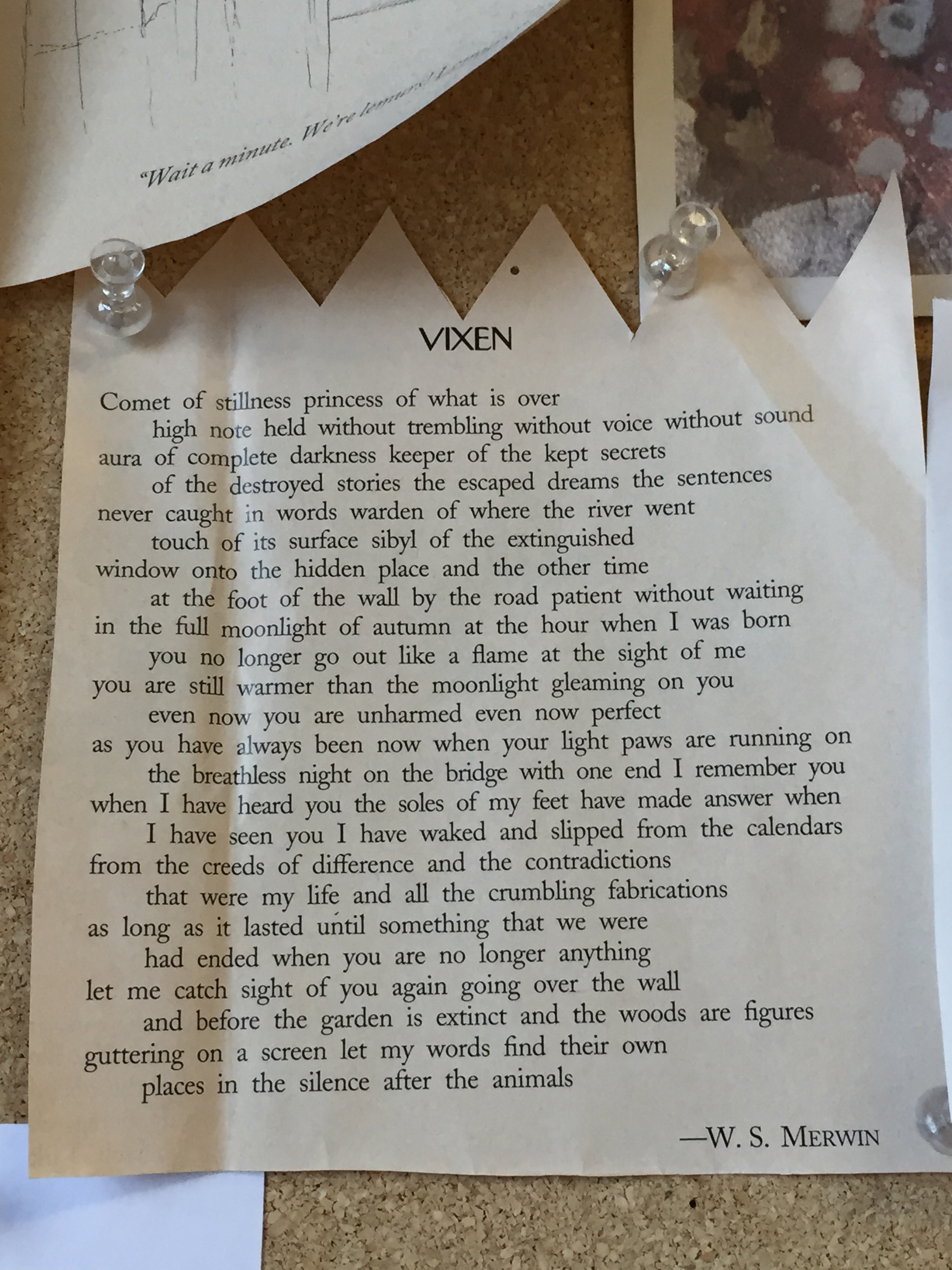
And just recently, while engaging in some unexpected dialogue about the poet W.S. Merwin, again on Facebook, of all places, a friend mentioned her love of his book, Vixen. Back in 1996 or so, I cut that poem out of The New Yorker when it was first published, and it’s been on my work bulletin board ever since. (Somehow I just add to the bulletin board. I never take anything off. It has an archeological feel by now.)

image

Now, any two things can look strangely connected if you examine them hard enough. And it certainly makes life more interesting to do so. But the reality is that there are an awful lot of fun things to look at out there that can liven up any part of a journey.

There was the incredible wild orchid I saw in Ecuador in our hike to see the hummingbirds. And on Friday when I walked home from work I was delighted to find an Italian restaurant that featured Hawaiian pizza and gyros. And as close as my own backyard are some tiny basil plants springing up volunteer. We’ll see how long they last in our Florida “winter.”

Taken through an IPhone rain cover - a little blurry!
Taken through an IPhone rain cover – a little blurry!

We have just over two months before we attempt Pico de Orizaba. There will be a lot to look at before then.

Books for High Places – What to Read at 18,000 Feet

The
The “Old” Library

When most people think of climbing gear, they have in mind ice axes, crampons, helmets, and the other accoutrement needed to maintain life and limb at high altitude. But to me, an equally vital piece of equipment is whatever book I’ve selected to accompany me in whatever arduous spot I find myself in.

Believe it or not, there are a lot of opportunities to read while climbing high mountains. You’re typically going to bed as early as 7, especially if you are aiming for a midnight or 1 am departure for the summit. And that’s just summit day. On a lot of acclimatization days you find yourself collapsed in a hut or hacienda by mid afternoon following your first few forays over 14,000 feet. And, if you’re like me, you can’t sleep unless you’ve first consumed at least a few pages of a novel.

Now books for such trips must meet certain requirements, at least in my mind. First and foremost, they have to be available on a Kindle.  When every ounce you carry can make a difference, lugging paper around doesn’t seem like a particularly wise choice. They have to be of sufficient length to engage you. I love short stories but somehow they seem more suited for an evening jaunt in the neighborhood – not a multi-day expedition. And they have to be engaging. If your goal is to blot out an altitude headache, to forget how cold you are each time a part of you inadvertently slips out of the sleeping bag, and to screen out the assorted snores and noise of your fellow hut dwellers, you need something that transports you into some alternate world. The odd thing is that life on a mountain can be so surreal that the imaginary world of some novels can seem a more likely reality than the one you’re in.

The
The “New” Library

So, what are some of my top choices for high places?

Our first trek, in 2011, to Kilimanjaro, was accompanied by Abraham Verghese’s Cutting For Stone. The story of a doctor and his twin brother it globe trots from Africa to New York, and kept me enthralled at Crater Camp on the Western Breach, where we camped at 18,000 feet. It’s 690 pages long. Of course, I would have been in no shape to write a scholarly analysis of it at that altitude, but it was a good read.

On this summer’s trip to Ecuador I relied on the fantastic creatures and characters of Clive Barker’s Weaveworld to get me up the steep slopes of Cotopaxi. Yes, I do like science fiction and some fantasy, and the alternate reality of Weaveworld and its 768 pages (now you see why a Kindle is essential) fit the bill. Years ago, on a much tamer trip to California I read Barker’s Imagica, and I think it would be a equally suitable high altitude choice.

Some others? Consider:

And the Mountains Echoed by Khaled Hosseini – a story of a family in Afghanistan and elsewhere, covering multiple generations and places.

The Dust series by Hugh Howey – a post apocalyptic world – or is it? Be prepared.

The Flamethrowers: A Novel by Rachel Kushner – I will never forget the opening description of speed racing on the Bonneville salt flats.

These are only a few. What do you take with you on your travels? Let’s share.

Pain and Train – Getting Ready for Orizaba

Rainbow on Cayambe descent

Now that Labor Day has passed, it is time to return to the backbone of any successful summit bid – and that is the long hard slog of training.  I haven’t stopped since Ecuador and our adventures on Cotopaxi, Illiniza Norte and Cayambe, but I have definitely taken it a bit easier.

For example, I treated myself to the luxury of stairs without a 25 pound backpack. I haven’t attempted a seven mile run. And I have not been at all diligent about any weight lifting. It’s been nice.

But, as the Walrus said In Jabberwocky, the time has come. So on Saturday, after much futzing around (you do need to make sure your sunglasses are adjusted just so, headphones properly positioned, etc.), I embarked on a five mile run. I’ve been running four milers, but if we want to have a hope of scaling Mexico’s 18,491 foot Pico de Orizaba in January, I need to be back up there at the seven mile plus level. The run actually felt good. And on Monday, I’m going to reload the pack with the weights from my weight vest and lug it back off to work where my 16 story office building awaits.

In the meantime, I’ve been reading excerpts from a book called Fast After Fifty. It’s aimed at athletes who are trying to maintain or improve after age fifty and emphasizes interval and anaerobic training. But – true confession – I didn’t really do anything particularly athletic until I was almost fifty! So I have some reservations as to how applicable those principles are to me….although that may just be a copout as I have no desire to run as hard as I can for thirty minutes to find my lactic threshold.

At least I can find some inspiration in the movie, Meru, which we saw last night. It’s a documentary based on alpinists Conrad Anker, Jimmy Chin and Renan Ozturk’s two attempts to climb Mt. Meru in the Himalayas – 21,000 feet above the headwaters of the Ganges River. It’s the sort of mountain that makes Everest seem like climbing for dummies. Over the course of the three years between the first failed attempt and the second successful one, one of them was in a near fatal snowboard accident, which resulted in a severely fractured skull, and another narrowly survived an avalanche. But they ultimately made it up what is called the Shark Fin – razer like slabs of granite so unstable Chin said he could feel them move under his fingers.

On the first attempt they got within 500 feet of the summit – but ran out of food due to an unexpected four days waiting out a storm in a small tent half way the mountain.

The physical and mental strength it takes to know when to turn around and when to keep going is huge. I may not be headed to the super high mountains of the Himalayas, but I’m keeping my fingers crossed that my Florida version of training can at least get me ready again for something higher than Mt. Dora. For those of you non-Floridians, that’s what we in Central Florida call a summit – it’s a whopping 184 feet above sea level.

Labor Day – Take a Deep Breath

Taking a deep breath - Mt. Washington 2014
Taking a deep breath – Mt. Washington 2014

Many things just seem to stop on Labor Day. Including my 24 year old refrigerator that has occupied a convenient niche in our garage for the last several years.

Since I started this blog back in May or so of 2014 I have tried to publish posts once a week – I’m old enough that I tend to regard blogs as the digital equivalent of a weekly print magazine. But occasionally those periods occur where labor (aka work) takes over, becomes all consuming, and unfortunately, training, this blog, and yoga all take a back seat.

But all things pass, and it’s appropriate that they do so in time for Labor Day. It’s time to take a deep breath, and look forward to the fall and next adventures. Just like that first gust of cool wind on a fall day. After a summer of Florida heat and humidity, there’s no describing how refreshing that is. Unfortunately, I know from 25 years here that September isn’t much better than August.

So what is upcoming after the excitement of this summer’s trip to Ecuador? Most immediately, a trip to Maine with daughter #1 and the boyfriend N, and a hike up Puzzle Mountain. And after that….God willing and the creek don’t rise – we are seriously considering a trip to Pico de Orizaba in Mexico the first week of January 2016. It’s the third highest mountain in North America at 18,491 feet. And of course, it’s a volcano. Has anyone out there done this trip? We can certainly use all the help we can get.

In the meantime, this year’s Labor Day has involved refrigerator replacement, re-planting the vegetable garden, and a four mile run. I’ve taken a deep breath. Now it’s time to set our sights on the next summit.

Cotopaxi, Ecuador…..And the Volcano Erupted

20150701_074249
Cotopaxi viewed from Illiniza Norte

On July 3, 2015 J, our guide Ossy, and I stood on top on top of Cotopaxi, one of the highest active volcanoes in the world, blithely ignoring the sulfur fumes that had fortunately blown in a direction away from us. And on August 14, 2015, that very same volcano sent a two mile plume of ash, hot glass and fumes into the air, creating an ash shower for all the surrounding villages, some of which are now being evacuated.  (Apparently it is called a “pyroclastic flow.” Great name.)

This same weekend, I’ve read about a mountain guide who suffered a serious spinal injury while rock climbing in Ecuador. I believe that he’s someone we crossed paths with when we were in Ecuador – he was one of the guides working with the Climbing 4 My Donor team that we met both at Rucu Pichincha and Illiniza Norte.  (The Climbing 4 My Donor team consisted of heart/lung transplant recipients from the U.K. who were climbing in honor of their donors.  They were pretty inspirational.) There is a GoFundMe page for his medical expenses (Sebastian Carrasco).

E353138C-B7E6-4867-A66A-74F0156750CE
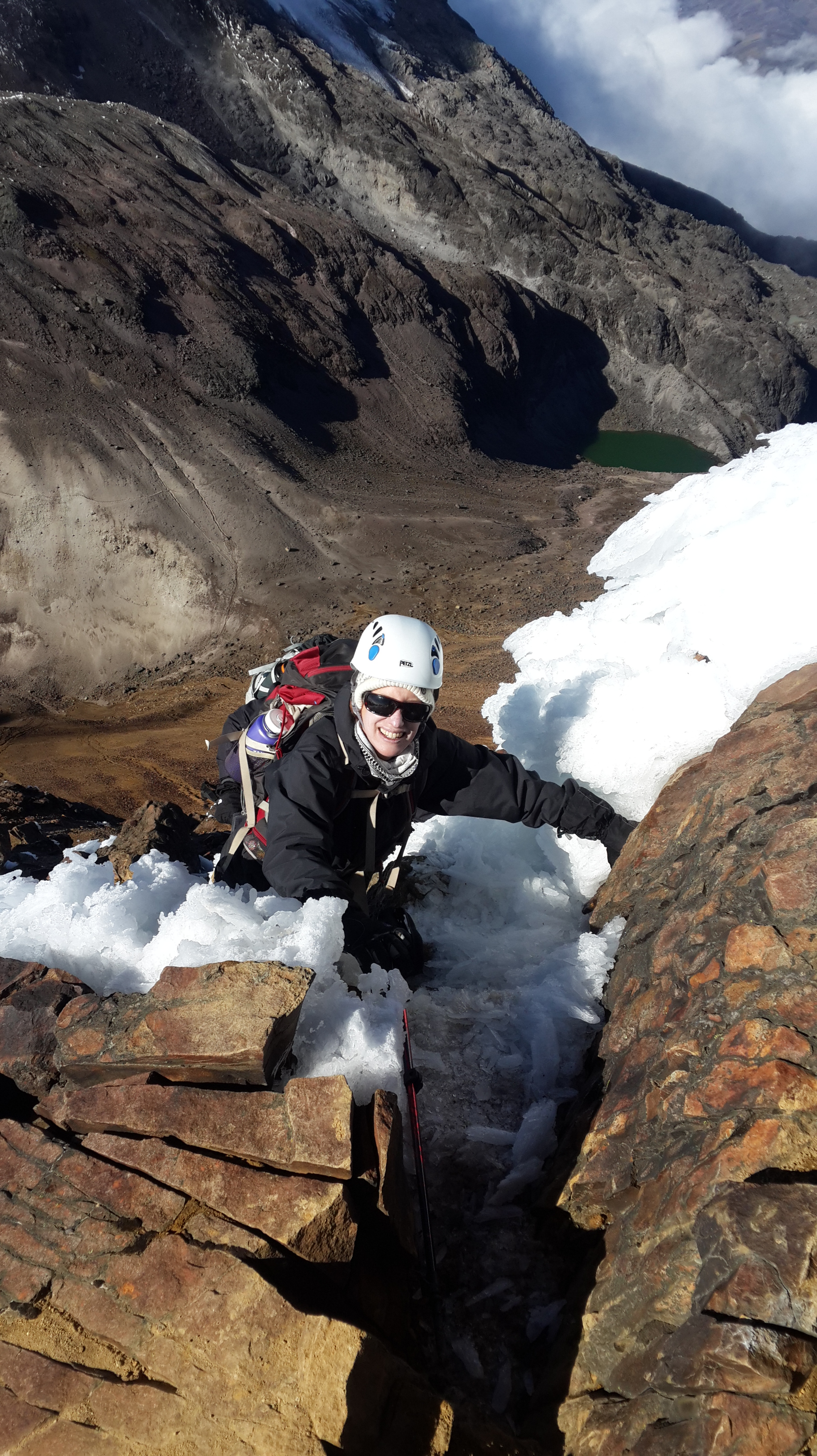
Rock climbing on Illiniza Norte

But recent dangers don’t appear to be limited to the summit. Down here in the swamp, this past week in Central Florida saw an absolutely horrendous accident — a woman swimming at a popular spot on a local river was pulled under by an alligator and lost her arm.

I tend to ignore the fact that my particular version of swamp to summit carries with it some degree of danger.  Even these recent events really only affect me in the sense of “oh wow, can you believe we were just there” or “we were just doing that.”  I think that’s part of the  journey – the danger is a given and it just becomes part of the landscape.  It certainly helps ratchet up the adrenaline, but when you’re on the mountain, you’re not thinking danger; you’re just thinking the immediacy of the moment and how to handle that which is in front of you.  Rock climbing up Illiniza Norte was a particularly good example of that.  In fact, I usually end up feeling more fear of physical failure than I do of external, more objective dangers.

For various reasons my Saturday run this week took me from downtown Orlando along a service road that parallels the now constantly under construction interstate.  It’s becoming increasingly overgrown, with many vacant lots.  I did briefly wonder whether this was actually the best place to be running by myself.  But the answer wasn’t to turn around.  I simply ran a bit faster.