Galopagos [http://www.flickr.com/people/59888966@N00 Pete]We’re still musing about whether to add Chimborazo to our Cotopaxi climb this summer.
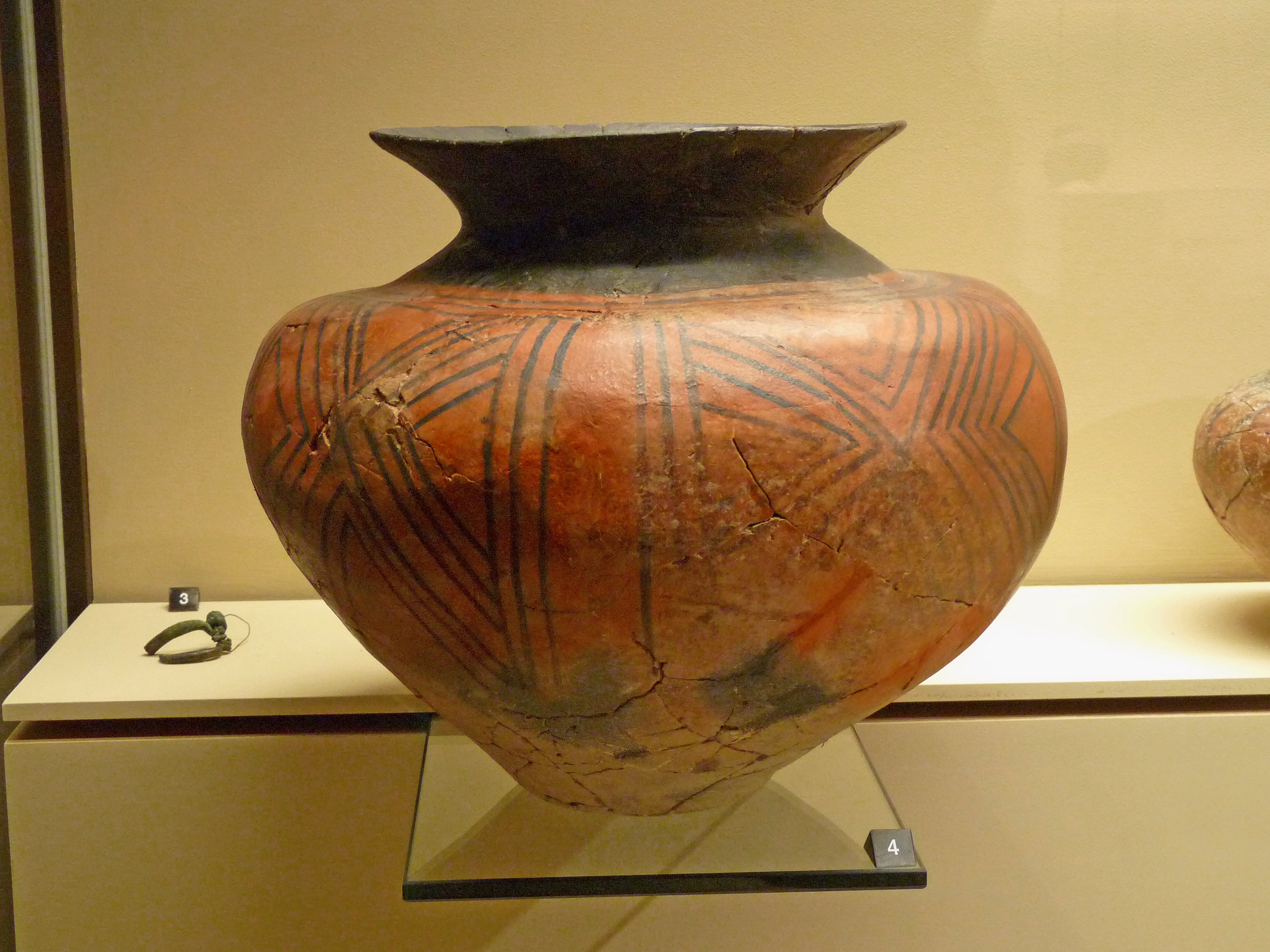
Last night we went to a combination birthday/retirement party for a dear friend. Among other presents – was an URN. Not an urn for a plant, or to carry water or wine, and it wasn’t even Grecian – rather it was the repository for ashes after the inevitable end. And what made it even more remarkable – it was a USED urn. I did not inquire too deeply of the circumstances that had led to the removal of one set of ashes and the apparent preparation for another occupant.
Tonight we had dinner with another old friend who was singing the praises of the Galopagos Islands. And one of my yoga buddies wore his Galopagos Islands t-shirts to yoga today. What I haven’t mentioned before here is that Chimborazo isn’t our only possible trip extension – Galopagos is there also.
Connection with urn? Back to the only live once phenomenon. On the urn – as John Keats told us – the characters are immortalized in time and art. The husband and I clearly aren’t going to be. Life is now or never. So now we’ve added a third decision point – we KNOW Cotopaxi is in – I have already submitted my application although the husband is dilly dallying with his. But now – no extension, Chimborazo – which would stretch mind, body and soul, or Galopagos? I should be happy to have such first world problems. Thoughts, fellow travelers?
Point Lobos is like a summit turned on its side, lying on the deep blue bed of the Pacific. This Thanksgiving, as almost always, the husband and I made the trek to and from Florida and California on the busiest travel days of the year – Wednesday before Thanksgiving and Sunday after – to meet up with daughters one and two and an assortment of brothers, sisters, cousins and friends in the Monterey area.
One tradition has always been a Thanksgiving Day excursion of some sort. It used to be what we called sand sledding on the large sand dunes that overlooked both highway and ocean near aptly named Sand City. Kids and adults alike would zoom down the steeply angled dunes on pieces of cardboard – usually wiping out somewhere before the bottom, only to clamber back up and try it all over again. Thanksgiving didn’t seem complete without sockfuls of sand that would appear in odd places for several days after.
As the children got bigger and the adults creakier, sand dunes shifted to hikes. We’ve done several at the Garland Ranch. During one of the first, daughter one (and possibly daughter two) and I managed to get separated from the rest of the contingent, and spent an extra couple of hours wandering lost through the chaparral. Finally we saw a rather dressed up family whose outfits clearly showed they weren’t off for a long distance hike and we were able to follow them back to civilization. Another hike – when we were training for Kilimanjaro – was up in the Soberanes Canyon – and by up I mean steep! For some reason I had brought hiking boots, but no hiking appropriate jacket, not realizing how cold it would be. A common mistake when going to California. I ended up wearing my black Michael Kors raincoat for the whole thing. I’m not sure whether I cut a dashing figure or looked like some eccentric character out of a vampire novel.
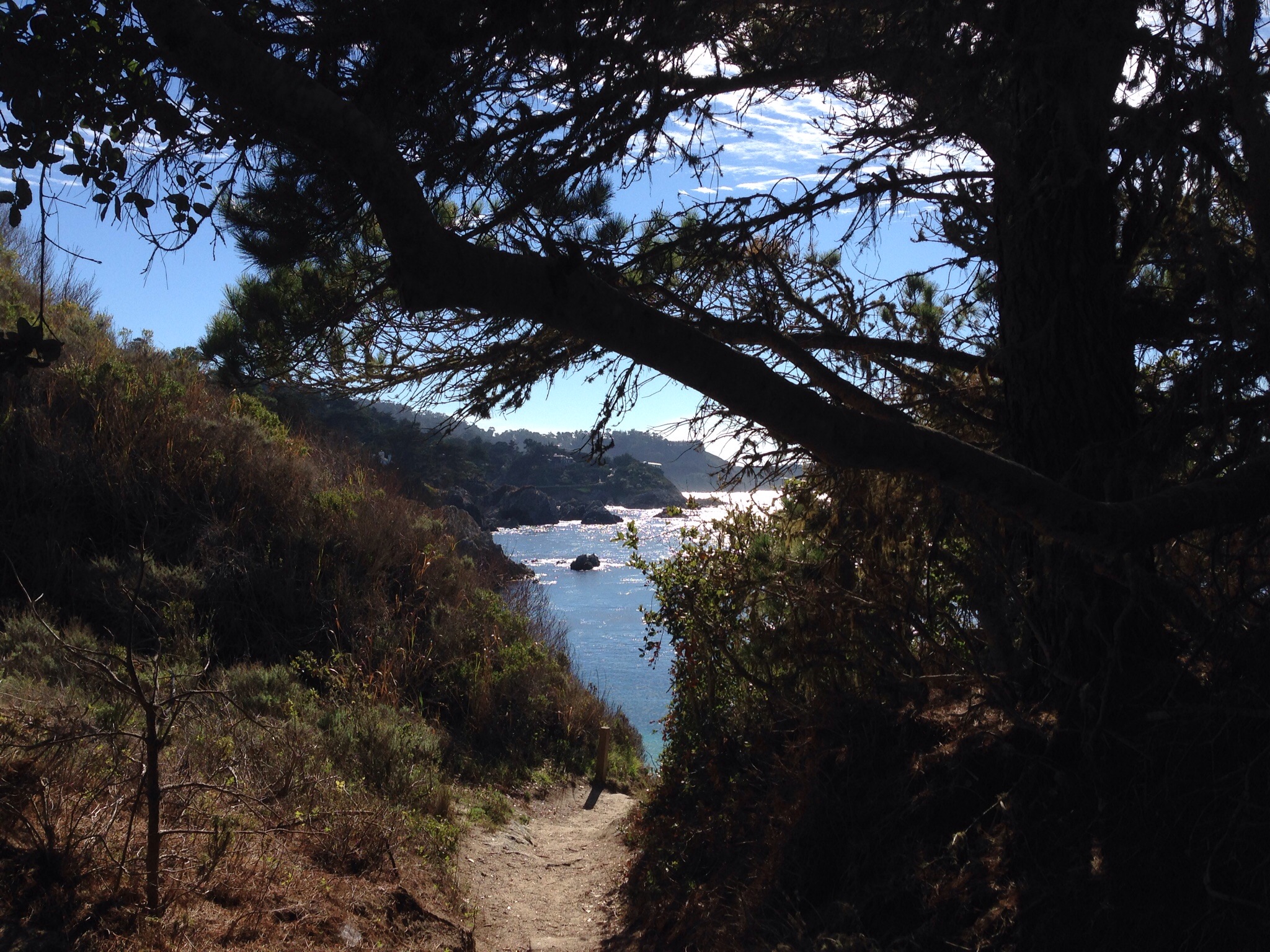
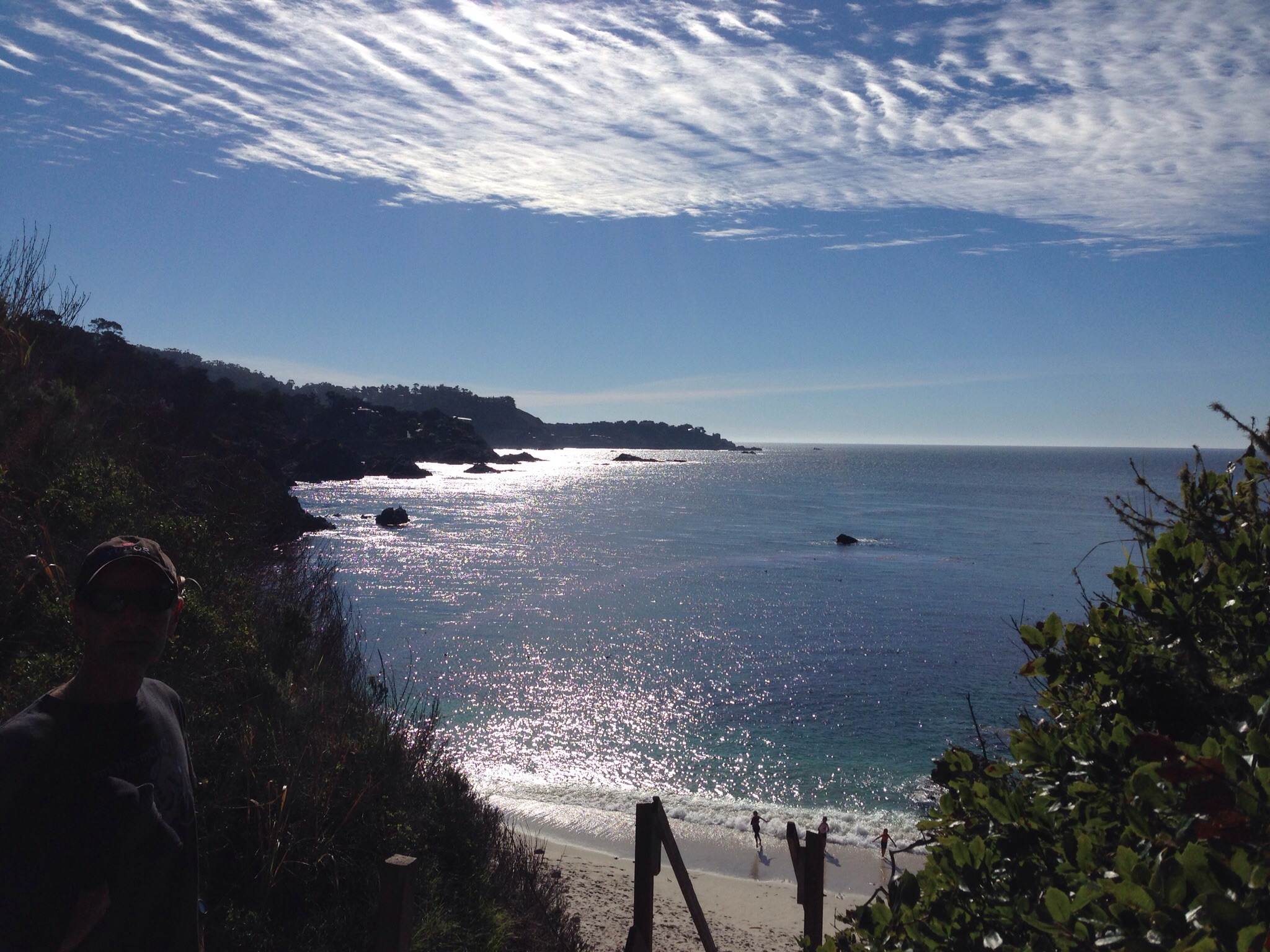
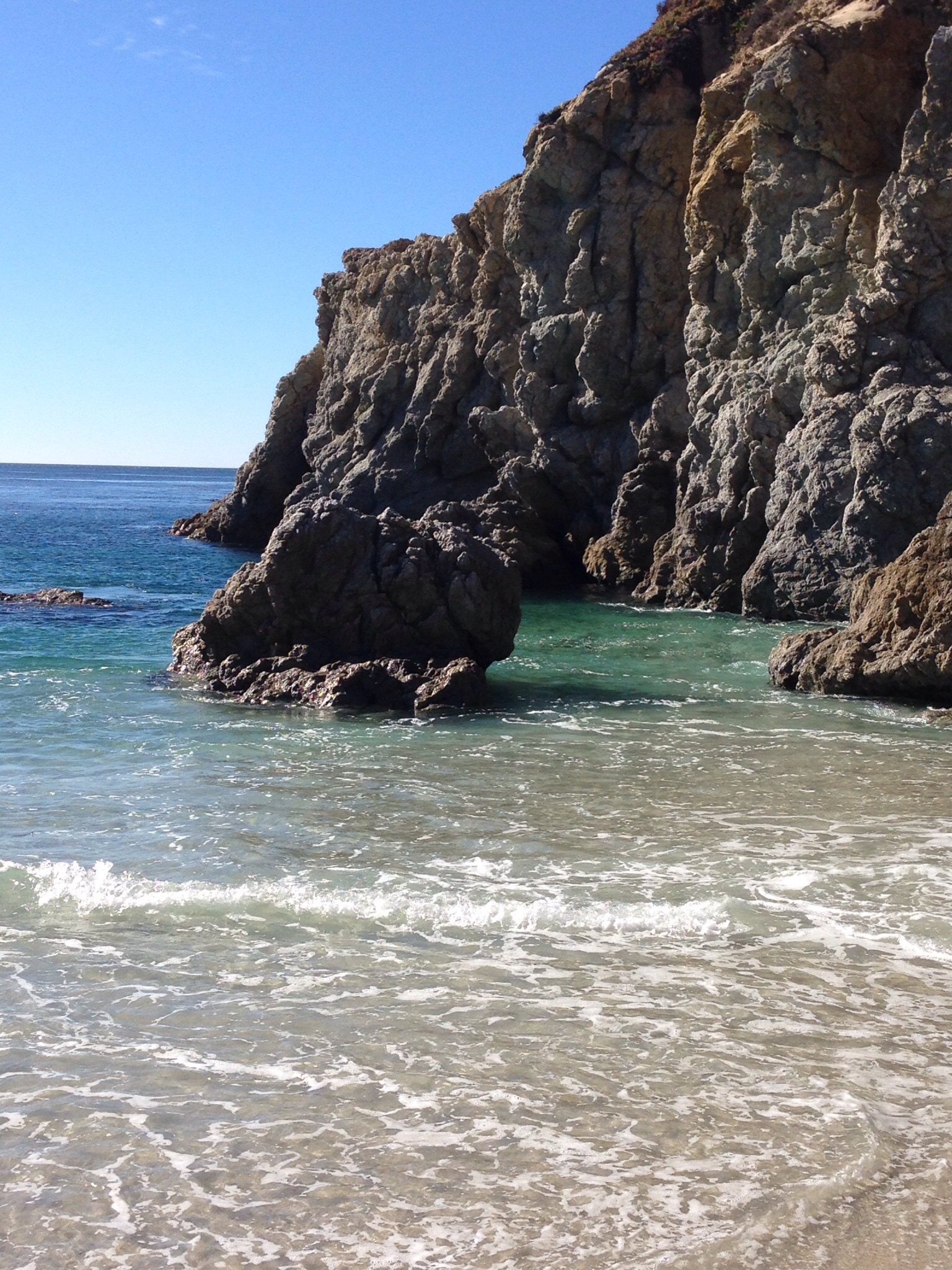
This year we returned to Point Lobos. Just south of Carmel, near the start of Big Sur, the spectacular coastline between Carmel and Santa Barbara. Trails wander through coastal woods, and lead to cliffs that manage to be both rocky and sandy at the same time. Cypress trees are silhouetted against an open skyline, and out in the ocean rocks form classic arches that create pathways for the waves to pool and then crash. Along the route, numerous white sand beaches nestle between the cliffs. They are only reachable by rickety wooden stairs that wash out in every storm of any significance.
These hikes aren’t really for training and they aren’t even really to see or experience anything new. What makes them special is our family and friends, many of whom we only see once a year. We’ve been to these spots together any number of times. But as each year passes, the lens I view them through changes. The daughters launched into their twenties; the nieces with babies and boyfriends. Yet despite the ever growing cascade of years — the pelicans are still in flight; the sun glints off the water; the flat silver half dollar of the ocean is tossed by the roar of the waves. Still a peak experience, of sorts.
As an English major and daughter of two now retired English professors, I was raised in a house filled with thousands of books. We didn’t just have one copy of a book – we would have triplicate, because, I suppose, you can never have too much of a good thing.
But reading has always powered my imagination – and imagination is probably behind my starting this whole mountain climbing thing in the first place. Well, to be more precise, it was a 1991 movie called K2 that I saw on TV. In fact checking for this post, I discovered it was largely panned by the critics, but I still remember the drama of preparation (one of the climbers was a lawyer) and the critical moments on the mountain where one climber had to make the decision to leave his injured companion behind. The husband found the film absolutely appalling. But for some reason, the adrenalin junkie in me found the battle of man versus the elements completely fascinating.
A good book about the mountains – or any adventure travel – brings you that one step closer to making the summit your own reality. Lots of books have given me that little last push up that extra flight of stairs. Here are some of my favorites and I’d like to know yours – I’m currently perfecting my Kindle reading technique for stair climbing.
The Seven Summits by Frank Wells and Dick Bass. This may be where it truly started. A work colleague of mine lent me this book back in the 1990s, and, true confessions, I never returned it. It’s the tale of the original two who climbed the seven summits in one year, 1983, the year I graduated from university. Easy reading and puts the mountains within reach.
Paths of Glory by Jeffrey Archer. The story of George Mallory’s fateful trip to Everest, starting with his days climbing church steeples. The mystery remains – did he or did he not summit?
Mark Horrell’s travel diaries – these are available very inexpensively in Ebook format. He seems to have climbed everything and his very detailed accounts of mountains ranging from Cotopaxi to Elbrus are quite reassuring to a novice climber.
Into Thin Air by Jon Krakauer. Need I say more.
And, to finish up, The Orchid Thief by Susan Orlean. Ok, it’s not about summits but it is about swamps., Possibly the most beautiful prose ever written about the adventure of hiking through the wild Florida of the Fakahatchee swamp and the search for rare orchids. Inspirational for swamp dwellers who want to see more than the concrete of Florida development.
As I sit here on a weekend, waiting for the plumber to take his interminable time to arrive (three hours late, thus far), we have some decision-making to do. As hoped, the work schedule cleared up, freeing the way to commit to some June 2015 dates for our next mountain climbing endeavor. And I’ve already contacted the guide company that successfully led us up Elbrus, so that’s done.
But here’s where the itch of mountain climbing – or you could say hubris – sets in. It turns out for an additional four days and a few more dollars, we not only could climb Cotopaxi, but also climb Chimborazo – the highest mountain in Ecuador and one that reaches my long dreamed of goal of a 20,000 foot mountain. Well, long dreamed of if you count 2011 as a long time ago, since that’s when all this started. This would mean acclimatization hikes up Guagua Pichincha and Illiniza Norte, followed by Cotopaxi at 19,348 feet and three days, later – Chimborazo. At 20,564 feet, Chimborazo is harder than Cotopaxi. It’s one degree south of the equator, and because of the bulge of the earth, is the farthest point away from the earth’s core and the closest point to the sun. Hubris is the right word. Think Icarus.
I hadn’t really considered doing the extension. But then yesterday, in the midst of multiple levels of work related issues and general lawyerly stresses – and perhaps in reaction thereto (what a good, lawyerly phrase) – I suddenly found myself saying, “hell, yes.” Not out loud. But a lawyerly phrase, nonetheless.
If not now, then when? I’ll be 54 by next June. There’s no doubt that if we make this commitment it will require the highest level of training either the husband or I have tried to achieve. Sometimes mountains – and summits of all sorts – whether at work or at play – throw the gauntlet down before you and just ask to be climbed, and climbed hard. But I still think I better have a serious talk with the guide company.
Mountains do not rise up from the earth like isosceles triangles. And most things in life don’t have that perfect equilibrium either. Like this week – everything just a little off.
It started when I unpacked a gigantic box containing a keyboard that had belonged to an uncle and now had wended its way to Central Florida. In reaching down into the thousands of styrofoam peanuts that surrounded said keyboard in order to ensure we had located all its bits and pieces, the husband pulled out a carefully wrapped plastic package. I cut it open, expecting a plug or some similar piece of equipment, only to find – a string of pearls! A visit to the jeweler the next day confirmed they weren’t real, but now I still face the task of contacting UPS to see if they there is any report of missing pearls in peanuts.
That set the tone for the rest of the week.
One of our elderly Westies continues to be profoundly deaf and is proving not very capable of learning sign language. His brother has decided he can only eat dry dog food if scattered on the floor outside of his bowl. And the ancient cat continues to believe he is a mountain lion and to attack dogs.
My dearly beloved ten year old car blew the same fuse for the second time in six weeks. Who knew the same fuse that controls the radio controls the ignition. But combined with a very leaky convertible top, the prospect of having to change fuses on the side of the interstate while driving to an out of town meeting on Monday was enough to cause us to finally buy a new car.
At least events of tomorrow should determine my schedule sufficiently that we can actually book our Cotopaxi trip. At yoga last Wednesday night the moon was full but for a slice off one side, teetering against the black sky. I’m hoping that this next week – with the next summit firmly chosen and set – restores equipoise.
For several years I have had a semi-inflexible yoga schedule. What I call “regular” yoga on Wednesday nights and Sunday afternoons, with some cardio thrown in on the step mill or treadmill, accompanied by Bikram on Saturday afternoons. But all things change, and my long beloved 4 pm Bikram class is, at least for now, no longer. What’s a girl to do?
True, I could go to a 10 am class, which I have occasionally done, but I find my balance is not nearly as good in the morning. Somehow I need the day to be underway before I have the necessary focus.
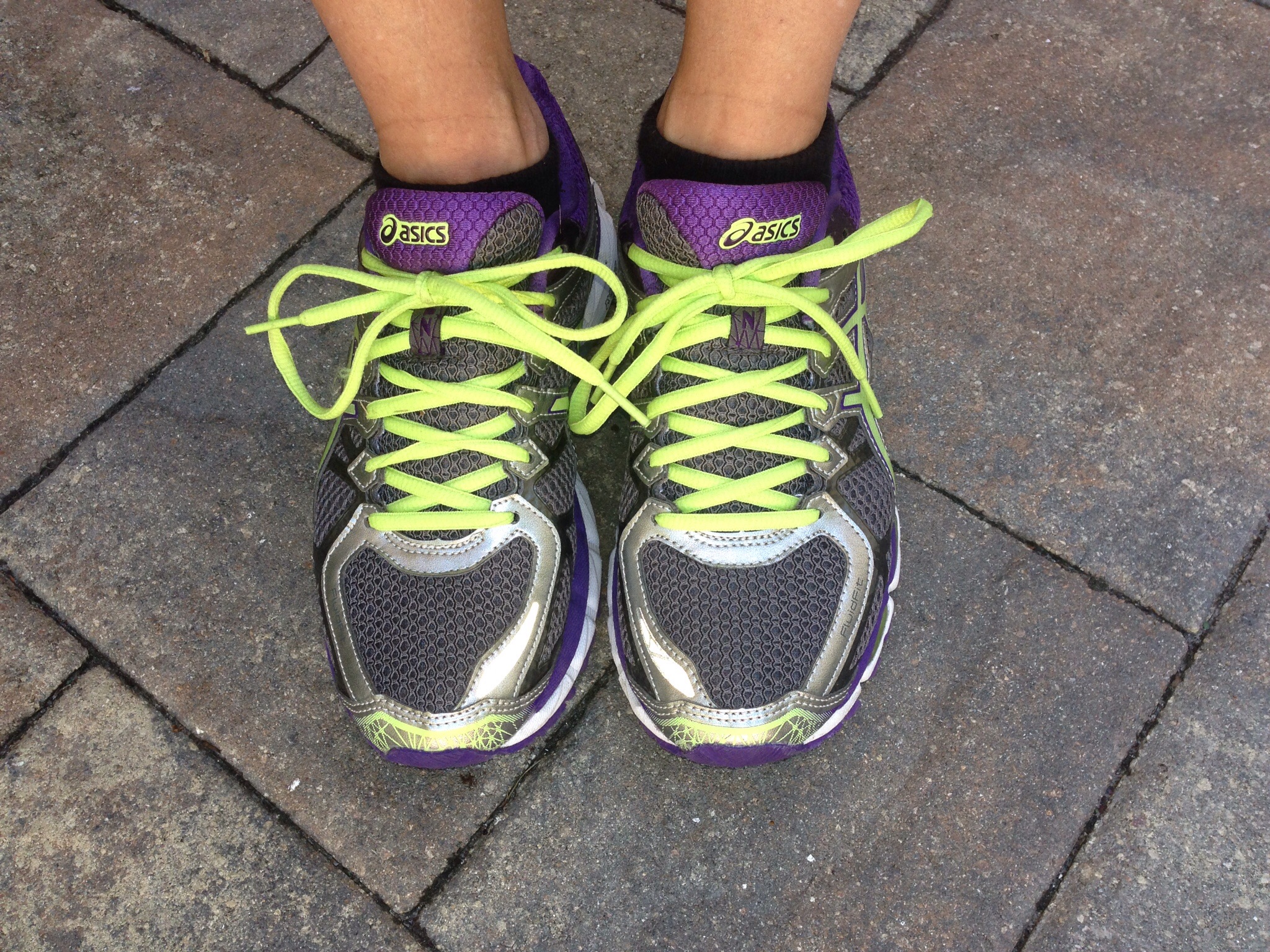
So, without making any commitments one way or the other to what my new Saturday routine will be, yesterday morning I ventured off to a high end running shoe store. It’s one of those places where customers are called guests, and you’re assigned a salesperson (although I’m sure they call them something else) as soon as you walk in. The process starts with extensive foot measurements, followed by a video of you running along the sidewalk in front of the store so they can frame by frame analyze how your foot strikes.
At the end, I was the proud owner of a remarkably expensive pair of Asics, together with super feet insoles. But I don’t mind spending money on those things – the cost of shin splints or otherwise wrecking your feet, legs, or back is way too great when you have mountains to climb.
And it turned out to be worth it. Fall finally fell in Central Florida and my new shoes and I went for a 4 1/4 mile run around the lake we live on. The difference between running in 90 and 65 degrees should have been self-evident, but I was still surprised by it. There was a decent breeze that was behind my back for a bit, not a cloud to be seen, and the pink seed casings of the tabebouia trees served as a very acceptable substitute for fall leaves.
Ok, so my left hip now hurts and maybe I really shouldn’t have used my new insoles for the first time on a four mile run against instructions, but whatever. Letting go of one training routine and opening up some new possibilities – I think that’s the flexibility it’s going to take to get up all 19,500 feet of Cotopaxi.
Audubon Park with Loyola University in the background
The name of this blog isn’t FromSwamptoSummit for nothing. Occasionally, it’s important to come down from the summit or to allow yourself to be side tracked from the attempt to reach it, and enjoy a good wallow in a swamp. And what better place to wallow than New Orleans!
The husband and I have a long history with this city. When we got married in the spring of 1986, we planned to use the frequent flyer points I had garnered over a year of “fly outs” – as we then called the interview trips paid for by law firms to lure prospective summer associates – for our honeymoon. The only problem – all my points were with the now defunct New York Air. Besides Boston and New York, where we respectively resided, New York Air flew only to Detroit and New Orleans. The choice was not difficult.
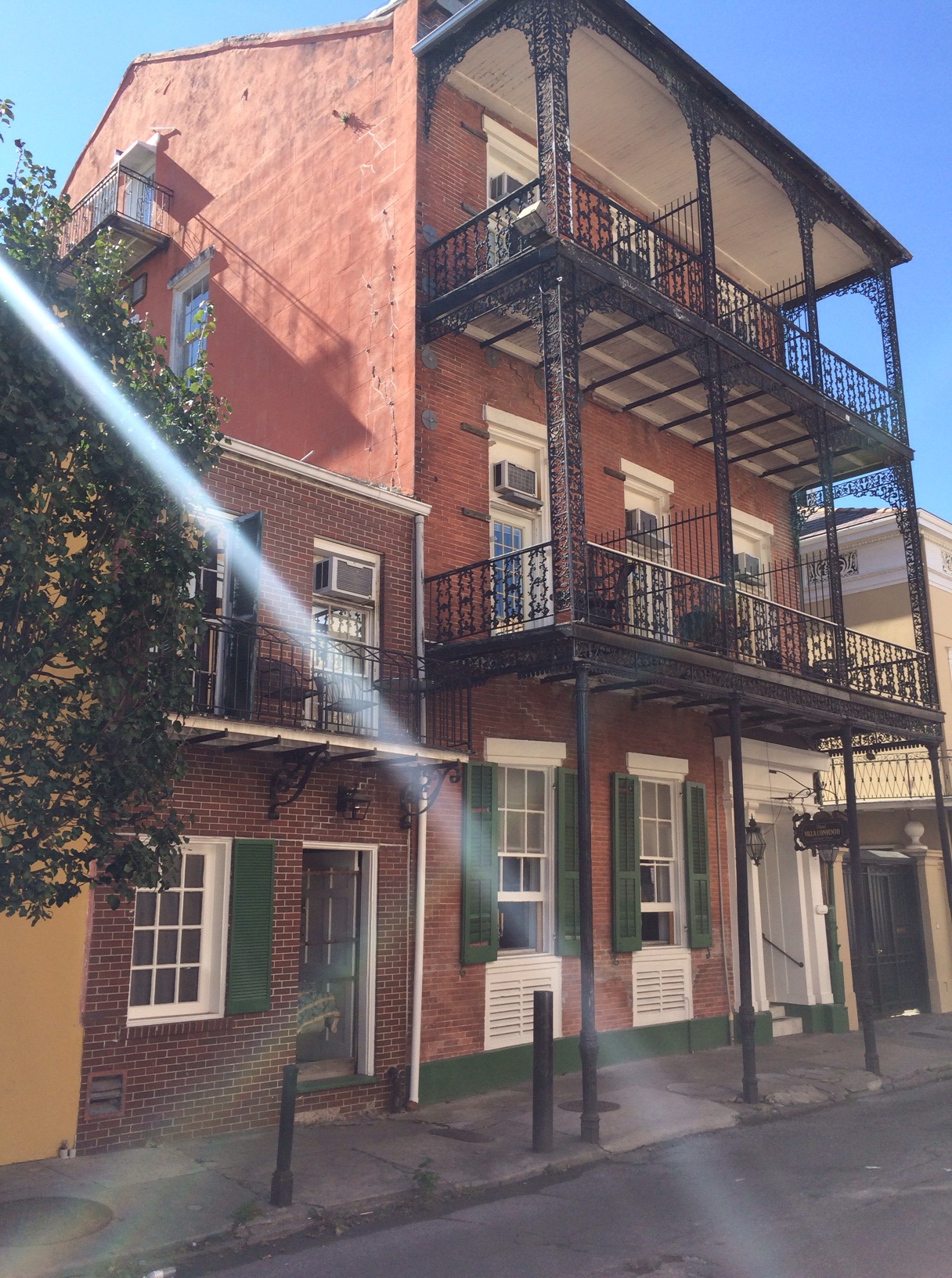
Hotel Villa Convento – not sure where the ghostly light came from. Perhaps something to do with the House of the Rising Sun?
Back in 1986, we stayed at the Hotel Villa Convento on Ursalines Street. In those pre Internet days we found it through a budget travel guide that I am sure we consulted at a bookstore without ever purchasing. The small family owned hotel has the dubious distinction of being across the street from a convent and is supposedly also the original house of sin made famous in the song, House of the Rising Sun. It had a certain moldy, faded glory, and we loved it. We’ve been back numerous times, including visits with children, parents and friends.
This trip – to visit daughter #2 – was assisted by the budget hotel vendor, HotWire, and the winner of this particular lottery was the Clarion Grand Boutique Hotel on St.Charles Street, the grand dame of all of New Orleans’ many boulevards. We knew we wanted to stay on St. Charles and this location is just about a mile above the Central Business District on the way uptown. We feared things might be off to an odd start when we checked in only to find a completely unknown credit card number associated with our reservation, together with a San Francisco address. After some detective work (oh, that legal training), we realized the address was that of HotWire itself – and who knows what the credit card was but we checked in anyway.
The daughter had made dinner reservations for us and several of her housemates at Martinique, a nice restaurant off Magazine Street with a pretty garden room where we were seated. The menu was most notable for its desserts – in particular, chocolate rye cake with beet chutney. I was somewhat surprised when the husband – who hates beets – said he’d try a bite. He was equally surprised when what he thought was a raspberry topping turned out to be beets.
The food extravaganza continued on Saturday. At least we started the day with a four mile walk from the hotel up St. Charles Street to the daughter’s house on the far side of Tulane – one of our favorite walks anywhere. Most cities have only a narrow strip of historic homes – New Orleans has blocks and blocks that run deep. The houses are often very close together, yet are huge. Many of them appear to still be single family residences. They are grand, with ornate columns and details, small front yards, and the dark, large front doors suggest a secret world closed off to all but those whose families hail from New Orleans’ early days.
We picked up sandwiches at the St. James Cheese Company, a small cafe selling gourmet – what else – cheese, and had a picnic lunch at Audubon Park, New Orleans’ answer to New York’s Central Park. We were barely off St. Charles Street, but our lunch companions were multiple types of ducks and turtles lazing in the sun.
An island of turtles – look closely….
Drove down to the French Quarter and poked around for a little bit. Bourbon Street as tacky as always, but the side streets as charming as I remember. Lots of Halloween ghouls peeking over the balconies, contemplating the various spooky characters below.
Zoom in for the Halloween hosts –
Dinner at GW Fin’s. I was amused to see that New Bedford sea scallops from Massachusetts were on the menu, together with gulf coast pompano. The daughter and husband both had “scalibit” – it’s a piece of halibut with scallops baked into the top of the fish and tastes as decadent as it sounds.
A trip to New Orleans wouldn’t be complete without a trip to the Sazarac Bar at the Roosevelt Hotel. And following that a visit to the Marigny to hear music on Frenchmen Street. But who knew that there were two such streets in New Orleans – or one street that is disconnected in the middle….I knew something was wrong on our Google maps when we found ourselves on the interstate, ending up at a Frenchmen Street that dead ended into the city bus parking lot! All I can say is the white SUV in front of us had apparently made the same mistake since it made the same u-turn and trip back to the city.
Once we finally got to the right place we listened to some retro sounding jazz at the Apple Barrel and finished with blues by the Smokey Grenwell Band at Club Bamboula’s.
A final travel note – we ended our stay with a leisurely breakfast at Coulis and a drive through the Fly – also called Avenger Park. It’s the riverside part of Audubon Park where you can see the tugs pushing long lines of barges down the Mississippi. It’s a favorite hangout for the daughter.
And it was particularly leisurely because we thought our flight left at 2 pm. We got to the airport early – and fortunately so, because it turned out the 2 pm on my calendar was eastern time – and the plane was leaving at 1 pm Central! But New Orleans gave us that one extra hour to enjoy without worry – just another one of the gifts of slow time and ease that the city offers. We all need to spend more time in the swamp.
I’m still processing our Mount Washington hike. And I am increasingly struck by how little I actually want to go “real” rock climbing, which our present idea for a next adventure – The Grand Teton – seems to offer in abundance. I’m currently reading To the Last Breath – A Memoir of Going to Extremes by Francis Slakey. It starts off with him and a climbing partner sleeping on a ledge on the face of El Capitan in Yosemite – roped, of course – only to have the webbing that held their “cot” fray and plummet out from under them some 2000 feet down. Not for me.
But in contrast, somehow the idea of a 14 hour night into day slogging up and down a glacier on a volcanic mountain – even with the incumbent risk of avalanche, crevasses, and a slip that could turn into a never-ending tumble down – doesn’t read the same way to me. I’m not sure I can articulate why a sheer granite wall feels so different than an expanse of deep white, but it does. Perhaps the glacier seems something that simple determination can conquer; the other requires more innate physical ability and guts.
Whatever the case, all I can say is that narrowing our focus to a trip in June or July of 2015 to Cotopaxi, the second highest mountain in Ecuador, with acclimatization hikes up Guagua Pichincha (15,696 feet) and Illiniza Norte (16,818 feet), is reinvigorating my training. Today, having narrowly managed to dodge the paper avalanche currently threatened by thousands of documents on my desk, I climbed stairs for over an hour – seven times up and down my building. Cotopaxi will be at least as hard as Elbrus, and there will be a sufficient amount of scrambling, especially, I think, on Illiniza Norte, to satisfy any inchoate desire to climb up a pile of rocks.
Cotopaxi is 19,348 feet, 7 feet higher than Kilimanjaro and about 800 feet higher than Elbrus. Every time I have climbed a mountain I have always felt if I had a do-over I’d do it better the next time. But you don’t go backwards to a mountain. You just find a new one.
We are now back in flat Florida following a three day adventure in New Hampshire via Boston (Somerville, to be more exact). After a bumpy flight, we checked into our AirBnB. For those of you not in the know, wannabe hoteliers or innkeepers who have enrolled in the program can let out their spare room – or their whole apartment or house if it’s going to be vacant – for varying lengths of time and at reasonable rates. Our 20 something daughter had urged us to try it. Of course, it’s an app. Once we got used to the idea that we were staying in someone else’s temporarily empty studio apartment – surrounded by all their books and other possessions – it worked out well. I guess we should have tried Uber on this trip as well.
A Portuguese breakfast – climbing food?
After breakfast at a Portuguese restaurant – which involved cod, shrimp and fish cakes, rice and beans – the husband, the older daughter, her boyfriend and I left rainy Boston for the three hour drive to Jackson. Our transportation was the boyfriend’s aged Previa minivan with 168,000 miles, including at least two trans-continental trips. As we got closer to New Hampshire the grey clouds lifted and we entered Jackson under crystal clear blue skies – as well as a city-worthy traffic jam in North Conway. We clearly weren’t the only people with the idea of a long New Hampshire fall weekend.
We stayed at the Inn at Jackson, the former vacation home of the Baldwin family (as in pianos, for you musicians out there). Charming rooms with a very nice communal living room, roaring fire, board games, and all of the things that we Floridians associate with fall in New England. That night we had dinner at The Wentworth, a sprawling hotel coping with what seemed to be an unexpectedly large number of diners.
The Inn at Jackson
Sunday morning was our summit day. Our hosts had kindly put out breakfast food for us since we were hoping for an early departure – but somehow – due more to the husband and me than the other two members of our party – we still didn’t take off until 30 minutes later than planned – a pattern that unfortunately pervaded the entire climb.
We started from Pinkham Notch visitors center. The boyfriend bought me a three dollar map – which my daughter had said would make me happy. It did that, but more importantly, it actually served a much-needed traditional map function later in the day.
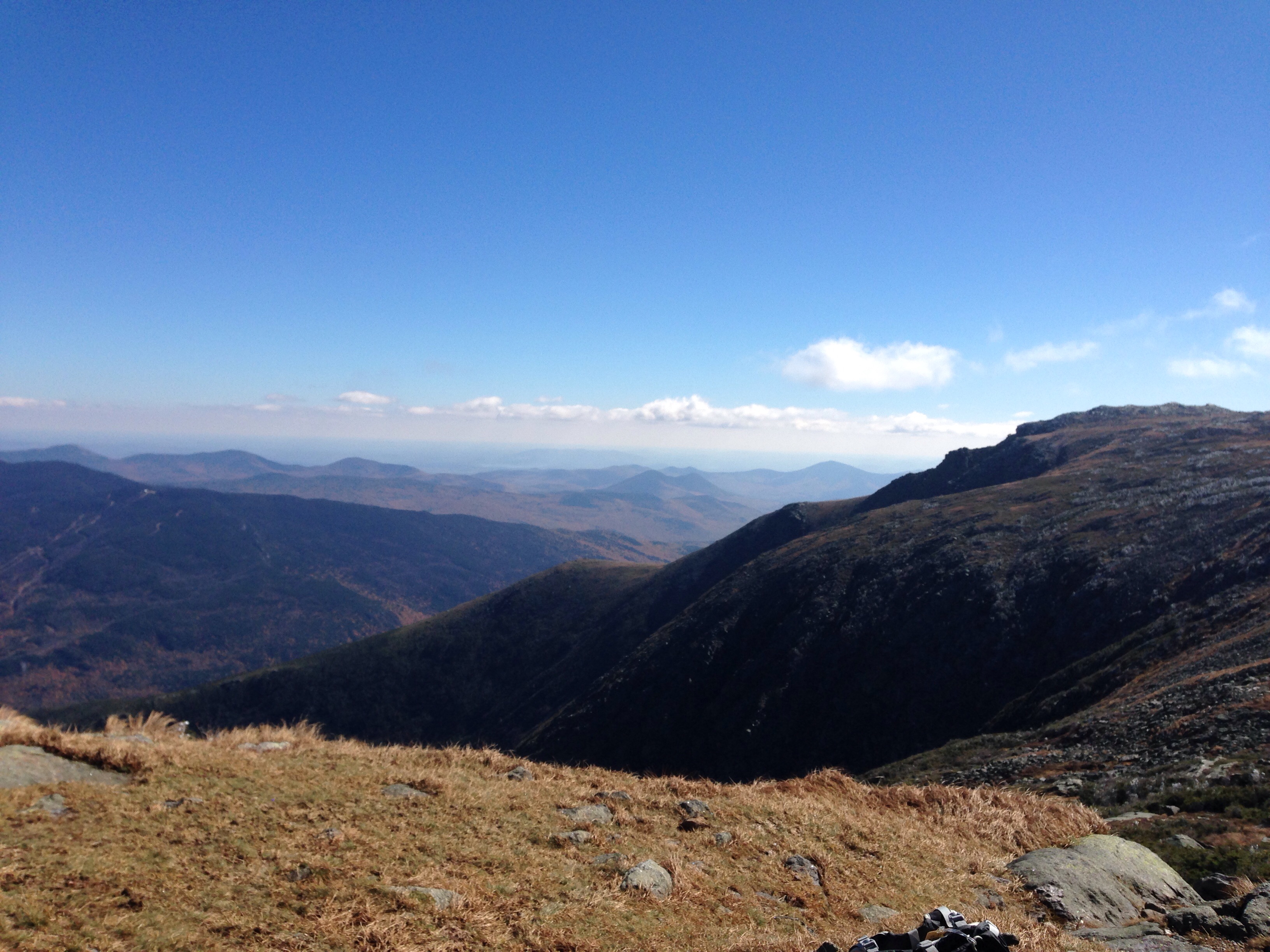
Mount Washington – and the Tuckerman Ravine Trail in particular- is rocky. The first couple of miles consisted of a wide path of semi steep ascents over what looked to be a rocky river bed. The half way point was Hermit Lake Shelter. Ironically, that was the windiest point of the whole day and caused us all to don extra layers that we spent the next few hours shedding. We stopped there for a mid morning snack. We may have been the only people climbing the mountain with a loaf of whole wheat bread, a hunk of cheese, a hunk of salami and a full jar of grey poupon mustard. Oh, and we had some left over GUs from Elbrus.
Below Hermit Lake Shelter
We had spectacular weather. Most of what I had read about Mount Washington had focused primarily on the horrible weather and didn’t spend much time at all on the difficulty of the trail. So while we were very prepared – in fact, over prepared – for the weather, we hadn’t actually taken into account the steepness and rockiness of the trail. After the half way point, we basically spent the next couple of hours scrambling up large boulders, some of which were quite wet from the waterfalls and streams that cross the trail. We were also slowed by the hordes of international tourists speeding up to the summit in terribly coordinated hiking outfits whom we felt compelled to let pass. In retrospect, we might have been better off had we been less polite.
And speaking of clothes – the ill-fated pants with the dysfunctional zipper (see earlier blog entries) reared their ugly legs again. I swear this was their last excursion. About an hour or so from the summit I realized the pants were constricting my left knee every time I stepped up – to the point I had developed a good sized blue bruise right below my knee. Finally I gave in, recognized the pants for what they were and stripped down to my light weight hiking pants that I had the foresight to wear underneath. My mobility increased enormously.
We finally reached the summit about 2 or so – well later than we should have, given that sunset was at 6:05. Nonetheless, we stopped for a while and had some hot tea in addition to our second meal of salami and cheese. The summit is a total tourist area. There’s a train that chugs its way up there. Others drive up on the “auto road,” and of course there are scores of people who actually climbed. There’s a museum, a gift shop and a snack bar. Remote, it is not.
Finally we started back down. We took Tuckerman Ravine Trail for a little bit, then veered left to the Lion Head trail. All of a sudden the crowds thinned, and the landscape grew wilder. It was much steeper than the other trail, and marked almost exclusively by stone cairns. We hiked through tunnels of dwarfed evergreens and slid ourselves down several rock chimneys. A number of the drops were steep enough that the daughter and I resorted to the good old fashioned sit down on your rear method of descent. At a couple of points the trail seemed to disappear into nothingness at the edge of a cliff – and all of a sudden you’d see a tiny little path down.
Lion Head Trail
Eventually that trail arrives back at Hermit Lake Shelter and rejoins Tuckerman Ravine Trail – at which point we realized we were out of water. We’d made a really stupid mistake of not refilling our bottles at tourist central at the summit, thinking we had enough. The boyfriend valiantly volunteered to run what we thought was a short distance to the water pump – only to find it wasn’t a very short distance and the pump required numerous pumps before anything came out of it. By then it was clear the sun was rapidly on its way down and we got out our headlamps to be ready.
We were now off the steeper and more beautiful trail back to the river bed of rocks. Actually there was a real river beside us much of the way. I finally took the lead since down is usually my strong suit – that is, when I am not having to slide down rocks on my rear – and we made extremely good time at first. Still, the only other people on the mountain now seemed to be professional trail runners who literally jumped over the rocks like moths flitting from light to light. Once the sun was down, any pretense we’d had to speed was done – one wrong step and turn of the ankle and that would be it. In the dark it’s easy to question where you are – especially since I had a strong tendency to want to follow the water runoffs – which looked awfully trail like to me – and the daughter seemed to want to turn right regardless of location. The three dollar map became very useful to provide some confirmation we were actually heading in the direction of the lights from the visitors center that occasionally flickered in the distance.
Finally – and almost suddenly – our journey through the night ended and there we were at the Previa. Injuries : some blisters – daughter and boyfriend; bruises – daughter and me (both banging legs on rocks and pants injury). Damaged equipment – somehow the daughter’s hiking pole had flipped open, the bottom part fell off, and she didn’t notice until we were at the bottom! She said it had seemed a little shorter. A Black Diamond, no less. Rewards: meeting a challenge head on with a team that included not just the husband and me but the daughter and boyfriend. When the husband and I are old and grey and sitting by the fire I hope they’ll remember we weren’t always that way.
So, lessons learned. In the broader scheme of things the husband and I remembered we really like sheer mountain climbing better than rock climbing – which can still sometimes trigger my innate fear of heights. We are rethinking the Grand Teton and are now seriously thinking again about Cotopaxi in Ecuador. It’s another almost 20,000 foot glaciated mountain that is awfully appealing.
And on the smaller scale of things we were reminded that you can make stupid mistakes on even 6200 foot mountains and regardless of how many you’ve climbed. You’ve got to be humble in the face of a mountain.
As I closed last time we were at campsite 2 (Pacamayo), removed from all cell service, in the view of the tall peaks of the Andes. The next day, Day 3, was the longest, but most beautiful, day of the hike. In the morning, after a typical early start, we stopped at various Incan ruins. The one that stuck out the most was a religious site where mummified bodies were taken after they had been dead for several years. The bodies, which were mummified into terribly contorted shapes, were transported along the stone trail to this location, where they were placed into very small niches. After various rituals involving special water were performed, the mummies were returned to their homes and placed in holes on the sides of the nearby mountains.
It was either there or at the second pass (I believe Dead Woman’s Pass was considered the first pass) that we hiked up a peak and each placed a stone from below on a cairn as an offering to Pachamama – Mother Earth. The so-called “Inca Cross” actually represents the Incan belief in the need to bridge the gap between earth and sky, and man to the gods. Perhaps not so different.
Above the clouds on the third pass of the Inca Trail
After lunch we reached the heights of the third pass. Surrounded by snow capped mountains and looking through vistas of mountain ranges. We descended into heath and very quickly down into the “cloud jungle.” As we journeyed lower and lower there were more wild begonias and blooming orchids.
Descending from the third pass
At a certain point on the descent, our guide, Juan, took us to a small structure, manned by a single lady. It was a local “pub,” according to Juan, where the local corn beer, “chicha,” was made. The small, low-ceilinged room was filled with wood benches, and the proprietress looked as if she’d had one too many. We all passed around a cup of chichi – it reminded me a lot of the “shebeens” in South Africa – the local drinking establishments.
Toward late afternoon the trail split and you could take a 20 minute detour to another ruin. The husband and I declined, but by then the two daughters were well ahead, not having found my tendency to hang back and study the flowers a particularly desirable quality in a hiking companion. We didn’t know if they had chosen the detour, and suddenly I became convinced they had taken a wrong turn and were lost somewhere in the wilds of the cloud jungle…I sprinted the last downhill hour (developing a rapid descent technique that has served me well on other hikes), only, of course, to find them safe and sound at the third campsite, Winay Wayna. They had staked out the best tent site; the husband and I were relegated to the one by the particularly awful “bathrooms.”
That night was our last camping night – we were to arise at 3:40 a.m. the next morning to hike the remaining five miles to Machu Picchu itself in the hopes of seeing the “Sun Gate” at sunrise. Dinner was quite elaborate, featuring a rice cake shaped like – I think it was a chicken! The tipping ceremony also took place that night. But at that point, the complexion of the entire trip changed.
As you’ll recall, daughter number 2 was the one left cold and shivering on the way to Dead Woman’s Pass. That apparently caught up with her and she couldn’t eat dinner – the cook’s very kind offer of a special celery tea made her feel even worse given her extreme dislike of celery in any form. In any event, at 12:30 a.m., a little voice (or as little as the voice of a nineteen year old is) called at our tent door, “Mommy, I have to go to the bathroom.” I found myself taking her on a midnight excursion to what passed for a bathroom; she was burning with fever, so I moved into daughter number 1’s spot in their tent, and daughter number 1 moved into my tent with the husband. We were the only people up in the campsite shuffling back and forth between tents in the early morning hours, and lord knows what our companions thought we were up to. That’s when I discovered my older daughter apparently sleeps in the equivalent of a squirrel nest, surrounded by so many possessions it was impossible to straighten my legs! I finally got the sick daughter to sleep and dozed off myself for a couple of hours before we started on the final leg of the hike.
Sunrise over the Andes – on the way to Machu Picchu. Day 4.
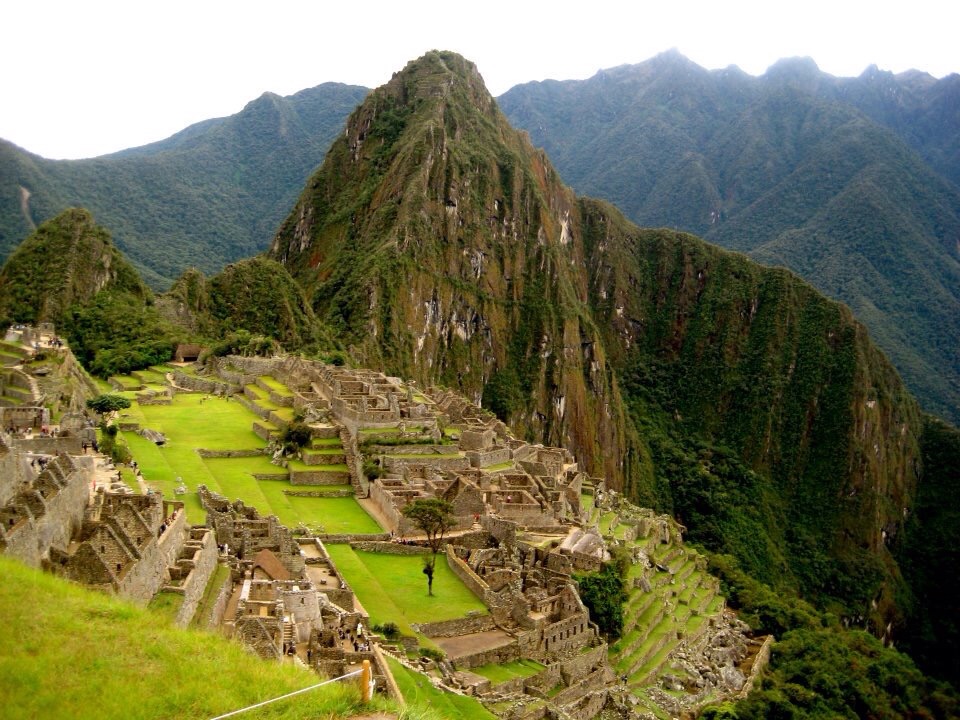
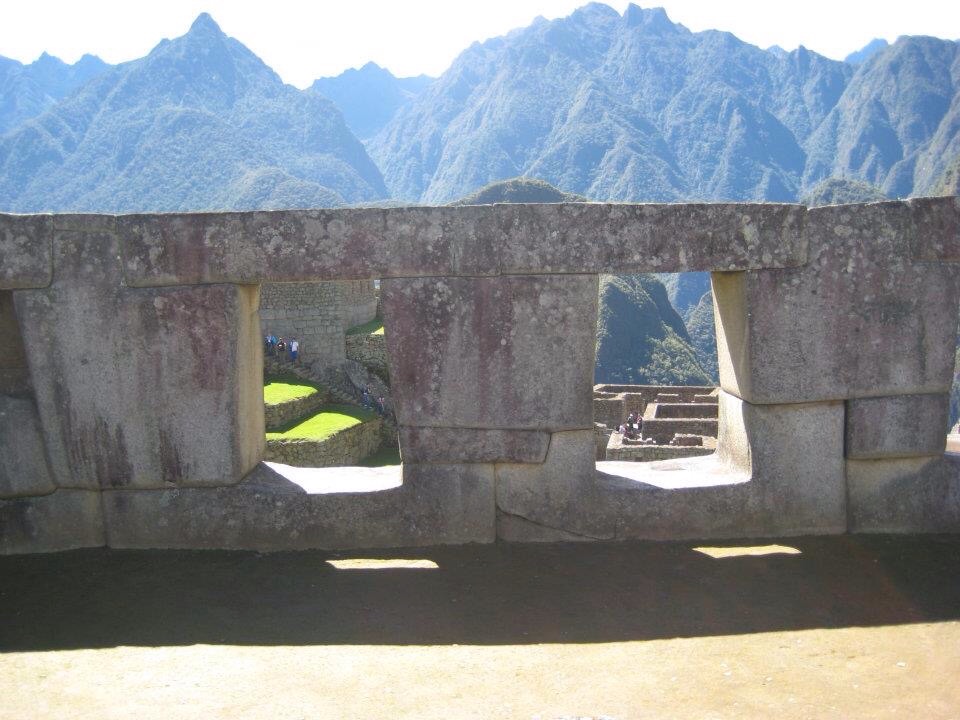
The daughter now known as the Sick Daughter was a trooper though! She made the hike without complaining and although we missed sunrise, the view of the mysterious ruins, the elegance of the structures, and the incredible geometry of the carved stones was overwhelming. I was struck by the lack of ornamentation. Not one curlicue, not a single mark that served anything other than a functional purpose. Instead of decoration, perfectly cut stones, brilliant in simplicity — yet forming a place the purpose of which is still not fully understood.
The approach from the trail, I think, is very different than if you have taken the train to the site. There’s a drama to reaching it after four days of intense hiking that a train simply can’t mimic.
Sick Daughter unfortunately spent the half day we toured Machu Picchu in the shadow of one of those perfectly formed stone walls, together with another of our hiking companions who had similarly been taken ill.
View down onto Machu PicchuCarved stones at Machu Picchu
About noon we took a bus (!) down to the small village of Aguas Callientes, where we stayed until the night train and van ride back to Cusco. After four days of hiking in the wilds, it was a shock to see cars, streets, and shops. Our guide was friends with the owners of a restaurant, which, like so many Peruvian structures, had an unfinished second floor that was still open to the main street. They let Sick Daughter stay up there on an air mattress; as I warned, if she rolled she was going to topple out of the building and into the street. In the meantime, the rest of us went to the mineral baths. As we had no swim gear we rented bathing suits – we did pick a place where we could see the washing machines! Quite civilized – and such a change from where we had been. You could order Pisco sours and drink them in the hot tubs.
The trip back to Cusco was an amalgamation of bad travel experiences. Bullet points: (1) On the way to the train station, all the power in the village went out, and hundreds of people were rushing in the dark, carrying heavy backpacks (at least those of us who had hiked). (2) Our hiking companions had decided illegally to bring beer onto the train – and the bag in which it was stored broke, causing beer cans to roll all through the dark train station, to the great concern of our guide. (3) No one sat in their assigned seats on the train, meaning that I could hardly find a place to sit with my feverish and clearly ill daughter.
The train didn’t actually go to Cusco but to another location, about a two or three hour van ride away from the city and our hotel. The roads were long and windy and steep and high and we had been up since pre-dawn, hiked miles at altitude, toured Machu Picchu and soaked in hot springs. At a certain point we stopped because Sick Daughter needed to go to the bathroom – I got out with her. As we stood there in the pitch blackness, we suddenly heard rustling in the underbrush and something started to lunge out toward us….we both screamed and scurried back to the van as fast as we could. To this day, I’m convinced we nearly fell victim to a mountain lion.
Finally, we made it back to Cusco and the sophistication of the Hotel Marquesas.
It’s hard to sum up the Inca Trail – not a summit of height, but certainly a summit of sorts. And next week – finally a real summit. A week from today we’ll be hiking Mt. Washington in New Hampshire.

![Galopogos [http://www.flickr.com/people/59888966@N00 Pete]](https://fromswamptosummit.com/wp-content/uploads/2014/12/image3.jpg)








 FromSwamptoSummit