Iceland, Land of Tomatoes – The Final Chapter

Tomato greenhouse in Iceland

After the adrenalin of our glacier hike and adventures in Vik, and the harrowing drive back to our Farmhotel – so much so that at dinner that night a couple from Sydney, Australia stopped by our table to ask what we had been doing that had engendered such excitement – we decided our last full day needed to be one of stark contrast.

We had seen an advertisement for lunch in a family-owned greenhouse that produced 18% of Iceland’s tomato crop, which seemed bizarre enough to fit well with the overall ethos of our trip. But first we wanted to sample one of Iceland’s famed hot springs, which we thought would be a good balance to the frigid ice of the day before. So we said farewell to the Efstidalur and set back along what was now our favorite snow covered road, heading, of course, in the general director of Fludir.

We had already decided to reject the more famous Blue Lagoon hot springs in favor of the much closer Laugarvatn Fontana geothermal baths. For a very reasonable price, you are given access to a series of pools situated at the edge of a lake, which is surrounded by snowcapped volcanic mountains in the distance.  The changing room was possibly the most spotless place I have been – two girls were diligently vacuuming the tops of the lockers themselves. The pools ranged in temperature, rising up to 50 degrees Celsius, and were adorned with rocks for resting your head, jets of varying water pressures, and benches to sit on. After steaming ourselves for a while, we started to resemble good New Orleans shrimp that has just started to turn pink. That was our sign to transfer to the Finnish-style, cedar lined sauna to dry ourselves out.  Once our shrimp-like selves had started to take on a slight bacon-like overlay, we felt that was a clue we had had enough. M and I retired to the previously empty women’s changing room only to discover it had been taken over by a bus load of middle aged jovial naked German women for whom this was clearly one of the highlights of their trip. We also realized we had probably violated most of the shower rules (don’t ask) but fortunately no one had been there earlier to observe our general American incompetence.

Keeping the red theme going, we then slipped and slid along more snow covered roads to the tomato greenhouse, Fridheimar.  And what a greenhouse it was! Masses of tomato plants, all growing from small boxes at the ends of the aisles, their vines entangled along string structures spanning the entire width of the greenhouse. Electricity is very cheap in Iceland due to the geothermal energy pulsing under everything, and no one would think twice about the energy costs of greenhouse gardening of this magnitude. Automatic on off light switches don’t even exist.  Tables were set for lunch, which was, of course, all you could eat tomato soup, or if you were a big spender like S, pasta with tomato sauce. There was also a hollowed out tomato filled with birch schnapps – Iceland was covered by birch forests until the Vikings cut them all down.

image image

Having had our fill of tomatoes, we returned to Reykjavik by way of a quick hike around and into the Kerid crater and a stop at two seaside villages.  Very empty in March – the small towns are best summed up by unpronounceable names, giant waves crashing on sand bars out at sea, black sand beaches littered with tiny shards of snail shells, and a solid 50 mph wind that didn’t let up. That wind pursued us the whole way back to Reykjavik, where even on the main road the local drivers had slowed down to a crawl due to the blowing snow. When we finally staggered back into the by then familiar Hotel Natura we were more than ready for a happy hour drink in the bar, together with the car mechanics convention attendees who seemed to have taken over much of the hotel.

Return to Reykjavik
Return to Reykjavik

Demonstrating some travel smarts, we enlisted the aid of the front desk clerk who was able to wangle a reservation for us at one of the city’s trendier restaurants  – the not particularly creatively named Seafood Grill.   All the food was good (although I could have passed on S’s whale and puffin appetizer) but the desserts were outstanding. I had an almond skyr cake infused with thyme….possibly one of the best desserts I’ve ever had.

We headed back to the airport the next day. But adventure still wasn’t letting us go. Just when we thought we had already faced some of the worst driving conditions known to man (at least to Florida man), the road to the airport – exposed, flat open – was simply consumed by blowing snow. J could see absolutely nothing – occasionally the yellow stakes at the side of the road made a brief appearance, but much of the time we were simply in whiteout. We arrived at the car rental return place to the spot where supposedly you could refuel – only to find the pumps were closed and we had to drive yet another 10 km  to find gas. We did, eventually, only then to have to turn around and drive along the same terrible road we had barely survived before. And, if anything, it had gotten worse the second time around! To say we were happy to leave the car with the rental people is an understatement. We later learned the road had been closed right after we had driven along it following a six car pileup.

image

But lest you think our happy travelers simply then boarded their plane for a smooth flight back to the land of sunshine and oranges….no, not indeed. We had been unable to book a direct flight back and were returning via Toronto. But our flight was delayed out of Iceland (I’ll leave it to my brilliant readers to guess why) and the airline would not hold the connecting flight from Toronto to Orlando the necessary 15 minutes – despite the fact there were about twelve of us on the plane who were missing that very connection. But this blog doesn’t exist to complain about the incompetence of airlines – by now that’s just part of the condition of human existence – suffice it to say that we ended up with an unexpected night in Toronto and a very early morning flight back to Florida.

I’m now sitting here listening to one of our first Florida wet season rain storms pelting down, and contemplating the next summits facing us in June in Ecuador. Iceland wasn’t really a summit, per se.  But travel takes all forms – and travel with friends is one of the highest.


Let It Go, Flow

image

Apologies to Paul Simon for the title (“never look back, Jack”). I’ve been writing an account of our trip to Iceland in early March – a travelogue of driving adventures, Nordic history, and stunning scenery. But all good sagas need intermissions – a time to break out the mead (or whatever it is the Vikings drank), roast some lamb (or whatever they ate) – and just generally sit around the fire and stare at the sky.

And so it is with my Nordic epic. I started this blog almost a year ago because I thought it would be the simplest way to share our then upcoming trip to Mt. Elbrus in the Caucasus Mountains with everyone who had expressed interest. But I rapidly discovered that I was getting something else out of it entirely – a chance to write outside of the tightly constrained boundaries of legal writing (my profession) and an opportunity to speak in what I like to think of as a more authentic voice.

Yet I can’t escape my Type A tendencies. As I faced writing this weekend about our final days in Iceland, I realized, “I really don’t feel like writing about that now.” And you know what? I don’t have to. I have to fight the impulse to turn everything into a homework assignment for myself, making this blog just one more weekly deadline to add to the numerous and all pervasive deadlines I deal with on a daily basis.

I’m a really disciplined person, in most ways. It’s what has enabled me to climb these mountains even though I started at age 50, and I’m soon to be 54. It takes a lot of will to climb up and down the world’s most boring staircase between two and four times a week almost every week since April 2010. No, I’m not kidding.

But it’s one thing to be disciplined and another thing to let it enslave you. The discipline of making myself write at least once a week here is one thing. But it’s another thing to feel I have got to write Part 4 of Iceland when I don’t feel like it, even when there’s no court or client demanding I do so. And it’s also another thing to feel compelled to publish this on a Sunday simply because I’ve arbitrarily imposed that internal deadline on myself.

So today I’m going to go with the flow. I did do my stairs today (in fact I wore my mountaineering boots and I’m sure I looked even more peculiar than usual), but I’m going to press publish tonight. Even though it’s Friday.

And how about you? How do you keep from turning things that are optional into obligations?

image

Iceland Part 2 – The Golden Circle, or All Roads Lead to Fludir

image

When last we left our intrepid travelers they had just finished slipping and sliding across a parking lot in Reykjavik, tattered map in hand, hail and wind gusts abounding. But day 2 they woke up bright and early to another Scandinavian/English breakfast to boldly embark on the next part of the great Nordic challenge, also known as the Golden Circle. It has a certain Wagnerian overtone – Ring series and all that.

Speaker of the Law
Speaker of the Law

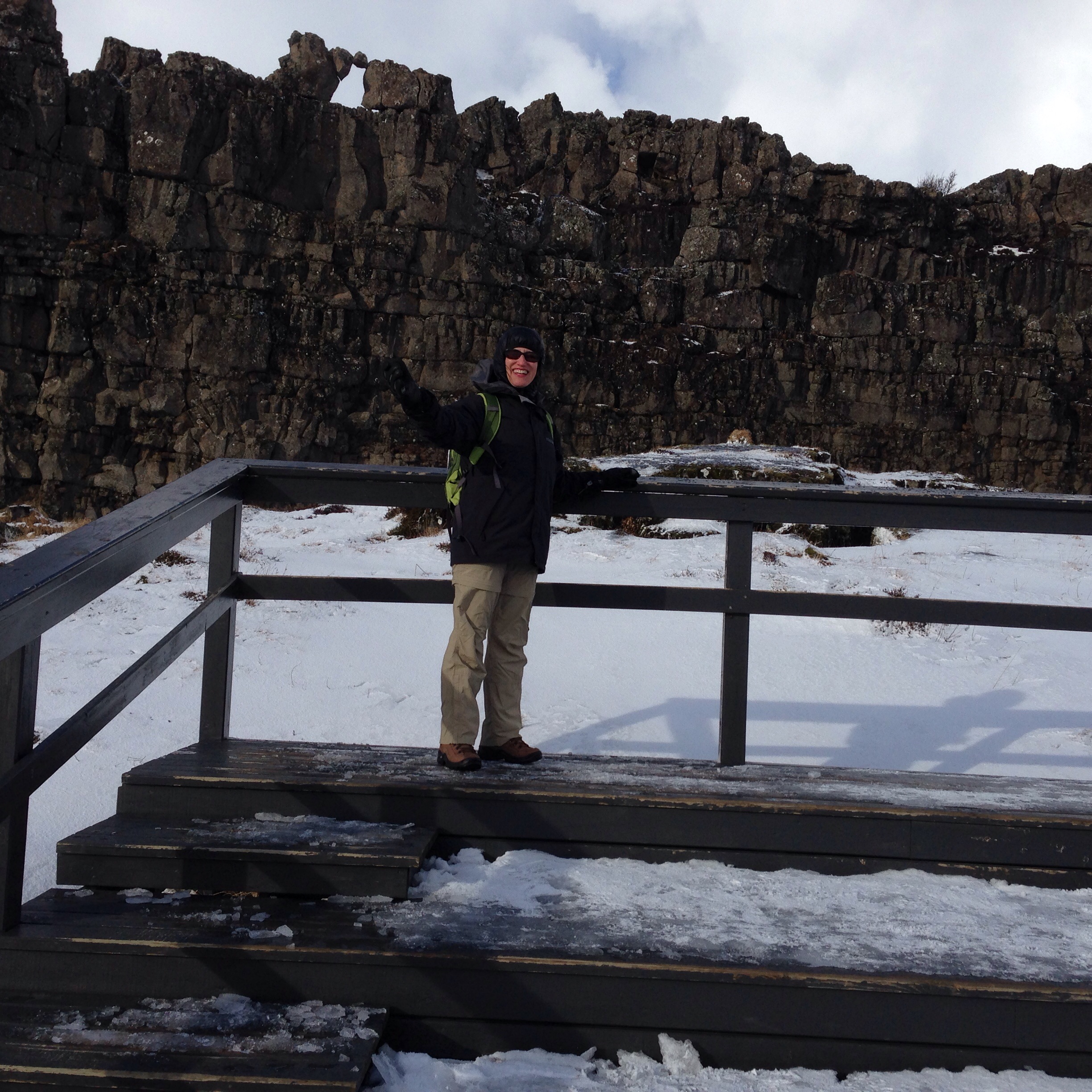
The Golden Circle has three main stops.  First is  Pingvellir or Thingvellir (I don’t have Icelandic characters on my keyboard),  the seat of Iceland’s Parliament starting in the 900s and, according to the signs, the oldest Parliament in the world. Unbeknownst to the ancients they had picked a valley located on the exact rift between the Euroasian and North American tectonic plates, which are pulling apart at the rate of a tenth of an inch a year – in geologic terms, the equivalent of a Daytona 500. You hike down the valley past such illustrious spots as the Drowning Pool and, my personal favorite, the Speaker of the Law Rock. Now if they would just put one of those in a courtroom….

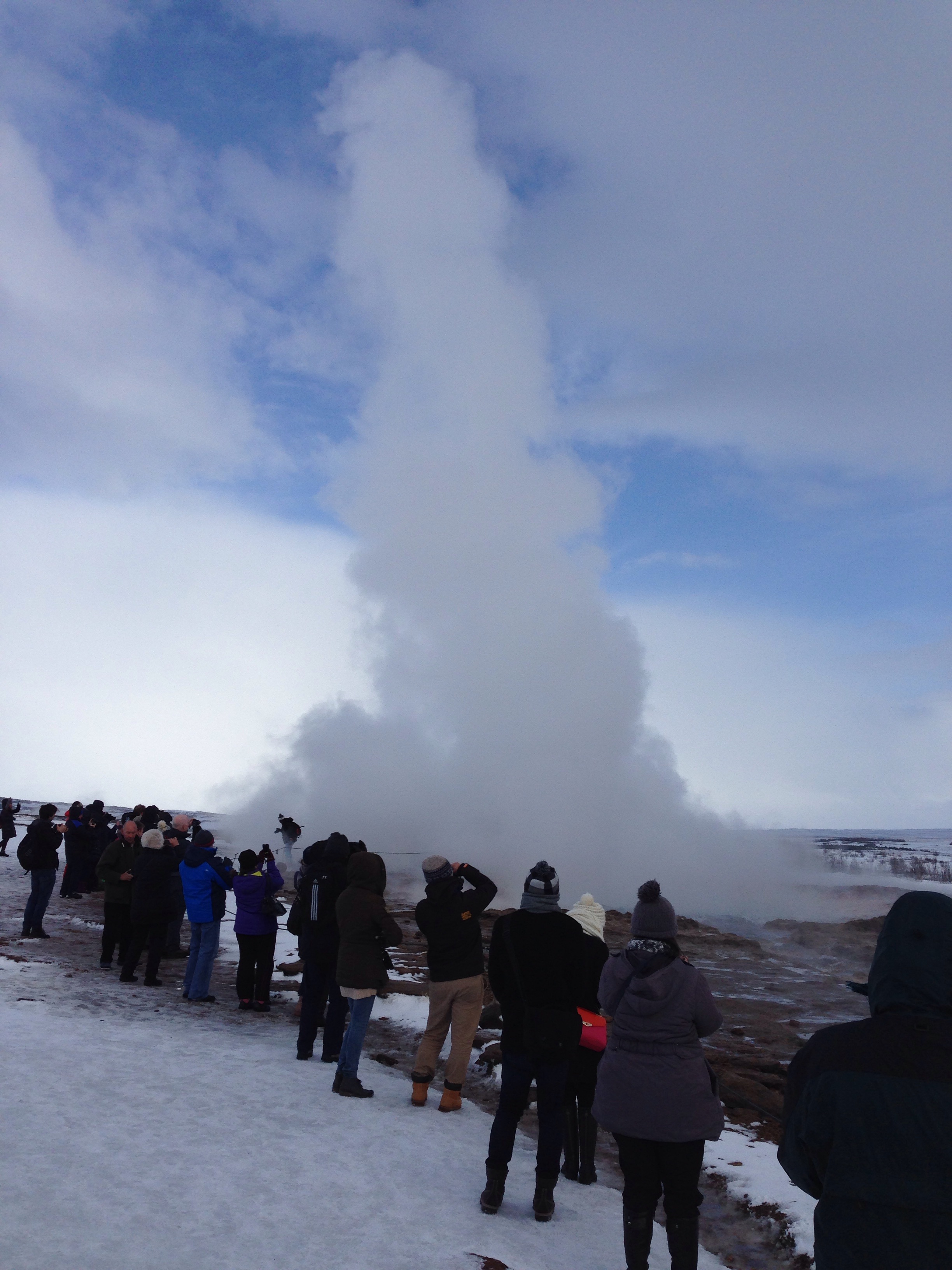
After exploring the seat of ancient Icelandic government, the next stop was the geyser, Strokkur. Unlike its larger cousin, the Geysir, it erupts every few minutes, so no one leaves disappointed. It wasn’t too crowded in early March, but must be a nightmare in high season. Mind you, through all this, husband J was bringing his Florida driving skills to bear through wind and rain and ice and snow. What friends M and S didn’t know until the last day was that he’d waived the collision damage insurance. Strokkur was dutifully impressive, shooting its 20 meter high spout with the regularity of a factory whistle. I personally found the little steam spouts percolating out of the side gullies and small bubbling puddles just as interesting.

image

Continuing our tour – along with a few hundred people doing the exact same route – in fact, I started to recognize people from stop to stop – we journeyed onto the famous waterfall of Gulfoss. After encountering some quite bad weather on the way there, we didn’t even realize we’d arrived. You’re on a high plain, seemingly with no topography, and then an elaborate visitors center appears out of the middle of nowhere. We actually sent S out on a reconnaissance mission before we all ventured out to confirm there really was a waterfall in sight. It is an amazing confection of spray and rock and mist. Not quite as massive as Niagara Falls, it has two tiers and at that time of year, one side is frozen into sharp stilettos, contrasted with frozen rolls of ice that cascade down the side of the valley.  The falls then flow around a bend and plunge into a narrow ravine that must be enormously deep.

image

Aside from the falls themselves, Gulfoss has quite a remarkable gift shop. We had to convince S that he truly didn’t need to take a seal skin back to the United States. Ethical issues aside, the guide books are full of warnings of the dire consequences such attempts will result in at U.S. Customs.  Of course, it is quite likely said seal skin really was produced in some quaint Icelandic greenhouse specializing in man made fur. More on the greenhouses later.

But by then it was mid afternoon, and we felt it wise to get somewhere within striking distance of the Farmhotel where we were to spend the next two nights. As three of us are lawyers (well, M has relinquished the profession in favor of a more divine calling), we followed the “detailed itinerary” provided to the tee, arriving in the bustling metropolis of Fludir in late afternoon – but only after driving through a pounding snow storm on what became our new best friend of a road, I think numbered 341. Little did we know that Fludir would become our navigational tool for the remainder of our stay in the Iceland countryside.

On the way to Fludir

As a point of interest, Fludir has a population of 394. It is located in the unpronounceable municipality of Hrunamannahreppur in the Southern Region, Iceland.  And the way we navigated, we ended up going toward, through and around Fludir for the next couple of days, since all roads seemed to lead to it.

After quickly passing all of its few commercial establishments – including yet another of the  ubiquitous Icelandair hotels, S finally broke down and went into the Fludir equivalent of a convenience store to ask where the Efstidalur Farmhotel was located. It was at that precise moment that J and I both had the same realization. We had noticed some weeks before that the hotel we were booked at was not the hotel featured on the self drive tour company’s website, but was actually located in an even more remote spot, further east and away from Reykjavik. Oh. And the itinerary from the tour company, of course, presumed we were staying at the hotel people were normally booked at. Oh.

So, J and I were not overwhelmingly surprised when S tromped out to announce that the hotel was not here but there and we had another half hour of fun driving in the snow before arrival. But the convenience store lady had given him a very detailed map which became our Bible for the next couple of days.

Through more snow and sleet we went, eventually driving up a steep hill to an actual dairy farm. Cows all around, out buildings, and a small low building of ten rooms, five of which overlooked the wide white valley of fields below.

We were home for the night.

Main building at the Efstidalur Farmhotel


Live From Iceland –

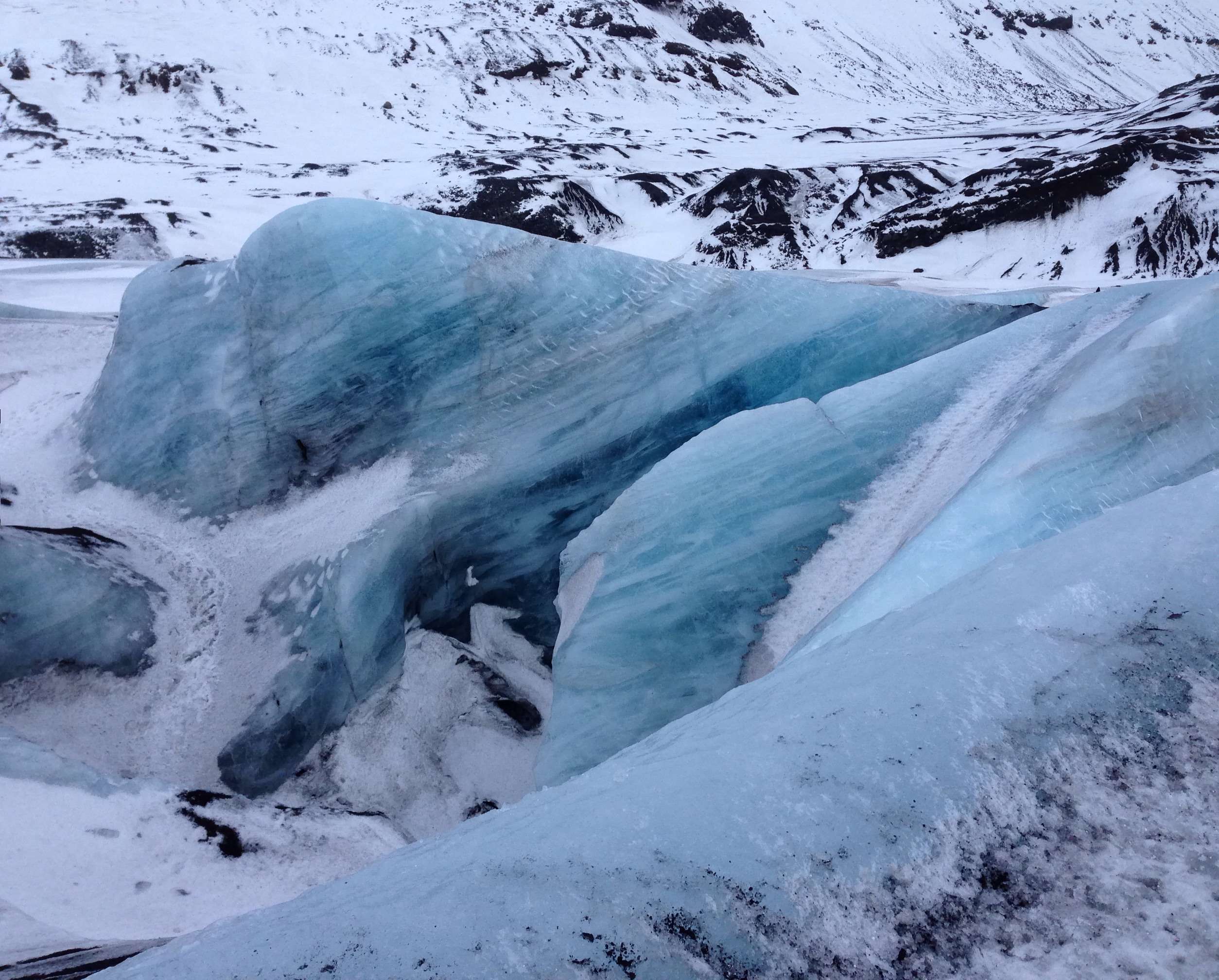
Sitting at the airport about to return from solid white out in Iceland to sunshine in Florida – much more to come in succeeding posts when I’m not about to catch a plane. Iceland: Glaciers to windswept sea to white on white against grey skies, and blue ice pitched against black lava. In the meantime, a quick photo:

Blue ice on black
Blue ice on black


An Ode to Airports – Terminals Aren’t Terminal

When I started this blog last April, one of my first posts was entitled, “Where am I going and where have I been?” It was made up of exactly one photograph, as at that point I was still working my way through the intricacies of things like figuring out that a tag wasn’t a piece of paper with a price written on it (and was a far cry from a backyard game).

But a layover at the Miami airport this weekend provided the perfect graphic to answer that original question – at least for the next six months. As I looked at exotic destinations on the departures screen, many much more exciting than my 40 minute jaunt back to Orlando, I saw the below:

image

Where am I going? Quito, listed there near the bottom. (Or Orlando, depending on your time frame, shown just at the top of the screen.) And where have I been? Well, Raleigh-Durham – where I grew up – appearing right under Quito. (Or Orlando, once again, depending on your frame of reference.) For the record, “Raleigh-Durham” is a misnomer – I grew up in Durham!

Airports are like that. You can smell the adventure waiting at the other end of a flight. I still find it remarkable that 100 plus people can be sent 30,000 feet high at over 500 mph. At an airport, you can sum up the where you are and where you want to be in one screen shot.

image

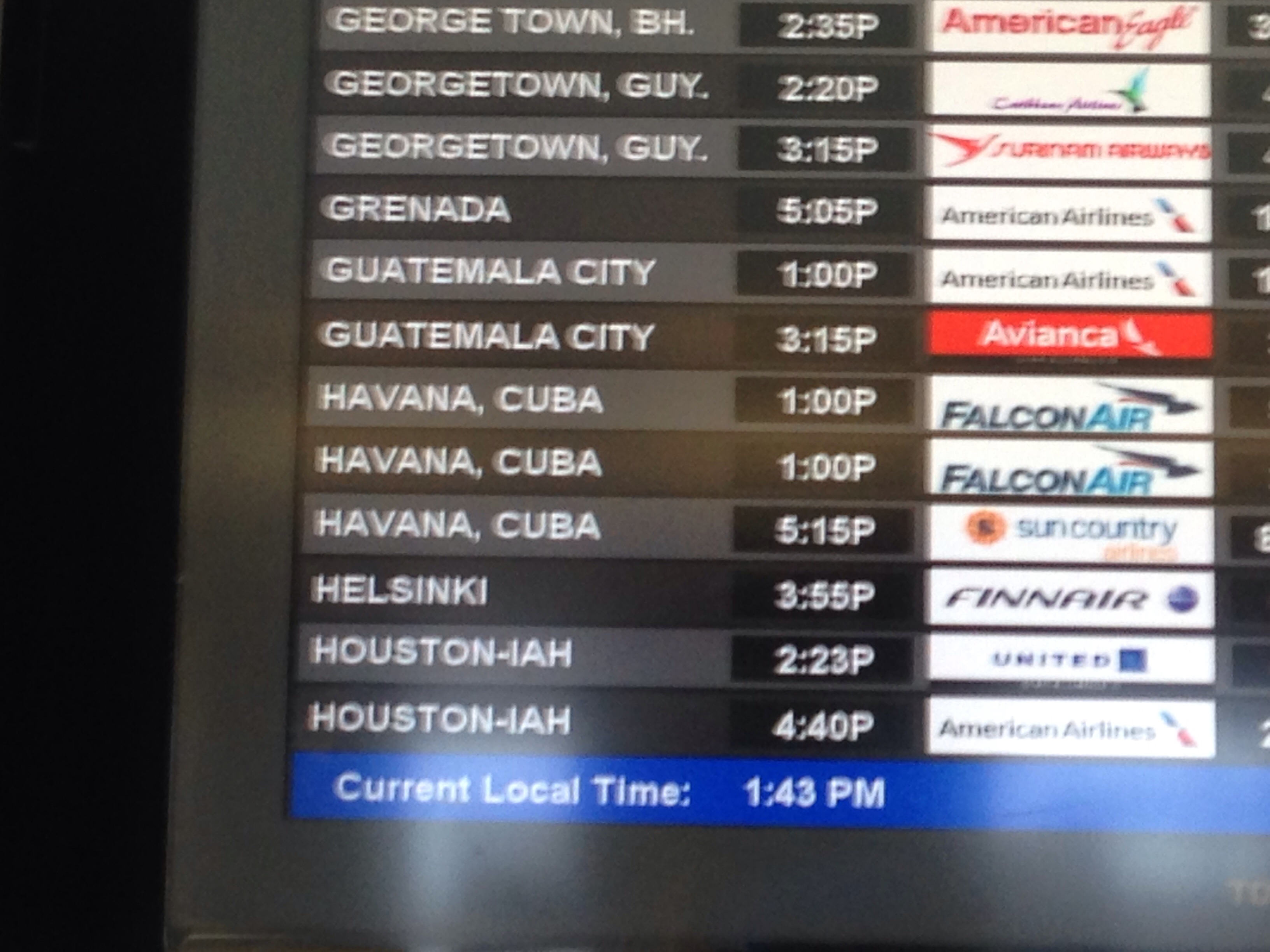
Another example – note the Havana, Cuba destination. I’m not sure I can recall ever before seeing Havana listed on a departure screen, much less right above Houston, Texas. What better way to show a shift in geo-political realities.

When I was growing up in the 1960s and 1970s, my family always arrived at the airport dressed in Sunday best and several hours before any scheduled departure. My brother and I regarded the waiting at the airport as much a part of the trip as the actual journey. I still remember the iconic TWA terminal at JFK, and how slick and modern Dulles Airport was, rising out of what was then a rural area outside of Washington.

Photo by Joe Ravi, lic. CC-BY-SA3.0

As the reality of the Cotopaxi and Chimborazo climbs sets in (right now I am at the slightly terrified stage), I just need to take it one step at a time. And after the training – the next step is going to be at an airport. And whatever happens, I know that when I set foot in one of those ultra modern terminals, it’s not a terminal in the sense of an end. Yes, it will evoke memories of where I’ve been – but even more excitement over where I’m going.

Cotopaxi and Chimborazo – Where We Are Going

Volcanoes of Ecuador

So I did it. Last week, on Tuesday to be precise.  I emailed Mountain Madness, our trekking company, and just said yes to the Chimborazo extension. Now I recognize that some of you were pushing for the Galopagos Islands, but I simply couldn’t escape the fact that there will be no other point at which husband J and I stand a better chance of actually climbing a 20,000 foot mountain. I think I can manage the Galopagos in future years.

As I continue the grueling process of forcing  myself to run at ever faster paces and climb stairs with increasing amounts of weight – and of finding the time to do so – it occurs to me that I have not really described the two mountains that are engendering such passion (or foolhardiness). I’ve referred to them by name, but without much explanation.

Here’s what is inspiring me.

Both mountains are part of Ecuador’s Avenue of Volcanoes, named by 19th century German scientist Alexander Van Humboldt.  Due to a location just above and below the equator, the scenery is supposed to be reminiscent of the Scottish highlands or the Arctic tundra, at least according to our trekking company.  Both were first summited (at least by westerners) in 1882 by Edward Whymper, for whom some of the passes are named.

Cotopaxi last erupted in 1940 and some consider it the world’s highest active volcano.  It stands at 19,347 feet (5897 meters) and is located near Quito, which at 9400 feet is itself one of the world’s highest cities.  Cotopaxi has been worshipped as a sacred mountain, a bringer of rain and fertility.

We will acclimatize for the altitude first with a climb up Guagua Pichincha (just outside Quito, standing at 15,696 feet, last eruption 2004) and then what is described as an “enjoyable rock scramble” up Illiniza Norte (16,818 feet), with trekking, camping and stays at haciendas in between. Mules are supposed to help at certain points as we travel between and up the various mountains.  Once we are at Cotopaxi, summit day (summit night is a more accurate description) begins at 15,749 feet, where we will have been staying at the Jose Ribas Hut.  The glacier starts at about 17,000 feet, and according to Mountain Madness, we will be crossing snow bridges, avoiding large crevasses, and climbing “short, steep sections.”  Once at the summit of Cotopaxi, we should be able to peer into a perfectly round caldera, the origin of the steam you apparently can sometimes see boiling up.

I have found a lot less written about Chimborazo. It is famous for being the point closest to the sun, due to the bulge of the earth at the equator. As I mentioned before, I hope our attempt to climb it is not too Icarus like. It is currently inactive, with a last eruption in 550 A.D. or so.  It reaches a whopping 20,564 feet (6268 meters) and is the highest mountain in Ecuador. Chimborazo can sometimes be in very bad condition – with unstable snow, big crevasses and high risk of rock fall. The itinerary states that if Chimborazo is not climable, we are to attempt Antisana. It’s only 18,714 feet high, but from what I’ve read is even more technically challenging, as it is completely covered by glaciers, and is not climbed very frequently.

Despite all this, you may still be left wondering – but “why?” Well, a summit goal, for me at least, gives me something to focus on, look forward to, and lifts me out of the drab tension of the day to day working world.  And the other reason is simply a variation of the “because it’s there” phrase – because there is something about standing on a summit that gives a high that doesn’t come from anything else.

A Walk on the West Orange Trail

Cement plant amid abandoned orange groves

Training has to be in earnest now. The long Martin Luther King weekend  provided the impetus for our first hike with weight since – oh, probably when we were training for Elbrus last year. But with Cotopaxi and still maybe Chimborazo looming a mere six months away, it’s time to ramp up.

Orlando has been working on its urban and semi-urban trails for a number of years, and the West Orange Trail was one of the first. It stretches 22 miles from Killarney to Apopka, running mostly along abandoned railroad tracks.  It passes through suburbia, a high end residential enclave, abandoned orange groves, and, every now and then, glimpses of the pine forests and palm hammocks that graced the state before development threatened to turn it into one giant subdivision.

Husband J and I had hiked the segment from Killarney to Winter Garden last year, so we were already familiar with the classic car show that takes place in Winter Garden on Saturdays. People from all walks of life sit on lawn chairs with everything from Model Ts to 1967 Mercury Cougars on display. Somehow I don’t think my 10 year old Sebring convertible would have qualified.

So this time we decided to load up the backpacks with about 25 pounds and walk the next segment, from Winter Garden to about three miles beyond the Chapin Station by Chapin Park, for a nine mile round trip. Before Ecuador this summer we are going to try to walk the whole length in one day. Hey, if the Romans could march over 20 miles every day, why can’t we?

Not really a walk on the wild side

The first part of the trail cuts through several housing developments. One of the most striking features is the lengths and lengths of white vinyl fences that line the trail. The fences finally stop and you’re treated to a view of backyard after backyard – all of which blend into one another with barely any delineation. Talk about peer pressure to mow your lawn! Notably, I saw not one soul sitting outside on any of these neatly manicured grass strips, even on a beautiful Saturday afternoon. Finally, housing developments give way to abandoned orange groves. As we passed the one with the cement plant rising up out of the middle (see photo above), we heard what at first sounded like a loud rant of some hellfire and brimstone preacher. But as we got closer, in the distance we could just hear an amplified broadcast of MLK’s I Have a Dream speech. Somehow very fitting for the weekend, the trail and our training.

West Orange Trail - J's trademark shadow in the corner
West Orange Trail – J’s trademark shadow in the corner

The next segment did move into something approaching nature, although the sound of the highways nearby was never too far away. A hawk almost strafed our heads as we paused on the bridge shown above, and then settled into the trees, its plump belly blending into the mottled deep green black leaves.  We passed by a specialty crop garden tended by a local high school, as well as what looked like an uninhabited barnyard with a big sign saying sustainable farming.  And at one point, from a warehouse al out hidden by the trees, we could hear the throbbing bass of a rock band practicing. On the way back, it seemed to have transformed into something that sounded like a mariachi band. Same band? Or rented space?

The West Orange Trail even has a few hills – at least by Florida standards. I just kept thinking to myself, “imagine it’s 10 degrees farenheit, it’s a 35 degree slope, and you are at 18,000 feet.” You’ve got to have some imagination to train in Florida.

There's a hawk somewhere in there - use your imagination!
There’s a hawk somewhere in there – use your imagination!

Iceland Cometh – Travel With Friends


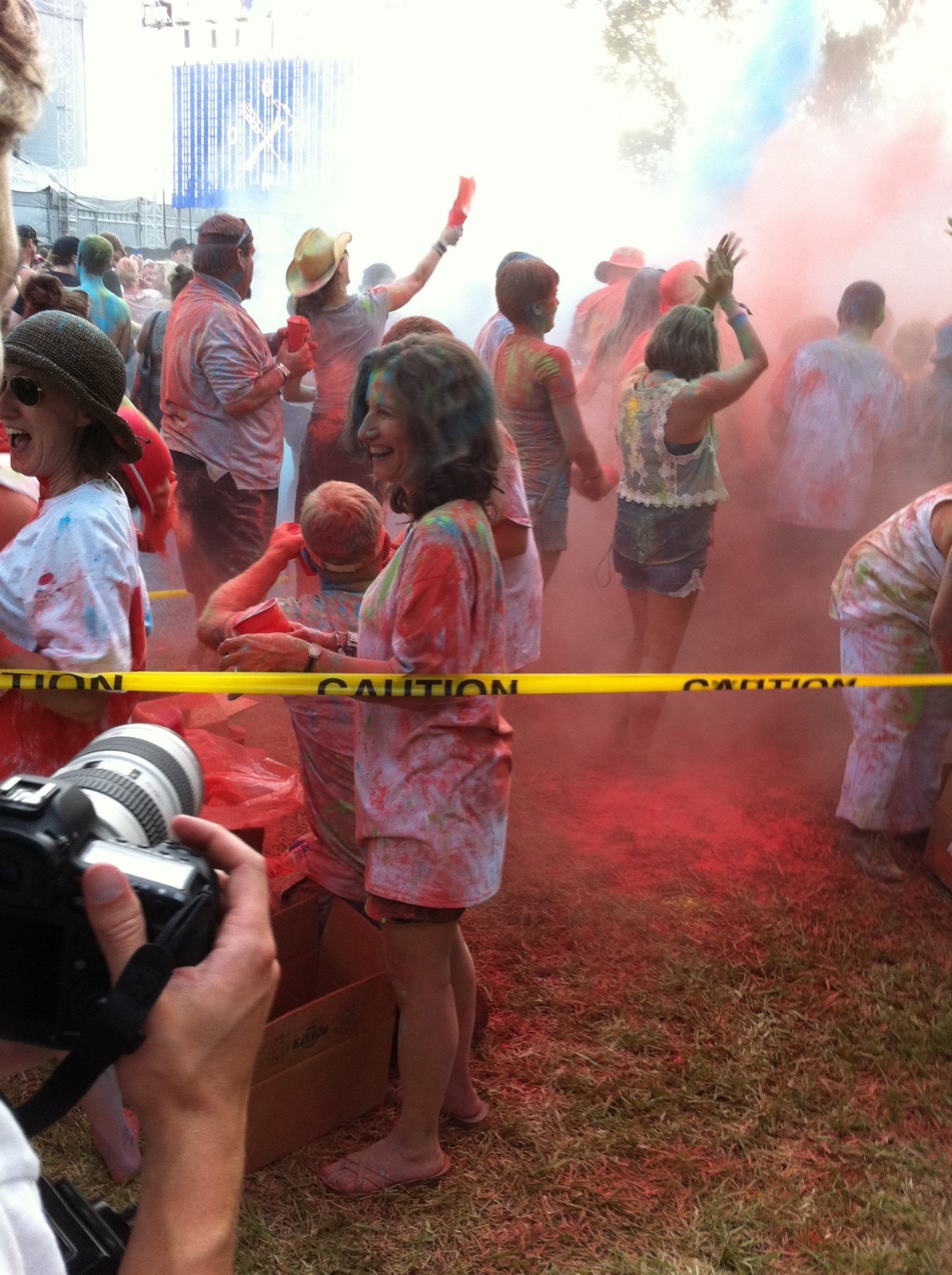
Powder paint at Gentlemen of the Road - Travel With Friends
Powder paint at Gentlemen of the Road – Travel With Friends

Many years ago, when daughter #1 was still being carted around in the plastic contraption we called the rocket seat, we would go out to dinner with our then childless friends, M and S, and drool over all the places we could explore once our parental responsibilities had lessened. But then daughter #2 came along, and M and S had their own equally charming off spring and those days seemed to get further and further away.

Oh, there was the moment when we thought there was a possibility of a two family trip on a Russian icebreaker to see an eclipse in the Arctic Circle. S, who is an amateur astronomer, had seen an ad in one of his magazines that suggested such an adventure could be had for the sum of $1500 a person. Unfortunately, in the cold light of Monday, he realized he had ignored the extra zero in the price.

A couple of years ago we did all make it to St. Augustine for a long weekend to see The Gentlemen of the Road tour (Mumford and Sons etc). A great time, but aside from the paint powder extravaganza shown above, it wasn’t what you would call a particularly adventurous weekend.

Althugh we have yet to convince the Friends that they too can reach summits we have all decided to spend several days in early March in Iceland. The plan started because at that point – for some unknown reason – there was a straight through flight from Sanford, Florida to Reykjavik on Icelandair. We were also all under the impression that Iceland was located closer to where Greenland is and there would be a minimal time difference, making it a good long weekend destination. We’ve now determined there is no direct flight and it is a five hour time difference but we are going just the same. I also bought husband J a globe for Christmas.

I have little idea about Iceland except for an early episode of Anthony Bourdain’s first series, No Reservations, but trips with no expectations are sometimes the best. And I am confident that we can get M and S onto a glacier – at least for a little bit.

So now when I’m training for the June trip to climb Cotopaxi and Chimborazo at least I have something else to occupy myself with – the 7 mile run yesterday was a lot more fun when I thought of volcanoes, hot springs and ice. I decided to ignore the dried cod.


Training Up on the Roof


Up on the roof - with hibiscus below
Up on the roof – with hibiscus below

In passing, I’ve previously mentioned a fear of heights – in fact, it played a role in the decision not to climb the Grand Teton. I’ve downplayed it to avoid the inevitable queries about why someone with any such concern would decide mountain climbing was for them. But occasionally that fear rears its head again, like the proverbial dragon waking up in its cave. And I realize that each time I set off for a new summit, vertical drops provide their own very special form of challenge (or torture).  It goes back to kindergarten when on my way to the second floor of the building I somehow slipped between the steps of the fire escape style metal staircase, just catching myself before I fell. I was a skinny child. I didn’t say much to anyone about it, but I remember it to this day.

Year later, when I was about 13, my family made a trip to Grandfather Mountain in North Carolina, where my father walked my brother and me over the swinging bridge that crosses a gorge several hundred feet below. I still have never told anyone how completely paralyzed I felt on that bridge, but one of my repeated anxiety dreams (aside from the one where you have to take an exam in a class that you forgot to attend) is of being on a high, narrow bridge with no rails, unable to move forward or back.

So, yesterday when my husband (now known as J) and I decided the time had come to clean the skylights on our house, I clambered up the ladder after him. (The roof really is a bit steeper than the photo shows.)  As soon as I put my foot down on the sloping roof every fear I’d had was triggered – what in the world would prevent me from simply sliding right back down and onto the patio below. I started to think about the angles of Cotopaxi – and, if we do it, Chimborazo – and thought, well, if you’re having a hard time on your own roof top you aren’t going to do very well there. So I took a deep breath, trusted in the grip of my tennis shoes, and bribed myself with the promise of the great view I would have of the neighborhood and everyone else’s backyards.

And it worked. By the time we were done I was skipping around on the roof – if not like a mountain goat at least like one of those mules that go up and down the Grand Canyon.

But, you know what? Last night I still dreamed about walking on a narrow ledge at the very top of a multi-level mall. I had to hold on to some sort of rope and half way along the ledge drop one rope and pick up another. I did really well on one side of the mall, but when I had to cross the ledge on the other side, I found myself saying to the anonymous, but stern, guides, I’d just prefer to do this tomorrow.

Still some work to be done before Cotopaxi!


Blue Springs – Mysteries of a New Year

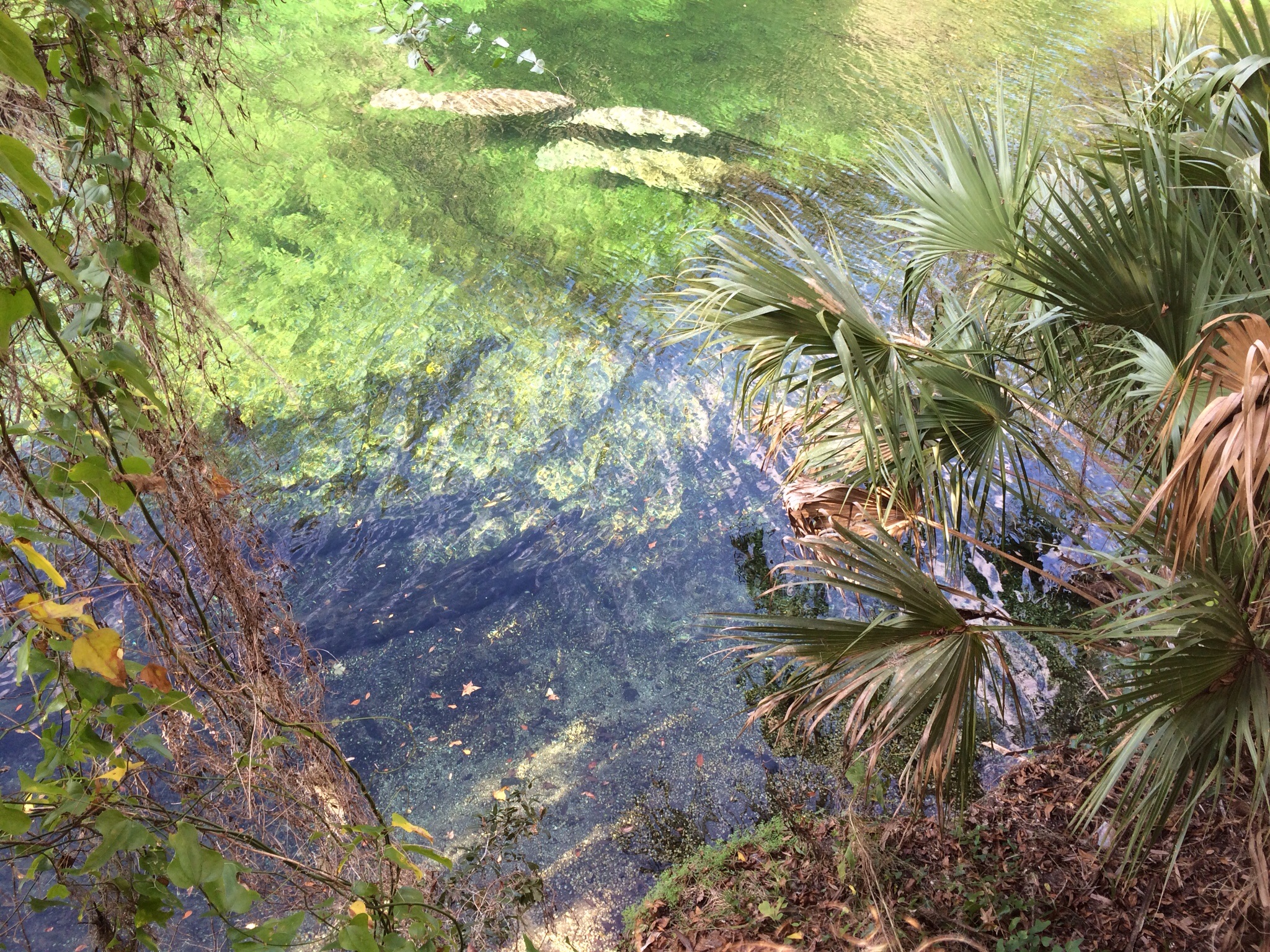
Manatees in the emerald waters of Blue Springs State Park

We celebrated the day before New Year’s Eve with a very tame hike along the boardwalk at Blue Springs State Park to see the manatees. Just daughter #1, her boyfriend, the husband and me. Oh, and in celebration of 2015 and six months of writing this blog, I’ve decided the husband can now have – if not a name – at least an initial. Perhaps a little Kafkaesque, but “J” does have a certain ring to it. Perhaps the daughters will obtain their own initials at some point.

I’d like to say that Blue Springs is a hidden treasure – but it has clearly been discovered, as demonstrated by the hordes of eager manatee watchers who were out in force on an overly hot winter’s day.  Blue Springs has always been “discovered”: it has been a tourist spot – or at least, a layover – since the pre-train days of 19th century Central Florida. The house of the original settlers still stands – a couple from Brooklyn, New York, who migrated to Florida to establish what became a steamboat stop on the St. John’s River in the 1870s or so. As steamboats gave way to trains, the place evolved into a weekend resort for hunters and fishers. The tourism that seems so out of place in the apparent wilderness is actually an authentic part of Blue Springs.

Blue Springs is also tremendously accessible to anyone with any physical challenges. A smooth boardwalk runs the length of the river, which not only helps walkers who need some assistance but also protects the plant life. The place itself is one of the most beautiful in Central Florida. The spring – one of the largest in North America – pumps out water from the Florida aquifer at a staggering 100,000,000 gallons per day. The water is a brilliant clear emerald color, and through it you can see long nosed gar wending their way down the river, as well as the large cow-like blobs that are the manatees themselves. Legend has it that manatees were the original mermaids, but it would take many days at sea for one of them to resemble Ariel!

One of my favorite parts of Blue Springs is the fact that somewhere hundreds of feet down the spring connects to the limestone caves that permeate Florida’s substructure.  As I understand it, many of these underwater caves are unexplored (and probably can’t be explored). Frankly, as much as I can imagine scaling summits of mountains, the idea of going underwater into a subterranean cave is unfathomable. But just knowing of the existence of those deep dark places – who knows, perhaps inhabited by goblins mining for the fairy queen’s jewels – adds an appropriate level of mystery for this New Year’s Eve.

Because who knows what 2015 will bring? It should bring our climb up Cotopaxi, but that’s just one of the many summits I’m sure I’ll encounter. 2015 is stretching out before me like those underground passageways below Blue Springs – and it will just take a little imagination  to realize its possibilities. Here’s to exploration in the New Year!