West Orange Trail – Starting from the Other End

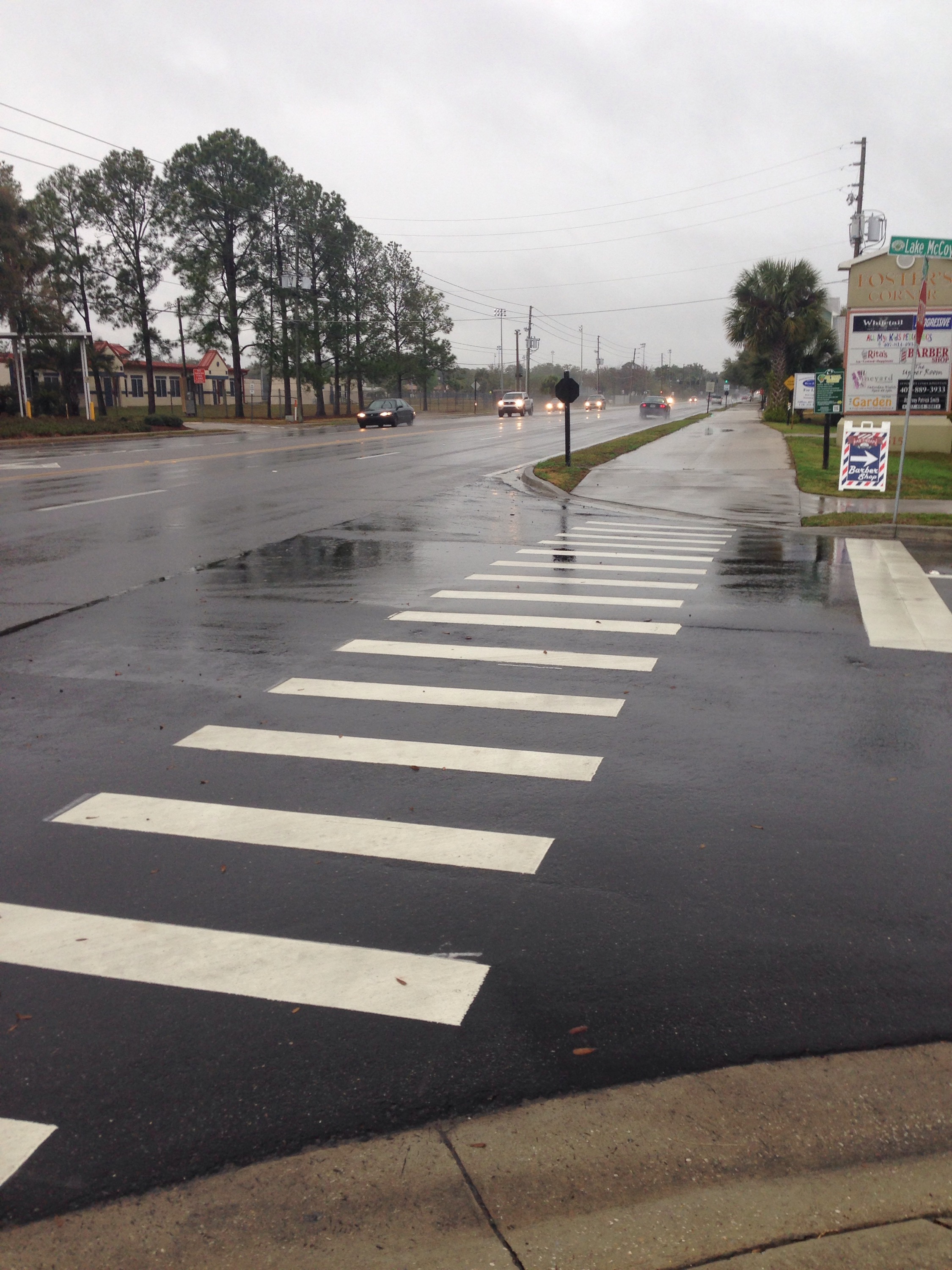
Pedestrian Bridge Over Apopka's Main Street
Pedestrian Bridge Over Apopka’s Main Street

Saturday presented with a solid drizzle of rain from dawn to dusk and thereafter. What better occasion than to try out some new gear to check how waterproof it really was.

Husband J and I decided a few more  miles on the West Orange Trail would be an appropriate testing ground. But this time, instead of starting in charming Winter Garden, we decided to begin our hike 22 miles away at the other end of the trail, just outside of Apopka. We have a goal of ultimately walking the whole thing in one fell swoop, but before we do so we thought we should have walked all its pieces.

The trailhead on the eastern end is nothing short of unimpressive. Literally nothing but a small sign marks the trail, which runs along a busy commuter road, and it’s hard to tell where the regular sidewalk ends and the trail begins. It’s equally mysterious why that particular point was selected – there’s certainly no distinguishing characteristic. There are a couple of strip malls, populated by places like “Beef O’Brady’s,” Pizza Hut, a grocery store and the inevitable 7-11. And no parking – except for the strip malls.

IMG_1703

After a couple of miles of cars whizzing past, we were glad to turn down a side street where the trail finally diverged from the roads. It wound back behind several schools in a wide concrete band, at one point on a well-built boardwalk that meanders past a deep gully, unusual for Florida. There were some houses tucked behind it and I couldn’t help but wonder what the bear population was. For those of you not from Florida, black bears have developed their own suburbs in all of Orlando’s outlying areas. As the boardwalk ended, we passed a huge Seventh Day Adventist church and several expanses of open land. It was not clear if they are parks, grounds of commercial establishments, or simply placeholders waiting for development. And there is some topography- there is at least one real hill and by the end of he trail, my Map Your Walk said we’d gained a whopping 65 feet.

The trail finally reaches the town of Apopka itself. A pedestrian bridge, shown in the top photo, crosses Main Street. There’s a restaurant called the Catfish House right by the bridge – which looks as though it would be an appropriate place for celebration when we finally do the entire trail. And it looks a lot more interesting than the Duncan Donuts, which appears to be the other food choice.

Next West Orange Trail hike – well, we still have about 12 or so miles before we’ve walked all of its bits and pieces. I’m hoping for a little less 4 wheeled traffic on the next part. As for the gear – it worked admirably. Patagonia Alpine climbing guide pants repelled water just as advertised and my new hiking boots – yes, after five years I have a new pair of Renegades by Lowa – continue to get broken in. And just as well – because the weather reports for Iceland – where I will report from next week – indicate snow every day!

Random Thoughts Of a Flatlander in Training

The Recalcitrant iPad

Some of these thoughts didn’t surface while actually  running, stair climbing or the like, but since those activities occupy a lot of my time, they were certainly in close proximity.

1. Technology baffles. Of all places and times, yesterday at the hair salon – after a morning run (despite appearances, aspiring climbers get their hair done too), my previously faithful iPad informed me that it had finished updating and would I like to activate it. As I hadn’t updated anything, I was a bit taken aback, but followed His Highness’s commands and briefly my iPad started working again….only to give me the same message a few minutes later. This time, however, my attempts at activation were met with the ominous response – “activation failed.” At that point I began to wonder if my iPad had been in communication with a neighboring iPad at the salon and they were engaging in concerted activity. A long visit with Apple phone support, involving iTunes and downloads of software updates, proved unsuccessful – leading to that most
frightening experience of the 21st century – a visit to THE GENIUS BAR AT THE APPLE STORE, presently scheduled for Tuesday. But this morning, I pressed the magic buttons again and amazingly – the iPad seems to be working. We’ll see. I’m not canceling my date with Mr. Genius yet.

Parsley and Kale
Parsley and Kale
Turnips from seed...
Turnips from seed…

2. Earth is good. Even though, horror of horrors, our temperatures here in Central Florida dropped into the thirties this week, the vegetable garden is continuing to produce. After a hard and busy week it is amazing the difference that the mere act of pulling weeds can make to your psyche. When people ask me how I can be afraid to peer over a balcony of a New York penthouse, but gazing down the steep pitch of a mountain doesn’t bother me, I answer that it’s the earth. When you’re on a mountain you’re always rooted to the ground. Not so on a steel and concrete structure.

3. Randomness amazes. One of the more interesting features of said vegetable garden is the plethora of plants that come up seemingly out of the blue. But after a few minutes of wonder, you remember, oh yes, I did plant Italian parsley there a couple of years ago. Or, that sorrel must be the remnants of the bitter war I waged with the world’s hugest sorrel plant in 2012 (do you know how few uses there are for sorrel?).  As of now, I have onions that sprouted from last year’s crop; some miscellaneous carrots whose seeds had apparently lain dormant for a while; and flat parsley. Remarkably enough, this gardening technique extends to my composter. One advantage to failing to turn over its contents is you never quite know what might start growing. I’m pretty sure I have bean plants coming up.

4. Iceland is around the corner and Ecuador approaches. Next week this time we’ll be getting out the winter gear and we have to put more money down for the Cotopaxi and Chimborazo trips.  Eyes on those goals. They keep me going every day, together with a healthy dose of randomness.

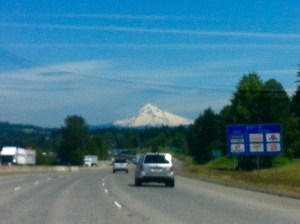
End Games or Beginnings? Mt Hood.

On the way to Mt. Hood  - photo from a car window

End games. What a great phrase. And it is what I think about as I trudge up the stairs with my backpack to prepare for this summer’s summits.

To remind myself of one of the original reasons I embarked on this journey to Cotopaxi and Chimborazo and what the end game actually is, here’s an account of an unsuccessful trek up Mt. Hood in June 2012.

We had just returned from our hike along the Inca Trail with daughters #1 and #2 in May 2012. But June is a month of brides and we were already scheduled to attend a wedding of a dear friend at the Columbia Gorge Hotel on the Hood River. What could be a more obvious add-on than an attempt on Mt. Hood.

We left the lovely afternoon wedding reception perhaps an hour early and drove off in the general direction of the biggest mountain we could see. Now, we’d been to Mt. Hood before, many years ago when the daughters were small, but that involved a car, a visit with old friends, and lunch at the ski resort. It did not involve ropes, plastic boots or crampons.

This time, we stopped at a grocery store to buy what we thought we might need food wise, and continued on up the winding road featured in the intro scene of the movie of Stephen King’s The Shining. It’s steep and windy and the pine trees lean in at you from both sides of the road. We eventually arrived at the Timberline Lodge, built in 1936. It was constructed entirely by hand, using many craftspeople from Europe, as part of a Depression era Works Progress Administration program. It is perched at the side of Mt. Hood at an elevation of about 6,000 feet, and an entire ski complex has grown up around it. The rooms are small, and retro. No televisions; there are quilts; and the phones have rotary dials.

This was our first experience on ropes and ice. One main guide company leads climbs up Mt. Hood, and they supply most of the equipment, from helmets to plastics boots to ice axes and crampons. Neither husband J nor I had used any such exotic gear before. Kilimanjaro just required leather boots and a strong set of legs.

The first day consisted of skills training. The two of us were the only climbers in our party. Our guide, Phil, was from Ireland, had learned to climb in and around Sheffield, England, where my mother is from, and had trained under classic alpinist climbers in Chamonix.

We knew knew we were off to interesting start when we checked in at the guide office. Just a few days before, an expert climber, climbing solo, had fallen to his death. Some of the guides had been involved in the rescue attempt, and were filling out accident reports as we were signing all of our liability waivers.

We spent several hours on an ice bank behind the hotel learning how to move on rope, self arrest, and the varying types of steps needed to ascend a mountain. Rest step (well, we knew that one from Kili), traversing (ascending steep sections in an s shape), “duck” steps straight up ….all the while remembering to keep that ice axe in your uphill hand.

By early afternoon the sun was beating down and it was time to go back to rest and prepare for our 2 am date with the snowcat that would take us to the point where we would start climbing. Even though it’s a little hard to sleep at 7 pm we managed a couple of hours before we got up at 11:30 – we knew it would take us ages to strap ourselves into all of our unfamiliar equipment without tangling ourselves up in carabiners, climbing harnesses and the like.

We expected problems as soon as the snowcat arrived – and out tumbled three very shaken looking climbers – a middle aged couple with a grandson – who had arrived at the point of departure up the mountain only to decide it was too windy and wet even to attempt a climb. They came down without ever even getting out of the cat! Phil said he had never actually seen that happen before. We had been watching the weather all afternoon and knew things didn’t look promising. We were offered a raincheck (appropriate use of words) but a Florida residence didn’t really lend itself to an impromptu trip up Mt. Hood any time over the next twelve months. We told Phil we recognized the risks and the likelihood we wouldn’t summit, but we wanted to go as far as we could while staying safe.

After we were unceremoniously dumped out of the snowcat at about 8,500 feet, what we didn’t know about mountain climbing became more and more apparent. Winds were gusting up to 50 MPH or so, and we were still struggling to get goggles on over our climbing helmets. That should say it all. Our lack of experience was obvious. The procedure for attaching our ice axes to our packs had become an absolute blank. Phil immediately took off to test the snow and to check conditions – which were awful. It was too soft for crampons. We took off, sinking into snow up to mid calf on most steps. Phil broke trail; I was in the middle; and J was behind me. There were very few other headlamps heading up in the swirling fog/rain/snow, and all I could do was keep watching Phil’s light in front, and follow along in his footsteps.

After several hours, it was clear we hadn’t fitted our boots, pants, and gaiters together properly, and we were getting ice and snow in our socks. My supposedly waterproof gloves were soaking.  And the wind was picking up, close to 60 MPH gusts. Fortunately, it was blowing toward the mountain, or I am convinced I would have been blown off. We started to feel chunks of ice and snow and, I suspect, some rock, hit our helmets,and ultimately reached a point that required crossing a large exposed area. At that point, Phil gave us the best of all guide advice. “We are not going to summit. No one is going to summit tonight. And I can’t keep myself safe and that means I can’t keep you safe.” The follow up was obvious – we had to descend.

As we descended, it became apparent that my short 5’1″ stature made it easier for me to go down – husband J, at 6’2″ and with a much higher center of gravity, had a harder time. I was able to glissade (boot ski) down as the sun rose over Mt. Hood, while he was a ways behind. (Two years later, on Elbrus, he made up for it with a much stronger descent than I!)

As the sun rose, we passed by the ski trail groomers, looking very zen, and could see the untouched ski runs that would would soon be home to the summer ski school skiers of Mt. Hood.

Did I mention that at some point we realized we had managed to lose both of our ice axes?

It’s a summit we didn’t achieve. But we played the end game. That afternoon, after a few hours nap, we found part of the Oregon Trail to hike. End games aren’t ends – they’re beginnings.

Summits – The To Do List

Part of the broken trekking pole

We have reached that point of every major travel adventure where the to do list seems as daunting and insurmountable as we fear the summits of Cotopaxi and Chimborazo themselves might be. So on Saturday I suggested to husband J, as he struggled with a new computer which seemingly has no spam filter, that perhaps he would feel more organized if he made a list. He didn’t follow this sage advice, and for that matter, neither did I. But I did think about what I would jot down in one of the many notebooks I have left over from the daughters’ school days that I use for such purposes (I can’t bear to throw away unused paper), if I were so inclined.

1. Go to Iceland. Now that may not be first on most people’s list of mountain climbing preparation, but it is a fact that we will be spending five days in Iceland in the beginning of March. And that upcoming adventure has created other subset of to do lists that I won’t even begin to address here.

2. The gear check. This is an inevitable part of any expedition and one that I both anticipate and dread at the same time. Certainly we are in much better shape than we were back on 2011 when we climbed Kilimanjaro but now we have broken gear to deal with and new and unusual gear to get. We are in good shape for crampons, but have never before had to buy any rope. Since the guide company supplies rope I’m still not sure why we have to have our own as well – an emergency supply in case we fall into a crevasse on the way to an outhouse? The possibilities are not reassuring. We have to call Travel Country to see if the balaclava/face mask I ordered has arrived and if climbing helmets in a smaller size are in stock yet. And we have to replace the trekking poles that somehow daughter #1 managed to break on Mt. Washington. I still don’t know how she hiked the last 5 miles not realizing that one pole was 12 inches shorter than the other. And this is just a fraction of the gear issues.

3. Order zinc for lips. As those of you who followed our climb up Mt. Elbrus know, it never occurred to me that my allergies to regular sunscreen meant that I couldn’t use Chapstick with any sort of sun protection. In fact, this didn’t occur to me until I was on the side of the glacier on summit day, realizing that I looked and felt like I had kissed a hot burner on a stove. Never again.

4. Write to do lists for work, training, family and trip. Yes, this is a circular blog post. But I can’t think of any other way to try to have some certainty about what remains to do for the next few months. Should it be one giant list, or multiple lists for each area? I’m trying to make some order out of chaos – but I’m afraid that if I overthink it I’ll be doing the reverse. Wish me luck.

An Ode to Airports – Terminals Aren’t Terminal

When I started this blog last April, one of my first posts was entitled, “Where am I going and where have I been?” It was made up of exactly one photograph, as at that point I was still working my way through the intricacies of things like figuring out that a tag wasn’t a piece of paper with a price written on it (and was a far cry from a backyard game).

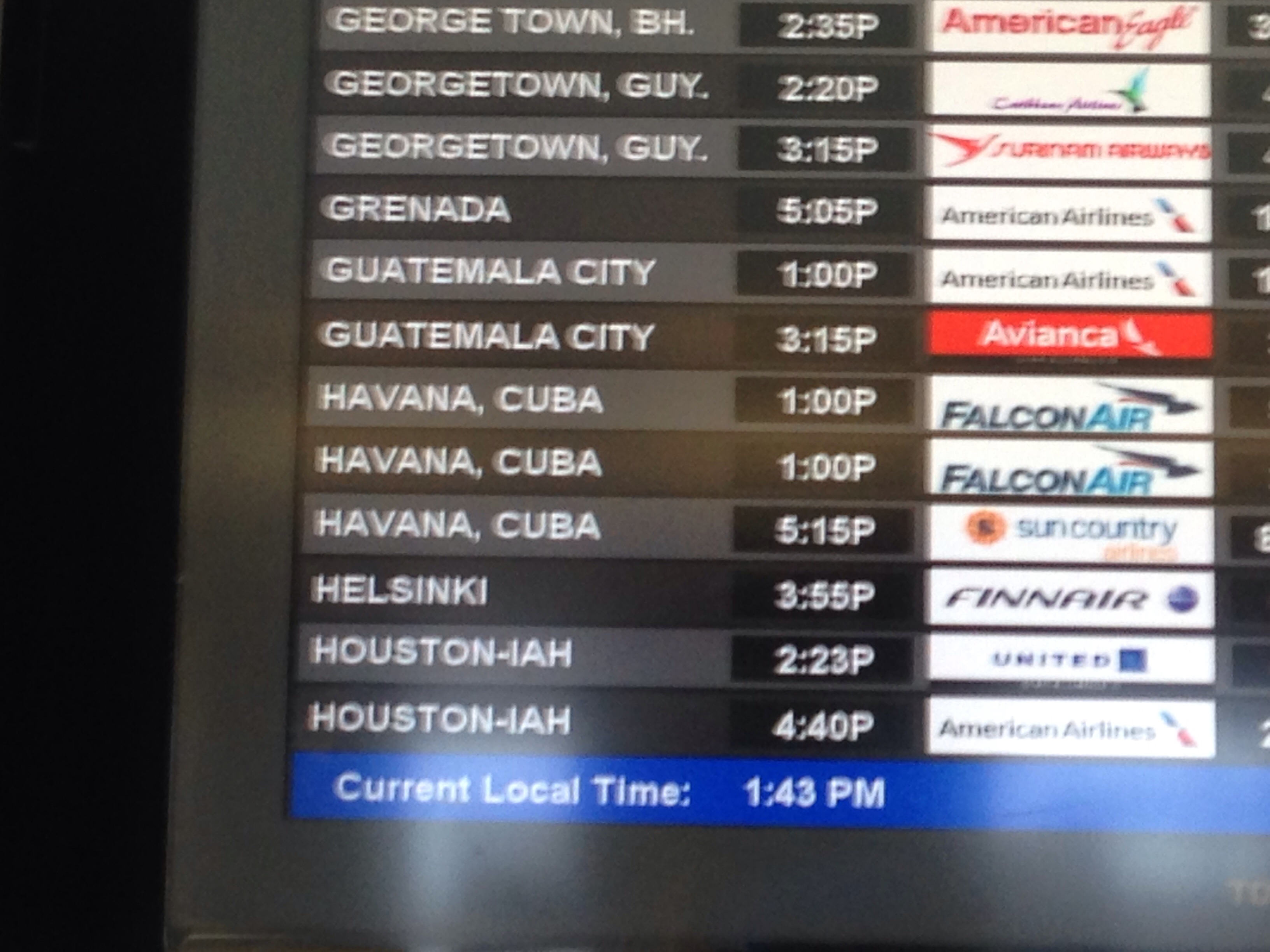
But a layover at the Miami airport this weekend provided the perfect graphic to answer that original question – at least for the next six months. As I looked at exotic destinations on the departures screen, many much more exciting than my 40 minute jaunt back to Orlando, I saw the below:

image

Where am I going? Quito, listed there near the bottom. (Or Orlando, depending on your time frame, shown just at the top of the screen.) And where have I been? Well, Raleigh-Durham – where I grew up – appearing right under Quito. (Or Orlando, once again, depending on your frame of reference.) For the record, “Raleigh-Durham” is a misnomer – I grew up in Durham!

Airports are like that. You can smell the adventure waiting at the other end of a flight. I still find it remarkable that 100 plus people can be sent 30,000 feet high at over 500 mph. At an airport, you can sum up the where you are and where you want to be in one screen shot.

image

Another example – note the Havana, Cuba destination. I’m not sure I can recall ever before seeing Havana listed on a departure screen, much less right above Houston, Texas. What better way to show a shift in geo-political realities.

When I was growing up in the 1960s and 1970s, my family always arrived at the airport dressed in Sunday best and several hours before any scheduled departure. My brother and I regarded the waiting at the airport as much a part of the trip as the actual journey. I still remember the iconic TWA terminal at JFK, and how slick and modern Dulles Airport was, rising out of what was then a rural area outside of Washington.

Photo by Joe Ravi, lic. CC-BY-SA3.0

As the reality of the Cotopaxi and Chimborazo climbs sets in (right now I am at the slightly terrified stage), I just need to take it one step at a time. And after the training – the next step is going to be at an airport. And whatever happens, I know that when I set foot in one of those ultra modern terminals, it’s not a terminal in the sense of an end. Yes, it will evoke memories of where I’ve been – but even more excitement over where I’m going.

Cotopaxi and Chimborazo – Where We Are Going

Volcanoes of Ecuador

So I did it. Last week, on Tuesday to be precise.  I emailed Mountain Madness, our trekking company, and just said yes to the Chimborazo extension. Now I recognize that some of you were pushing for the Galopagos Islands, but I simply couldn’t escape the fact that there will be no other point at which husband J and I stand a better chance of actually climbing a 20,000 foot mountain. I think I can manage the Galopagos in future years.

As I continue the grueling process of forcing  myself to run at ever faster paces and climb stairs with increasing amounts of weight – and of finding the time to do so – it occurs to me that I have not really described the two mountains that are engendering such passion (or foolhardiness). I’ve referred to them by name, but without much explanation.

Here’s what is inspiring me.

Both mountains are part of Ecuador’s Avenue of Volcanoes, named by 19th century German scientist Alexander Van Humboldt.  Due to a location just above and below the equator, the scenery is supposed to be reminiscent of the Scottish highlands or the Arctic tundra, at least according to our trekking company.  Both were first summited (at least by westerners) in 1882 by Edward Whymper, for whom some of the passes are named.

Cotopaxi last erupted in 1940 and some consider it the world’s highest active volcano.  It stands at 19,347 feet (5897 meters) and is located near Quito, which at 9400 feet is itself one of the world’s highest cities.  Cotopaxi has been worshipped as a sacred mountain, a bringer of rain and fertility.

We will acclimatize for the altitude first with a climb up Guagua Pichincha (just outside Quito, standing at 15,696 feet, last eruption 2004) and then what is described as an “enjoyable rock scramble” up Illiniza Norte (16,818 feet), with trekking, camping and stays at haciendas in between. Mules are supposed to help at certain points as we travel between and up the various mountains.  Once we are at Cotopaxi, summit day (summit night is a more accurate description) begins at 15,749 feet, where we will have been staying at the Jose Ribas Hut.  The glacier starts at about 17,000 feet, and according to Mountain Madness, we will be crossing snow bridges, avoiding large crevasses, and climbing “short, steep sections.”  Once at the summit of Cotopaxi, we should be able to peer into a perfectly round caldera, the origin of the steam you apparently can sometimes see boiling up.

I have found a lot less written about Chimborazo. It is famous for being the point closest to the sun, due to the bulge of the earth at the equator. As I mentioned before, I hope our attempt to climb it is not too Icarus like. It is currently inactive, with a last eruption in 550 A.D. or so.  It reaches a whopping 20,564 feet (6268 meters) and is the highest mountain in Ecuador. Chimborazo can sometimes be in very bad condition – with unstable snow, big crevasses and high risk of rock fall. The itinerary states that if Chimborazo is not climable, we are to attempt Antisana. It’s only 18,714 feet high, but from what I’ve read is even more technically challenging, as it is completely covered by glaciers, and is not climbed very frequently.

Despite all this, you may still be left wondering – but “why?” Well, a summit goal, for me at least, gives me something to focus on, look forward to, and lifts me out of the drab tension of the day to day working world.  And the other reason is simply a variation of the “because it’s there” phrase – because there is something about standing on a summit that gives a high that doesn’t come from anything else.

A Walk on the West Orange Trail

Cement plant amid abandoned orange groves

Training has to be in earnest now. The long Martin Luther King weekend  provided the impetus for our first hike with weight since – oh, probably when we were training for Elbrus last year. But with Cotopaxi and still maybe Chimborazo looming a mere six months away, it’s time to ramp up.

Orlando has been working on its urban and semi-urban trails for a number of years, and the West Orange Trail was one of the first. It stretches 22 miles from Killarney to Apopka, running mostly along abandoned railroad tracks.  It passes through suburbia, a high end residential enclave, abandoned orange groves, and, every now and then, glimpses of the pine forests and palm hammocks that graced the state before development threatened to turn it into one giant subdivision.

Husband J and I had hiked the segment from Killarney to Winter Garden last year, so we were already familiar with the classic car show that takes place in Winter Garden on Saturdays. People from all walks of life sit on lawn chairs with everything from Model Ts to 1967 Mercury Cougars on display. Somehow I don’t think my 10 year old Sebring convertible would have qualified.

So this time we decided to load up the backpacks with about 25 pounds and walk the next segment, from Winter Garden to about three miles beyond the Chapin Station by Chapin Park, for a nine mile round trip. Before Ecuador this summer we are going to try to walk the whole length in one day. Hey, if the Romans could march over 20 miles every day, why can’t we?

Not really a walk on the wild side

The first part of the trail cuts through several housing developments. One of the most striking features is the lengths and lengths of white vinyl fences that line the trail. The fences finally stop and you’re treated to a view of backyard after backyard – all of which blend into one another with barely any delineation. Talk about peer pressure to mow your lawn! Notably, I saw not one soul sitting outside on any of these neatly manicured grass strips, even on a beautiful Saturday afternoon. Finally, housing developments give way to abandoned orange groves. As we passed the one with the cement plant rising up out of the middle (see photo above), we heard what at first sounded like a loud rant of some hellfire and brimstone preacher. But as we got closer, in the distance we could just hear an amplified broadcast of MLK’s I Have a Dream speech. Somehow very fitting for the weekend, the trail and our training.

West Orange Trail - J's trademark shadow in the corner
West Orange Trail – J’s trademark shadow in the corner

The next segment did move into something approaching nature, although the sound of the highways nearby was never too far away. A hawk almost strafed our heads as we paused on the bridge shown above, and then settled into the trees, its plump belly blending into the mottled deep green black leaves.  We passed by a specialty crop garden tended by a local high school, as well as what looked like an uninhabited barnyard with a big sign saying sustainable farming.  And at one point, from a warehouse al out hidden by the trees, we could hear the throbbing bass of a rock band practicing. On the way back, it seemed to have transformed into something that sounded like a mariachi band. Same band? Or rented space?

The West Orange Trail even has a few hills – at least by Florida standards. I just kept thinking to myself, “imagine it’s 10 degrees farenheit, it’s a 35 degree slope, and you are at 18,000 feet.” You’ve got to have some imagination to train in Florida.

There's a hawk somewhere in there - use your imagination!
There’s a hawk somewhere in there – use your imagination!

Iceland Cometh – Travel With Friends


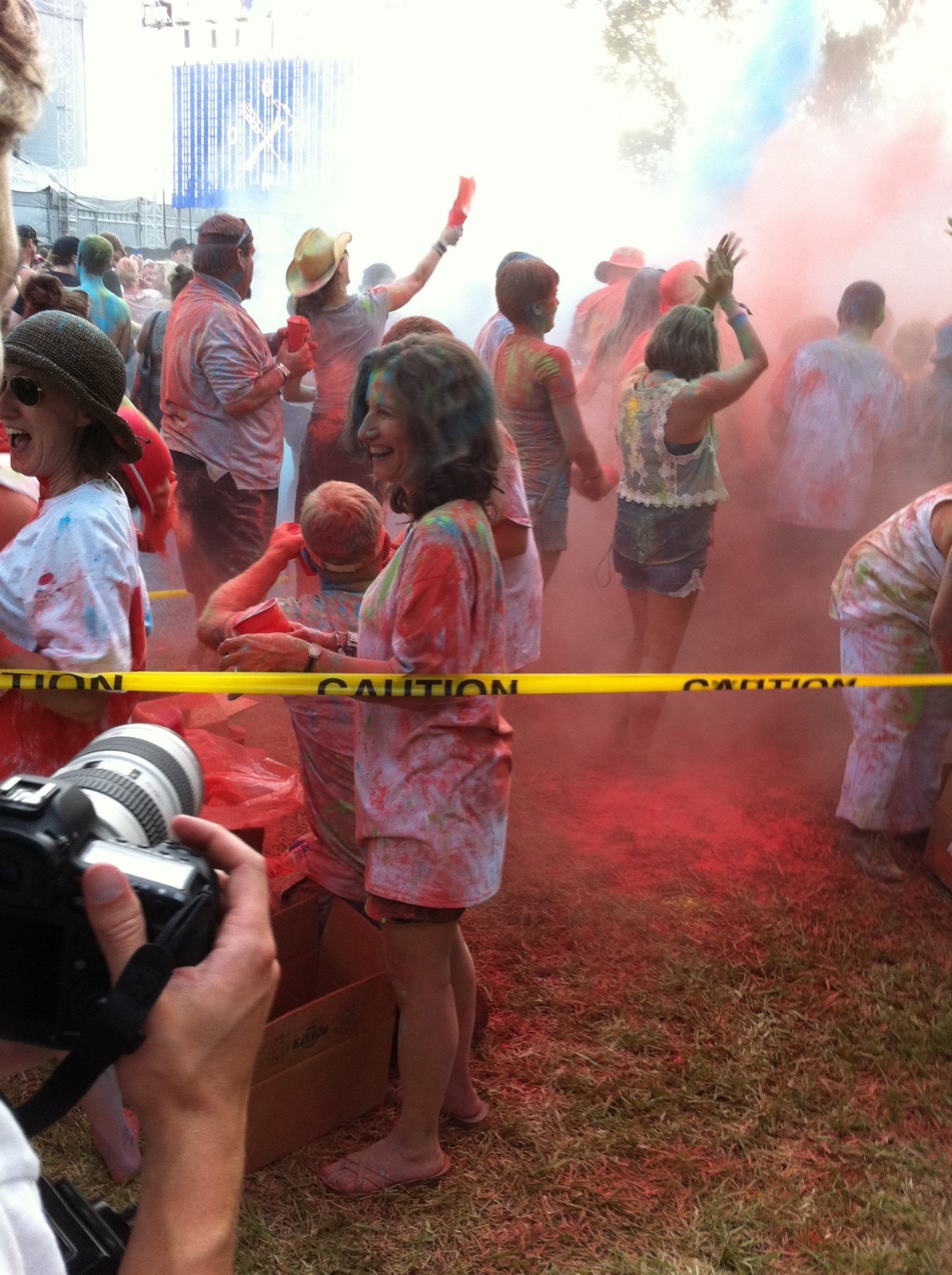
Powder paint at Gentlemen of the Road - Travel With Friends
Powder paint at Gentlemen of the Road – Travel With Friends

Many years ago, when daughter #1 was still being carted around in the plastic contraption we called the rocket seat, we would go out to dinner with our then childless friends, M and S, and drool over all the places we could explore once our parental responsibilities had lessened. But then daughter #2 came along, and M and S had their own equally charming off spring and those days seemed to get further and further away.

Oh, there was the moment when we thought there was a possibility of a two family trip on a Russian icebreaker to see an eclipse in the Arctic Circle. S, who is an amateur astronomer, had seen an ad in one of his magazines that suggested such an adventure could be had for the sum of $1500 a person. Unfortunately, in the cold light of Monday, he realized he had ignored the extra zero in the price.

A couple of years ago we did all make it to St. Augustine for a long weekend to see The Gentlemen of the Road tour (Mumford and Sons etc). A great time, but aside from the paint powder extravaganza shown above, it wasn’t what you would call a particularly adventurous weekend.

Althugh we have yet to convince the Friends that they too can reach summits we have all decided to spend several days in early March in Iceland. The plan started because at that point – for some unknown reason – there was a straight through flight from Sanford, Florida to Reykjavik on Icelandair. We were also all under the impression that Iceland was located closer to where Greenland is and there would be a minimal time difference, making it a good long weekend destination. We’ve now determined there is no direct flight and it is a five hour time difference but we are going just the same. I also bought husband J a globe for Christmas.

I have little idea about Iceland except for an early episode of Anthony Bourdain’s first series, No Reservations, but trips with no expectations are sometimes the best. And I am confident that we can get M and S onto a glacier – at least for a little bit.

So now when I’m training for the June trip to climb Cotopaxi and Chimborazo at least I have something else to occupy myself with – the 7 mile run yesterday was a lot more fun when I thought of volcanoes, hot springs and ice. I decided to ignore the dried cod.


Training Up on the Roof


Up on the roof - with hibiscus below
Up on the roof – with hibiscus below

In passing, I’ve previously mentioned a fear of heights – in fact, it played a role in the decision not to climb the Grand Teton. I’ve downplayed it to avoid the inevitable queries about why someone with any such concern would decide mountain climbing was for them. But occasionally that fear rears its head again, like the proverbial dragon waking up in its cave. And I realize that each time I set off for a new summit, vertical drops provide their own very special form of challenge (or torture).  It goes back to kindergarten when on my way to the second floor of the building I somehow slipped between the steps of the fire escape style metal staircase, just catching myself before I fell. I was a skinny child. I didn’t say much to anyone about it, but I remember it to this day.

Year later, when I was about 13, my family made a trip to Grandfather Mountain in North Carolina, where my father walked my brother and me over the swinging bridge that crosses a gorge several hundred feet below. I still have never told anyone how completely paralyzed I felt on that bridge, but one of my repeated anxiety dreams (aside from the one where you have to take an exam in a class that you forgot to attend) is of being on a high, narrow bridge with no rails, unable to move forward or back.

So, yesterday when my husband (now known as J) and I decided the time had come to clean the skylights on our house, I clambered up the ladder after him. (The roof really is a bit steeper than the photo shows.)  As soon as I put my foot down on the sloping roof every fear I’d had was triggered – what in the world would prevent me from simply sliding right back down and onto the patio below. I started to think about the angles of Cotopaxi – and, if we do it, Chimborazo – and thought, well, if you’re having a hard time on your own roof top you aren’t going to do very well there. So I took a deep breath, trusted in the grip of my tennis shoes, and bribed myself with the promise of the great view I would have of the neighborhood and everyone else’s backyards.

And it worked. By the time we were done I was skipping around on the roof – if not like a mountain goat at least like one of those mules that go up and down the Grand Canyon.

But, you know what? Last night I still dreamed about walking on a narrow ledge at the very top of a multi-level mall. I had to hold on to some sort of rope and half way along the ledge drop one rope and pick up another. I did really well on one side of the mall, but when I had to cross the ledge on the other side, I found myself saying to the anonymous, but stern, guides, I’d just prefer to do this tomorrow.

Still some work to be done before Cotopaxi!


Blue Springs – Mysteries of a New Year

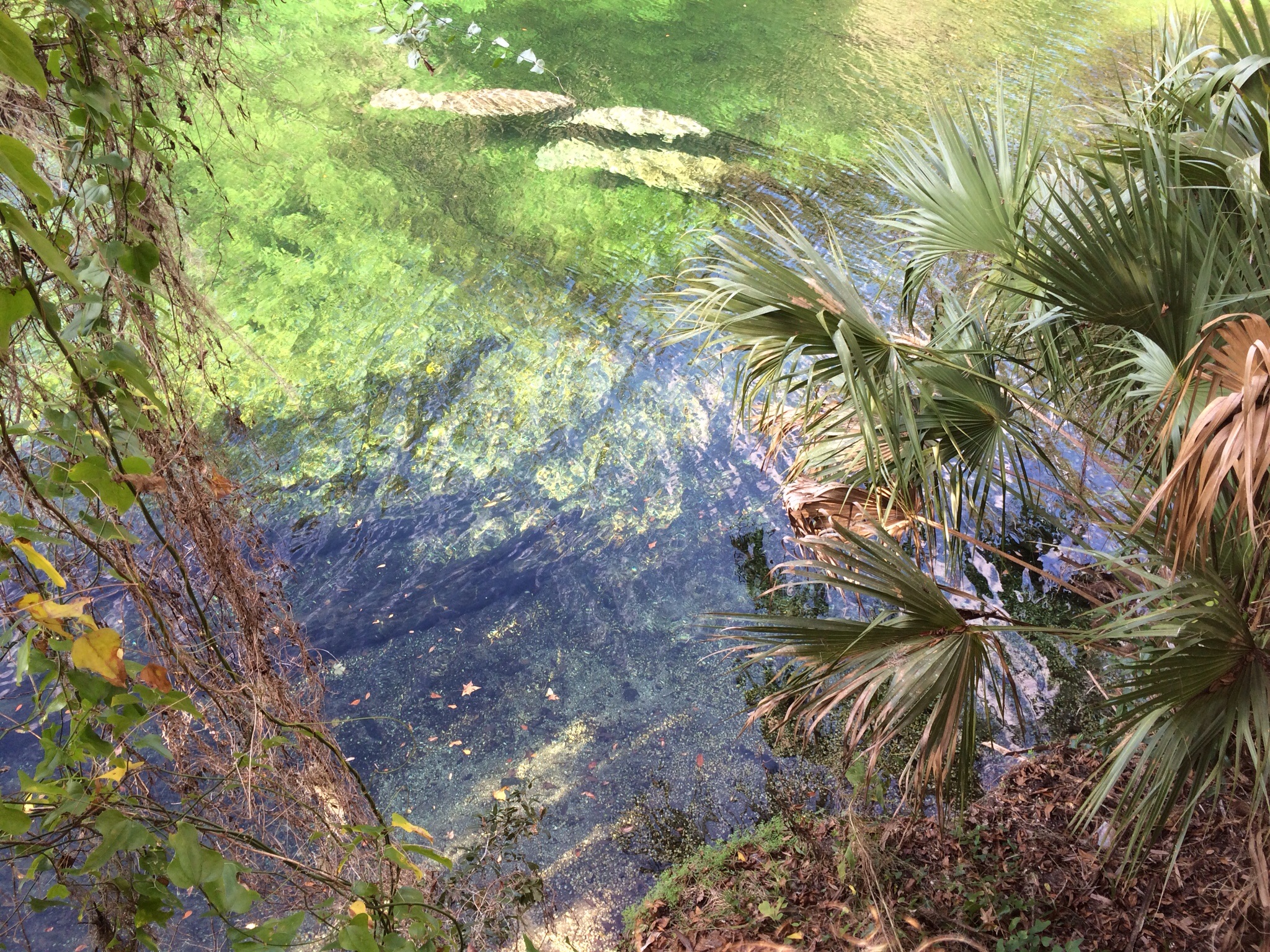
Manatees in the emerald waters of Blue Springs State Park

We celebrated the day before New Year’s Eve with a very tame hike along the boardwalk at Blue Springs State Park to see the manatees. Just daughter #1, her boyfriend, the husband and me. Oh, and in celebration of 2015 and six months of writing this blog, I’ve decided the husband can now have – if not a name – at least an initial. Perhaps a little Kafkaesque, but “J” does have a certain ring to it. Perhaps the daughters will obtain their own initials at some point.

I’d like to say that Blue Springs is a hidden treasure – but it has clearly been discovered, as demonstrated by the hordes of eager manatee watchers who were out in force on an overly hot winter’s day.  Blue Springs has always been “discovered”: it has been a tourist spot – or at least, a layover – since the pre-train days of 19th century Central Florida. The house of the original settlers still stands – a couple from Brooklyn, New York, who migrated to Florida to establish what became a steamboat stop on the St. John’s River in the 1870s or so. As steamboats gave way to trains, the place evolved into a weekend resort for hunters and fishers. The tourism that seems so out of place in the apparent wilderness is actually an authentic part of Blue Springs.

Blue Springs is also tremendously accessible to anyone with any physical challenges. A smooth boardwalk runs the length of the river, which not only helps walkers who need some assistance but also protects the plant life. The place itself is one of the most beautiful in Central Florida. The spring – one of the largest in North America – pumps out water from the Florida aquifer at a staggering 100,000,000 gallons per day. The water is a brilliant clear emerald color, and through it you can see long nosed gar wending their way down the river, as well as the large cow-like blobs that are the manatees themselves. Legend has it that manatees were the original mermaids, but it would take many days at sea for one of them to resemble Ariel!

One of my favorite parts of Blue Springs is the fact that somewhere hundreds of feet down the spring connects to the limestone caves that permeate Florida’s substructure.  As I understand it, many of these underwater caves are unexplored (and probably can’t be explored). Frankly, as much as I can imagine scaling summits of mountains, the idea of going underwater into a subterranean cave is unfathomable. But just knowing of the existence of those deep dark places – who knows, perhaps inhabited by goblins mining for the fairy queen’s jewels – adds an appropriate level of mystery for this New Year’s Eve.

Because who knows what 2015 will bring? It should bring our climb up Cotopaxi, but that’s just one of the many summits I’m sure I’ll encounter. 2015 is stretching out before me like those underground passageways below Blue Springs – and it will just take a little imagination  to realize its possibilities. Here’s to exploration in the New Year!