The Armchair Climber – The Power of the Book


My parents' house
My parents’ house

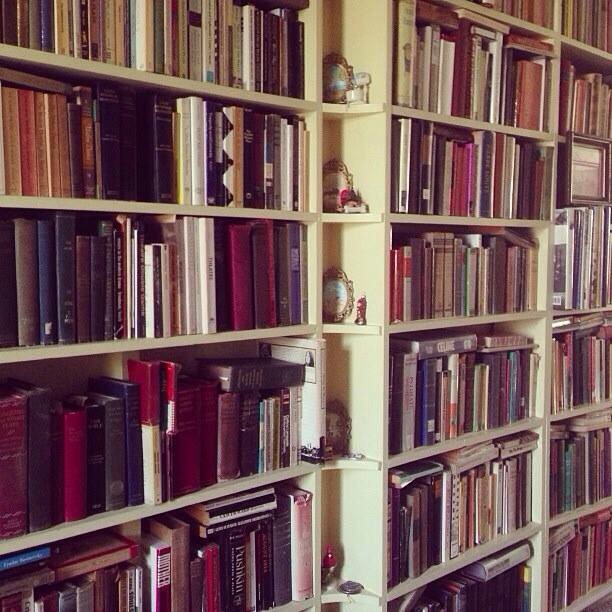
As an English major and daughter of two now retired English professors, I was raised in a house filled with thousands of books. We didn’t just have one copy of a book – we would have triplicate, because, I suppose, you can never have too much of a good thing.

But reading  has always powered my imagination – and imagination is probably behind my  starting  this whole mountain climbing thing in the first place.  Well, to be more precise, it was a 1991 movie called K2 that I saw on TV.  In fact checking for this post, I discovered it was largely panned by the critics, but I still remember the drama of preparation (one of the climbers was a lawyer) and the critical moments on the mountain where one climber had to make the decision to leave his injured companion behind. The husband found the film absolutely appalling.  But for some reason, the adrenalin junkie in me found the battle of man versus the elements completely fascinating.

A good book about the mountains – or any adventure travel – brings you that one step closer to making the summit your own reality. Lots of books have given me that little last push up that extra flight of stairs. Here are some of my favorites and I’d like to know yours – I’m currently perfecting my Kindle reading technique for stair climbing.

The Seven Summits by Frank Wells and Dick Bass. This may be where it truly started. A work colleague of mine lent me this book back  in the 1990s, and, true confessions, I never returned it. It’s the tale of the original two who climbed the seven summits in one year, 1983, the year I graduated from university. Easy reading and puts the mountains within reach.

Paths of Glory by Jeffrey Archer. The story of George Mallory’s fateful trip to Everest, starting with his days climbing church steeples. The mystery remains – did he or did he not summit?

Mark Horrell’s travel diaries – these are available  very inexpensively in Ebook format. He seems to have climbed everything and his very detailed accounts of mountains ranging from Cotopaxi to Elbrus are quite reassuring to a novice climber.

Into Thin Air by Jon Krakauer. Need I say more.

And, to finish up, The Orchid Thief by Susan Orlean. Ok, it’s not about summits but it is about swamps., Possibly the most beautiful prose ever written about the adventure of hiking through the wild Florida of the Fakahatchee swamp and the search for rare orchids. Inspirational for swamp dwellers who want to see more than the concrete of Florida development.

Training and the Power of the Shoe

The Power of the Shoe

For several years I have had a semi-inflexible yoga schedule. What I call “regular” yoga on Wednesday nights and Sunday afternoons, with some cardio thrown in on the step mill or treadmill, accompanied by Bikram on Saturday afternoons. But all things change, and my long beloved 4 pm Bikram class is, at least for now, no longer. What’s a girl to do?

True, I could go to a 10 am class, which I have occasionally done, but I find my balance is not nearly as good in the morning. Somehow I need the day to be underway before I have the necessary focus.

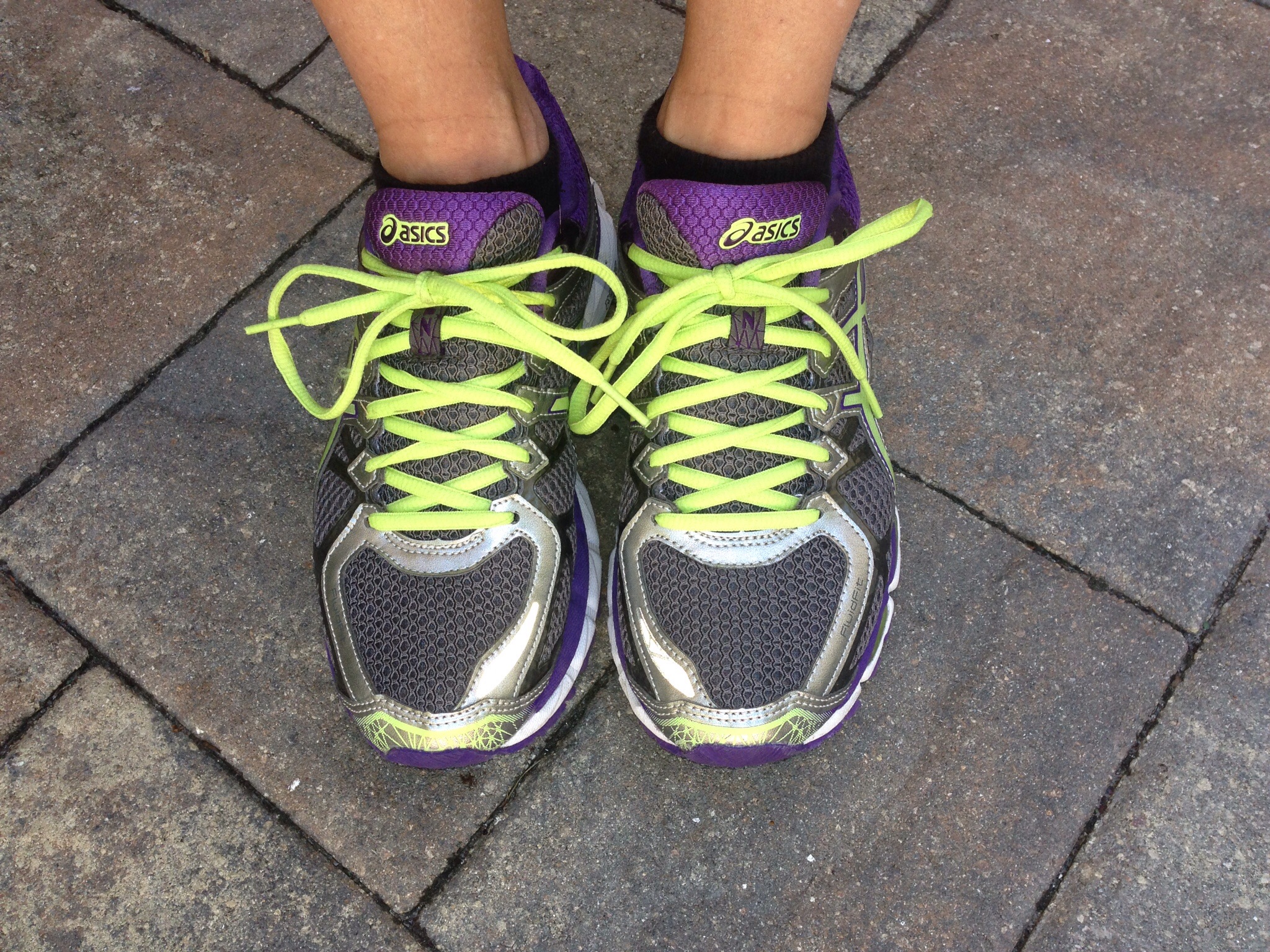
So, without making any commitments one way or the other to what my new Saturday routine will be, yesterday morning I ventured off to a high end running shoe store. It’s one of those places where customers are called guests, and you’re assigned a salesperson (although I’m sure they call them something else) as soon as you walk in. The process starts with extensive foot measurements, followed by a video of you running along the sidewalk in front of the store so they can frame by frame analyze how your foot strikes.

At the end, I was the proud owner of a remarkably expensive pair of Asics, together with super feet insoles. But I don’t mind spending money on those things – the cost of shin splints or otherwise wrecking your feet, legs, or back is way too great when you have mountains to climb.

And it turned out to be worth it. Fall finally fell in Central Florida and my new shoes and I went for a 4 1/4 mile run around the lake we live on. The difference between running in 90 and 65 degrees should have been self-evident, but I was still surprised by it. There was a decent breeze that was behind my back for a bit, not a cloud to be seen, and the pink seed casings of the tabebouia trees served as a very acceptable substitute for fall leaves.

Ok, so my left hip now hurts and maybe I really shouldn’t have used my new insoles for the first time on a four mile run against instructions, but whatever.  Letting go of one training routine and opening up some new possibilities – I think that’s the flexibility it’s going to take to get up all 19,500 feet of Cotopaxi.


Machu Picchu – Trail or Trial – Part Two

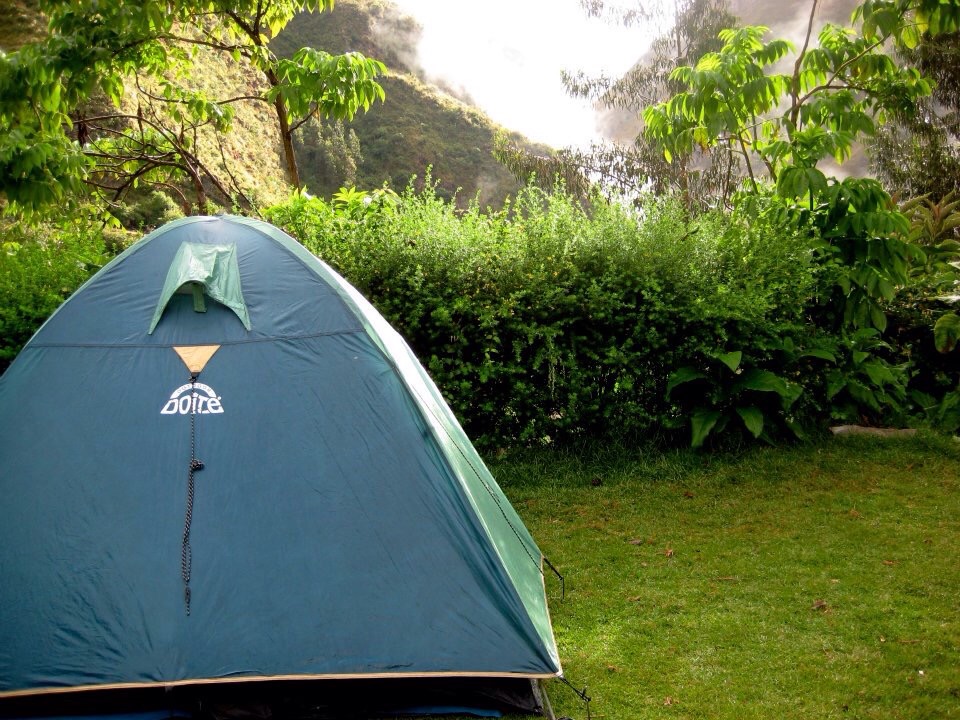
First campsite - Wayllabamba
First campsite – Wayllabamba

Inca Trail part two. I have realized that this experience was at least a trilogy, so part 3 will follow. Today’s installment – the “village” part of the hike, followed by “Challenge Day” and the Dead Woman’s Pass.

We met our fellow hikers at about 5:30 a.m. in front of the Hotel Marquesas in Cusco. We had briefly encountered each other the previous day during an introductory briefing session at the trekking company’s office. We were a diverse lot – our family of four, newlyweds from Boston exploring Peru, an English couple traveling around the world for a year, accompanied on this leg of the journey by a sister, a couple of salesmen from Texas, a doctor and his wife, also from Texas, and one man from California and another from Germany. Fifteen in all – it was a large and unwieldy group.

After what seemed like a very long bus ride, we stopped for breakfast in the small town of Oyelltambo. The restaurant was most notable for highly elaborate rabbit cages in its garden. It was very early in the morning but I think I am remembering this correctly.

We journeyed on to Kilometer 82 – the official beginning of the trail (or trial, depending on your perspective). We were struck by how agricultural it all was. Women on donkeys carrying bushels of herbs; local people selling water or other items at about every rest stop. The mountains on either side of the trail were green, capped with snow. And flowers everywhere. I hadn’t realized before that begonias grew in the wild. Views of the ruins of Llactapata – a settlement of 100 or so buildings that would have housed soldiers and others traveling the trail. Our trekking company did not scrimp on food. Trout for lunch. Apparently inspired by lunch, our guide then had to explain to one of our fellow hikers that the “no hunting” restrictions also meant “no fishing” with the fishing line he had brought from Texas.

Permits for the Inca Trail are strictly controlled and only a couple of hundred people can enter the trail on any given day. You also have to go with a trekking company – no independent forays along the hundreds of years old stone path.

The first campsite, Wayllabamba, 3000 m, was in the heart of the agricultural area; in fact, local people were selling all different beers and drinks from aluminum containers. Dinner was a highlight – chicken with flaming bananas! But even with the semi-village feel of the campground, the remoteness kicked in with the southern hemisphere of evening stars – visible without any city lights. This was our first time camping with our daughters. Since we hadn’t reinvented ourselves as climbers until age 50, they had never experienced this growing up. But they were good sports and settled into their own tent well – although quite greatful we had made them bring long underwear.

image

The next day, day 2, I finally started to feel I had found my hiking rhythm. That day we reached the highest pass in the trail – Dead Woman’s Pass – at 4200 m. It was overcast and drizzly and suddenly the layers of clothes that had seemed too warm in Cusco felt right.

It rained on and off the whole way, the grey punctuated by the yellow orchids we saw every now and then. The up was ok, if steep, but the down hard on the knees. By now hiking on the carved square stones of the trail – some replacements, but some the same the Incas hiked on those hundreds of years ago on missions no one, to this day, totally understands. There was no written tradition.

Yellow orchids - michi michi
Yellow orchids – michi michi

image

Of course, as we were accompanied on this hike by the daughters  I had to assume both my mother and hiker persona – not always compatible. In fact, the maternal one is also known as Mommy the Packhorse and as usual I ended up carrying many of the layers that belonged to the two girls. A lesson to be learned: the younger one decided to prance well ahead of the rest of the family on the steep approach to Dead Woman’s Pass, leaving her rain gear and warm jacket with her sainted mother. We found her 45 minutes or so later shivering and cold as the rain and wind picked up.

Dead Woman's Pass
Dead Woman’s Pass

The tree line was about 10,000 feet. Dead Woman’s Pass, at close to 14,000 feet, was cold, rainy, and very windy. Only a few hundred of feet below it was much warmer. Still, our camp site that night – Pacamayo, 3600 m, was very cold. Gone were the villagers. We were in a non cell phone service area, completely disconnected, and with only the grey shades of the ancient Incas for company.

To come – day 3 and 4: the placing of rocks on a cairn, Incan funereal rites, daughter number 2 gets really sick, sunrise (almost) over Machu Picchu, and the van ride back and the attack of the mysterious wild animal. Stories to come.

The Inca Trail – Pre-Trail or Pre-Trial – Part One

IMG_7342

Our trek along the Inca Trail in May 2012 started off as a natural follow up to Kilimanjaro in 2011. Granted, it wasn’t a summit per se, but it certainly was a well-known hike, seemingly had a degree of challenge, and besides, we were able to convince our daughters, then 19 and 21, to accompany us. But what we didn’t realize was that the trip would be as much of a cultural experience as it was a climb. Many mountains are remote and you are more exposed to the insular world of the mountaineer and whatever wildlife lives above the tree line than you are to any local residents. But Machu Picchu surprised with the many, many people we saw every mile of the way – from the beer hut on day 2 or so to the women riding donkeys with bushels of cut herbs on their backs.

The trip began rather inauspiciously – for some reason the husband and two girls thought that Mexican food and margaritas at the Orlando airport was an appropriate way to kick off a trip to Peru. Not so, and all I can say is they suffered quite a bit for it, while my salad and wine seemed to agree quite nicely, thank you very much. We flew on Copa Air – the Panamanian airline, and like most non US airlines, it was quite pleasant – although we had bad weather in Panama City and landed with quite a bump. Ran to the next gate and just made our flight to Lima, where we landed about midnight. But you would never have known it was the wee hours of the morning from the hustle and bustle of the Lima Airport. It might as well have been late afternoon on a Saturday of holiday weekend. All the shops open, people dining.

Had to recheck our bags at the LAN counter – our airline for for the trip to Cusco – and got to the gate about 2 a.m. Together with a number of other intrepid travelers, we each found a section of seats to crash on for a few hours, backpacks within touching distance. We arrived in Cusco in early morning, and could feel the change from sea level to 11,000 feet. We stayed at the beautiful Hotel Marquesas – a 16th century residence converted to hotel. A courtyard in the center; walls about a foot or more thick. The husband and I had a balcony overlooking the street from which we could see the cathedral. The girls had an interior room that felt like a cave. Because we had arrived so early, the rooms weren’t ready and we were immediately offered – and accepted – coca tea – which does in fact help with sudden altitude change.

Hotel Marquesas, Cusco

Travel hint. Only bring new bills to Peru. Currency exchanges will not accept anything with creases or tears. And they are serious about it. Sight seeing was the order of business for the first day or so. The cathedral’s wonderful painting of the Last Supper where a guinea pig substitutes for the bread embodied for me the peculiar marriage of local and foreign cultures. And the food! For lunch I had potatoes in a red pepper cream sauce. (Peru has, I believe, more varieties of potatoes than anywhere else in  the world.) Dinner – chicken stuffed with goat cheese and elderberry sauce; local trout; poached pears with cinnamon ice cream. And you can’t forget the pisco sours – like a gin fizz made with a brandy.

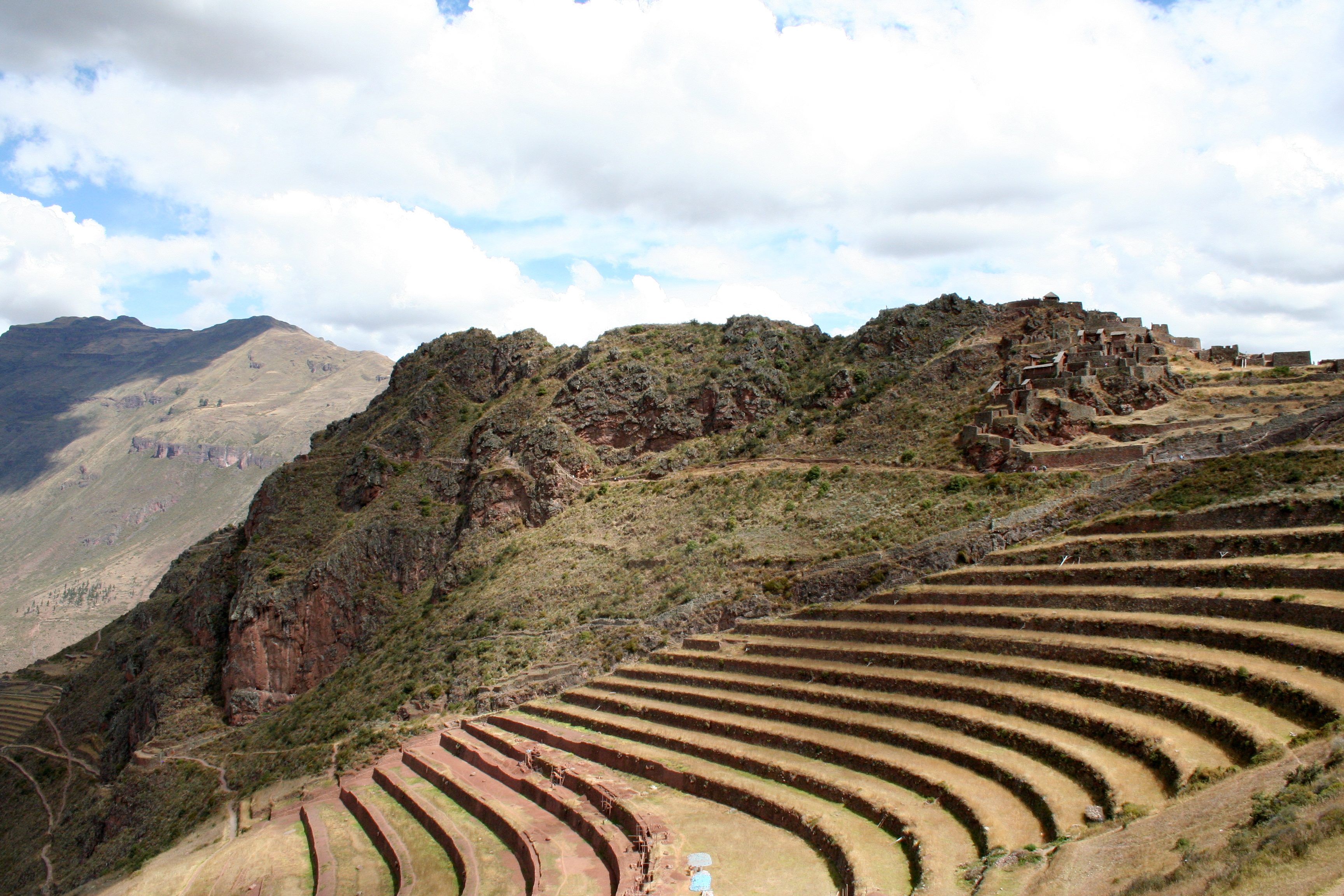
We spent the next day on a bus tour of the Sacred Valley. Although it was supposed to be for both Spanish and English speakers, we seemed to be the only English speakers and it was remarkable how ten minutes of Spanish could turn into about two sentences of English.  Nonetheless, the ruins were remarkable, the Andes amazing, and we were struck by the authenticity of the people and places we were driving through.

IMG_7394

That night the four of us did a mini gear check, getting ready for a van to pick up us up at  5:30 am to drive to the fabled Kilometer 82 – the start of the trail. Next post – the start of the hike.

IMG_4116

Boots With Soul

Boots with soul
Boots with soul

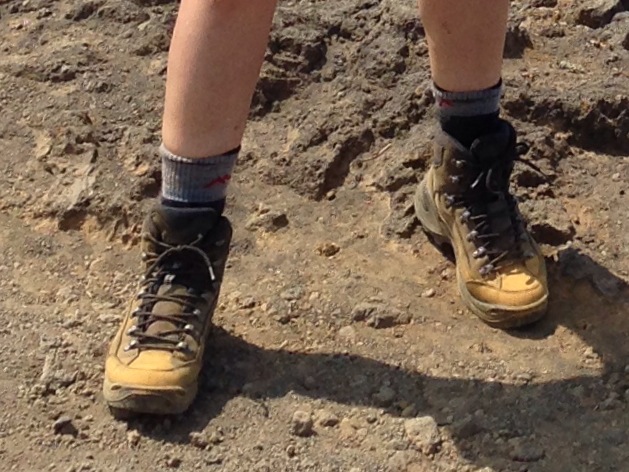
This coming week I’m planning to lug the hiking boots back to my office so they can start to climb stairs with me again. They are full leather Lowa Renegades that I bought in 2010. You could tell back then if a climber was from Central Florida because those were literally the only full leather boots being sold in the area.

I figure that it’s a good idea to be back in hiking boot mode before the Mt. Washington trip in a few weeks. And I know my daughter, who is going along for this trip, is tired of me telling her to do some hiking in her hiking boots – but since I don’t think she has done so for any length of time since the Inca Trail in May 2012, I certainly think it’s advisable.

Each time I put on my boots I see just a little bit of dirt or dust from treks past. Some days after the Boston Marathon bombing occurred and the bombers identified, I was climbing up and down the stairs in my office building. We had just returned a few weeks before from hiking down and up the Grand Canyon – South Kaibob and Bright Angel Trails. There was still red, copper dust ground into my boots that reflected the rusty color of the stair rails. The burnt colors around me, and the cavernous recollection of descending down into the canyon converged and I was overcome with the tragedy of how the two brothers could have so missed the point of the mountains and sun and whether they even realized what they had done.

I dragged around dregs of Kilimanjaro for months on my boots. The husband and I hadn’t bothered to take advantage of the repeated offers to clean our boots when we were in Africa – hence, even when we returned, my navy blue boots had a grey ashy sheen that outlasted multiple rainstorms. Each time I put them on I felt a little bit again the magic of that moment if stepping on the summit.

Elbrus didn’t make as big a mark on my boots as it did on me. Probably because once at the Barrels – the converted oil barrels where climbers stay at 12,000 feet – we were in our double plastic boots and crampons. But my boots still bear a little dust of the Caucasus mountains, especially the fields of wildflowers on the observatory hike and the dried salty sweat from the horses as we went horseback riding. And I’m sure that somewhere hidden in the creases of my boots there is a bit of olivine sand from Green Sands Beach in Hawaii, or the deep rich soil of the Inca Trail.

I’m hoping my boots have a lot more miles in them – although when I looked at the soles they have lost a fair amount of their grip. But grip or no grip – they have a lot of soul.

Fly Like An Eagle

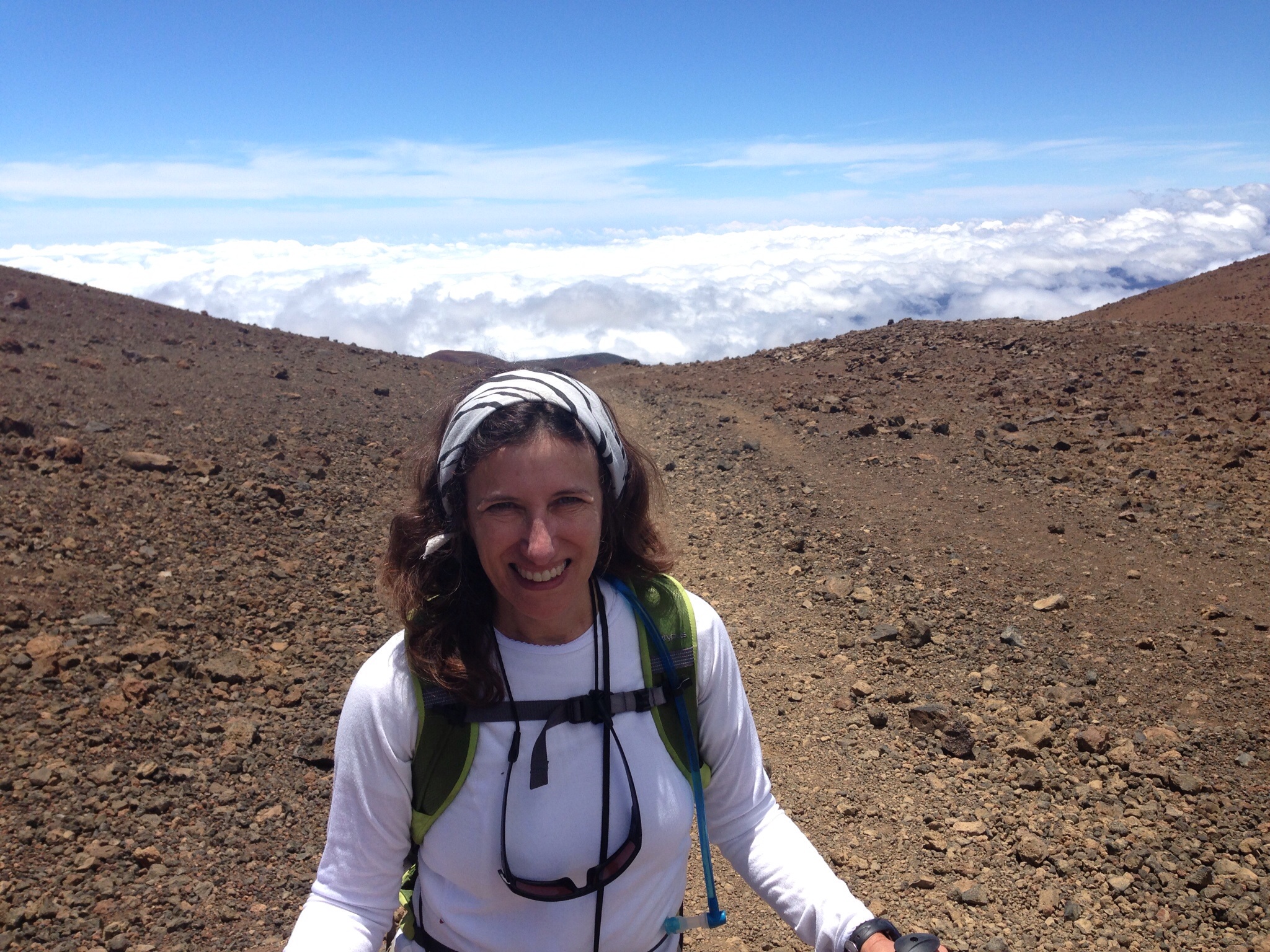
Summit of Mauna Kea, Hawaii

image

One reason I am enamored with altitude may well stem back to airplane trips taken early, early in my life. These started in the 1960s, when my mother, sometimes accompanied by my father but frequently on her own, would take my brother and me to England to visit our grandparents. In my earliest memory, I was four and my brother was two. I don’t remember much of that trip but from then on, I have much firmer recall. By the time we were six and four, my brother and I had realized that the coloring books dispensed by the flight attendants – then called stewardesses – made fine swords and the little Pan Am wing pins were potentially even better weapons to use against each other.

But, fast forwarding to the 1970s, my interest in how to torment my brother on long airplane trips had ceased to be my major in-flight activity. In those days you had to pay for headphones, which would enable you to listen to the single movie being projected on a drop down screen or the few “radio” channels assembled by the airline. This was an expenditure my parents saw as completely needless. Undaunted, however, my brother and I soon learned that if you pulled your armrest up to your ear you could actually hear the movie and the music – albeit risking a crick in your neck and not a very good sight line for the movie.

That particular flight – we must have been returning to the United States because it was day – the sun shone through the plane window, there were a few layers of fluffy clouds below us, below all that the Atlantic Ocean stretched as long and blue as my eyes could see, and the Steve Miller Band’s “Fly Like An Eagle” was playing through my armrest. I must have been somewhere in my teens. There above the clouds I felt safe – yet utterly free, unleashed of whatever cares pulled at me from far below. I was conscious, even then, that I would always remember that moment.

And to this day, when I board an airplane – despite the waits on the Tarmac, the ever narrowing plane seats, and the ever broadening list of things you have to pay for – I still hope that once above the clouds I’ll recapture that same feeling of serenity. Very occasionally I still do. But maybe that’s really why I climb mountains. Looking down from the summit at the rolling surf of clouds below gives a lightness to your soul that rarely happens anywhere else.

The “What Nexts”

I’ve puzzled greatly what the next post topics should be post Elbrus. And as I am on what seems to be my never ending quest to climb stairs during the hamster wheel of my work day, I have come up with numerous topics, all of which are duly recorded on the notes section of my phone.

But I have resisted the urge for an in-depth examination of my sunburned lips (although an expose of the sunscreen industry may be forthcoming) – and I similarly am not going in the direction of laundry, dogs and calling the kids. Instead, I finally settled for some thoughts on what’s next.

The “what’s nexts” can come up any time – I’ve had it happen after a big case is finally over, after any milestone reached. But there’s something particularly difficult – yet exciting – about the what nexts after a climb.

For one thing, at age 53, there simply is no such thing as stopping the training. So that’s not a what next. Maybe I’m not lugging 23 pounds around on my back while climbing stairs at the moment, but if I stop climbing stairs altogether, I don’t think there’s any amount of time that could get me back to where I am. It’s like the Woody Allen line from Annie Hall – if a shark doesn’t keep moving forward it dies. OK, he was talking about relationships but you get the point.

But more than just that – there is a world of infinite possibility out there – tempered only by some reality of space, time, and physical ability. Time and space – I truly don’t see how, until I actually retire, I can take three weeks off work to climb Mt. Vinson in the Antarctic, for example. Two weeks is hard enough. As for physical ability – I have to recognize it probably is not within my being to carry 65 pounds and drag a 100 pound sled. Unless I quit my job, do Cross Fit everyday and invent some other form of training that presently doesn’t exist – that’s just out – which means Denali is too.

So – what next? There is Cotopaxi in Ecuador. Maybe trekking in the High Atlas Mountains in Morocco? And I am still determined to summit Mt. Hood one of these days. Mt. Adams? And we are seriously discussing a trip with friends to Iceland in March. There has to be some fine climbing there.

I just want to use my ice axe again. Right now the most likely near term possibility may be a winter ascent of Mt. Washington in New Hampshire. And maybe I can even convince the daughters to come along.

I’ll throw it open for comments – from the north, south, east or west. Which summit next?

20140717-230013-82813796.jpg

A Wild Card Day or Summits Don’t End

Now that I’m back in the swamp, Internet speeds are much faster, so I’ll start this post with another visit to the summit:

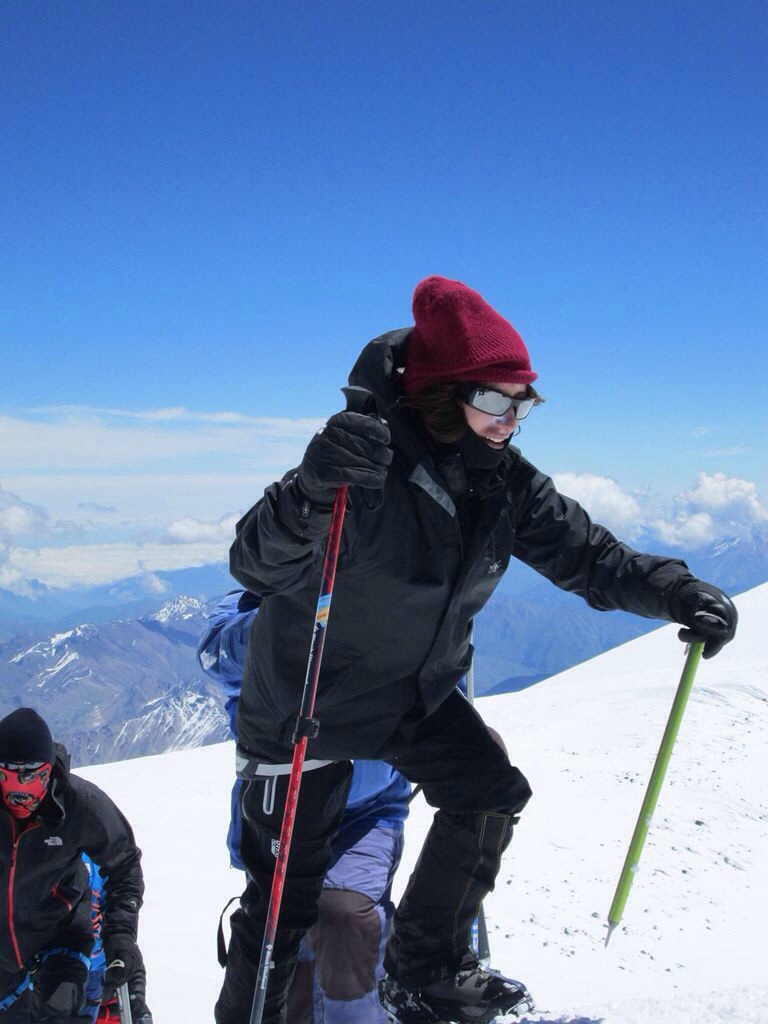
Stepping onto the summit of Mt. Elbrus:

20140709-065850-25130349.jpg

At the summit:

20140709-065927-25167059.jpg

We made it!

20140709-065952-25192097.jpg

We reached the summit Tuesday morning, July 1, and spent Wednesday reversing our trajectory back down the mountain, via chair lift and gondola, having a celebratory lunch and returning the much maligned puffy jackets to the rental store.

20140709-070312-25392412.jpg

20140709-070310-25390732.jpg

20140709-070309-25389393.jpg

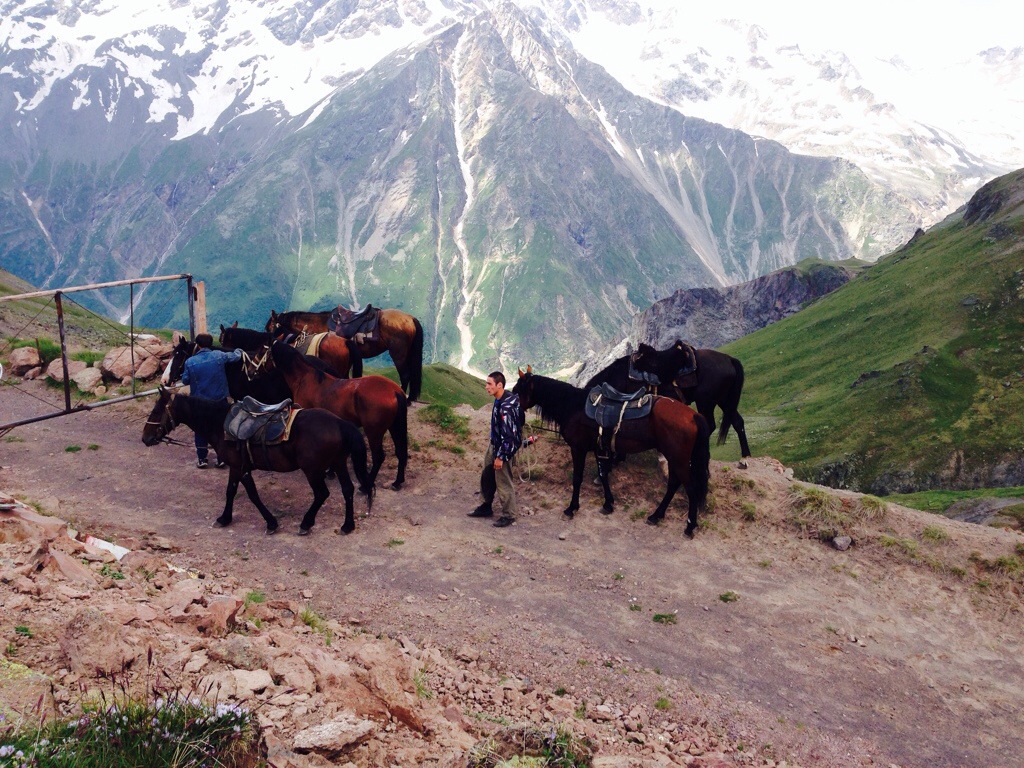
Because we summited a day early, Thursday was what my family affectionately refers to as a wild card day – one of those days with no plans, no reservations, that stretches out before you like a vast plain of infinite opportunity. Well, maybe not always that poetic. We decided to go horseback riding and take a picnic lunch. We rode back up the observatory trail that we had hiked, enjoying the different perspective on the still beautifully in bloom fields of windflowers.

The ride wasn’t without its share of danger, though, as the horses now and then veered ever so closely to the steep precipices below. I just kept thinking – remember, the horse doesn’t want to fall any more than you do. I felt I had a particularly western swagger since I spent most of the ride with my bandana covering the lower half of my burned face for the masked bandit look.

20140711-175610-64570781.jpg

That evening we celebrated at a restaurant by the Baksan River with its own trout pond. Ordering fish meant being handed a fishing pole. After I almost impaled our guide with a fish hook in my zeal to pull my first trout out of the water, I did manage to catch one. Fortunately others on our team were a bit more successful.

The next day we were supposed to drive the three hours back to the Minerale Vody airport, and arrive back in Moscow by noon. The best laid plains…..I can only sum up our 4 a.m. to 6 p.m. travel day in a series of bullet points:
– Board plane and wait for 45 minutes. Maintenance person goes in cockpit and doesn’t come out. Bad sign.
– Plane is broken.
– Get off plane and wait in terminal.
– Instructed to walk to another terminal to pick up luggage and recheck bags. Unclear why bags couldn’t be loaded directly onto another plane. Ours is not to reason why.
– Go through security again.
– Wait.
– Offered liter bottles of coke or sprite. But if you are a party of two or less you are given a paper cup with no lid instead of a bottle.
– Get in little bus to go to airplane on runway, together with open cup of coke or sprite with no lid if you are a party of two or less. Bus stops by plane; door opens. Instructed not to get out of bus. Bus door closes; continue tour of runway. Return to terminal. Unclear what purpose was except to distract restless passengers. Ours is not to reason why.
– Instructed to pick up bags again and recheck them.
– Go back through security.
– Riot almost breaks out among delayed passengers, who have lost patience with the interminable treks to pick up baggage, recheck and go through security. Multiple people filming confrontation of passenger vs Aeroflot rep vs Aeroflot rep on cell phones.
– Wait.
– Told to get back on little bus and finally onto a plane, six hours late.

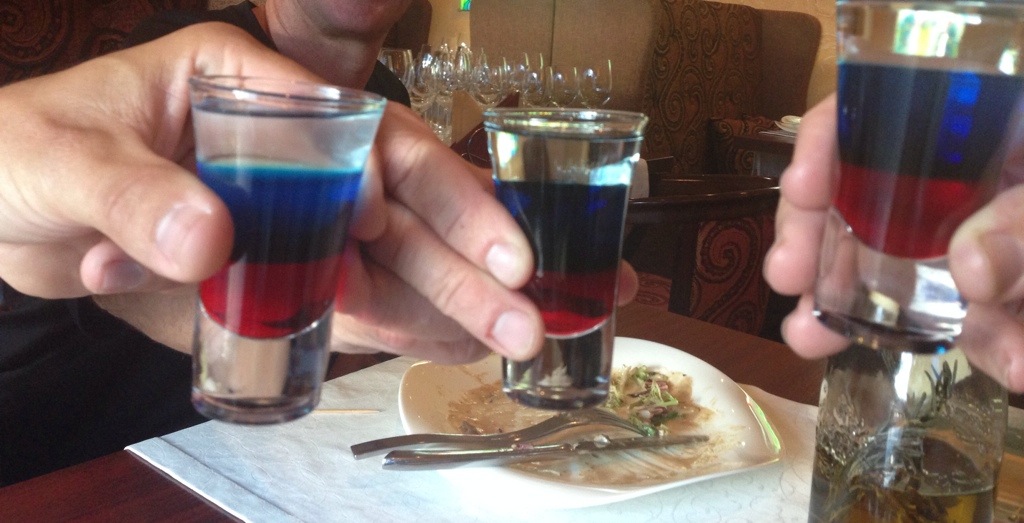
It was July 4, and we clearly needed to celebrate. As we were all exhausted from a very long and frustrating day we did what any red blooded Americans in Moscow would do – we went to an Italian restaurant near the hotel. There, a number of our group drank to the 4th with a red, white and blue drink appropriately named a “Russian flag.” I decided to stick to white wine. Our waitress didn’t seem overly enthusiastic – think the Soup Nazi on Seinfeld. She apparently regarded it as a personal insult if something was ordered from the menu that the restaurant didn’t have. Nonetheless, we were all still on the high that comes from the summit, and a little bit of brusqueness was not going to rain on our parade.

20140711-185035-67835571.jpg

July 5 we flew back to the swamp. But even though the Elbrus trip has ended – at least in real time – the lessons learned, friends made, and summits reached are still with me. And one other thing I have learned – I like writing this blog. So, neither it nor the trip is over. There are all sorts of summits – and I’m going to write about lots of them. And no sooner do you reach one summit then you need to be looking for the next, and that’s what I’m doing right now.

In fact, when I returned to work on Monday, I was already back climbing the stairs by Tuesday.

Looking Down the Barrel

Our multiple methods of transportation continued as our team moved camp from a nice hotel with electricity, toilets and running water to a compound consisting of six oil barrels converted to lodgings, several similarly converted cargo containers, and exactly three outhouses, one of which didn’t have a door. But it was more than made up for by the view from the outhouses (and the entire area) of mountain peaks and green valleys.

The Outhouse:

20140702-190422-68662370.jpg

The View From the Outhouse

20140702-210236-75756395.jpg

To get to the Barrels, we loaded our luggage, ourselves and food and water into a taxi to the starting point of a gondola that took us over the valley and up to the first level of ski runs. Then we unloaded and reloaded and did exactly the same thing for yet another gondola ride higher up. And finally, for a grand finale, we loaded one piece of luggage onto each chair of a single person chair lift – whose only safety feature was a metal bar that loosely swung in front of the rider as he or she soared hundreds of feet over the snow covered ground. The bar actually created more danger because it gave an illusion of slight security, encouraging the rider to lean forward to see the sights below.

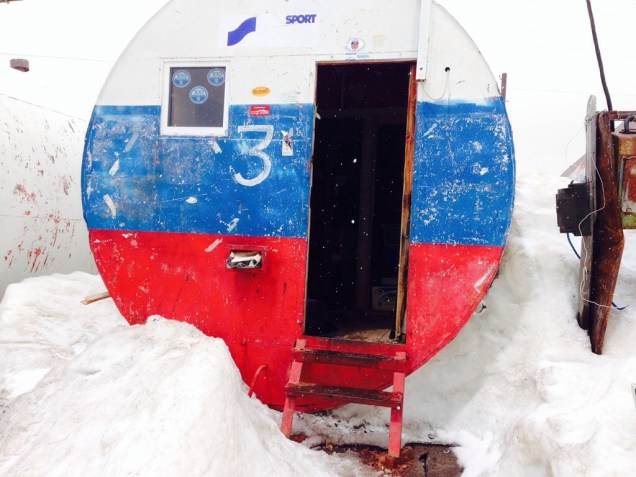
Our team was assigned Barrel #3, altitude 3900 meters (12,795 ft.). My husband and I had the first two “beds,” which were cots on each side of the barrel with a bedspread and pillow. There was a half wall (no door) dividing this area from the remainder, in which there were four more cots, two on each side, where our teammates and guide slept. Cozy quarters, to say the least. Prior residents had stuck all sorts of things on the walls, ranging from guiding company stickers to car ads (a high-end Mercedes). Each day, at some unexpected moment, electricity would suddenly be turned on for a couple of hours.

Home sweet home: in the top picture our backs are to the entry way to the barrel. We are facing the other cots.

20140702-211115-76275202.jpg

20140702-211113-76273883.jpg

Breakfast, lunch and dinner were all served in a converted cargo container a few feet from our barrel, although it was still treacherous to navigate the icy snow and broken concrete slabs between the barrel and container. Breakfast – oatmeal (and lots of it), unspecified sausage, cheese, bread, fruit, yoghurt. Lunch – soup, sausage, cheese, bread, and the ubiquitous cucumber and tomato salad. Dinner – more soup, entree of different stews and potatoes or pasta, and salad. Our cook’s name was Olga. At each meal, including breakfast, there was a bowl of chocolates.

The first day in the barrels we hiked with our Russian guide Alec – who seemed to know everyone on the mountain – up to the Diesel Hut for acclimatization. It’s a complex of three or four “buildings” and one stone hut that campers can rent. It was built on the site of the old Priut 11 hut that burned in 1998. Renters or not, everyone is allowed to go in. It took us 2 hours to reach that spot the first day. We had cut that down to 45 minutes by day 3. Tells you something about the body making more red blood cells at altitude.

The second day we hiked one level further, up to the Pastukhov Rocks, at about 4700 meters (15,420 ft.). By now we were feeling much more adept with our crampons, plastic boots, and poles. The two members of our team who were going to ski down Elbrus, in the meantime, were practicing skiing and “skinning” up the mountain.

20140702-214614-78374895.jpg

All was going smoothly until the dread zipper problem reared its ugly head again. To understand this paragraph fully, you must read the earlier entry, Gear Check #2 or How to Break Your Equipment Before You Start. Just as we were about to leave for the Pastukhov Rocks, the side zipper pull on my oh so expensive hard shell, full side zippered pants separated itself from the zipper yet again. Our resourceful guide safety pinned the offending area together, but it wasn’t enough to survive a crash and burn slip and fall on the snow. There’s a wonderful photo of me (that shall not be posted here) having a Janet Jackson wardrobe malfunction moment on the mountain. Fortunately I was wearing long underwear. Later that night our guide was able to fix the zipper – which required the use of pliers from his ski repair kit – but I was under strict instructions not to touch those side zippers again.

Day 3 in the barrels was supposed to be a rest day with some skills training. We spent an hour or so in the morning just below the Diesel Hut working on self arrest, footwork, what it’s like to be roped, and how to use an ice axe. Finally getting to use all the gear, the acquisition of which had consumed so much time, money and soul (at least in the part of my husband). I found I actually remembered some of the lessons from our unsuccessful Mt. Hood attempt. We spent a leisurely rest of the day trying to sleep, reading, etc. By now the barrel was starting to feel like home.

Although theoretically the two days for the summit attempts were days 4 and 5, everything in the mountains is about change. Because the weather looked good for Monday night into Tuesday morning, our guide made the decision we should attempt the summit a day early, and have an extra day in the Valley.

Monday night we had a huge 5 pm dinner of chicken and pasta. Although I was pretty well acclimatized by then I had lost my appetite and had to force myself to eat. We had spent much of the day packing our packs for summit day, no easy feat, and were supposed to be ready for a 1:15 am wake up call to have breakfast and get on yet another mode of transportation – a snowcat – that would take us to the Pastukhov at 3 am. By 7 pm we were all in bed, headlamps turned off, trying to sleep.

MCO to Moscow

20140624-100758-36478936.jpg

Perhaps not an iconic photo of Moscow, but that was the view from our hotel room at 3:30 a.m. this morning when my eyes popped wide open. We are staying at the Hotel Gamma Delta in the Izmailov area, just a few metro stops from downtown Moscow. The hotel is part of a tourist complex built for the 1980 Olympics and there are presently just as few Americans here as I suspect there were back then.

The trip to Moscow went smoothly, although accompanied by the usual hiccups – such as the last minute search for ski baskets for my trekking poles (none to be found in Orlando in June) only for the original six we had purchased months ago to be located under the pile of gear in the guest bedroom. And I shouldn’t omit the re-packing of all our carry-on luggage at the airport when we became concerned our backpacks exceeded the maximum 22 inches in length.

Our first day started with a long traffic jam as we left the airport, during which our non-English speaking taxi driver seemed to take particular delight in playing games of chicken with much larger vehicles. Our route took us past innumerable high rise apartment buildings. Some rehabbed; many not. They stood in stark contrast to the incredible green surrounding the airport. We spent the afternoon recovering from jet lag and exploring the Izmailov area, which includes a reconstruction of a wooden Russian church and brightly painted castle and surroundings, now used for the History of Vodka Museum and weddings. There’s very little English here, and I’ve been looking up how to say “please” and “thank you,” not to mention trying to gain some understanding of the Cyrillic alphabet.

image

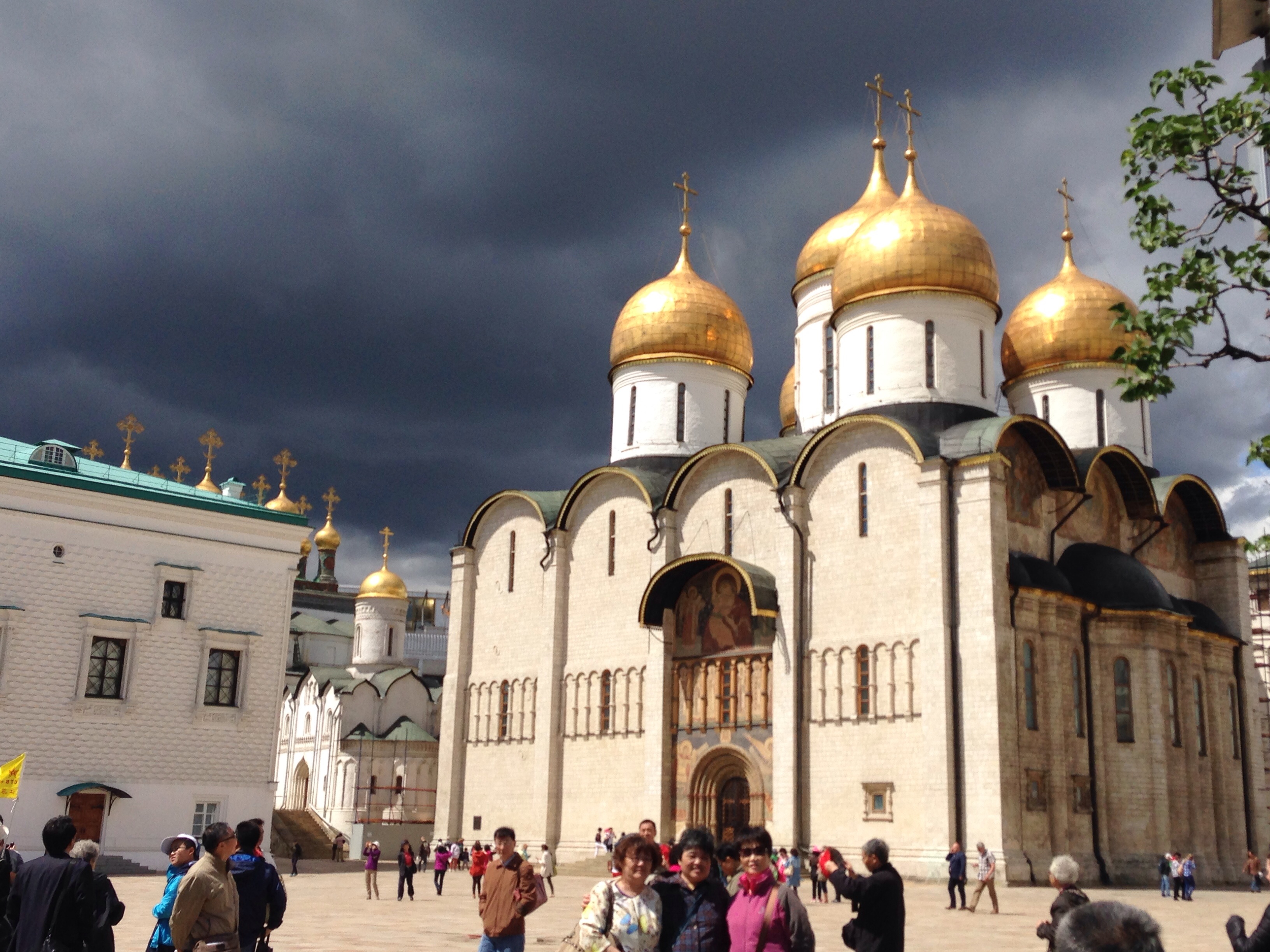
After dinner at a traditional Russian restaurant last night with our guide and one of our climbing companions (who has climbed Denali and Acongagua, among others), we spent the day touring Moscow. The Armoury Museum at the Kremlin – itself surrounded by 15th century walls, is incredible. The opulence of the dress, crowns, carriages, and jewels rivals Versailles. No wonder there was a revolution. Particularly interesting was seeing the two presidential helicopters land only a couple of blocks from us in the Kremlin, then take off again, and shortly after we saw the presidential car with its two security vehicles exit the Kremlin.

We ended the day with dinner at a very ultra modern Italian restaurant that embodies the new Moscow. Now it’s back to re-packing everything for a long travel day to the Baksan Valley in the Caucasus Mountains where our mountaineering will really begin.

And who knew? The name “Red Square” has nothing to do with the
Soviet Union. The word red means beautiful.

At Red Square
At Red Square