As I sit here on a weekend, waiting for the plumber to take his interminable time to arrive (three hours late, thus far), we have some decision-making to do. As hoped, the work schedule cleared up, freeing the way to commit to some June 2015 dates for our next mountain climbing endeavor. And I’ve already contacted the guide company that successfully led us up Elbrus, so that’s done.
But here’s where the itch of mountain climbing – or you could say hubris – sets in. It turns out for an additional four days and a few more dollars, we not only could climb Cotopaxi, but also climb Chimborazo – the highest mountain in Ecuador and one that reaches my long dreamed of goal of a 20,000 foot mountain. Well, long dreamed of if you count 2011 as a long time ago, since that’s when all this started. This would mean acclimatization hikes up Guagua Pichincha and Illiniza Norte, followed by Cotopaxi at 19,348 feet and three days, later – Chimborazo. At 20,564 feet, Chimborazo is harder than Cotopaxi. It’s one degree south of the equator, and because of the bulge of the earth, is the farthest point away from the earth’s core and the closest point to the sun. Hubris is the right word. Think Icarus.
I hadn’t really considered doing the extension. But then yesterday, in the midst of multiple levels of work related issues and general lawyerly stresses – and perhaps in reaction thereto (what a good, lawyerly phrase) – I suddenly found myself saying, “hell, yes.” Not out loud. But a lawyerly phrase, nonetheless.
If not now, then when? I’ll be 54 by next June. There’s no doubt that if we make this commitment it will require the highest level of training either the husband or I have tried to achieve. Sometimes mountains – and summits of all sorts – whether at work or at play – throw the gauntlet down before you and just ask to be climbed, and climbed hard. But I still think I better have a serious talk with the guide company.
Audubon Park with Loyola University in the background
The name of this blog isn’t FromSwamptoSummit for nothing. Occasionally, it’s important to come down from the summit or to allow yourself to be side tracked from the attempt to reach it, and enjoy a good wallow in a swamp. And what better place to wallow than New Orleans!
The husband and I have a long history with this city. When we got married in the spring of 1986, we planned to use the frequent flyer points I had garnered over a year of “fly outs” – as we then called the interview trips paid for by law firms to lure prospective summer associates – for our honeymoon. The only problem – all my points were with the now defunct New York Air. Besides Boston and New York, where we respectively resided, New York Air flew only to Detroit and New Orleans. The choice was not difficult.
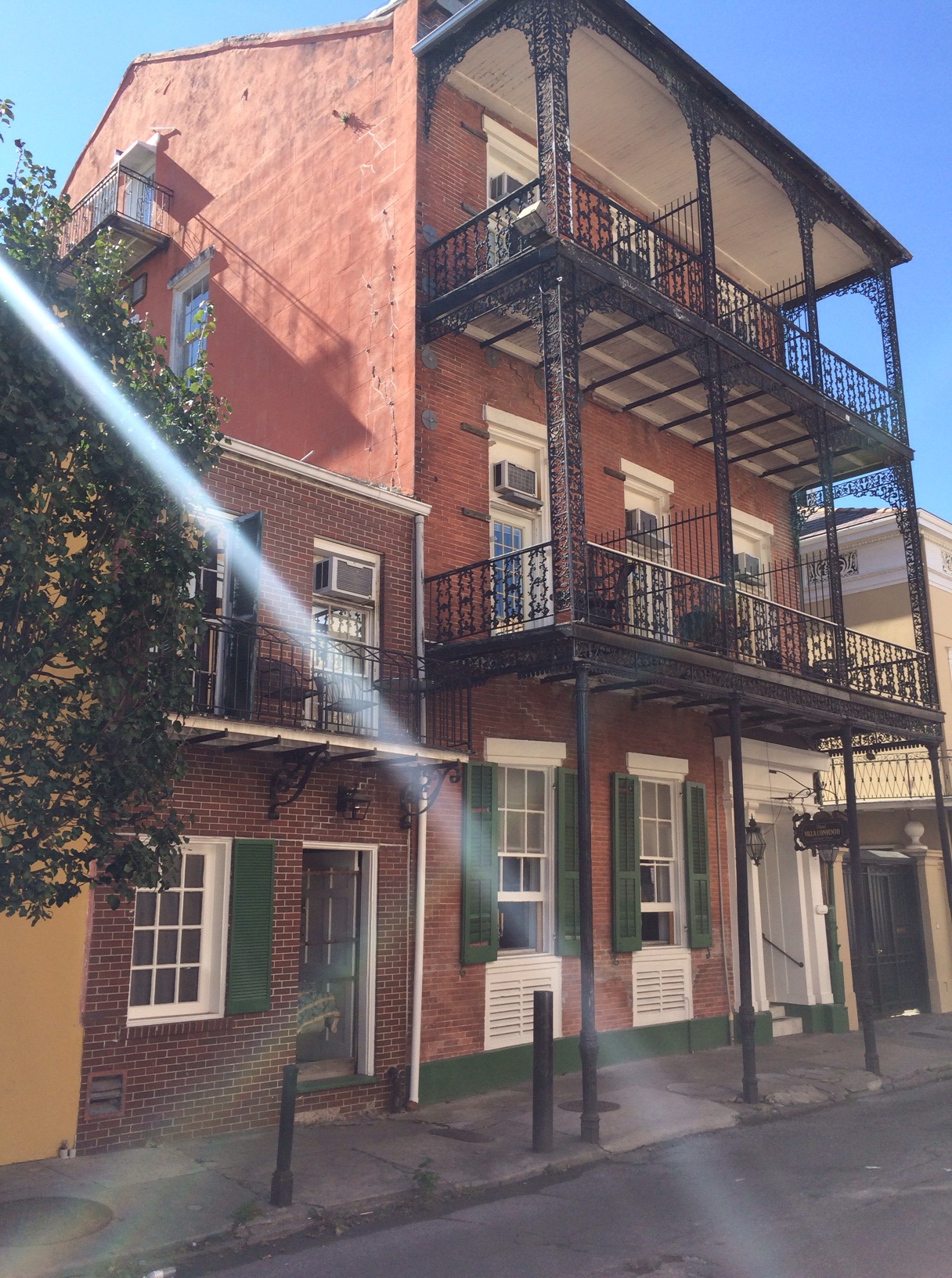
Hotel Villa Convento – not sure where the ghostly light came from. Perhaps something to do with the House of the Rising Sun?
Back in 1986, we stayed at the Hotel Villa Convento on Ursalines Street. In those pre Internet days we found it through a budget travel guide that I am sure we consulted at a bookstore without ever purchasing. The small family owned hotel has the dubious distinction of being across the street from a convent and is supposedly also the original house of sin made famous in the song, House of the Rising Sun. It had a certain moldy, faded glory, and we loved it. We’ve been back numerous times, including visits with children, parents and friends.
This trip – to visit daughter #2 – was assisted by the budget hotel vendor, HotWire, and the winner of this particular lottery was the Clarion Grand Boutique Hotel on St.Charles Street, the grand dame of all of New Orleans’ many boulevards. We knew we wanted to stay on St. Charles and this location is just about a mile above the Central Business District on the way uptown. We feared things might be off to an odd start when we checked in only to find a completely unknown credit card number associated with our reservation, together with a San Francisco address. After some detective work (oh, that legal training), we realized the address was that of HotWire itself – and who knows what the credit card was but we checked in anyway.
The daughter had made dinner reservations for us and several of her housemates at Martinique, a nice restaurant off Magazine Street with a pretty garden room where we were seated. The menu was most notable for its desserts – in particular, chocolate rye cake with beet chutney. I was somewhat surprised when the husband – who hates beets – said he’d try a bite. He was equally surprised when what he thought was a raspberry topping turned out to be beets.
The food extravaganza continued on Saturday. At least we started the day with a four mile walk from the hotel up St. Charles Street to the daughter’s house on the far side of Tulane – one of our favorite walks anywhere. Most cities have only a narrow strip of historic homes – New Orleans has blocks and blocks that run deep. The houses are often very close together, yet are huge. Many of them appear to still be single family residences. They are grand, with ornate columns and details, small front yards, and the dark, large front doors suggest a secret world closed off to all but those whose families hail from New Orleans’ early days.
We picked up sandwiches at the St. James Cheese Company, a small cafe selling gourmet – what else – cheese, and had a picnic lunch at Audubon Park, New Orleans’ answer to New York’s Central Park. We were barely off St. Charles Street, but our lunch companions were multiple types of ducks and turtles lazing in the sun.
An island of turtles – look closely….
Drove down to the French Quarter and poked around for a little bit. Bourbon Street as tacky as always, but the side streets as charming as I remember. Lots of Halloween ghouls peeking over the balconies, contemplating the various spooky characters below.
Zoom in for the Halloween hosts –
Dinner at GW Fin’s. I was amused to see that New Bedford sea scallops from Massachusetts were on the menu, together with gulf coast pompano. The daughter and husband both had “scalibit” – it’s a piece of halibut with scallops baked into the top of the fish and tastes as decadent as it sounds.
A trip to New Orleans wouldn’t be complete without a trip to the Sazarac Bar at the Roosevelt Hotel. And following that a visit to the Marigny to hear music on Frenchmen Street. But who knew that there were two such streets in New Orleans – or one street that is disconnected in the middle….I knew something was wrong on our Google maps when we found ourselves on the interstate, ending up at a Frenchmen Street that dead ended into the city bus parking lot! All I can say is the white SUV in front of us had apparently made the same mistake since it made the same u-turn and trip back to the city.
Once we finally got to the right place we listened to some retro sounding jazz at the Apple Barrel and finished with blues by the Smokey Grenwell Band at Club Bamboula’s.
A final travel note – we ended our stay with a leisurely breakfast at Coulis and a drive through the Fly – also called Avenger Park. It’s the riverside part of Audubon Park where you can see the tugs pushing long lines of barges down the Mississippi. It’s a favorite hangout for the daughter.
And it was particularly leisurely because we thought our flight left at 2 pm. We got to the airport early – and fortunately so, because it turned out the 2 pm on my calendar was eastern time – and the plane was leaving at 1 pm Central! But New Orleans gave us that one extra hour to enjoy without worry – just another one of the gifts of slow time and ease that the city offers. We all need to spend more time in the swamp.
I’m still processing our Mount Washington hike. And I am increasingly struck by how little I actually want to go “real” rock climbing, which our present idea for a next adventure – The Grand Teton – seems to offer in abundance. I’m currently reading To the Last Breath – A Memoir of Going to Extremes by Francis Slakey. It starts off with him and a climbing partner sleeping on a ledge on the face of El Capitan in Yosemite – roped, of course – only to have the webbing that held their “cot” fray and plummet out from under them some 2000 feet down. Not for me.
But in contrast, somehow the idea of a 14 hour night into day slogging up and down a glacier on a volcanic mountain – even with the incumbent risk of avalanche, crevasses, and a slip that could turn into a never-ending tumble down – doesn’t read the same way to me. I’m not sure I can articulate why a sheer granite wall feels so different than an expanse of deep white, but it does. Perhaps the glacier seems something that simple determination can conquer; the other requires more innate physical ability and guts.
Whatever the case, all I can say is that narrowing our focus to a trip in June or July of 2015 to Cotopaxi, the second highest mountain in Ecuador, with acclimatization hikes up Guagua Pichincha (15,696 feet) and Illiniza Norte (16,818 feet), is reinvigorating my training. Today, having narrowly managed to dodge the paper avalanche currently threatened by thousands of documents on my desk, I climbed stairs for over an hour – seven times up and down my building. Cotopaxi will be at least as hard as Elbrus, and there will be a sufficient amount of scrambling, especially, I think, on Illiniza Norte, to satisfy any inchoate desire to climb up a pile of rocks.
Cotopaxi is 19,348 feet, 7 feet higher than Kilimanjaro and about 800 feet higher than Elbrus. Every time I have climbed a mountain I have always felt if I had a do-over I’d do it better the next time. But you don’t go backwards to a mountain. You just find a new one.
We are now back in flat Florida following a three day adventure in New Hampshire via Boston (Somerville, to be more exact). After a bumpy flight, we checked into our AirBnB. For those of you not in the know, wannabe hoteliers or innkeepers who have enrolled in the program can let out their spare room – or their whole apartment or house if it’s going to be vacant – for varying lengths of time and at reasonable rates. Our 20 something daughter had urged us to try it. Of course, it’s an app. Once we got used to the idea that we were staying in someone else’s temporarily empty studio apartment – surrounded by all their books and other possessions – it worked out well. I guess we should have tried Uber on this trip as well.
A Portuguese breakfast – climbing food?
After breakfast at a Portuguese restaurant – which involved cod, shrimp and fish cakes, rice and beans – the husband, the older daughter, her boyfriend and I left rainy Boston for the three hour drive to Jackson. Our transportation was the boyfriend’s aged Previa minivan with 168,000 miles, including at least two trans-continental trips. As we got closer to New Hampshire the grey clouds lifted and we entered Jackson under crystal clear blue skies – as well as a city-worthy traffic jam in North Conway. We clearly weren’t the only people with the idea of a long New Hampshire fall weekend.
We stayed at the Inn at Jackson, the former vacation home of the Baldwin family (as in pianos, for you musicians out there). Charming rooms with a very nice communal living room, roaring fire, board games, and all of the things that we Floridians associate with fall in New England. That night we had dinner at The Wentworth, a sprawling hotel coping with what seemed to be an unexpectedly large number of diners.
The Inn at Jackson
Sunday morning was our summit day. Our hosts had kindly put out breakfast food for us since we were hoping for an early departure – but somehow – due more to the husband and me than the other two members of our party – we still didn’t take off until 30 minutes later than planned – a pattern that unfortunately pervaded the entire climb.
We started from Pinkham Notch visitors center. The boyfriend bought me a three dollar map – which my daughter had said would make me happy. It did that, but more importantly, it actually served a much-needed traditional map function later in the day.
Mount Washington – and the Tuckerman Ravine Trail in particular- is rocky. The first couple of miles consisted of a wide path of semi steep ascents over what looked to be a rocky river bed. The half way point was Hermit Lake Shelter. Ironically, that was the windiest point of the whole day and caused us all to don extra layers that we spent the next few hours shedding. We stopped there for a mid morning snack. We may have been the only people climbing the mountain with a loaf of whole wheat bread, a hunk of cheese, a hunk of salami and a full jar of grey poupon mustard. Oh, and we had some left over GUs from Elbrus.
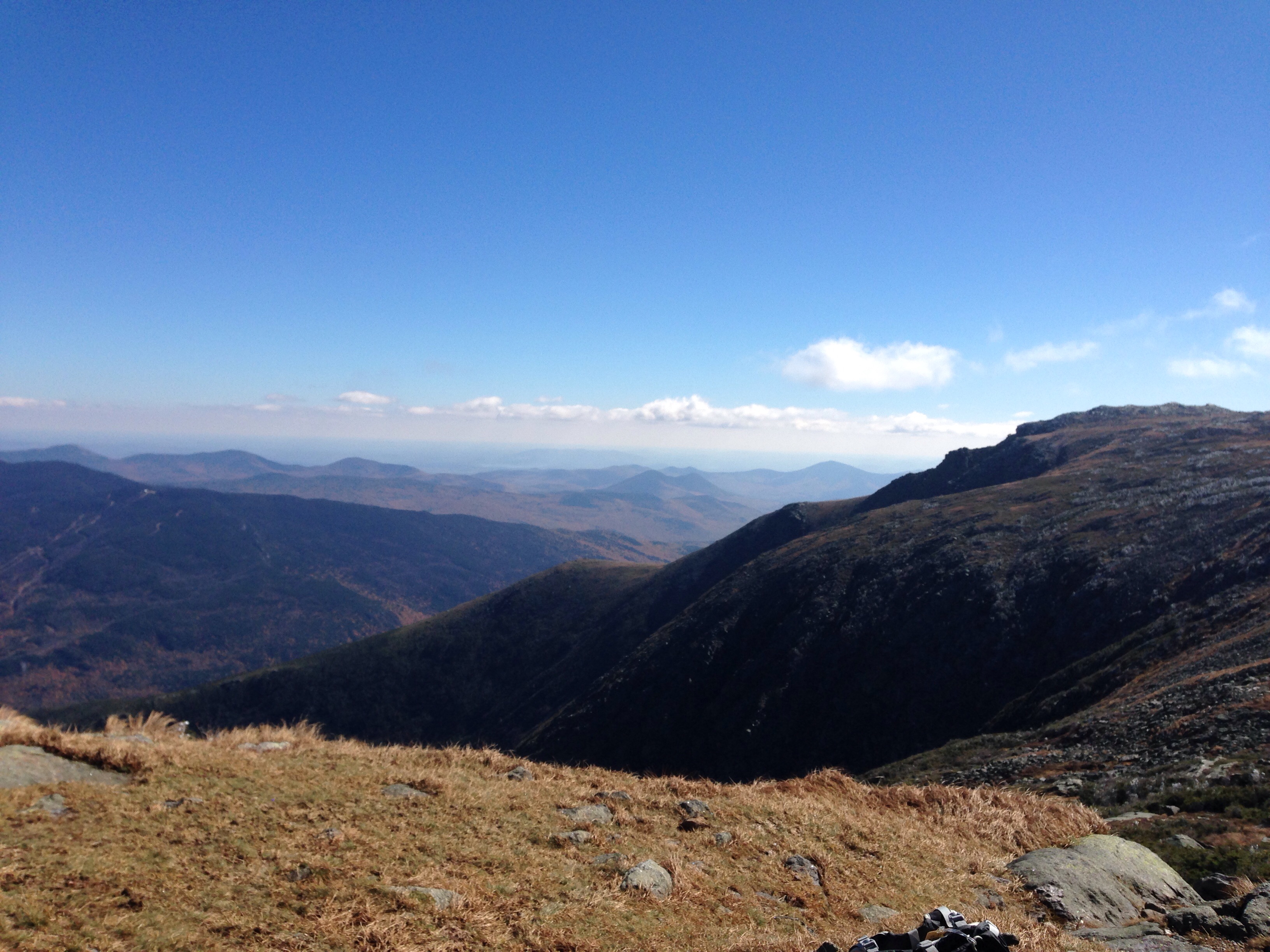
Below Hermit Lake Shelter
We had spectacular weather. Most of what I had read about Mount Washington had focused primarily on the horrible weather and didn’t spend much time at all on the difficulty of the trail. So while we were very prepared – in fact, over prepared – for the weather, we hadn’t actually taken into account the steepness and rockiness of the trail. After the half way point, we basically spent the next couple of hours scrambling up large boulders, some of which were quite wet from the waterfalls and streams that cross the trail. We were also slowed by the hordes of international tourists speeding up to the summit in terribly coordinated hiking outfits whom we felt compelled to let pass. In retrospect, we might have been better off had we been less polite.
And speaking of clothes – the ill-fated pants with the dysfunctional zipper (see earlier blog entries) reared their ugly legs again. I swear this was their last excursion. About an hour or so from the summit I realized the pants were constricting my left knee every time I stepped up – to the point I had developed a good sized blue bruise right below my knee. Finally I gave in, recognized the pants for what they were and stripped down to my light weight hiking pants that I had the foresight to wear underneath. My mobility increased enormously.
We finally reached the summit about 2 or so – well later than we should have, given that sunset was at 6:05. Nonetheless, we stopped for a while and had some hot tea in addition to our second meal of salami and cheese. The summit is a total tourist area. There’s a train that chugs its way up there. Others drive up on the “auto road,” and of course there are scores of people who actually climbed. There’s a museum, a gift shop and a snack bar. Remote, it is not.
Finally we started back down. We took Tuckerman Ravine Trail for a little bit, then veered left to the Lion Head trail. All of a sudden the crowds thinned, and the landscape grew wilder. It was much steeper than the other trail, and marked almost exclusively by stone cairns. We hiked through tunnels of dwarfed evergreens and slid ourselves down several rock chimneys. A number of the drops were steep enough that the daughter and I resorted to the good old fashioned sit down on your rear method of descent. At a couple of points the trail seemed to disappear into nothingness at the edge of a cliff – and all of a sudden you’d see a tiny little path down.
Lion Head Trail
Eventually that trail arrives back at Hermit Lake Shelter and rejoins Tuckerman Ravine Trail – at which point we realized we were out of water. We’d made a really stupid mistake of not refilling our bottles at tourist central at the summit, thinking we had enough. The boyfriend valiantly volunteered to run what we thought was a short distance to the water pump – only to find it wasn’t a very short distance and the pump required numerous pumps before anything came out of it. By then it was clear the sun was rapidly on its way down and we got out our headlamps to be ready.
We were now off the steeper and more beautiful trail back to the river bed of rocks. Actually there was a real river beside us much of the way. I finally took the lead since down is usually my strong suit – that is, when I am not having to slide down rocks on my rear – and we made extremely good time at first. Still, the only other people on the mountain now seemed to be professional trail runners who literally jumped over the rocks like moths flitting from light to light. Once the sun was down, any pretense we’d had to speed was done – one wrong step and turn of the ankle and that would be it. In the dark it’s easy to question where you are – especially since I had a strong tendency to want to follow the water runoffs – which looked awfully trail like to me – and the daughter seemed to want to turn right regardless of location. The three dollar map became very useful to provide some confirmation we were actually heading in the direction of the lights from the visitors center that occasionally flickered in the distance.
Finally – and almost suddenly – our journey through the night ended and there we were at the Previa. Injuries : some blisters – daughter and boyfriend; bruises – daughter and me (both banging legs on rocks and pants injury). Damaged equipment – somehow the daughter’s hiking pole had flipped open, the bottom part fell off, and she didn’t notice until we were at the bottom! She said it had seemed a little shorter. A Black Diamond, no less. Rewards: meeting a challenge head on with a team that included not just the husband and me but the daughter and boyfriend. When the husband and I are old and grey and sitting by the fire I hope they’ll remember we weren’t always that way.
So, lessons learned. In the broader scheme of things the husband and I remembered we really like sheer mountain climbing better than rock climbing – which can still sometimes trigger my innate fear of heights. We are rethinking the Grand Teton and are now seriously thinking again about Cotopaxi in Ecuador. It’s another almost 20,000 foot glaciated mountain that is awfully appealing.
And on the smaller scale of things we were reminded that you can make stupid mistakes on even 6200 foot mountains and regardless of how many you’ve climbed. You’ve got to be humble in the face of a mountain.
As I closed last time we were at campsite 2 (Pacamayo), removed from all cell service, in the view of the tall peaks of the Andes. The next day, Day 3, was the longest, but most beautiful, day of the hike. In the morning, after a typical early start, we stopped at various Incan ruins. The one that stuck out the most was a religious site where mummified bodies were taken after they had been dead for several years. The bodies, which were mummified into terribly contorted shapes, were transported along the stone trail to this location, where they were placed into very small niches. After various rituals involving special water were performed, the mummies were returned to their homes and placed in holes on the sides of the nearby mountains.
It was either there or at the second pass (I believe Dead Woman’s Pass was considered the first pass) that we hiked up a peak and each placed a stone from below on a cairn as an offering to Pachamama – Mother Earth. The so-called “Inca Cross” actually represents the Incan belief in the need to bridge the gap between earth and sky, and man to the gods. Perhaps not so different.
Above the clouds on the third pass of the Inca Trail
After lunch we reached the heights of the third pass. Surrounded by snow capped mountains and looking through vistas of mountain ranges. We descended into heath and very quickly down into the “cloud jungle.” As we journeyed lower and lower there were more wild begonias and blooming orchids.
Descending from the third pass
At a certain point on the descent, our guide, Juan, took us to a small structure, manned by a single lady. It was a local “pub,” according to Juan, where the local corn beer, “chicha,” was made. The small, low-ceilinged room was filled with wood benches, and the proprietress looked as if she’d had one too many. We all passed around a cup of chichi – it reminded me a lot of the “shebeens” in South Africa – the local drinking establishments.
Toward late afternoon the trail split and you could take a 20 minute detour to another ruin. The husband and I declined, but by then the two daughters were well ahead, not having found my tendency to hang back and study the flowers a particularly desirable quality in a hiking companion. We didn’t know if they had chosen the detour, and suddenly I became convinced they had taken a wrong turn and were lost somewhere in the wilds of the cloud jungle…I sprinted the last downhill hour (developing a rapid descent technique that has served me well on other hikes), only, of course, to find them safe and sound at the third campsite, Winay Wayna. They had staked out the best tent site; the husband and I were relegated to the one by the particularly awful “bathrooms.”
That night was our last camping night – we were to arise at 3:40 a.m. the next morning to hike the remaining five miles to Machu Picchu itself in the hopes of seeing the “Sun Gate” at sunrise. Dinner was quite elaborate, featuring a rice cake shaped like – I think it was a chicken! The tipping ceremony also took place that night. But at that point, the complexion of the entire trip changed.
As you’ll recall, daughter number 2 was the one left cold and shivering on the way to Dead Woman’s Pass. That apparently caught up with her and she couldn’t eat dinner – the cook’s very kind offer of a special celery tea made her feel even worse given her extreme dislike of celery in any form. In any event, at 12:30 a.m., a little voice (or as little as the voice of a nineteen year old is) called at our tent door, “Mommy, I have to go to the bathroom.” I found myself taking her on a midnight excursion to what passed for a bathroom; she was burning with fever, so I moved into daughter number 1’s spot in their tent, and daughter number 1 moved into my tent with the husband. We were the only people up in the campsite shuffling back and forth between tents in the early morning hours, and lord knows what our companions thought we were up to. That’s when I discovered my older daughter apparently sleeps in the equivalent of a squirrel nest, surrounded by so many possessions it was impossible to straighten my legs! I finally got the sick daughter to sleep and dozed off myself for a couple of hours before we started on the final leg of the hike.
Sunrise over the Andes – on the way to Machu Picchu. Day 4.
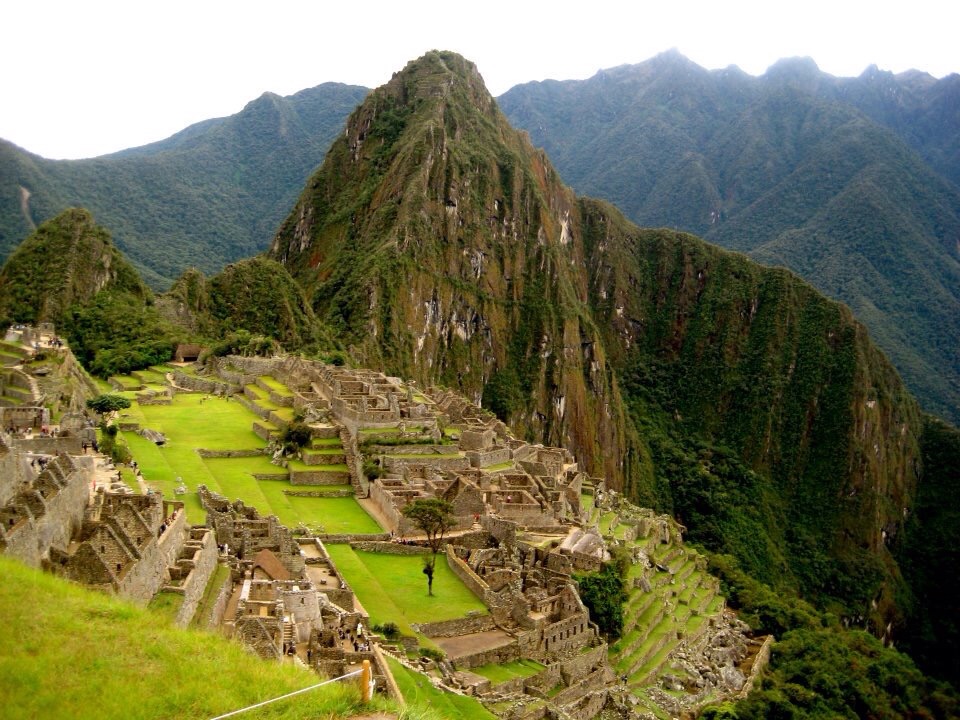
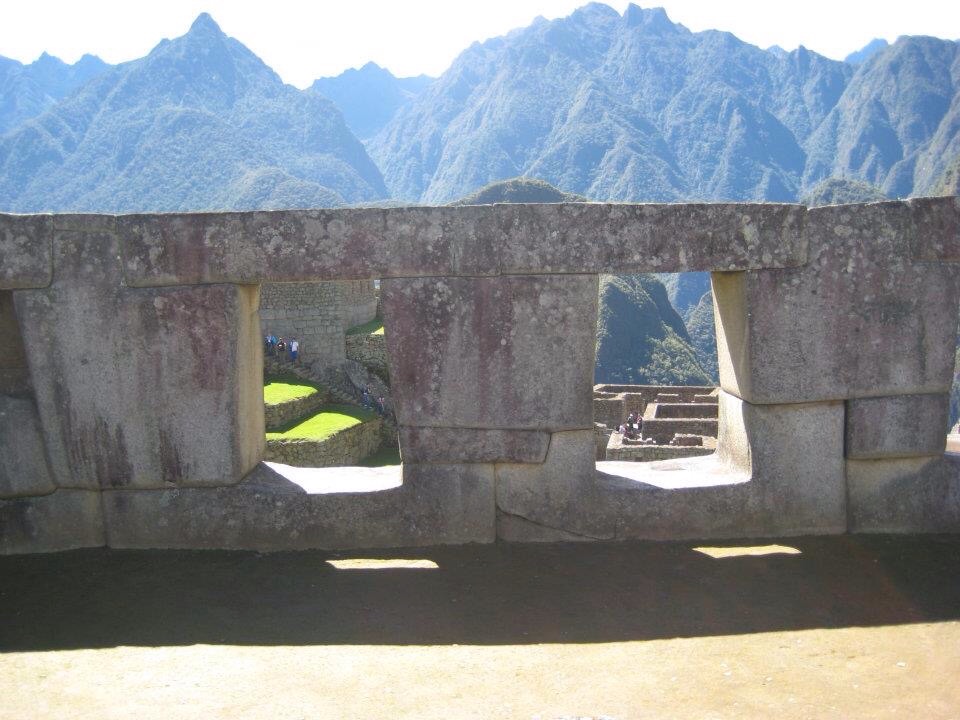
The daughter now known as the Sick Daughter was a trooper though! She made the hike without complaining and although we missed sunrise, the view of the mysterious ruins, the elegance of the structures, and the incredible geometry of the carved stones was overwhelming. I was struck by the lack of ornamentation. Not one curlicue, not a single mark that served anything other than a functional purpose. Instead of decoration, perfectly cut stones, brilliant in simplicity — yet forming a place the purpose of which is still not fully understood.
The approach from the trail, I think, is very different than if you have taken the train to the site. There’s a drama to reaching it after four days of intense hiking that a train simply can’t mimic.
Sick Daughter unfortunately spent the half day we toured Machu Picchu in the shadow of one of those perfectly formed stone walls, together with another of our hiking companions who had similarly been taken ill.
View down onto Machu PicchuCarved stones at Machu Picchu
About noon we took a bus (!) down to the small village of Aguas Callientes, where we stayed until the night train and van ride back to Cusco. After four days of hiking in the wilds, it was a shock to see cars, streets, and shops. Our guide was friends with the owners of a restaurant, which, like so many Peruvian structures, had an unfinished second floor that was still open to the main street. They let Sick Daughter stay up there on an air mattress; as I warned, if she rolled she was going to topple out of the building and into the street. In the meantime, the rest of us went to the mineral baths. As we had no swim gear we rented bathing suits – we did pick a place where we could see the washing machines! Quite civilized – and such a change from where we had been. You could order Pisco sours and drink them in the hot tubs.
The trip back to Cusco was an amalgamation of bad travel experiences. Bullet points: (1) On the way to the train station, all the power in the village went out, and hundreds of people were rushing in the dark, carrying heavy backpacks (at least those of us who had hiked). (2) Our hiking companions had decided illegally to bring beer onto the train – and the bag in which it was stored broke, causing beer cans to roll all through the dark train station, to the great concern of our guide. (3) No one sat in their assigned seats on the train, meaning that I could hardly find a place to sit with my feverish and clearly ill daughter.
The train didn’t actually go to Cusco but to another location, about a two or three hour van ride away from the city and our hotel. The roads were long and windy and steep and high and we had been up since pre-dawn, hiked miles at altitude, toured Machu Picchu and soaked in hot springs. At a certain point we stopped because Sick Daughter needed to go to the bathroom – I got out with her. As we stood there in the pitch blackness, we suddenly heard rustling in the underbrush and something started to lunge out toward us….we both screamed and scurried back to the van as fast as we could. To this day, I’m convinced we nearly fell victim to a mountain lion.
Finally, we made it back to Cusco and the sophistication of the Hotel Marquesas.
It’s hard to sum up the Inca Trail – not a summit of height, but certainly a summit of sorts. And next week – finally a real summit. A week from today we’ll be hiking Mt. Washington in New Hampshire.
Inca Trail part two. I have realized that this experience was at least a trilogy, so part 3 will follow. Today’s installment – the “village” part of the hike, followed by “Challenge Day” and the Dead Woman’s Pass.
We met our fellow hikers at about 5:30 a.m. in front of the Hotel Marquesas in Cusco. We had briefly encountered each other the previous day during an introductory briefing session at the trekking company’s office. We were a diverse lot – our family of four, newlyweds from Boston exploring Peru, an English couple traveling around the world for a year, accompanied on this leg of the journey by a sister, a couple of salesmen from Texas, a doctor and his wife, also from Texas, and one man from California and another from Germany. Fifteen in all – it was a large and unwieldy group.
After what seemed like a very long bus ride, we stopped for breakfast in the small town of Oyelltambo. The restaurant was most notable for highly elaborate rabbit cages in its garden. It was very early in the morning but I think I am remembering this correctly.
We journeyed on to Kilometer 82 – the official beginning of the trail (or trial, depending on your perspective). We were struck by how agricultural it all was. Women on donkeys carrying bushels of herbs; local people selling water or other items at about every rest stop. The mountains on either side of the trail were green, capped with snow. And flowers everywhere. I hadn’t realized before that begonias grew in the wild. Views of the ruins of Llactapata – a settlement of 100 or so buildings that would have housed soldiers and others traveling the trail. Our trekking company did not scrimp on food. Trout for lunch. Apparently inspired by lunch, our guide then had to explain to one of our fellow hikers that the “no hunting” restrictions also meant “no fishing” with the fishing line he had brought from Texas.
Permits for the Inca Trail are strictly controlled and only a couple of hundred people can enter the trail on any given day. You also have to go with a trekking company – no independent forays along the hundreds of years old stone path.
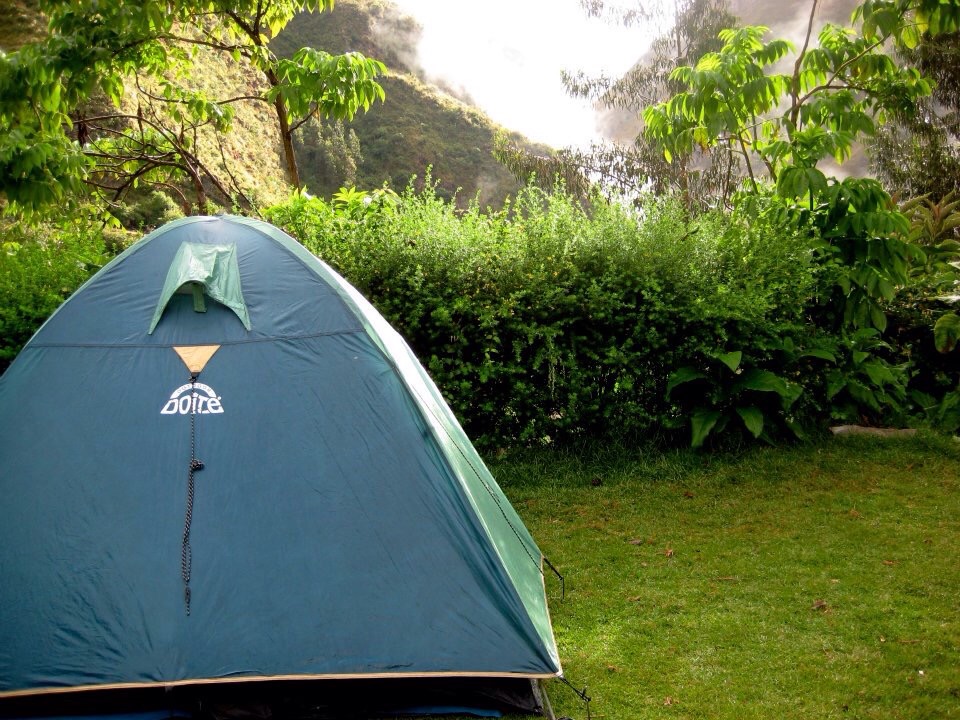
The first campsite, Wayllabamba, 3000 m, was in the heart of the agricultural area; in fact, local people were selling all different beers and drinks from aluminum containers. Dinner was a highlight – chicken with flaming bananas! But even with the semi-village feel of the campground, the remoteness kicked in with the southern hemisphere of evening stars – visible without any city lights. This was our first time camping with our daughters. Since we hadn’t reinvented ourselves as climbers until age 50, they had never experienced this growing up. But they were good sports and settled into their own tent well – although quite greatful we had made them bring long underwear.
The next day, day 2, I finally started to feel I had found my hiking rhythm. That day we reached the highest pass in the trail – Dead Woman’s Pass – at 4200 m. It was overcast and drizzly and suddenly the layers of clothes that had seemed too warm in Cusco felt right.
It rained on and off the whole way, the grey punctuated by the yellow orchids we saw every now and then. The up was ok, if steep, but the down hard on the knees. By now hiking on the carved square stones of the trail – some replacements, but some the same the Incas hiked on those hundreds of years ago on missions no one, to this day, totally understands. There was no written tradition.
Yellow orchids – michi michi
Of course, as we were accompanied on this hike by the daughters I had to assume both my mother and hiker persona – not always compatible. In fact, the maternal one is also known as Mommy the Packhorse and as usual I ended up carrying many of the layers that belonged to the two girls. A lesson to be learned: the younger one decided to prance well ahead of the rest of the family on the steep approach to Dead Woman’s Pass, leaving her rain gear and warm jacket with her sainted mother. We found her 45 minutes or so later shivering and cold as the rain and wind picked up.
Dead Woman’s Pass
The tree line was about 10,000 feet. Dead Woman’s Pass, at close to 14,000 feet, was cold, rainy, and very windy. Only a few hundred of feet below it was much warmer. Still, our camp site that night – Pacamayo, 3600 m, was very cold. Gone were the villagers. We were in a non cell phone service area, completely disconnected, and with only the grey shades of the ancient Incas for company.
To come – day 3 and 4: the placing of rocks on a cairn, Incan funereal rites, daughter number 2 gets really sick, sunrise (almost) over Machu Picchu, and the van ride back and the attack of the mysterious wild animal. Stories to come.
Our trek along the Inca Trail in May 2012 started off as a natural follow up to Kilimanjaro in 2011. Granted, it wasn’t a summit per se, but it certainly was a well-known hike, seemingly had a degree of challenge, and besides, we were able to convince our daughters, then 19 and 21, to accompany us. But what we didn’t realize was that the trip would be as much of a cultural experience as it was a climb. Many mountains are remote and you are more exposed to the insular world of the mountaineer and whatever wildlife lives above the tree line than you are to any local residents. But Machu Picchu surprised with the many, many people we saw every mile of the way – from the beer hut on day 2 or so to the women riding donkeys with bushels of cut herbs on their backs.
The trip began rather inauspiciously – for some reason the husband and two girls thought that Mexican food and margaritas at the Orlando airport was an appropriate way to kick off a trip to Peru. Not so, and all I can say is they suffered quite a bit for it, while my salad and wine seemed to agree quite nicely, thank you very much. We flew on Copa Air – the Panamanian airline, and like most non US airlines, it was quite pleasant – although we had bad weather in Panama City and landed with quite a bump. Ran to the next gate and just made our flight to Lima, where we landed about midnight. But you would never have known it was the wee hours of the morning from the hustle and bustle of the Lima Airport. It might as well have been late afternoon on a Saturday of holiday weekend. All the shops open, people dining.
Had to recheck our bags at the LAN counter – our airline for for the trip to Cusco – and got to the gate about 2 a.m. Together with a number of other intrepid travelers, we each found a section of seats to crash on for a few hours, backpacks within touching distance. We arrived in Cusco in early morning, and could feel the change from sea level to 11,000 feet. We stayed at the beautiful Hotel Marquesas – a 16th century residence converted to hotel. A courtyard in the center; walls about a foot or more thick. The husband and I had a balcony overlooking the street from which we could see the cathedral. The girls had an interior room that felt like a cave. Because we had arrived so early, the rooms weren’t ready and we were immediately offered – and accepted – coca tea – which does in fact help with sudden altitude change.
Hotel Marquesas, Cusco
Travel hint. Only bring new bills to Peru. Currency exchanges will not accept anything with creases or tears. And they are serious about it. Sight seeing was the order of business for the first day or so. The cathedral’s wonderful painting of the Last Supper where a guinea pig substitutes for the bread embodied for me the peculiar marriage of local and foreign cultures. And the food! For lunch I had potatoes in a red pepper cream sauce. (Peru has, I believe, more varieties of potatoes than anywhere else in the world.) Dinner – chicken stuffed with goat cheese and elderberry sauce; local trout; poached pears with cinnamon ice cream. And you can’t forget the pisco sours – like a gin fizz made with a brandy.
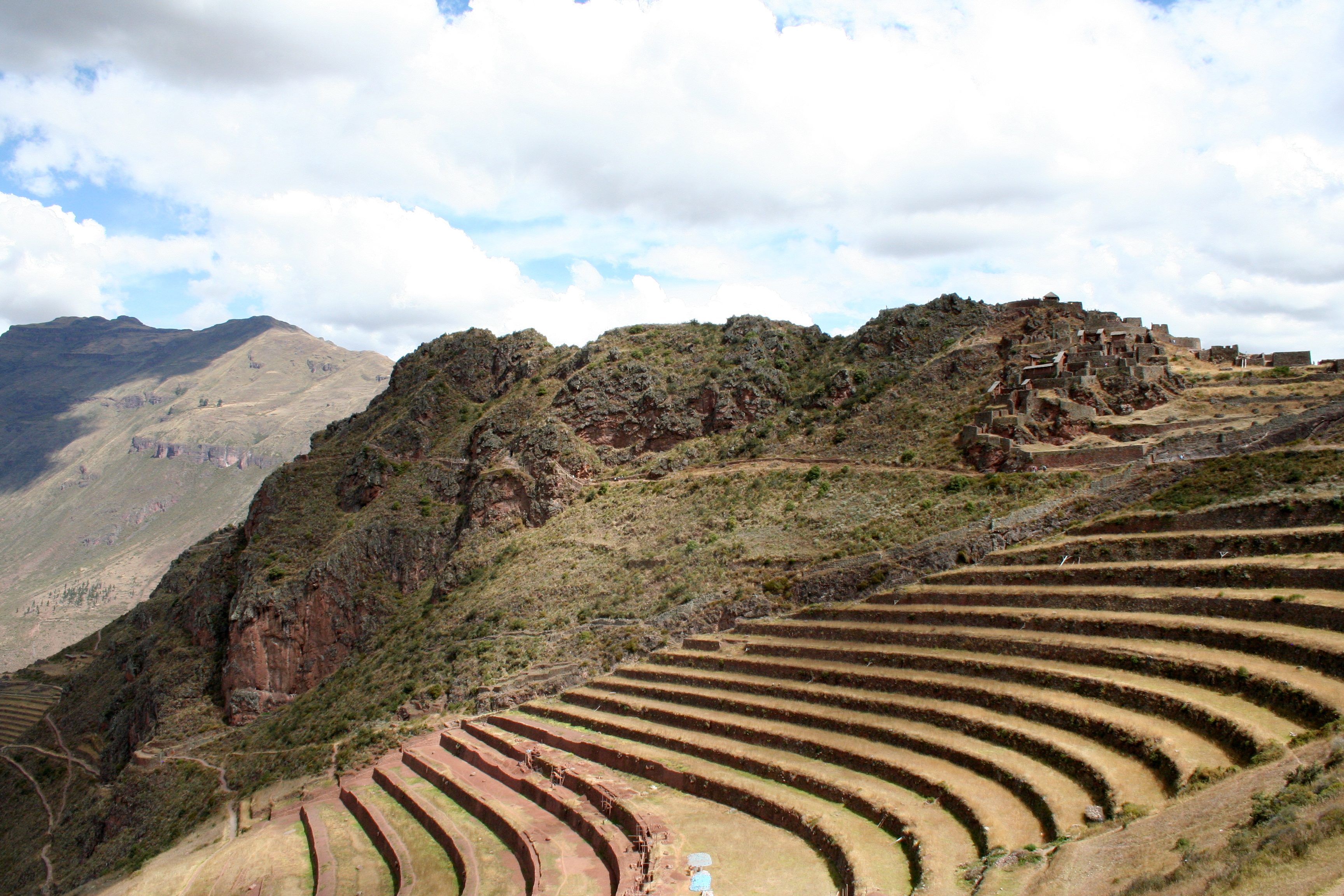
We spent the next day on a bus tour of the Sacred Valley. Although it was supposed to be for both Spanish and English speakers, we seemed to be the only English speakers and it was remarkable how ten minutes of Spanish could turn into about two sentences of English. Nonetheless, the ruins were remarkable, the Andes amazing, and we were struck by the authenticity of the people and places we were driving through.
That night the four of us did a mini gear check, getting ready for a van to pick up us up at 5:30 am to drive to the fabled Kilometer 82 – the start of the trail. Next post – the start of the hike.
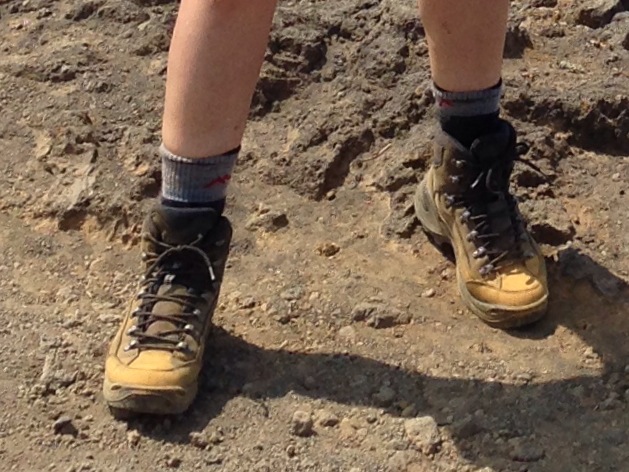
Boots with soul
This coming week I’m planning to lug the hiking boots back to my office so they can start to climb stairs with me again. They are full leather Lowa Renegades that I bought in 2010. You could tell back then if a climber was from Central Florida because those were literally the only full leather boots being sold in the area.
I figure that it’s a good idea to be back in hiking boot mode before the Mt. Washington trip in a few weeks. And I know my daughter, who is going along for this trip, is tired of me telling her to do some hiking in her hiking boots – but since I don’t think she has done so for any length of time since the Inca Trail in May 2012, I certainly think it’s advisable.
Each time I put on my boots I see just a little bit of dirt or dust from treks past. Some days after the Boston Marathon bombing occurred and the bombers identified, I was climbing up and down the stairs in my office building. We had just returned a few weeks before from hiking down and up the Grand Canyon – South Kaibob and Bright Angel Trails. There was still red, copper dust ground into my boots that reflected the rusty color of the stair rails. The burnt colors around me, and the cavernous recollection of descending down into the canyon converged and I was overcome with the tragedy of how the two brothers could have so missed the point of the mountains and sun and whether they even realized what they had done.
I dragged around dregs of Kilimanjaro for months on my boots. The husband and I hadn’t bothered to take advantage of the repeated offers to clean our boots when we were in Africa – hence, even when we returned, my navy blue boots had a grey ashy sheen that outlasted multiple rainstorms. Each time I put them on I felt a little bit again the magic of that moment if stepping on the summit.
Elbrus didn’t make as big a mark on my boots as it did on me. Probably because once at the Barrels – the converted oil barrels where climbers stay at 12,000 feet – we were in our double plastic boots and crampons. But my boots still bear a little dust of the Caucasus mountains, especially the fields of wildflowers on the observatory hike and the dried salty sweat from the horses as we went horseback riding. And I’m sure that somewhere hidden in the creases of my boots there is a bit of olivine sand from Green Sands Beach in Hawaii, or the deep rich soil of the Inca Trail.
I’m hoping my boots have a lot more miles in them – although when I looked at the soles they have lost a fair amount of their grip. But grip or no grip – they have a lot of soul.
I’ve been meaning to write this post for a long time. Certainly, when I have been training for various climbs and treks, adding cardio to my work out was an essential component of success. But much of climbing or trekking is the sheer grit of simply keeping on going even when every part of you is saying stop right now. And that’s where yoga has made all the difference – and here’s a shout out to my many, many yoga instructors over the years, whose voices were in my head on so many of these hikes. Elbrus on the long slushy slog on the way down. Mt. Hood, where the 60 mile an hour winds were blowing me into the mountain and I couldn’t see because the blinding snow had totally occluded all vision.
I remember my first Bikram yoga class in 2007 or so. At that time, Bikram Yoga Orlando was located next to an elevated expressway in an small old strip center (and I mean old – circa 1960s) next to a pet grooming place. That’s the reason I had seen it – I had dropped off the dogs (who are now 14!) and picked up a schedule from the pile outside the door. I’d been doing yoga for a long time and had heard of Bikram, but had never tried it. But I was then working long hours on an arbitration – the precise contours of which have long escaped me – and I thought, maybe this is just what I need as a break.
Bikram is supposed to be practiced at 105 degrees and 40% humidity – and at the new studio it is. But at that old place down on South Street I swear you could see clouds forming overhead and I am sure there were a couple of times rain drops actually came down.
After my first class – and I didn’t leave the room nor did I lie down, despite the heat – I thought – Ok, I’ll try this every other week. But the next week I was back. And, although I’ve kept “regular” Wednesday and Sunday yoga classes, pretty much every week I’m also at Bikram. For someone whose job is comprised of making decisions, to be in an environment where there is no decision except the one to go on is an incredible luxury. I follow what the instructors say; I know the dialogue; and each class I feel my body respond and become stronger. And there is a particular moment where listening to the dialogue and your own physical presence merge and become one – and for once, you can be in the present – no decisions to make except for the one to keep going.
And I don’t want to dismiss my so-called “regular” yoga classes either. Where else have I learned the ability to literally stretch my body into shapes and places it wouldn’t normally go. The beauty of Bikram is that it’s the same every week – but the beauty of the other yoga is that I’m challenged to see where I can move my body in space and create that extra last dimension around me and fill it with movement.
So why does this relate to summits? I’ve learned to control my breathing. On the mountain, I think – breathe normally, in slowly and out even longer. On Elbrus I recited the Bikram dialogue in my head. I went into that quiet place of the present that allows you to take those last few steps that lead to the summit – and just as importantly – that allow you to descend.
Mauna Kea isn’t particularly well-known as a destination hike. Most people get to the top by car. But after my husband became the only person in Hawaii to come down with a severe case of flu in the middle of August 2013, thus putting the kabosh on our plan to backpack the Muliwai trail (more on that later), Mauna Kea seemed an attractive alternative.
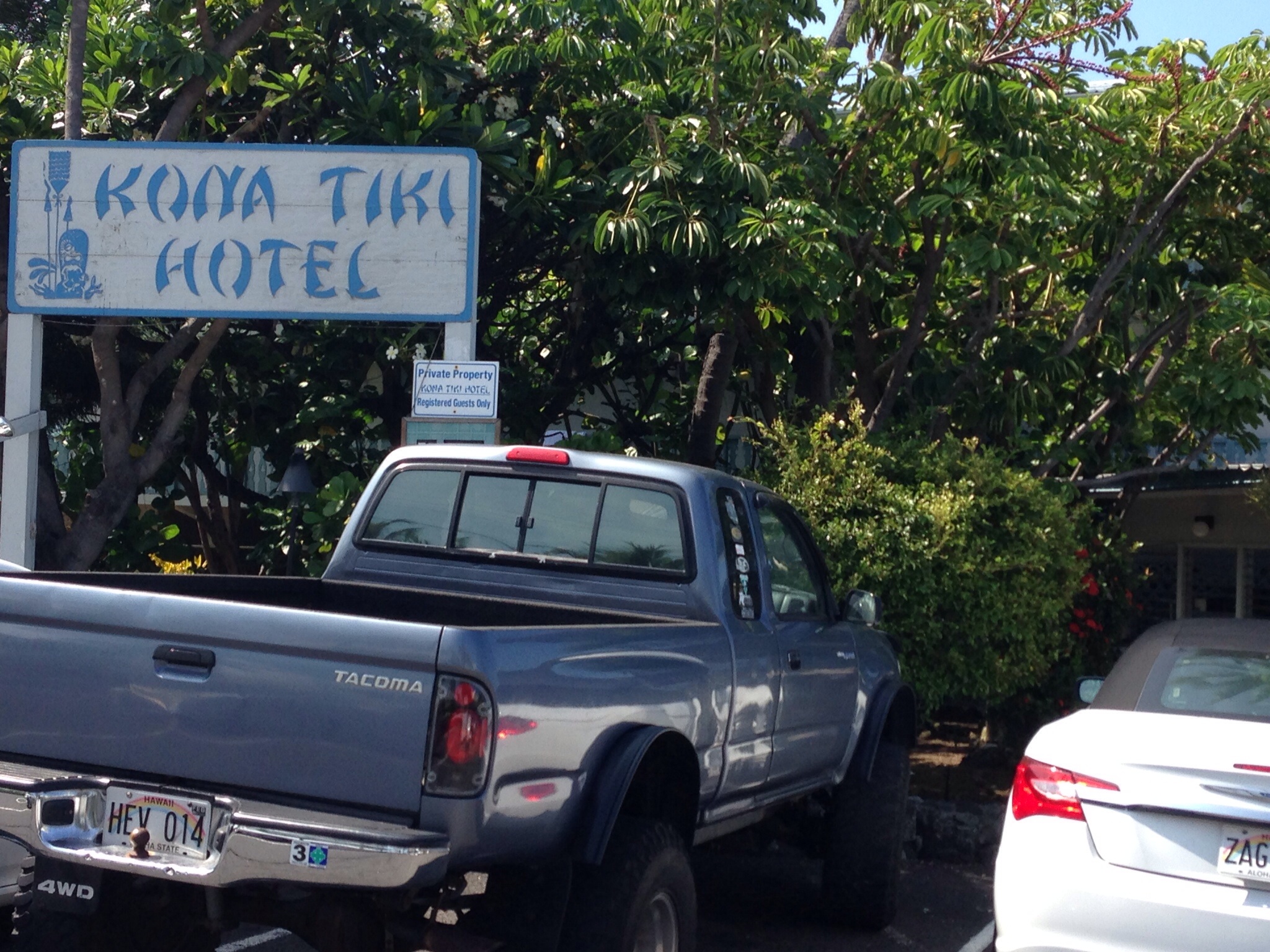
Due to the unexpected change in plans we had several wild card nights – no reservations, no nothing. Two nights before we climbed Mauna Kea we stayed at a 1970s hotel on the edge of Kona, complete with kitchenette and ancient dinette table. Ocean front was an understatement as the second floor unit we were in was bombarded with large waves throughout the night – unclear what the decibel level was. The next night we returned to the semi rundown estate of the Rockefellers outside of Waimea, now converted to a somewhat quirky bed and breakfast – without the breakfast.
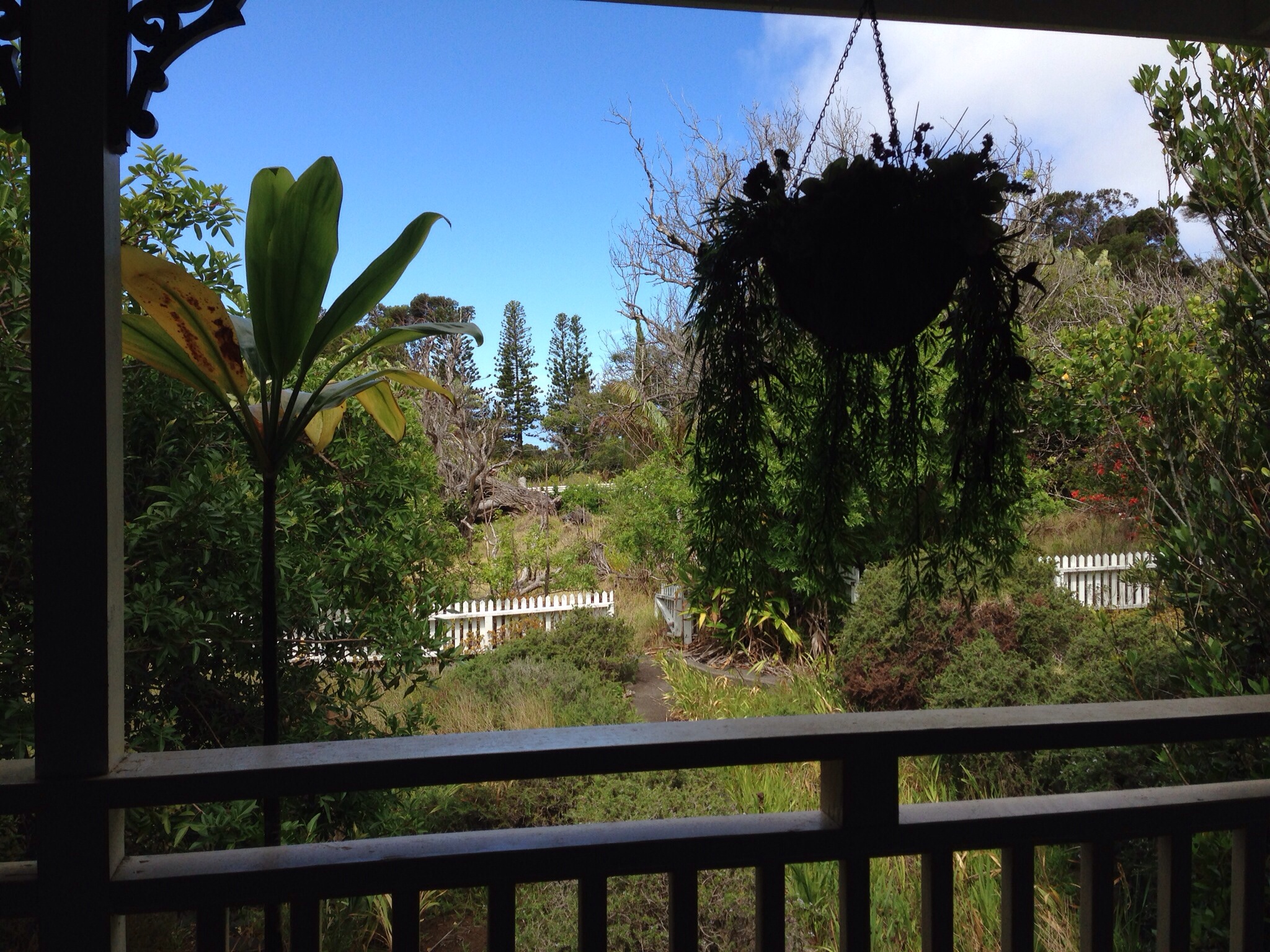
View from our porch at the former Rockefeller estate in WaimeaKona Tiki Hotel, Kona
The next day we awoke early to an hour or so drive along Hawaii’s oh so well maintained road to Mauna Kea. We parked at the ranger station at approximately 9200 feet elevation about 7 am and signed in. Little did we know that only two other hikers would sign in that entire day.
After the first bit of the hike – some fields, some green – we might as well have been hiking on Mars, or at least my idea of Mars. Black and red lava rocks, occasional prehistoric (maybe) cairns of rocks, and very little that resembled vegetation. The temperature varied between extremely hot and downright chilly during the few moments when the sun went behind the clouds.
One of the more peculiar features was that even though the road up would occasionally pop into view I felt more isolated on Mauna Kea than anywhere on Kilimanjaro, much less Mt Elbrus. The trail wasn’t always well marked and it was not hard to imagine being found years later after suffering an unhappy death from dehydration.
Making the trip even more interesting was the rapid elevation gain – literally sea level to almost 14,000 (13,796) feet – in about six hours. I usually don’t feel anything at 14,000 feet but I definitely started to have a headache near the top, combined with some dehydration.
As you approach the top, all of a sudden you start to see the telescopes. Peering up over the orange landscape and the gradual volcanic cones, it is as though you have inadvertently wandered off course and ended up on Another Planet. There’s also a set of porta-potties, a nice reminder of earth, however. I kept thinking of the novel Cloud Atlas – one part of which involves an adventure at the top of Mauna Kea by the observatories – “you’re crazy. There ain’t nothing on Mauna Kea but Old Georgie and his temples hid in ‘closure walls. He’ll not let you in unless you’re ‘ready died an’ your soul is his.”
Telescopes on Mauna Kea
There we encountered the only two other hikers we saw the entire day. But the last mile or so up requires walking along the side of the road, with cars whipping past you. Resentment toward the motorists kicks in – they hardly deserved the summit! The summit itself involves a trek down one indentation and then up to the peak – flat on top – with various offerings to the Hawaian volcanic gods placed on a small stone altar. The wind is much more intense and as we had no idea how long it would take to go down we didn’t stay long.
It turned out our fears were unfounded. While we hiked to the summit in under 5 hours we got down in just over two – scree skiing most of the way. The sun went in and we had a good 45 minutes of walking through clouds – very refreshing after the blazing sun of earlier.
Clouds on the descent
Once at the ranger station, we were met by bus loads of tourists there for night sky observation tours. While it wasn’t exactly a return to a space station, our seven hours of hiking felt like light years.














 FromSwamptoSummit