
Everest Base Camp Trek – Tengboche and Dingboche (or Lost Horizons)

IMG_0293

After two nights acclimatizing in Namche Bazaar, it was time for the march to continue. Sleep patterns were by now most peculiar – I found myself asleep by 9 pm, awakening at 1 am or so and reading, and then returning to sleep. I seemed to have reverted to the Middle Ages concept of first and second sleep.

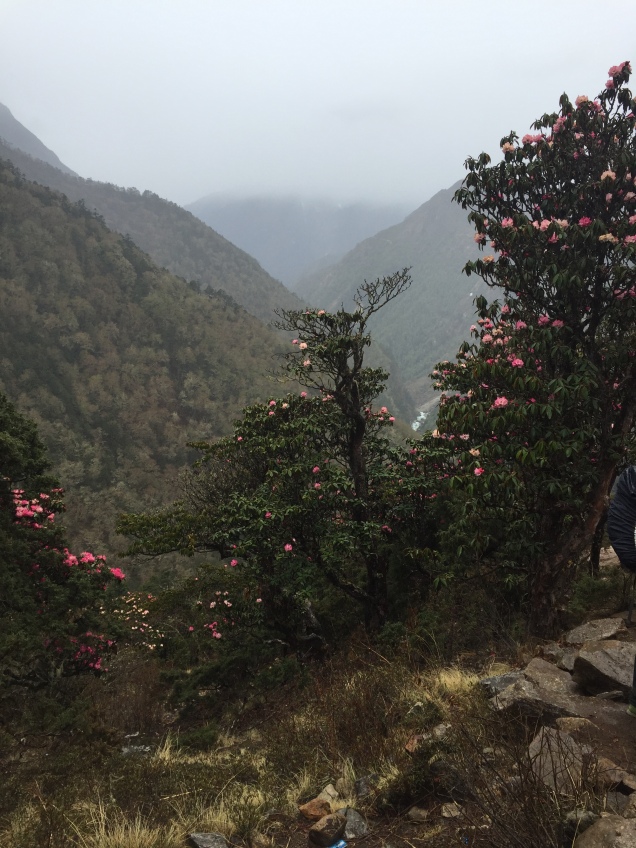
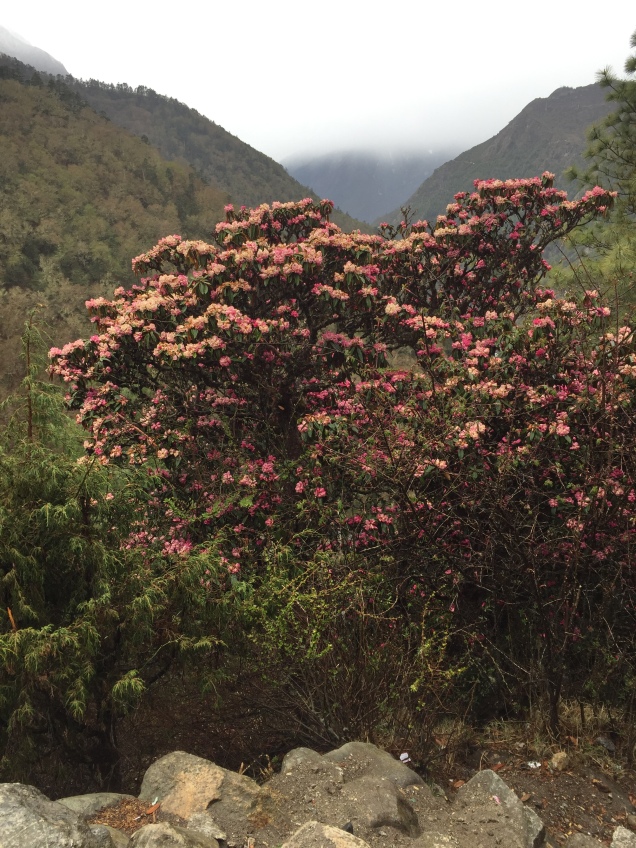
The day we left Namche was the day before Buddha’s Day. We walked clockwise (of course) around the monastery where prayers had already started and along the trail that we had looked down upon the day before. At first it was relatively flat, with some gradual ups and downs. After some time, we entered the Sagamurtha National Park and the altitude where the rhododendrons were still in bloom. Pink, white, red – forming an arcade over the trail. Another swinging bridge – I can feel myself start to sweat – and then time for lunch in a small cafe. The walls were covered in tapestry and all the food was prepared by two women over a wood burning stove. It felt as though we were in an old fashioned gypsy caravan.  After, we were backed against a wall by one of the many yak trains coming through. This was S’s first of many encounters of the not good sort with a yak.
IMG_0291

A couple of hours of up through layered jagged mountains, overhanging fog, framed by rhododendrons.  These mountains are new, geologically speaking, and a young world appeared around each bend in the trail.  Light green trees interspersed with dark pines, creating a textures that clothed the mountains.  We made it to the top in a respectable time, turned a corner, and suddenly we were at the Tengboche Monastery.

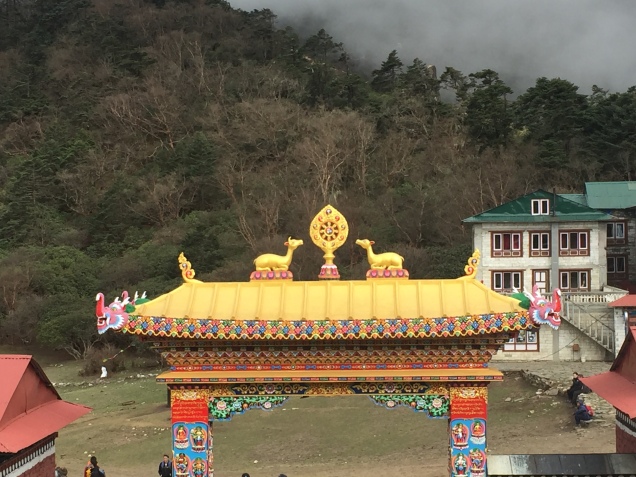
Checked in to the Tashi Delek Lodge and then visited the monastery. Tengboche is centered around the very old monastery – there were a few tea houses for trekkers and a bakery, but we were now far away from the village culture we had previously experienced. It is bucolic. There’s an open meadow area where cows roam, the gate to the monastery and some low buildings where the monks live in numbered rooms, and a few grey stone tea houses.
IMG_0310

Six of the 12 resident monks sat in the center, chanting in a low drone. They spend their lives here, in very small rooms.  When we stayed at Tengboche on the return, we saw the younger ones going off to play soccer, crimson robes flapping in the wind.

The fog rolled in, slowly covering the small dwellings.

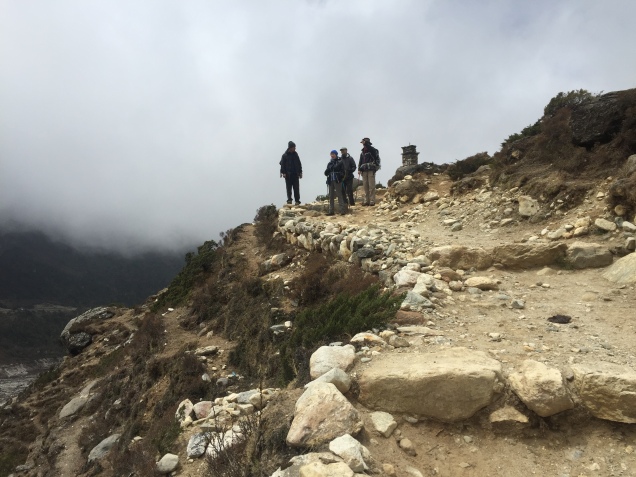
The next day we trekked to Dingboche, where we were to spend two more days acclimatizing to to over 14,000 feet. We could hear prayers chanted in each of the villages as we walked through.  The wooded part of the trail soon opened up into a stony valley – the milky river below and some serious rock slides where I did not want to linger. Ultimately we ended up in Upper Pangboche. Most trekkers go through Lower Pangboche only, but it was clear that our guide wanted to make a special stop at the monastery for Buddha’s Day. This is a 400 year old structure, founded by a monk who allegedly flew there. Various people were coming in and out to pray for Buddha’s Day. Z lit a butter lamp, incense was burned, and he prostrated himself three times. A lay monk poured water in all of our cupped hands to drink and smoothe on our foreheads as an act of purification. He also showed us a niche in the wall of the monastery that housed a relic of the flying monk – a bone of some sort.
IMG_0328

Hiked on and on, including a stop for lunch, and then another couple of hours to Dingboche. Trail normally about 2 feet wide, sometimes with very steep drops on each side. Across the river the stones were white with splashes of red. We were above the tree line now. Small junipers, yaks, and a lot of helicopters making their way to base camp.

in Dingboche we stayed at the Good Luck lodge. It was packed. We had a nice little room where the sun shone through the window and it was almost warm. The last few have been cold and damp. We are now at the point where yak dung provided the only fuel for the fire in the comunal dining area (which is never ignited before 5 pm). The middle of Dingboche is all privately owned potato fields – to get anywhere you have to walk three sides of a square.

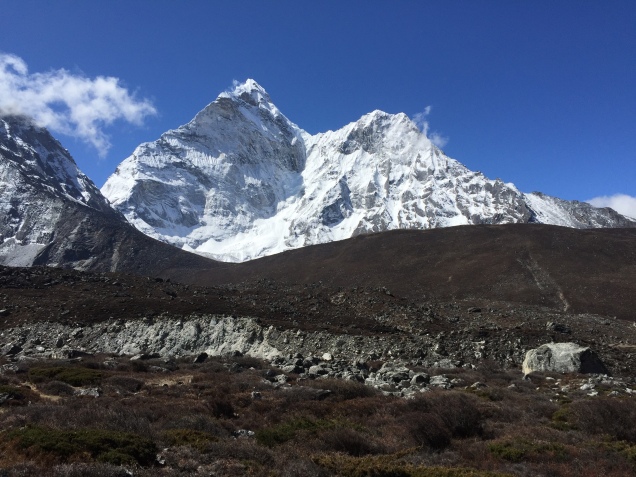
The next day we did an acclimatization hike to the Chukung Valley. We followed the milky river. A wide, stony expanse, with Ama Dablam peering at us from the right, Lhotse to our left, and Island Peak in solitary splendor straight ahead. We stopped at a cafe – and who was there but the guy from the plane. This time he explained that his seat hogging actions had been fueled by a few too many pints after he unexpectedly ran into a cousin at the Dubai airport. He and his friends were doing the three pass EBC route.
IMG_0344

There was a piercing wind on the way back and we went much faster.  Once safely ensconced in Dingboche,  J and I explored the village while M Andy S made friends with some fellow trekkers who were happy to share the very exotic salami they had brought from France. A nice change from gu’s! The dining room was packed because the rooms were so cold.

We were now acclimatized to over 14,000 feet. Next up – two nights at over 16,000 feet – EBC itself and Kala Pattar!

Everest Base Camp Trek – Lukla to Namche Bazaar (or the Bridges of Doom)

ALERT – photos will have to be uploaded later. I’m writing from Nepal – and am seriously wifi challenged at the moment!

After we exited our flying tin can (also known as a Twin Otter) in Lukla and had a cup of tea, we immediately started uphill. The first part of the EBC trek is nothing as much as a human highway connecting numerous small villages. There are no combustion vehicles of any types – no farm equipment, no cars, no trucks – and correspondingly, no roads. Instead there are yaks, gakyos (1/2 cow and 1/2 yak), and humans. Regardless of their size, they are all carrying huge packs. Yaks were carrying sacks of rice and blue containers of kerosene; one very small gentleman was carrying a load of rebar and another a full size freezer. Apparently the humans are paid by the amount of weight they are carrying. I have never seen such strong people – including at  any gym I’ve ever been to.
Each little village has at least a mani stone – a large rock painted with mantras, frequently om mani padme hum. (I read a translation today at the Sherpa Cultural Center that said it meant “hail to the jewel of the lotus,” but I’m not sure how much stock to put in that.) You pass to the left of the stone, always clockwise. Many villages have prayer wheels, ornate cylinders also engraved with prayers that you run your hand along, turning them always clockwise. Some prayer wheels are powered by water. Sometimes bells ring as they turn.
A lot of places welcome you with a stupa. From the air it appears as a mandala. Generally, three terraces at the bottom represent the foundation of meditation. The dome is the womb of emptiness from which all comes. The box on top is painted with the eyes of the guardian Buddha. Some stupas, instead, have a statue of the Buddha in a glass enclosed niche. The 13 steps above represent the 10 levels of compassion and the 3 levels of tantric awareness. The umbrella is the sovereign sanctity of the Buddha mind and the crowning jewel in the top its wish fulfilling capacity. Buddhism is woven in to the fabric of everyday life here. On the return part of our trek I saw an old man sitting outside his tea house, running his fingers along his mala (a rosary of 108 beads) while spinning a handheld prayer wheel. His wife sat next to him, wearing the traditional long skirt with a woven apron on top, while their dog slept in the sun – all with the majestic mountains towering in the background.

Most fantastic – that first day at least – was Gauri Ghat monastery. An elaborate structure in the middle of the area, multiple prayer wheels under shelters decorated with paintings of the Buddha. A feeling of serenity throughout.

I had known before this trip that at some point I would encounter my nemesis – the swinging bridge of doom. It happened shortly after we left Lukla. For years my most frequent anxiety dream has involved a swinging bridge over a gorge where I can’t move forward or back. And that is exactly what I had to cross – following M’s white hiking shirt, feeling the bridge sway – at least 100 feet over the rapidly running river. I refused to look down or to the side (where I could tell the chain link fencing that formed the sides had been kicked out at the bottom, leaving a realistic possibility of slipping through). Saying mantras was a necessity.

After three hours we reached Phak Ding and our first experience of tea house culture. The tea houses changed as we worked our way up to EBC and away from village into trekker culture. More on that later. But typically there’s a dining room that serves as a communal living area, common toilets (although our first two tea houses had “en suite” toilets – little did we know what a luxury that was!), and very cold small plywood pine rooms with twin beds, sheet and blanket, and if you were lucky, hooks and a light that would work after 6 pm. Ultimately we realized we needed to regard the rooms as a sophisticated version of a tent.

After lunch, we took a steep acclimatization hike through a pine forest and small fields of potatoes and onions and spinach to a monastery that was being repaired. The monks were painting elaborate designs in geometric and representational patterns in colors for each of the five elements (iron being the one I didn’t know about). The paint contained a special resin to make it shine.

We had to cross a second swinging bridge to get there – which made me no happier than the first – when who should appear but the guy who’d sat (slept) next to me on the plane. We recognized each other and exchanged pleasantries. Given my bitterness over the seat hogging, this was a fitting karma experience to accompany all the monasteries we had seen. And it’s not over yet.

The next day we trekked to Namche Bazaar (originally Nauche) where we were to spend two nights. Much of the route was along the Milky River, a mint green blue rapidly running river that accompanied us most of the way to EBC. Today involved not two but five swinging bridges. Fortunately M continued to wear the white hiking shirt so I still had my driste to focus on. We had a lovely lunch by the river and the trail got progressively steeper. Fabulous views of the Three Sisters along the way. A yak herder following his yaks, while carrying his dog down the mountain.

We reached NB suddenly. A pretty village of square stone buildings with a interesting mixture of trekker culture and village life. Trekking has been part of Nepalese life since the 1950s. What’s amazing is that every last thing has been carried here – by human or animal. Namche does have a small airstrip for cargo, but even then – everything has to be moved several miles to the village.

A very nice tea house with some beautiful woodwork in the dining room but COLD rooms. There was even a version of a shower with hot water (the last one we would see for days). Probably the prettiest tea house we stayed in. Unlike the very crowded places further along the route, we were the only people staying there.

After we arrived, we went to the nearby monastery. A stupa is being rebuilt and the monks, all in crimson robes, were conducting four days of prayers to bless the items that will be placed in the stupa. Plus, day 4 is Buddha’s Day and there will be a big celebration. Because 12 monks were needed the prayers were occurring in the common area instead of the actual monastery itself. All of them sat in a row; the leader chanted in a deep sonorous voice and the others chimed in with various instruments- symbols, something that looked like a clarinet and bells. At one point plates of food were brought out as offerings – they would ultimately be left for the animals. There was a huge gold Buddha on one wall and a monk folding prayer shawls.

We visited the upstairs museum, near the rooms in the upper galleries where the religious objects are taken care of. A monk asked us if we wanted to go to the actual monastery where the prayers normally occur. 300 years old, the walls were painted with images of Buddha. There was a shrine with statues of the past, present and future Buddha. Butter lamps lit, colors and patterns on every square inch, but a sense of peace emanating from the sensory overload.
For dinner S and I tried yak curry, although I think it is usually buffalo. More of the local spinach, rice, potatoes, dal and apple pie for dessert (which was almost like an apple baklava).

During our full day in NB, our acclimatization hike to the viewpoint at the Everest View Hotel allowed us our first view of Everest, Ama Dablam and Lhotse. We trekked gradually at first and then steeply up to about 12,600 feet, from pines to scrubby pines. Then down the other side of the valley to Kung Jung (sp) – tranquil, uncrowned, green rooves, and the home of the school founded by Sir Edmund Hillary.

After poking around NB in the afternoon, we had Sherpa Stew for dinner. A thick broth with dumplings and potatoes, ginger, spinach and carrots.

Next move – to Tengboche and Dingboche.

Leaving for Lukla or Monkeys in the Airport

20170506_053222

Twenty years ago, Husband J and I and our dear friends M and S used to sit in restaurants with small children in tow (who were frequently vying to see which of them could engage in the most dangerous dinner table activity involving condiments) and fantasize about the exotic trips we’d take once we were empty nesters. We started small – with St. Augustine, graduated to Iceland and discovered we actually made good traveling companions – and now I write this from Namche Bazaar in Nepal on our trek to Everest Base Camp.

But first things first. How did we get here? After enjoying a night at a hotel at the Hyatt, courtesy of our daughter A, we got up at the ungodly hour of 2:45 am to check in for our flight to JFK. At least we could return to our rooms after. At JFK we had the pleasure of the Airtrain tour of the whole airport since it turned out going from terminal 5 to 4 required visiting every other existing terminal first. Tours of the backsides of airports ended up being a theme of the trip.

Emirates lived up to its name, free drinks, good food and an unending supply of movies. After 12 long hours our gigantic Airbus descended in Dubai as gracefully as one of the egrets on Lake Ivanhoe. And we could even see the landing through the cameras affixed to the outside of the plane.

IMG_0098

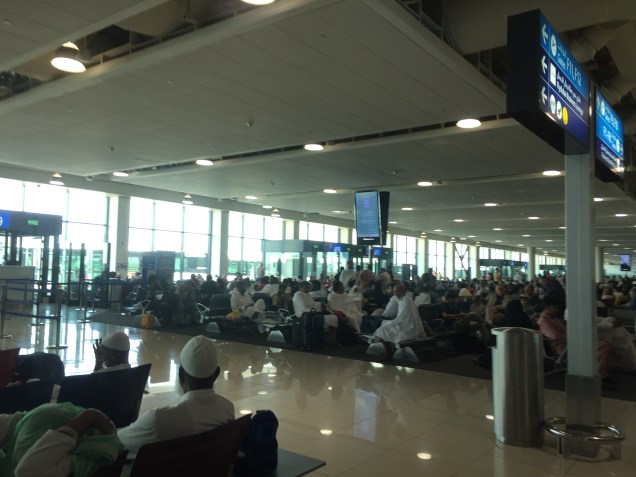
We took yet another airport tram – this time to circumnavigate the airport in a short 45 minute journey from terminal 3 to 2 with a visit to terminal 1 thrown in for good measure. Terminal 2 was a far cry from the rarified and modern Emirates terminal. It was teeming with people, all wearing every variety of regional dress of the Arab world imaginable.  As usual, I realize how provincial we are in our outlook. Where were the groups of men in white robes, wrapped a bit the way the Masai wrap their cloaks, from? How about all the men in long cotton shirts, sitting barefoot in lotus position? And the group of ten or so women lying on the floor, completely encased in their black burkas, with one older woman awake and sitting guard over them?

Finally our four hour layover ended and we boarded FlyDubai for a four hour flight to Katmandu. I had the pleasure of sitting next to someone who immediately fell asleep and hogged the entire armrest, not to mention part of my chair. More about him later. There’s a karma story coming.

After finally getting some sleep on the plane, we landed on time in Katmandu. Fortunately we didn’t face another airport tour. Hint to travelers – get your visas before you arrive! It was the equivalent of a TSA pre. Our duffel bags all arrived as did our guide, Z.

Katmandu traffic is insane. The city was packed, people selling wares along the street, tiny shop after tiny shop. Hordes of motorcycles weaved between vans and vehicles, for all the world like a motorcycle gang out of Mad Max.

It took close to an hour for what we learned the next day was only a 20 minute drive. Finally turned into what I think was a more elegant section of town (it was dark) and to the very nice Yak ‘n Yeti Hotel. We had a lovely quick meal at the bar – and then spent another hour repacking and reweighing everything to get our luggage down to 15 kg. They are serious about the weight on the flight to Lukla.

A 5 am we journeyed back to the airport. It was a scene of chaos. Trekkers, guides and monkeys (yes, monkeys) running through the airport getting ready to board the 20 person flights to Lukla. Well, not the monkeys. Went through at least three metal directors and M and I kept getting relegated to the special women’s line – but never had to remove shoes and no one worried about liquids.

IMG_0125

The plane ride lived up to its reputation. 20 people, 10 a side and an open cockpit. It turned out we were one of the last flights out – the rest were canceled for weather reasons. We flew between sharp green mountains , clouds floating around us, and eventually a glimpse of the high snow covered Himalayan peaks, pasted against the sky like white jagged metal.

IMG_0136

Landing in Lukla is like landing on an aircraft carrier. The runway is short and if the pilot doesn’t make an immediate right turn you’ll run into the side of the mountain.

We deplaned, found the bathroom (first rule of travel – go to the bathroom whenever you get the chance), and had a cup of tea at a nearby tea house. We were ready to trek.


I’m busy. I leave tomorrow. Everest.

No photo in tbis blog. I’ve been too busy. I started this post with five days to go. And now I’m staying in the hotel at the airport in preparation for a 6 am flight, followed by 24 hours plus of traveling.

I’ve faced my usual paranoia that the ridiculous hours I’ve been working in order to garner 2 1/2 weeks off will have so impeded my training I’ll find myself coughing as soon as I hit 10,000 feet, only to have a so far unexperienced asthma attack, get pulmonary edema, and expire somewhere at an unimpressive 12,000 feet. Matters have not been helped by the death of Ueli Steck a few days ago on Everest.

One can’t help but wonder about the possibilities. But more important than the possibilities – however tantalizing they may be – at least for those of us who have some great need for adrenaline – is figuring out why you’re going up the damn mountain  in the first place.

The busyness – business of our lives has taken over. I don’t know about you, but if one more person asks me to do one more thing, I might just combust. I’m called upon every hour multiple times per hour to make decisions. Some small; some large. Whether my recommendation affects one or thousands – you know what? It’s just as important if it affects one person’s working life as it is if it affects many.  Jobs are important to people.

Back to topic. I’ve been training for this trek since we came down from the last. And I really, really need to get away from that busyness – business. I’m hoping that somewhere in Nepal, on the way to Everest, there’s some fabulous lost horizon that’s going to give that sense of peace.

Namaste.