

On July 21, 2023 a massive landslide (aka as a “land slip” in England) moved tons and tons of cliff side onto the Seatown beach, dividing it in half. About seven miles away, on Christmas Eve, 1839, the same thing happened; that time dumping 45 acres of meadowland into the ocean at Lyme Regis, creating what is now called the Undercliff. The fallen land has been conserved since the 1960s, and allowed to revert to wilderness, creating a walk way running between the bare chalk walls rising above and the forested ravines below.
It is the area featured in Lyme Regis resident John Fowles’ The French Lieutenant’s Woman. It was Fowles’ description of the Undercliff that drew us to a three night stay at Lyme Regis. Fowles wrote: it is “cut by deep chasms and strange bluffs and towers of chalk and flint, which loom over the lush foliage around them like the walls of ruined castles *** People have been lost in it for hours, and cannot believe, when they see on the map where they have been lost, that their sense of isolation – and if the weather be bad, desolation – could have seemed so great.”
After a first night at the Nag’s Head Inn, whose pub was inhabited by elderly men watching cricket, and dinner at the very nice Royal Lion Hotel (fyi, to get free Wi-Fi you have to sign up for a million mailing lists and my gmail account is paying the price…), the next day was designated for the Undercliff Walk. The Undercliff is also part of the South West Coast Path, so it fit nicely into our theme of walking at least parts of “the greatest hits of English paths.”

The beginning of the walk is very poorly posted. We finally found a small marker by the Lyme Regis Bowling Club, which seemed a popular place to be that particular morning. I had strong memories of my great-uncle taking us to his bowling club in Skegness back in the early 1970s – but now women also get to play! Men and women alike were wearing the requisite (mostly) white outfits.

The walk starts with a never ending series of steps up to what appears to be a top ridge. but at some point you realize that you are really traversing the half way line of the land slip, with cliffs towering both above and below.
After the land slip occurred in 1839, it became a huge tourist attraction. People took boats to gaze upon it from the sea, and a “Landslide Quadrille” was even written in its honor. No one, however, seems to remember the composer!

Since then, woodland and grasslands have grown up. The woods are dense and dark and mysterious. Green tunnels formed by arched trees and wild roses run through the woods. Wildflowers, including white bindweed, yellow wild snapdragons, red berries of Italian arum, and simple wild roses create patterns in the deep carpets of ferns.

Now and then the views opened up, either to see the chalk cliffs above or the ravines below and the sparkling English Channel.
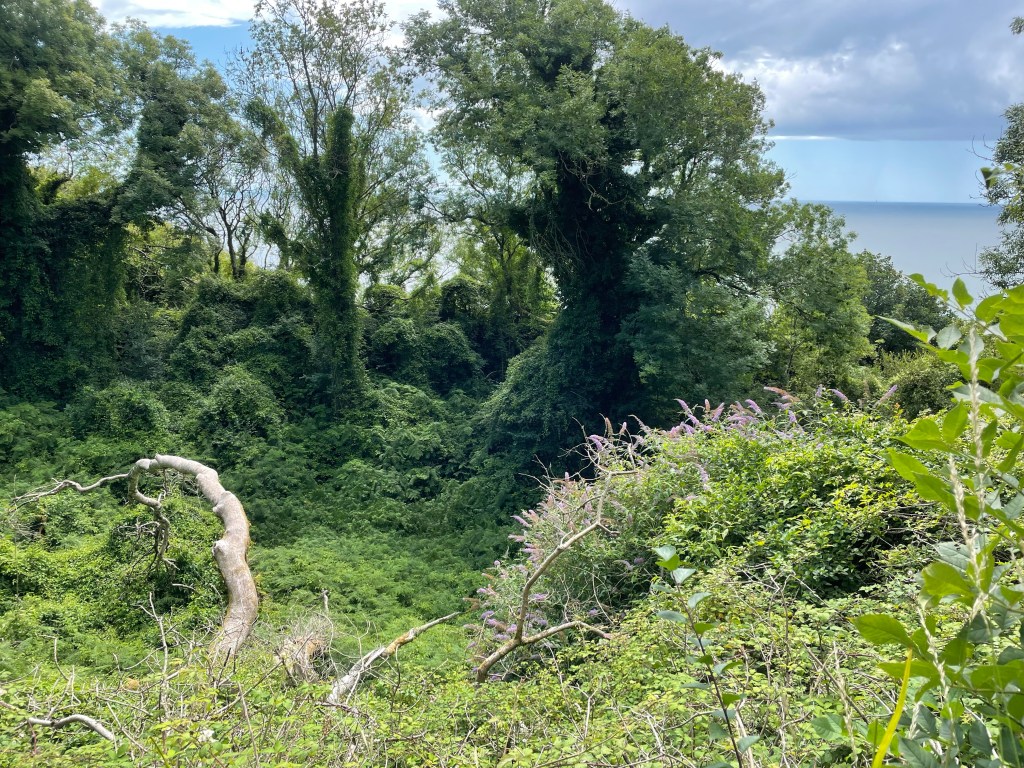

It was very steep and muddy, and even though it didn’t rain, beads of water resident on the high hedgerows created their own fairy mist.
After about 7 miles, we entered into an area of very rare grasslands. If you looked closely, you could find lavender chalk fragrant orchids and pink everlasting peas enjoying the sun brushing the golden fields.


The path turns away from the sea, and ends, oddly enough, with a stroll down the middle of golf links and down a steep hill into the very small harbor town of Seaton. Apparently we began with bowls and ended with golf.
We caught the bus back to Lyme Regis. A double decker bus ride whizzing along the narrow hedge lined lanes is an experience not to be missed.
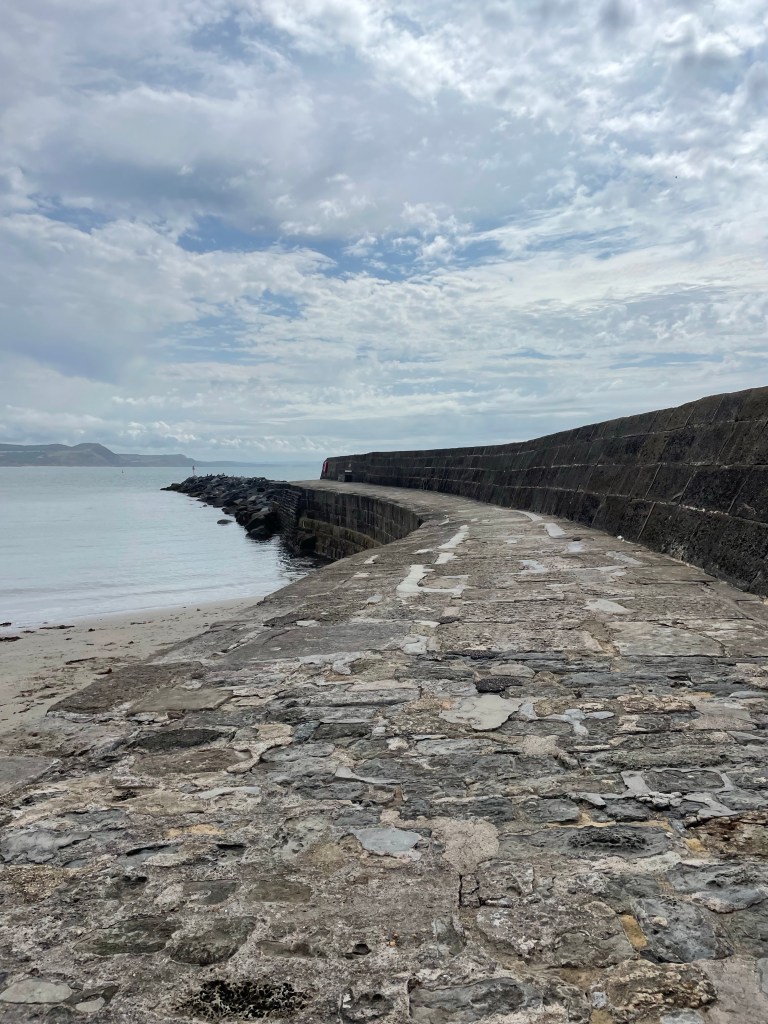

Our final full day in Lyme Regis was dedicated to visiting the Cobb and embarking on a fossil hunt. The Cobb is a stone breakwater that thrusts into the sea to protect the harbor. No one really knows why it is called the Cobb. The first mention of it is in 1294, and after being destroyed on a number of occasions it was almost completely rebuilt in 1817. Fishing boats, mostly for tourist trips, still leave from the Cobb, and we watched fishermen mending their nets.
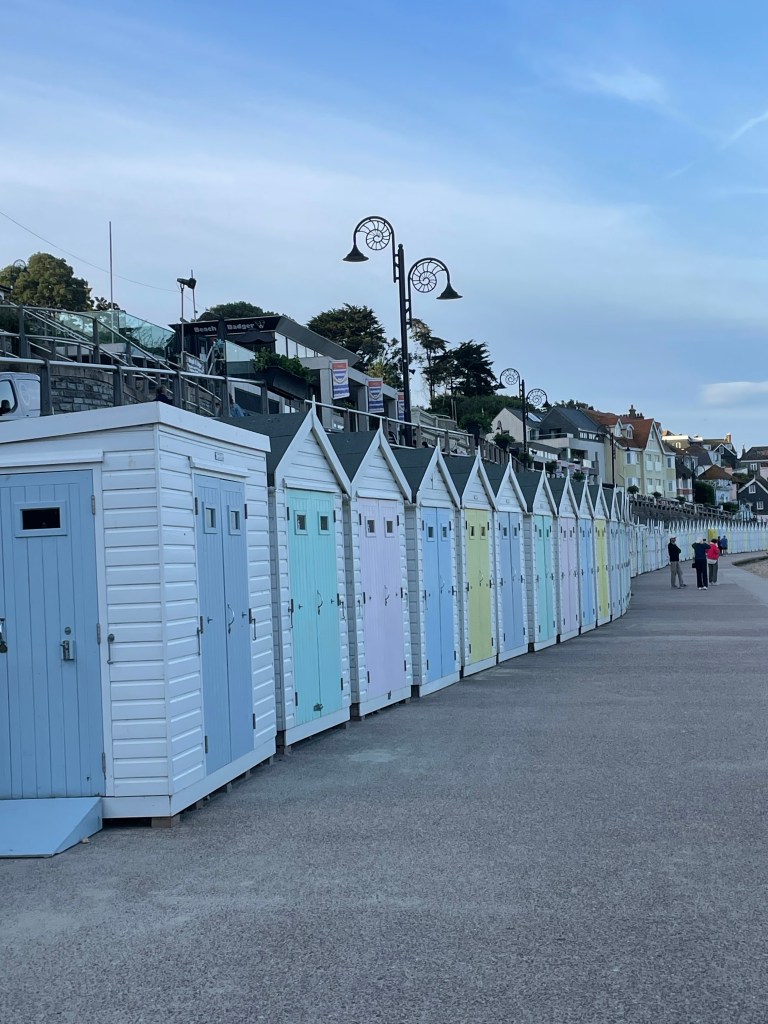
The seaside itself is lined with colorful bathing huts. We were lucky enough to see the interiors of some of them, whose residents had their doors open….featuring kettles for boiling water, shelves for holding snacks, and I’m sure there was local ale somewhere there also. Or at least canned cocktails, which seem to have taken over in England. By the way, look at the lamp posts. They are modeled after fossilized ammonites.

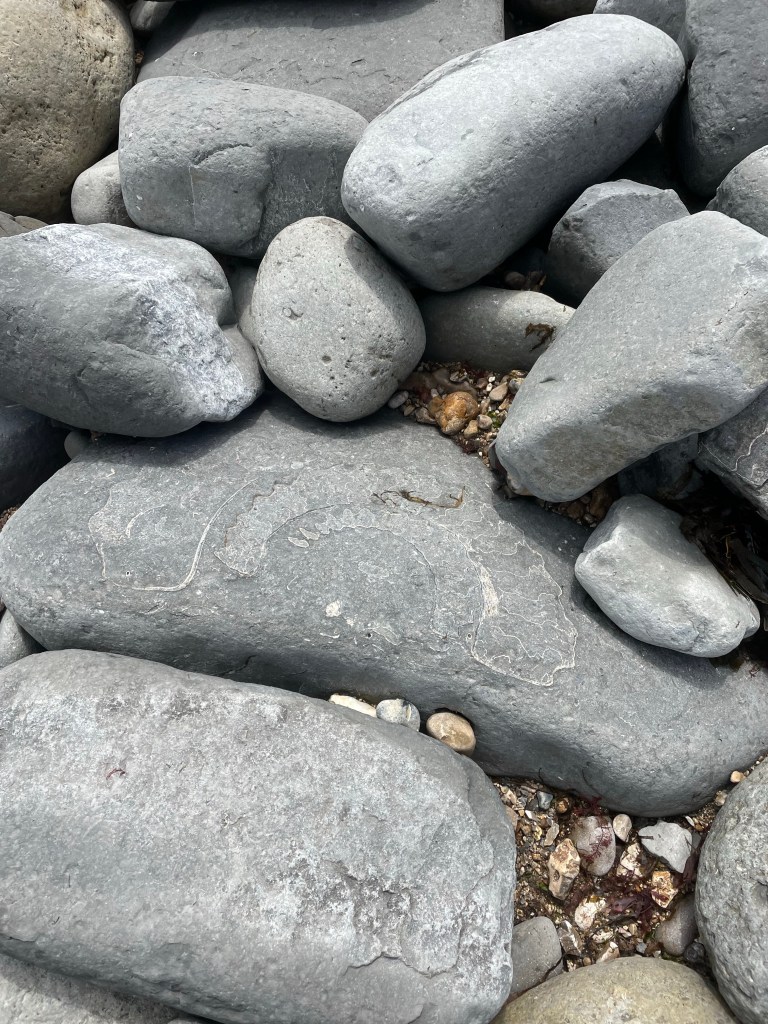
On the other side of the Cobb is rocky Monmouth Beach. Instead of seashell hunters, it is populated by amateur fossil hounds wielding mallets, this being one of the greatest spots to find fossils. Hence the name, Jurassic Coast. (In fact, in the Undercliff the various stone levels are dated, including back to Jurassic times.) Even if you don’t find one yourself (I like to think a half inch, grey ridged rock we found was one), ammonites are etched into all of the big rocks, creating a mural of fossils running along the beach floor.
After a long session of fossil hunting, we walked up the steps to the Jane Austen Garden and the Langmoor and Lister Gardens, which offer stunning sea views. They were surprisingly tropical and and natural – as was the Undercliff itself – as opposed to formal and contained.

Finished up our stay in Lyme Regis with a relaxing afternoon and some great Indian food.
Lyme Regis is full of history and tradition and fossils. But this coast is constantly evolving, as evident from the landslip just a couple of weeks ago. I keep contrasting this natural progression to what’s been happening this summer where much of the coral in parts of South Florida died in two weeks after ocean waters increased to bath water temperatures.
The land slip that formed the Undercliff was a force for creation and change and new life. That’s the sort of evolution that happens when the land is conserved and preserved and allowed to revert back to its raw, beautiful self.


 FromSwamptoSummit