The NSB of Northern Spain – Plentzia, Basque Country

Because daughter S had the strongest feelings about where we should stay in northern Spain, we left the AirBnb choice up to her. Hence, we ended up in Plentzia (Basque), Plencia (Spanish), a town that I can only describe as the New Smyrna Beach of northern Spain. Those of you from Florida will understand.

Actually, it’s an absolutely lovely small beach town about 30 minutes outside of Bilbao. And it did remind me of NSB – lots of family groups and grandparents escorting their small charges off for a day at the seaside. This was not a place for non-local tourists. We might have heard some French, but ours were practically the only U.S. accents we heard our whole time there.

Getting there was not without mishap. As there were six of us (actually, S took charge of this and ended up with really good fares), we rented two small cars. J, son in law N, and S went off to retrieve them from the airport in San Sebastián, while T, A, and I closed down the Airbnb and moved all our luggage down the three flights. All was going well – except for the fact that all the bridges in San Sebastián were shut for some unknown reason, necessitating many detours for the drivers of the rental cars as they attempted to pick up the rest of the party.

In any event, we were eventually all retrieved, and started the drive to Plentzia. On the way, we stopped at Gatevia, a nice beach town that houses the Balenciaga museum. We watched whole fish being grilled on large, flat, wood burning grills – an old seafaring tradition from when fish was grilled aboard the boats.
Ultimately, we made it to Plentzia where we had to decode Google maps to try to find what appeared to be a very unusual address. I was in the car with N and A – we somehow found ourselves making a hairpin turn down a steep narrow lane where the car got stuck on the high curb as we turned. Undaunted, we continued down the lane only to end up in someone’s front yard, where the very nice owner told us to calm down (“Tranquillo!”) and assured us his directions would take us to the correct location.

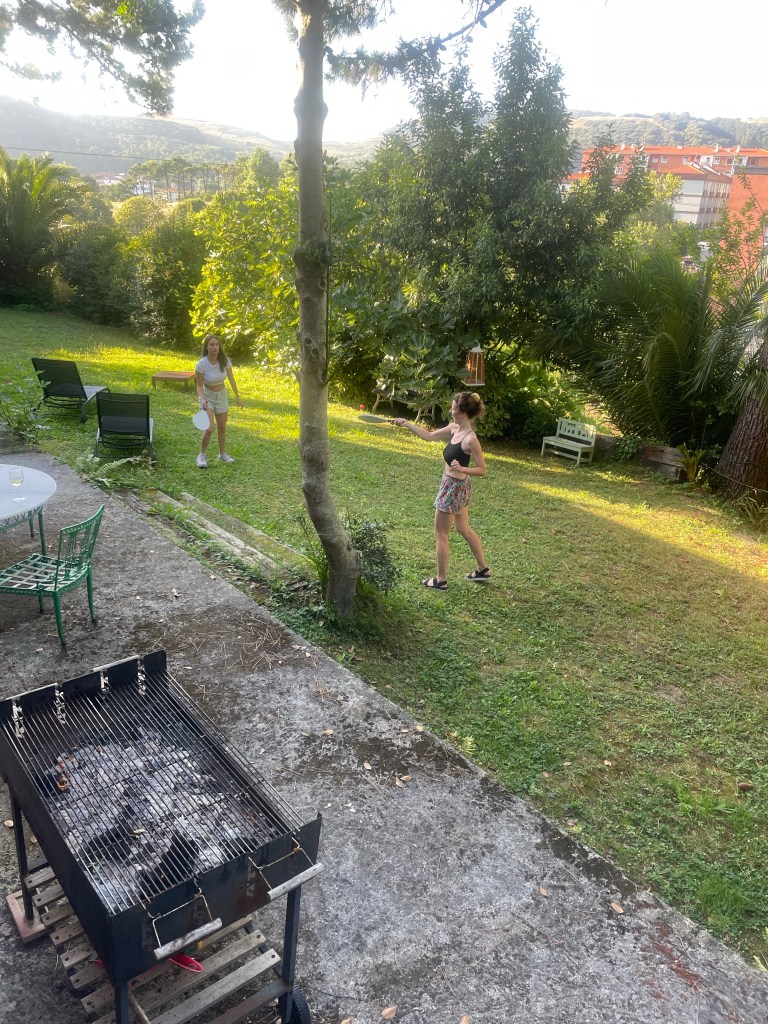
The AirBnb was of quirky “farmhouse shabby chic” design and would have been great but for the lack of screens and abundance of mosquitoes. If anyone would like to join me in starting a screen company for Spain, please let me know. I think we’d make a killing.
A nice walk down to the beach at night.

The next day, based on an inaccurate reading of weather reports, we decided should be the hiking and mountain day. We started, however, with N and me making a trip to a very local fish market in a neighboring town. The Turkish (?) fishmonger apparently found us so interesting that he threw multiple free sardines and anchovies into our order.

I was really struck by how different the small towns in Spain were from England. Many of the residences are all apartment buildings, as opposed to semi-detached or detached dwellings, even in the remote areas. I’m sure there’s some interesting social commentary there, but having walked 11 miles today in the Yorkshire Dales (we’re now on the walking portion of this trip) I’m not sure what it is right now!

We finally got on the road in the Citroen and Toyota for what turned out to be quite a long drive into the mountains, and the weather definitely turned for the worse. But it was just a drizzling misting rain. After a series of hairpin turns we reached the Urkiola Preserve, a location chosen by A, who knew her parents wouldn’t be happy unless they’d experienced some of the Basque Country mounting.

The park office was just closing as it was almost 2 p.m. and time for siesta. The park official nonetheless left it open to give us a map and explain where to walk. Given the weather, we opted for the shorter version of the hike. This was a beautiful walk through pollarded beech trees – meaning large limbs cut for ash leaving a somewhat peculiar three pronged shape.

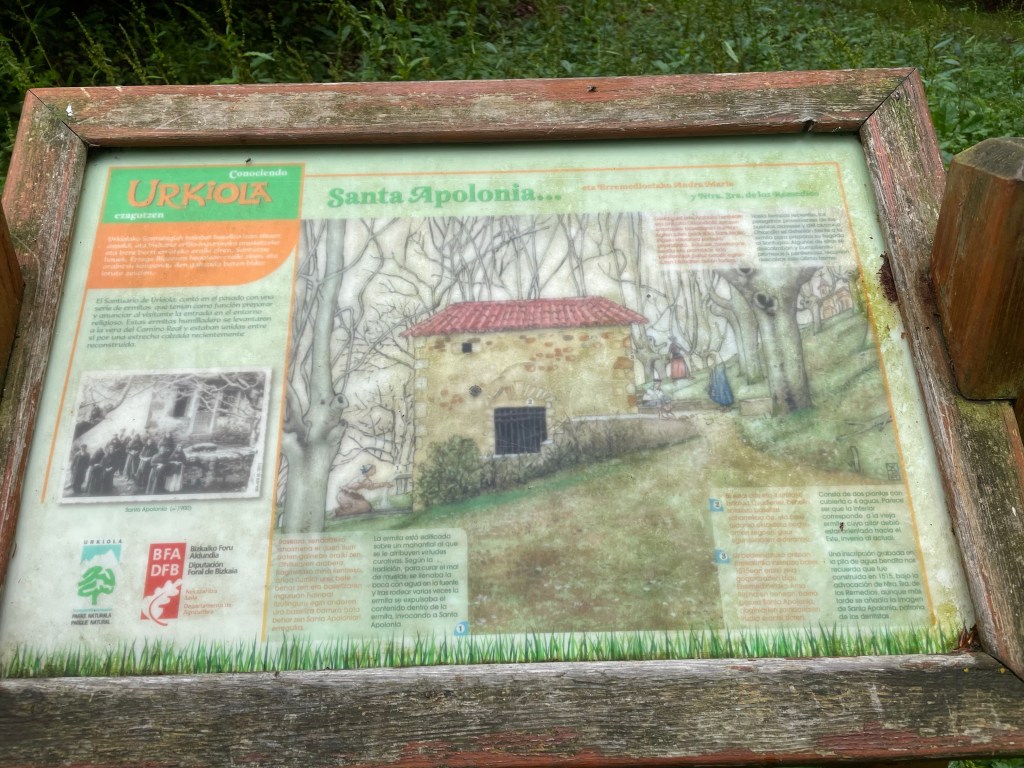
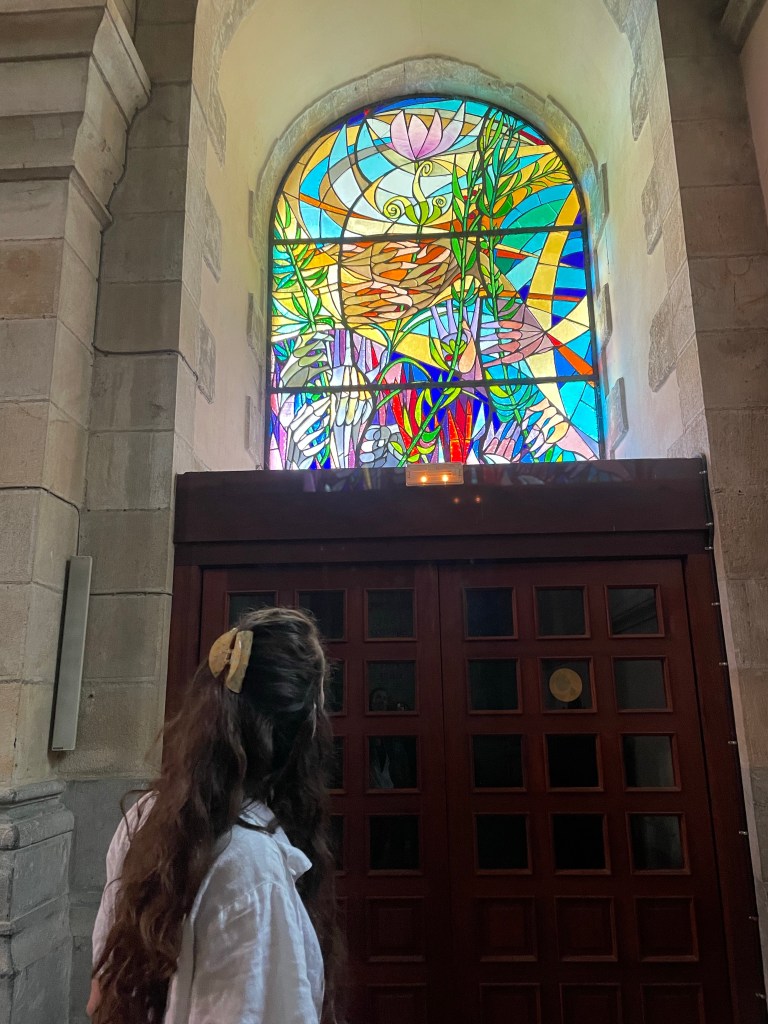
There are three or four “hermitages” on the way up to the church at the top of the mountain, although they seemed more like pilgrimage spots rather than a place a hermit lived. The church was originally built in the 8th/9th century, but has had many incarnations – a main one was in the 1970s by a group of monks. The church has beautiful stained glass windows, themed around vibrantly colored organic flowers and was never fully finished.
From the church we walked to a panoramic overlook, with a spectacular view framed by three large crosses. A number of what might have been tombstones dotted the landscape.

This was an interesting mix of Christian and pagan. Mari, the Lady of a boat, is supposed to live in a cave, looking after Urquiola. She can shape shift from animal to plant to woman.

At the top of the mountain is a nice cafe where we re-joined the 21st century with a drink.
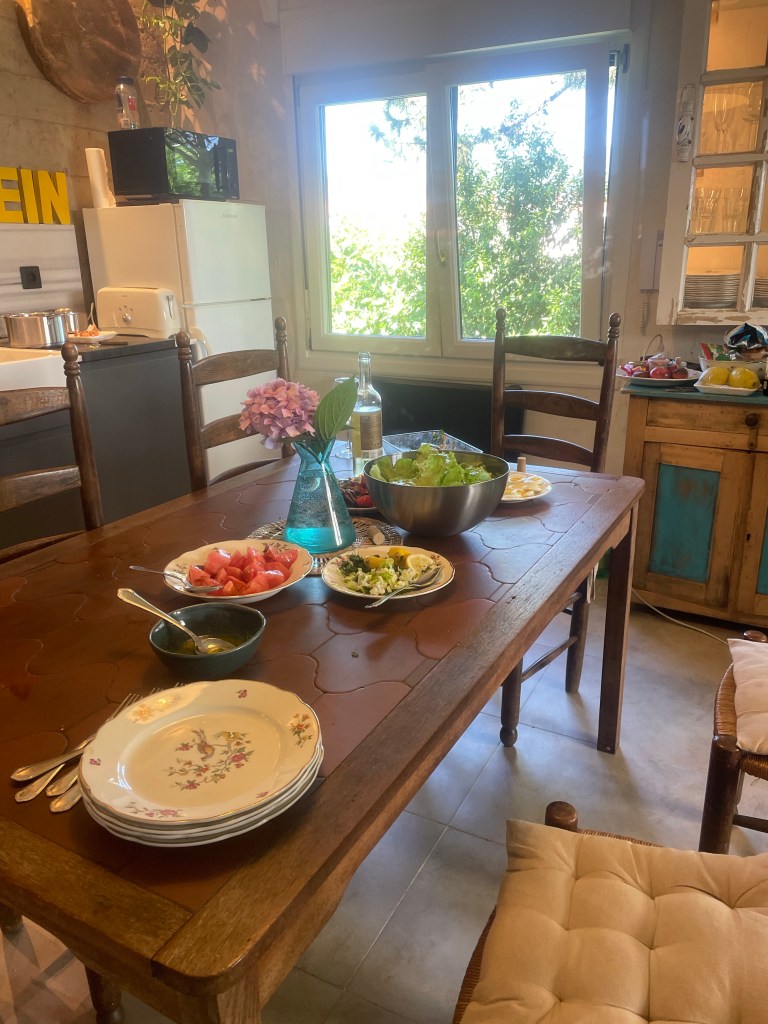
Drove the hour plus back into Plentzia, where we proceeded to create our own version of a Basque fish feast. The most marvelous thing was that we knew we still had several days ahead of us.

The Rain in Spain…and in Hastings

Except fortunately, it didn’t, in Spain. At least, unless you count a few drizzly moments, which I refuse to do.

From Rye, in East Sussex, we took train and plane to Bilbao, in the Basque Country of Northern Spain. Along the way, we disembarked in Hastings, where it really did rain. To avoid a very long wait for our 7 pm flight from Gatwick we decided to check out Hastings, which turned out to be a singularly unsuccessful pit stop.

This is the only picture I have of Hastings.

We lugged ourselves and all our luggage into the Old Town; we could see the Castle up on the hill and thought about the Battle and 1066 and all that, but that’s about as close as we got to any sights. The beach/boardwalk runs along the front – there were loads of people, but let’s just say the glory was more than faded. It didn’t take us very long to decide to trudge back (in the rain) to the train station.

We finally took off from Gatwick for a short and uneventful flight to Bilbao – except for the part where J’s water bottle (which he had cleverly stowed in the outside pocket of his back pack and placed in the overhead bin) started to leak on everyone below.

We arrived in Bilbao after 10 – there’s an hour time difference for reasons that date back to Franco and WWII – only to find we’d missed the last shuttle to the Holiday Inn Express where we were staying for a night. In any event, a taxi safely delivered us, sans any further mishaps.

After a truly excellent “continental” breakfast – why are coffee machines so much better in Europe? – we managed to take the shuttle to the airport and figure out how to purchase bus tickets to San Sebastián. It turned out the ticket machine was broken, so as always, the answer was “download the app and buy online.” At least J was able to extract my credit card when when in a moment of desperation I pushed it into the only other slot available in the ticket machine – which turned out to be for bills only.

After a longish bus ride, we arrived for more lugging of luggage, and finally made contact with A and son in law N at the Deutsche Bank where we were getting euros. Travelers note – there are two Deutsche banks near the water in San Sebastián.

The major dining experience in this part of Spain is pintxos – basically the Basque word for tapas. A language note – Basque is considered a “language isolate”, not related to any other language. It likely dates back to the indigenous peoples of the area. “X” is pronounced “ch”, similar to the pronunciations you see in the Yucatán.

Pintxos take all forms – mushrooms in rich sauces, small sandwiches, scallops, oxtail, and ubiquitous fried potatoes, to name just a few.

After sampling several for lunch, we made our way to our Airbnb, where daughter S and boyfriend T arrived at almost exactly the same time. They’d been in Biarritz the night before and appeared to have had a more seamless journey than J and I.

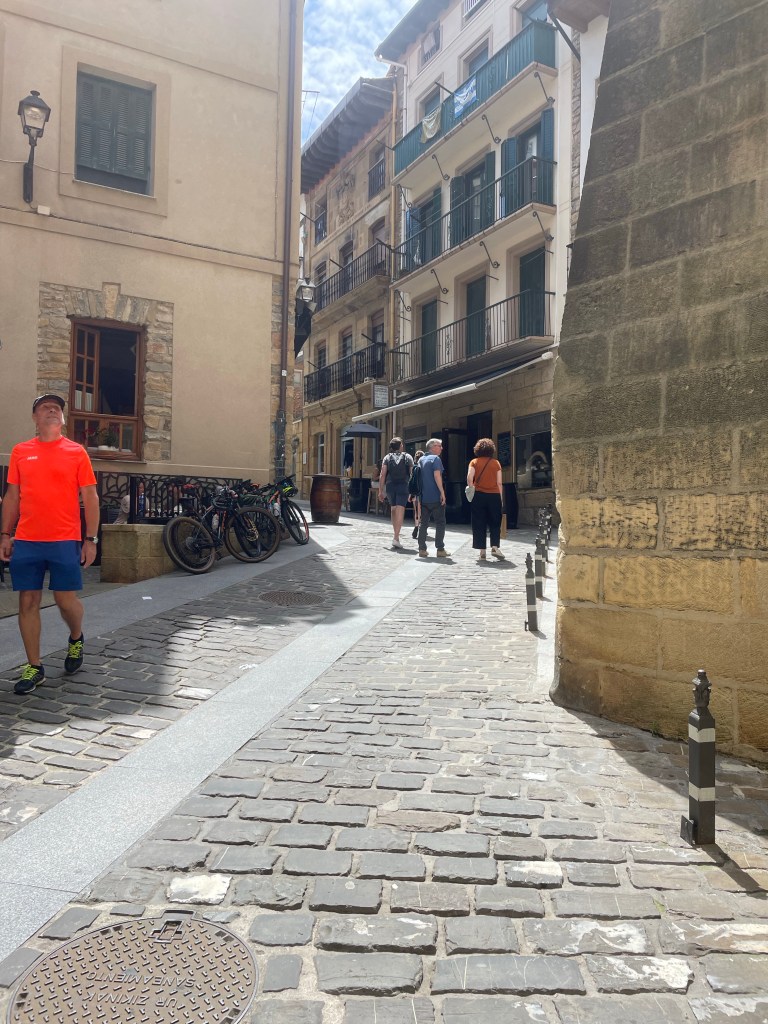
The Airbnb was on one of the city’s many pedestrian streets. There are wonderful clothes shops and elegant, balconied apartment buildings edging the avenues, The beach is a long crescent of sand packed with bathers, cliffs on either side of the bay.

As fate would have it, we were in town at the same time as a college friend, C, and his two sons and son in law. They’d been in Pamplona for the running of the bulls (which sounds as gruesome as I had feared) and were staying in Bilbao. In fact, when we arrived in Bilbao we were greeted by numerous men and women all wearing white outfits with red bandanas in honor of the event (C himself had grown a Hemingway-like beard just for the occasion). We were able to rendezvous with him and his son, and enjoyed even more pintxos (by now I had a potato overload), gelato, and a beautiful walk along the beach to see the sunset.

The next day was rainy and dreary. We found a hole in the wall pintxos place that was just as good as the higher end one from the day before, and then ventured off to the Museum to try to learn a little more about Basque culture, although very few explanations were translated into English.

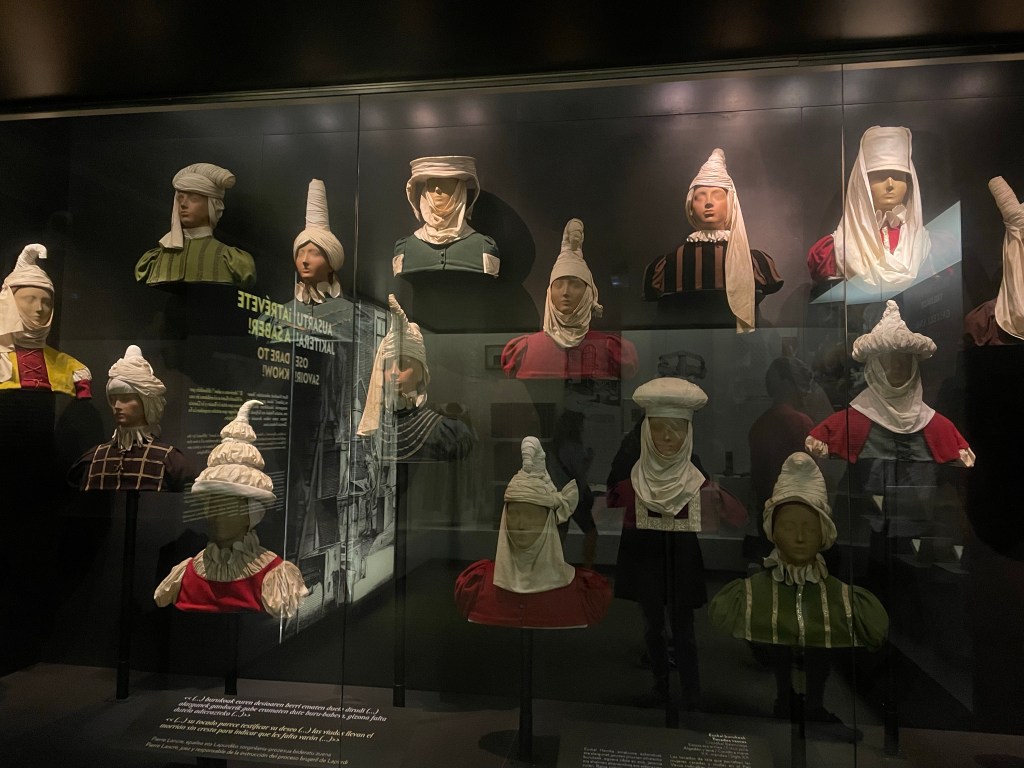
Basque hats – some of the women’s ultimately outlawed; you can speculate why….

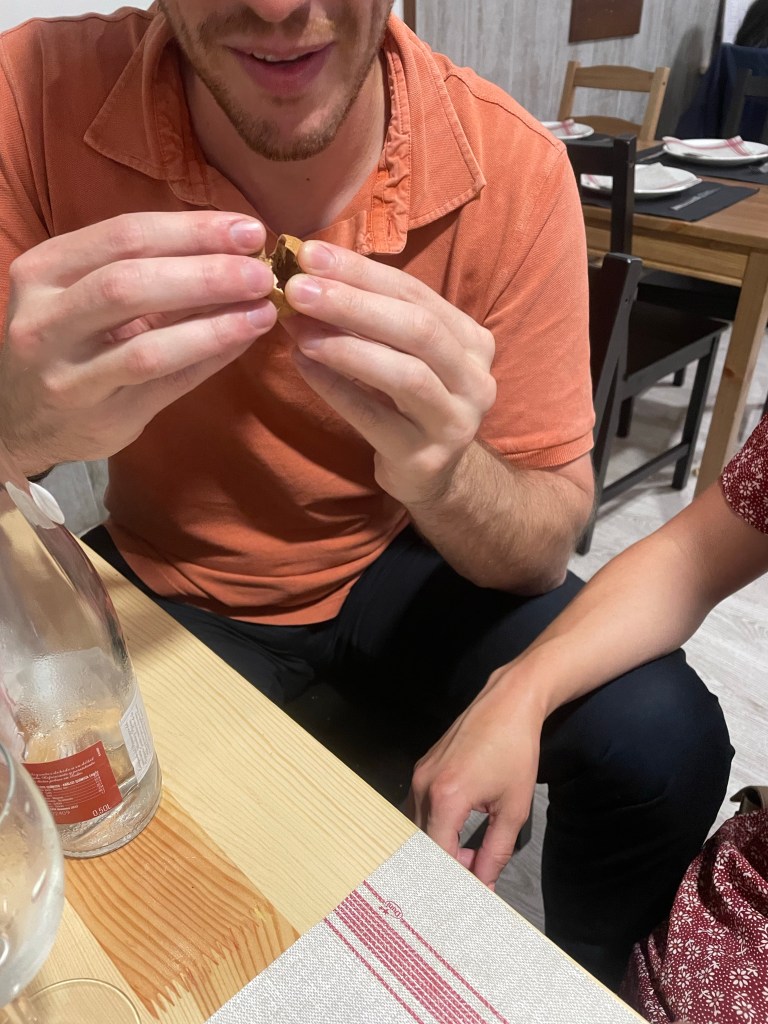
We had an absolutely marvelous dinner at a restaurant across the street from the Airbnb – prawns served with heads fully attached, fried peppers, samples of hand pulled dry cider. The star was dessert – a French toast type thing that was stuffed with custard and caramel i Ed, and a Basque Cheesecake with a vanilla sorbet. And a cheeseboard with walnuts in their shells – which led to a walnut cracking competition among certain of our party.

The cracking of the walnuts

By the way, we found Spain unbelievably inexpensive, both for food and drink. A good bottle of wine could easily be found for under 4 euros.

We only had two nights in San Sebastián before our next move – to the beach town of Plentzia, about thirty minutes outside Bilbao. All of us left feeling we needed another night in San Sebastián- but perhaps not anymore patatas bravas!