
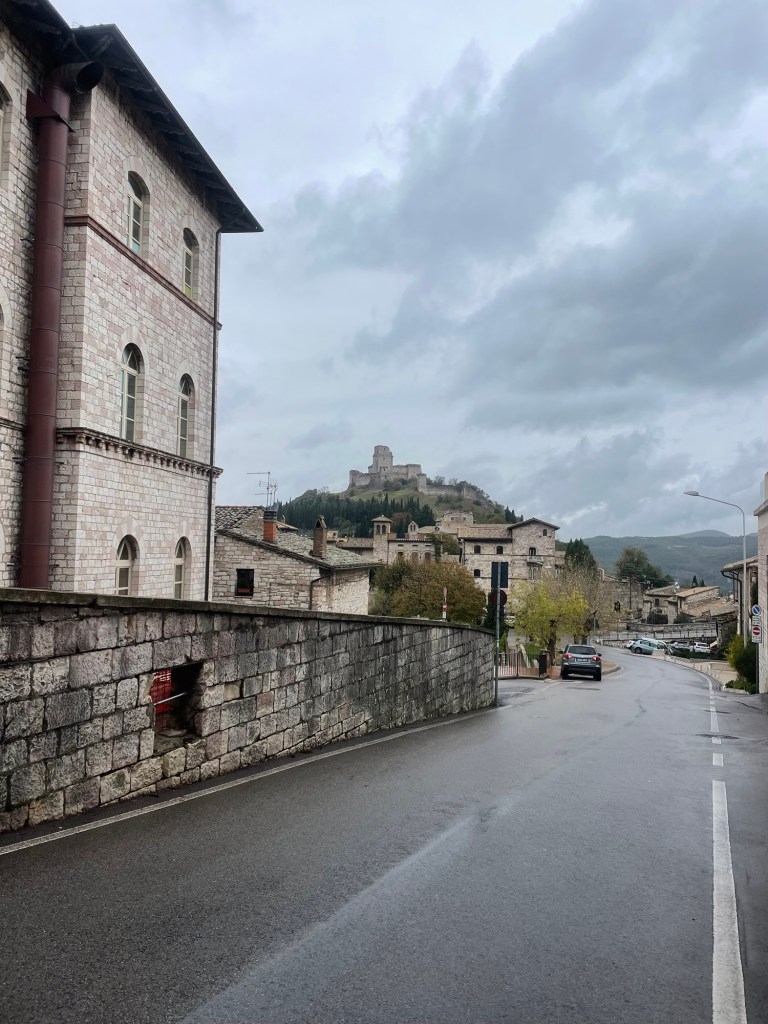
On a cold wintry day in early November 2023 we ventured from the comfort of our Tuscan farmhouse, along the shore of Lake Trisimino and into Umbria, and through many extremely scary tunnels. We finally found the underground parking lot in Assisi, just narrowly having avoided illegally driving into the historic section of the town.
Our day started with the pre-Christian underpinnings of this very Christian town, the remains of the Roman amphitheater. But from there, it was churches, churches, and more churches.

First was the Cattedrale di San Rufino di Assisi, dedicated to the patron saint of Assisi. Very few tourists. Austere, Romanesque.

Then the Temple of Minerva, a first-century, six-columned Roman building, transformed into a church dedicated to the Virgin Mary in 1539 and renovated in Baroque style in the 17th century.
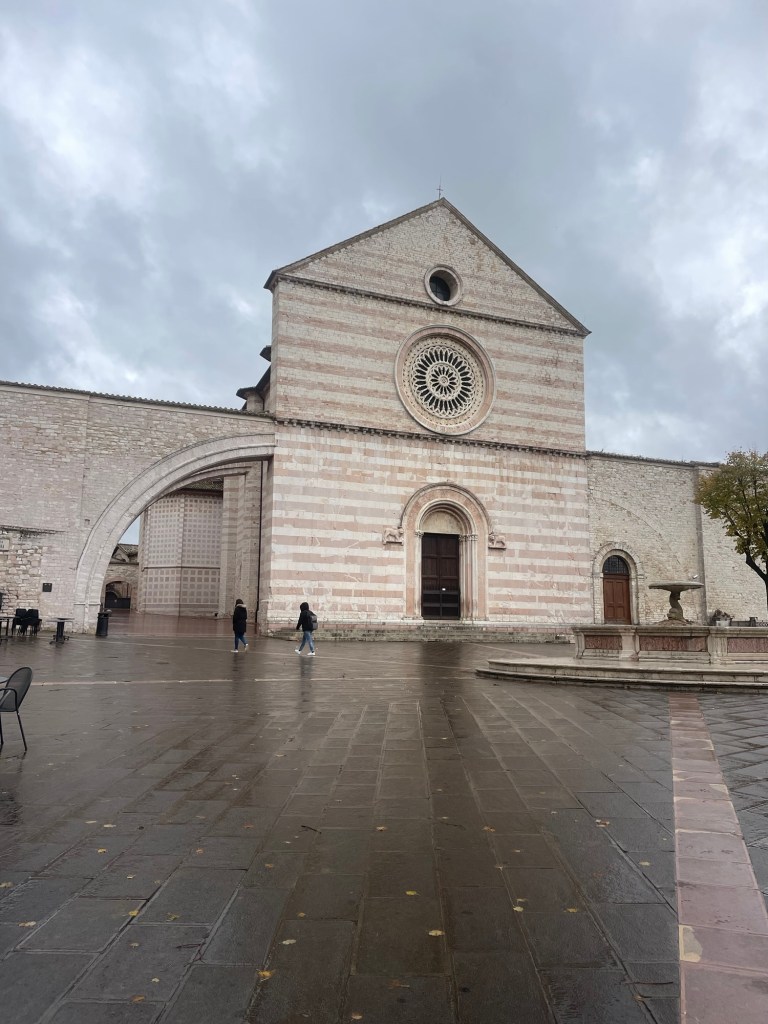
The church of San Chiaro – home of the poor Clares – was closed, but the severe structure of the building and the total lack of tourists said it all. The church of San Stefano, the simple church, was so simple there wasn’t even a way to enter it on this gray November day.

After a quick snack at a snack bar, we strolled along the streets whose store fronts weren’t the latest fashion styles, but rather the latest styles in religious vestments. J briefly toyed with the idea of religious garb for everyone.

We passed the houses of repose, clearly monastic retreats, solemn in their stone solidity, to the San Francisco Basilica. It was awe inspiring. It houses two churches, with a huge courtyard flanked with colonnades providing the entry into the lower church where St. Francis is entombed. That church contains a reliquary chapel with writings penned by St. Francis, a vaulted ceiling of stars. It is very intimate, and the few people there were using the space as a church, not just gawking at the sites. For obvious reasons, I have no photographs of the interior, just memories.
The tomb itself is a level below, in an area with a center altar, from which you take an external staircase to the upper church. On the way you pass a gigantic gift shop – while there were all manner of religious items for sale, at least they weren’t selling bits of relics or indulgences.
The upper church is Gothic, from the 1300s. Much stained glass, and an amazing series of Giotti’s frescoes depicting the life of St. Francis. There did seem to be a little propaganda in some of it, but nonetheless it was very moving. The fact there were barely any tourists enhanced the experience.
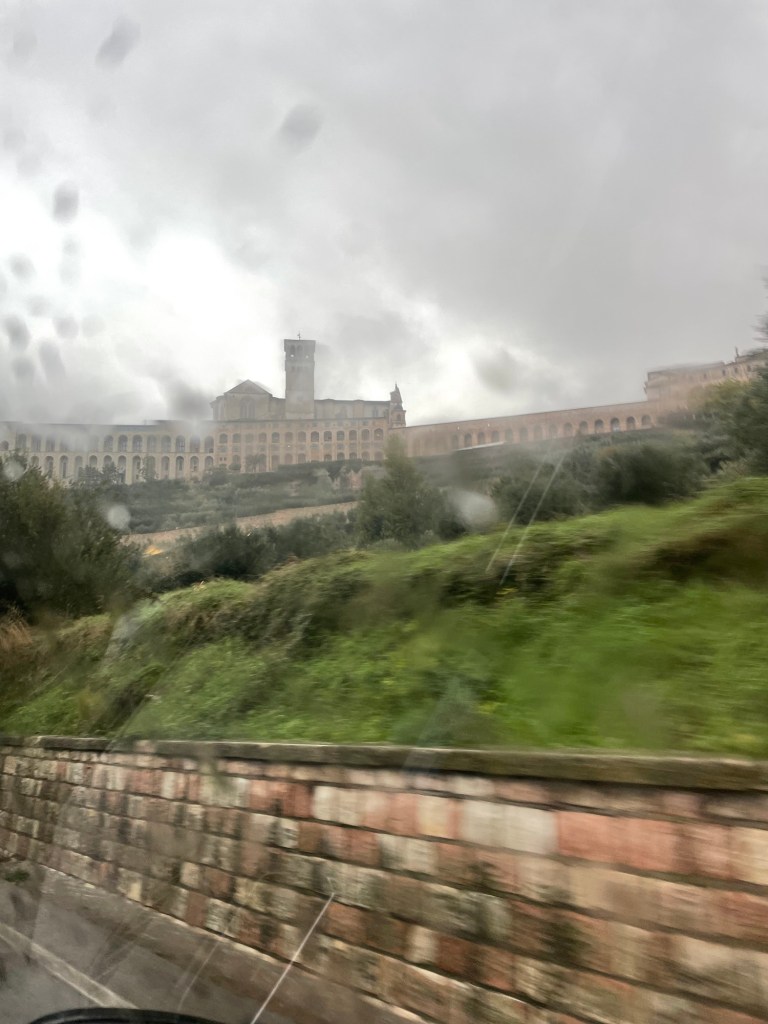
We had a long, uphill slog back to the car in the rain. The best part of the walk was a group of nuns (possibly Poor Clares?), clad in brown habits and sandals. Some had removed their head coverings, and they were in paroxysms of laughter at something they had seen in the window of a beauty salon.
The return drive was lengthy. But the spirit of St. Francis helped guide us back through those very scary tunnels.
 FromSwamptoSummit