The hike was over and it was time to walk to the train station in Bad Goisern for our journey to Vienna. A quick change of trains and after two and a half hours we were back in the city center.
This time we stayed at the Hotel Josefshof, a very different experience than the Superbude, both in location and ambience. It’s an old building, and everything inside is modeled after Klimt designs, even down to a gold sink and a Klimt drawing on the glass door to the bathroom. It is in the Josephstadt area, just off the outer ring road.
After checking in, we did a gigantic walk along the ring roads. The buildings are massive, and I’ve never seen so many statues on top of buildings – a veritable army of gods, goddesses, emperors, and war heroes staring down at you. We explored multiple, high end shopping areas – very high design, plus Hermes, Luis Vuitton, etc etc. The Fersatt (sp?) passageway was particularly amazing. There were lots of museums I wish we’d had time to see, such as the Sisi Museum and the Imperial Apartments. By then it was so late it made no sense to return to the hotel; instead we found an Italian restaurant.
From there, we walked to the KarlsKirche, named for the emperor Charles. It’s a masterpiece of Counter Reformation architecture – all marble rust and cream interior, with Asian, Byzantine, Roman, and Greek references. Definitely an attempt to wow the masses. A pool outside reflected the glowing dome, giving the whole place a movie set like quality. The kids playing funky electric music provided a stark contrast to the concert we were going to in the church – Orchestra 1756, performing Vivaldi’s Four Seasons on original instruments. By the way, the Viennese somehow lost Vivaldi’s grave….which turned out to be a theme of much of the rest of the trip. He wasn’t the only one whose remains went missing.
The next day was for travel. After coffee and pastries, we took the underground to the main station, HBF, a train to the airport, and boarded our plane for the Charles de Gaulle airport in Paris. One more train into Paris itself – and our French adventure was about to begin.
The 24/7 church bells clanging next to our hotel in Strobl didn’t keep us up quite as much on our last night there, so we were a bit better rested for our trek to our next stop, Bad Ischl. The weather was cool, and great for hiking. Our walk started off along the banks of the River Ischl – lots of flood control and hydropower. Some pretty woodland sections but not nearly as dramatic as the fairy dells we discovered the day before.
The hike passed through a number of small villages. The houses here, even if old, look so much newer than those in England. White stucco with dark wood work and balconies.
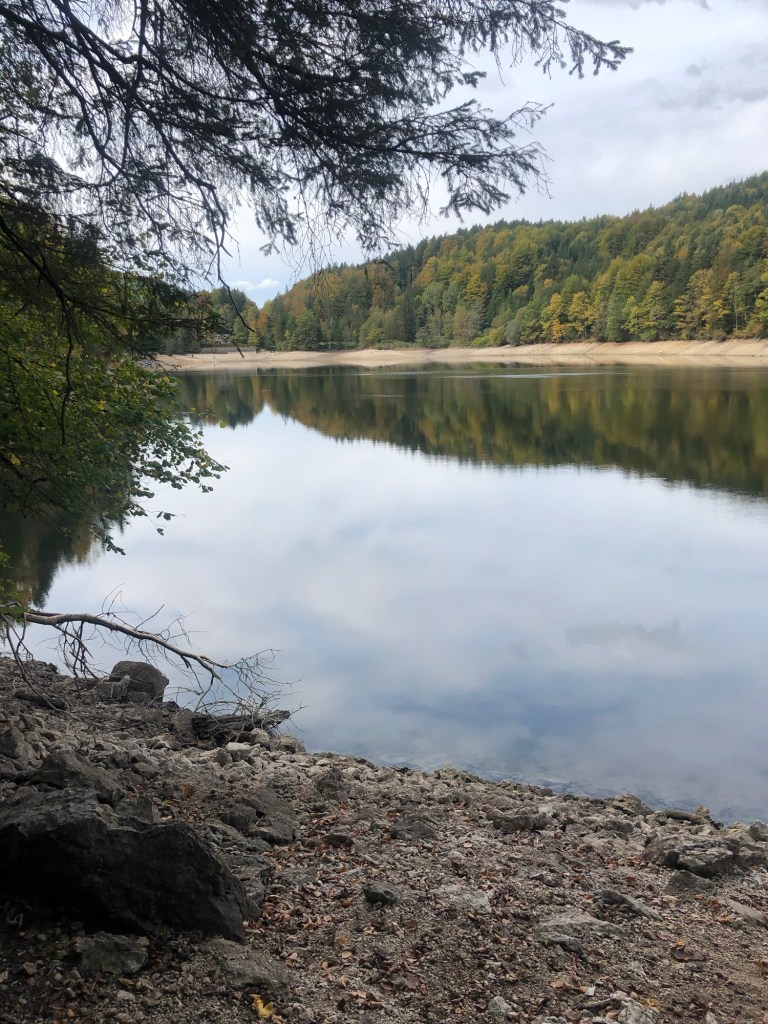
We finally reached Nunsensee (Lake), which looked almost like a dugout reservoir. We were worried about rain so we didn’t even stop for lunch and reached Bad Ischl close to 2 p.m. A church greeted us at the outskirts. I wanted to go in, but two people were in there, clearly praying. The flowers in the terraced gardens were all labeled.
Bad Ischl is an old spa town of the Habsburg regime, located by the river. The Goldeness-Schiff hotel, where we were staying, faces the River Traun, which is part of the River Ischl. (The water geography seemed very complicated.) The hotel was very modern; we had a small room without a view, but perfectly adequate. They gave us a coupon for a free drink for agreeing not to have daily cleaning. No decision there!
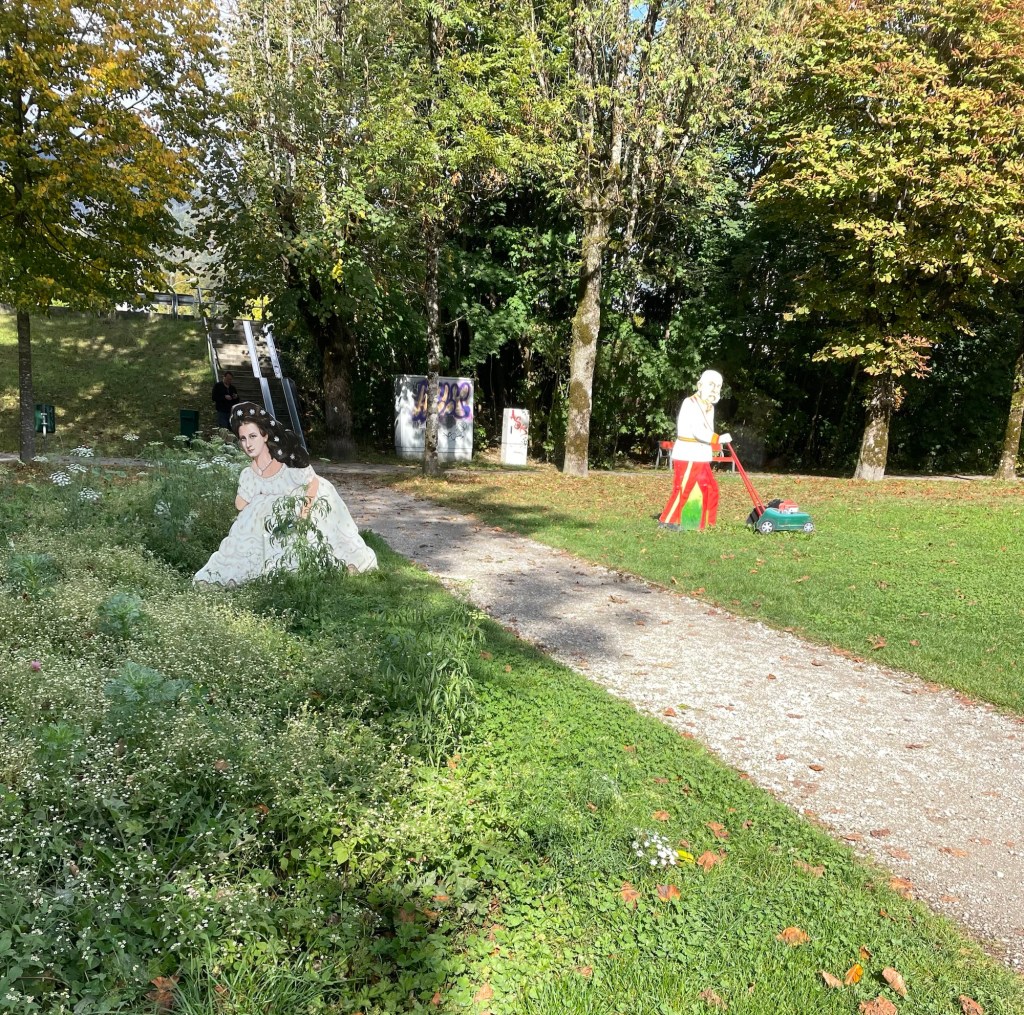
We decided against a visit to Kaiservilla, the summer residence of Emperor Franz Joseph I, and Empress Elisabeth of Austria (known as Sisi). It was very expensive and we only had an hour before closing, so instead we chose to have a drink at an open air cafe (under the awning, while it rained around us), and enjoy window shopping (especially the modern takes on traditional Austrian dress). We also spent time in Sisi Park. Bad Ischl pays homage to her (and her husband) in many ways (for example, cartoonish metal sculptures of them gardening in the park…).
Dinner was at the Spoarhead Gastropoda. Very nice and a nice server, who managed well with few other servers, and appreciated our patience. I always feel like an ambassador for the U.S. on these trips. Chicken Paprika for J and couscous chicken bowl for me. Austria closes down early. We were back in our room by 8:30.
Sunday dawned to a very elegant breakfast, with Prosecco on tap! I wish I had felt like trying it, just to say I’d done so. And a fresh squeezed orange juice maker – I’ve never seen one of those before. We again were anxious about the weather so we skipped the local hill walk that was on our itinerary and instead walked along the banks of the Traun, by lots of sports fields, to the almost empty gondola station. The gondola took us up almost 4000 feet in just 10-15 minutes. Wow! At least the gondola came to a nice slow speed at the top so we could step off.
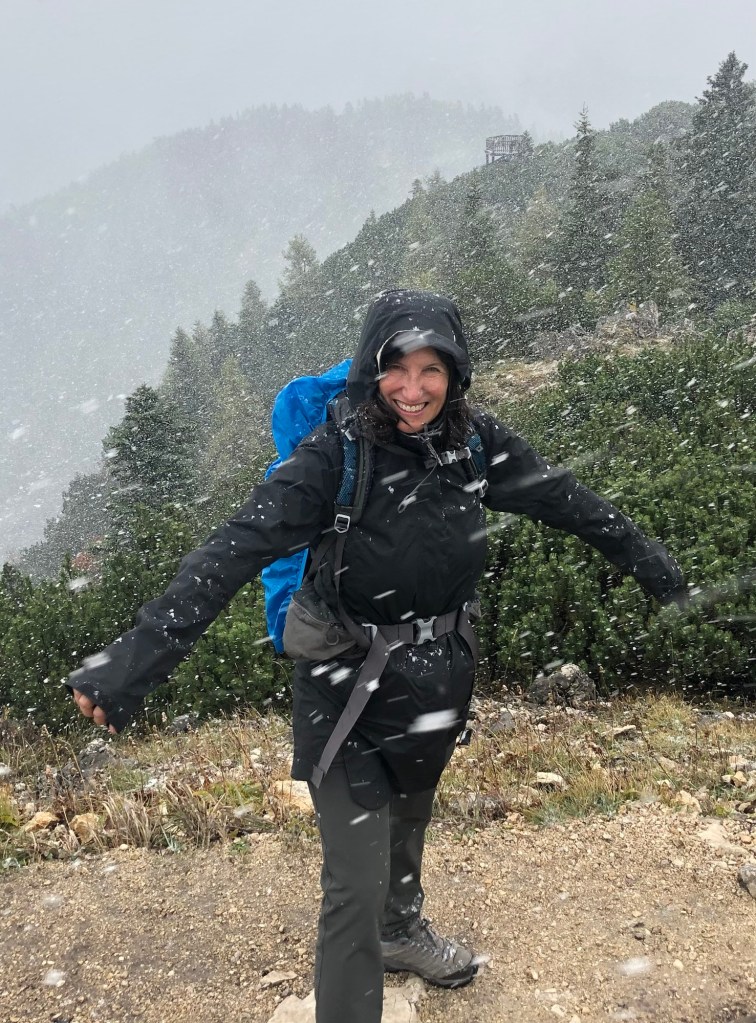
It was very cloudy, misty, and the “hut” where we’d hoped to have lunch was closed (as was most everything on Sunday). We took off up the mountain to the Katrinkogel, with only a few others hikers around. Tall evergreens gave way to short ones – and then it started to hail (small round pellets), shortly turning into genuine snow. It was very arid, dry and felt much better than rain. While this wasn’t a hard trail, there were certainly lots of steps.
After snowy views on Katrina, we backtracked and took another spur trail to the higher Elferkogel – we were the only people up there. Evergreens beautifully snow tipped and energy emanating from the crisp air. On the way down the clouds started to clear, and once on the gondola the views were great.
We walked back the same way to the hotel. It was clouding up so we still didn’t want to risk the other hill. We found zero places to eat. Everything was closed. Eventually we made it back to the hotel and ventured out to the nearby cafe for a beer – they didn’t even serve food. We were under an umbrella, but then the skies simply opened. We spent the last part of the afternoon in the our room planning the Italy portion of the trip. A nice dinner at the hotel restaurant – it seemed quite popular, but of course, it was one of the only places open.
On Monday, after another nice breakfast (Prosecco was on tap even on a Monday!), we packed and took the train to the train station for Hallstatt, which is a UNESCO world heritage sight. From the station you catch a ferry to the other side of Hallstadtsee, where the actual village is located. There’s a replica of this place in China, and there were tons of Asian tourists, even out of season.
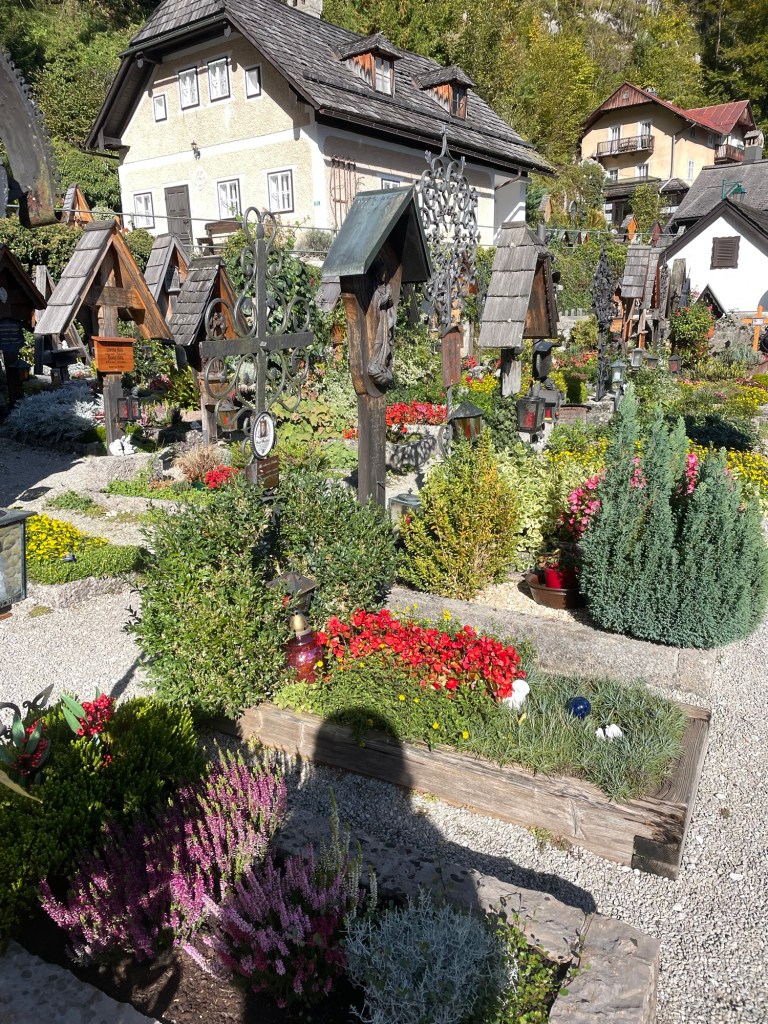
The town, built on the side of a cliff, is spectacular and filled with flowers. Salt mining was its claim to fame. The 19th century Lutheran church (first non-Catholic church I’ve seen ) by the dock has a large poster explaining that’s where the unfortunate Protestants were sent during the Counter Reformation. The Catholic Church is high up on the hill, surrounded by a cemetery, each grave with its own flower plot.
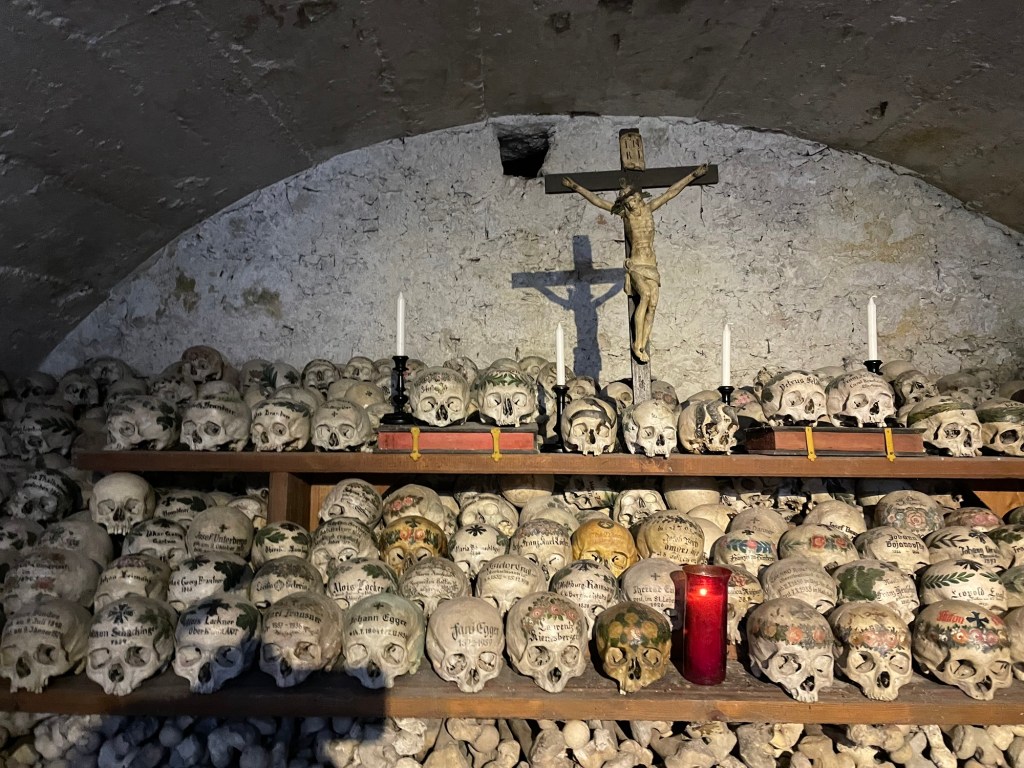
But Hallstatt is best known for the Charnel House. We saw the entrance by the cemetery and decided to pay the 2 euros to go in, little knowing that we were about to walk into an ossuary for skulls. When the graveyard became too congested, the families brought the skulls into the ossuary. (Not sure what happened to the rest of the remains.) But rather than just plop the skulls down, they were painted with family crests, dates, and remembrances. I actually found it surprisingly peaceful. J, on the other hand, found it quite creepy.
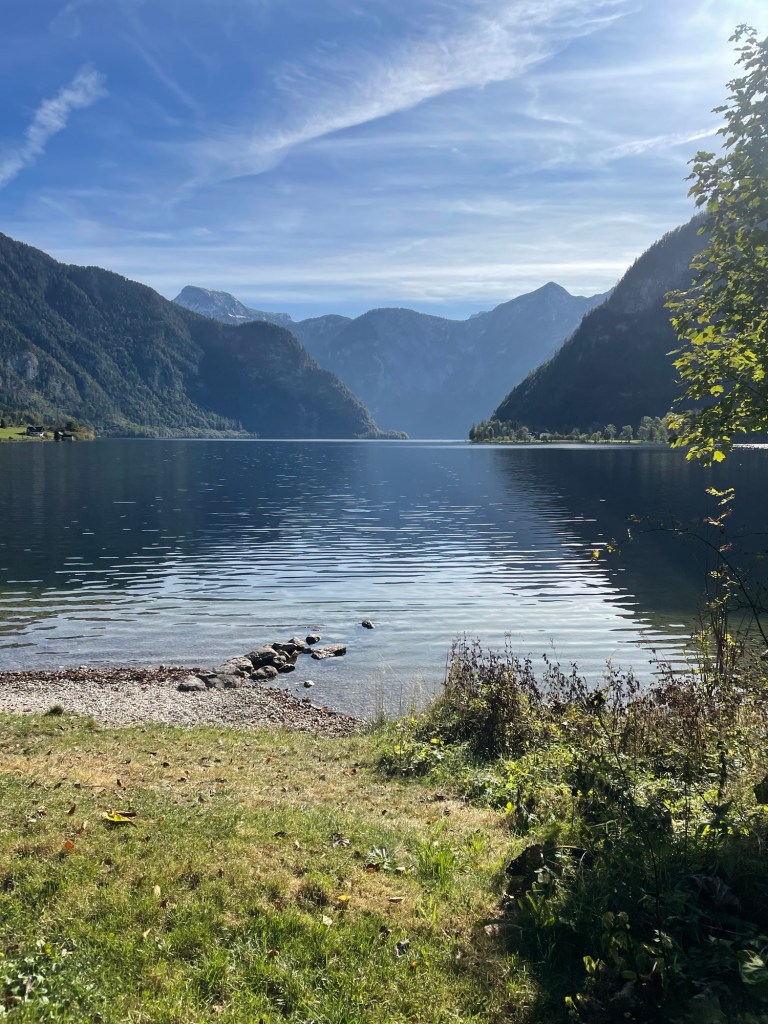
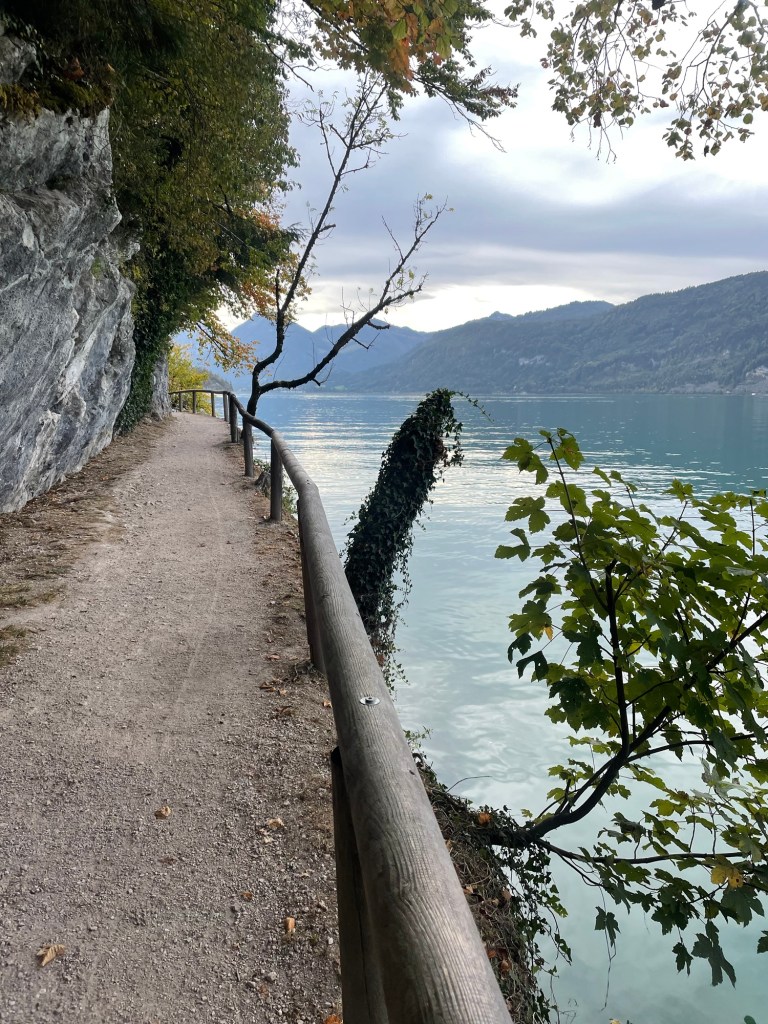
We then ferried back across the lake to start our seven mile walk to Bad Goisern, our next stop. The first part was around the lake – beautiful views, and much of the trail hangs off the cliffs over the lake. Mountains towering over the lake, and you could actually see a nearby glacier. The trail paralleled the railroad track near the lake. Lots of very small yellow finches accompanied us. There were some beautiful private homes. I can’t judge wealth in this country, but at least in the rural parts, it’s hard to see anything I would characterize as poverty.
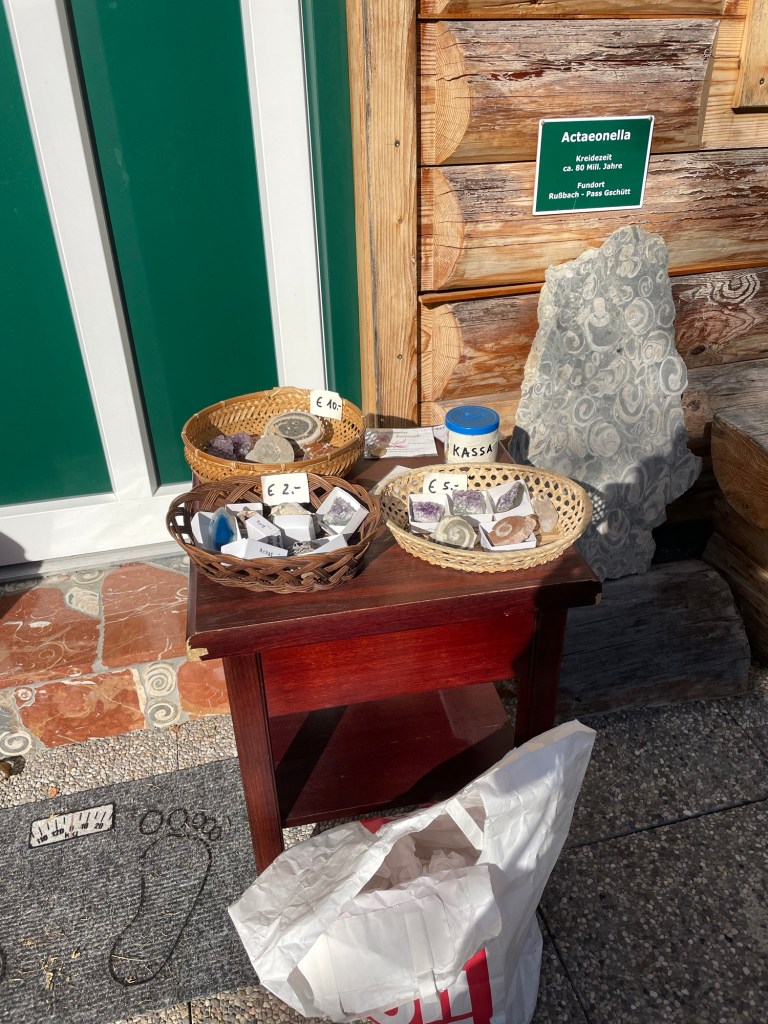
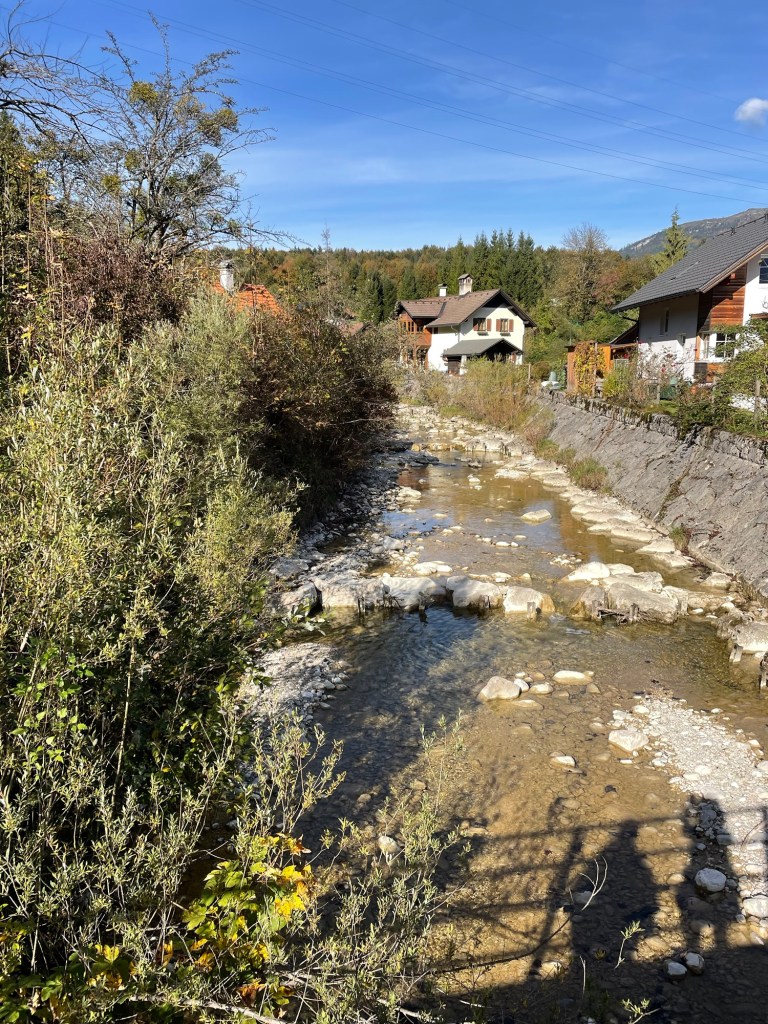
Eventually, we left the lakeshore to walk along the banks of the River Traun, which feeds into the lake. My favorite bit was the tiny village of Undersee. There, along the street in front of someone’s house, was a table of gems and fossils for sale on the honor system. I bought a beautiful ammonite for five euros.
A very nice, easy walk.
Bad Goisern is a real, little town, not just a tourist place. We stayed at the 17th century Hotel Moserwirt, in a large corner room that even had a balcony. After a grocery store trip, we had a lovely drink on the balcony with the late afternoon sun illuminating the mountains. The day was topped off with a dinner of venison and pork at the hotel restaurant.
We’d finished our Austrian hike. Now back to Vienna, and then to Nice.
It was October 12. The next stage of our Austrian adventures involved a hike from St. Gilgen to St. Wolfgang and a ferry to Strobl. Incidentally, one of the many things I learned on this trip is that you can download any language from Google translator onto your phone and use it even when you don’t have Wi-Fi or cell. That turns out to be invaluable when you’re in a German speaking country and your only German consists of Gesundheit.
Once again, a very nice breakfast buffet at our St. Gilgen hotel (Kendler Hotel). J and I are getting used to the pushed together twin beds, each of which has its own duvet. It turns out that minimizes a lot of arguments about who has pulled the covers off of whom. This coffee machine was exceptionally good, with at least six plus types of coffees, and once again, many types of breads (you are given a basket, just so you can completely carbo load), meats, cheese, eggs, fruit, yoghurt.
The hike from St. Gilgen to St. Wolfgang is an actually a pilgrimage route for St. Wolfgang himself. He lived as a hermit, later founding a monastery in St. Wolfgang. Lots of information boards along the way told his story, including in English at first…but then someone clearly became tired of translating and they were in German only.
Some very steep uphills made the trail markers that depicted pilgrims carrying heavy crosses quite appropriate. A small white church stood at the peak, right by a spring (shrine) that was supposed to have healing properties. Although I felt I could use some healing properties by that point, I resisted the urge to take off my boots and dabble my feet. The trail had a nice mix of up and down, and reminded me a bit of the Balkans.
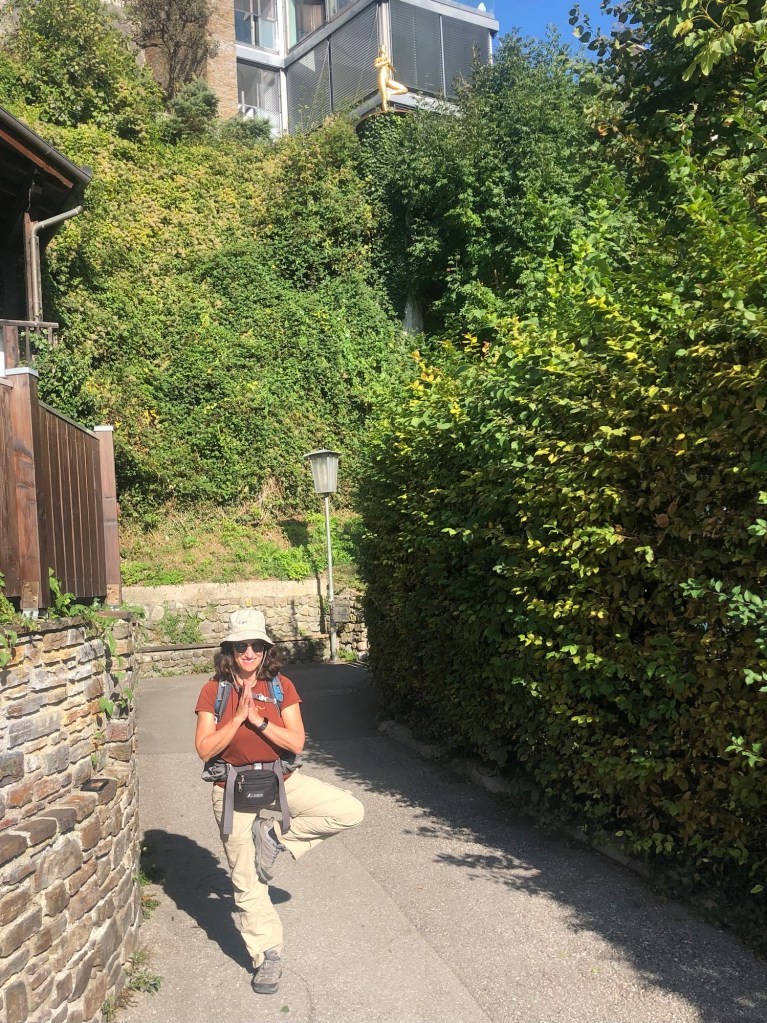
One of many Virgin Mary shrinesTwo Yogis – Look Closely
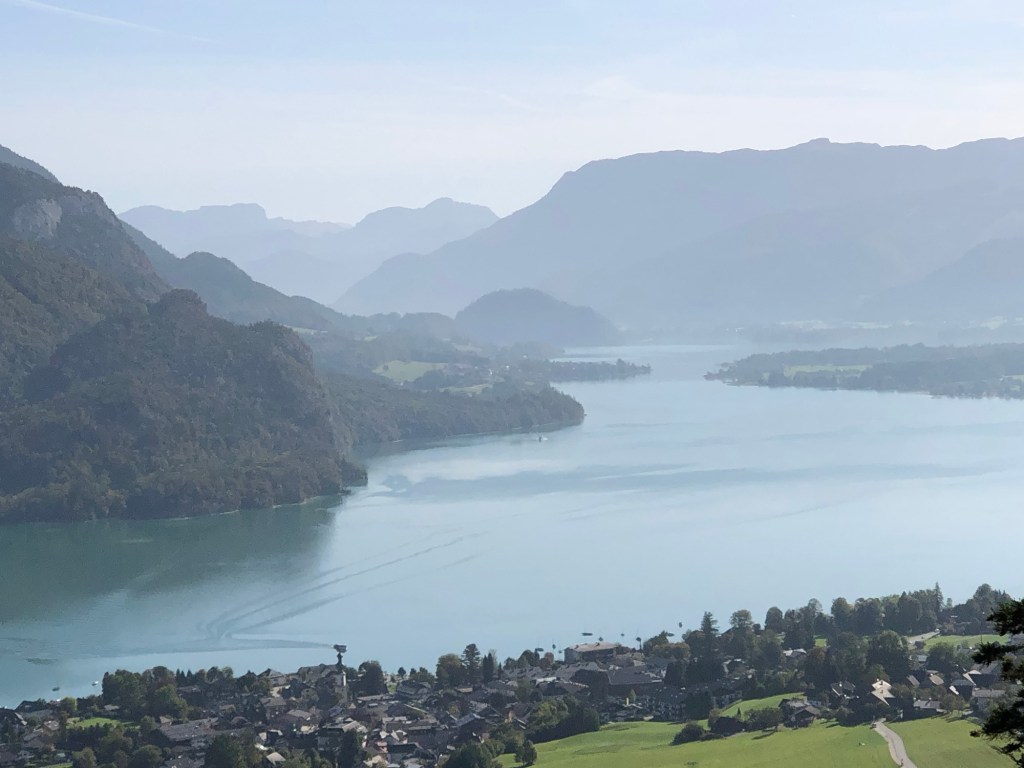
We reached St. Wolfgang in time for lunch at a cafe by the church. The very young servers seemed overwhelmed, so it left a bit to be desired. St. Wolfgang is quite the tourist spot, but still retains a lot of charm. Nice little boathouses line the lakeside; it looked like you could rent them. And I was amused by all the statues of yogis! It was quite the contrast to the Virgin Mary icons we were seeing everywhere, at stops on trails, above front doors.
The 15th century church, right beside the lake, was amazing – painted ceilings, multiple carved alters.
We bought our ferry tickets online and took the 15:45 to Strobl, where we were to stay for two nights. Like the buses, the ferries leave right on the dot. It was about a 20-25 minute ride across the lake to the far end. Strobl feels smaller than St. Wolfgang, although it looks bigger on the map. I think it’s just less touristy.
A fair number of places were closed for the season. We stayed at the Hotel Strobler, very nice and convenient, but right by the church which rings its bells every 15 minutes, 24 hours a day. Our window looked out on a well-maintained and colorful graveyard, decorated with flower gardens atop each grave.
After a walk down to Lake Wolfgang (Wolfgangsee), we had dinner at a brewery with very interesting food. I had a vegetarian meal of baked potato with sour cream, root vegetables and chestnuts. J had Wiener schnitzel (not so unusual). Sleep was a bit hard to come by, with the church bells clanging every 15 minutes.
The next day was Friday the 13th. After our somewhat disrupted night, we made it to a grocery store to pick up lunch food for our day hike. We started off by passing the elementary school track races; lanes had been marked off by the lake, and there was lots of excitement.
The start of the Burgl Panaramaweg (Trail) is neat. In contrast to the ancient Wolfgang pilgrimage we had taken the day before, it opened in 1982. The trail starts off on a boardwalk tethered to the side of a mountain as you round the Burgl Rock. It then meanders through a valley (replete with very nice cows, all wearing bells), and though a pass and up, up, up to the Schwarzensee (see means lake).
On the way, we walked through beautiful mossy areas that looked like fairy spots, biodiverse forests, followed by spread out tall pines with light dappling through. The lake seems small compared to the others, but it’s large enough when you walk around it.
We had a nice picnic lunch in a secluded spot on the banks, and made it back to St. Wolfgang (where we’d been the day before) in time to catch the same 15:45 ferry.
As I wrote this diary entry, we were enjoying a drink in the garden at the Hotel Strobler while vaguely watching the only other Americans we’ve seen (two men, investments bankers?), who were also on the ferry, trying to figure out how to order drinks.
Our final night we had dinner at Kirchenwirt – we even made reservations. J had a goulash, and I had spinach dumplings. Fortunately we were either so tired or so used to the every 15 minute church bells we didn’t even hear them that night. A good thing, because the next day was 9 miles to Bad Ischl.
It does sound a bit like “I Had Trouble in Getting to Solla Sollew,” for those of you who remember the 1965 Dr. Seuss book…but Fuschl am See was our next destination after our couple of nights in Vienna. (“See” means lake; “am” means “at the”.) This entailed trains and buses and trails, oh my, and a few wrong turns along the way.
Actually, we were about to embark on the hiking phase of our trip — about a week exploring the hills surrounding the Salzburg Lake District. Our adventure started with the subway to the main train station in Vienna, a long wait, and then a train to Salzburg. Fortunately, it was easy to find the bus from Salzburg to Fuschl am See, although getting off the bus proved more difficult.
We bought tickets for the 2:15 bus and boarded almost immediately, except for the delay occasioned by some woman who insisted we put our suitcases in the cargo area below. I knew we must be in the right place, since one of the few passengers on board was wearing a native green Austrian hat, festooned with feathers and insignia. See photo above. We clearly weren’t in Kansas anymore.
We had looked at all the stops listed on the electronic display on the bus and there seemed to be only one Fuschl stop. Although this was not consistent with my previous research, we thought we better go with the real time indication on the bus and get off at that one. I should have relied on my research, as we ended up disembarking a full four stops too soon. It turns out that having Fuschl in the name of a place was not much of an indicator…there were multiple stops labeled Fuschl and the electronic display simply hadn’t shown them yet!
Anyway, we exited the bus at what was a suspiciously remote stop on the side of a highway, after making quite a production since the bus driver had to help us get the suitcases out from the cargo hold. The fact no one else got off should have been another hint. It didn’t take more that a couple of minutes before it was clear something was terribly wrong. I checked GPS (which, by the way, works without cell data or Wi-Fi) and realized we were a good three miles from our destination. Since pulling our luggage along the side of a two-lane highway without sidewalks didn’t seem like a very good idea we were happy to learn the next bus was only 20 minutes away. The bus driver rolled his eyes when we got back on but let us use the same tickets…clearly chalking it up to incompetent Americans. This time we did not put our suitcases in the cargo hold!
After three more stops, we arrived at the correct Fuschl stop and located the Hotel Jakob (which also seemed to have a moniker of the Triathlon hotel). And indeed it was aimed at triathletes and cyclists, with bikes on display and biking gear for sale. The town was quite small – on a beautiful lake surrounded by mountains. J and I strolled through town and had a gin and tonic at a nice lakefront cafe, and made a dinner reservation for the attached restaurant, which was recommended for local fish.
The temperature dropped; we returned to the hotel to change. This is when we figured out that Austrians, at least in the country, eat early – between 6 and 7 p.m.! I can only describe the restaurant as staid, lots of older people (it was a weeknight in the off season), all seated at tables lined up around the sides of the room so we could all inspect everyone else as they ate their meals….I had three types of fish all from the lake – a filet whose name I didn’t catch, arctic char, and perch, served with carrots and leeks.
The next day we finally started the hike, but only after an amazing breakfast buffet featuring salmon, cold meats, cheeses, breads. I managed to mess up the coffee machine by using too small a cup for my latte (you can imagine what happened), but discovered that the coffee machines in Austria rivaled those in Spain. America needs these!
After we checked out of the hotel, we started to follow the “blue line” on our downloaded GPS map, just as we had done in the Yorkshire Dales. The first part, through a valley, was a trail themed around gnomes, with little signs up everywhere telling a story of some ill fated gnome. The landscape really does explain where the Brothers Grimm got their tales.
It was only about a five miles to our next stop, although there was a decent uphill and down, and I did miss my hiking poles – but there was no way to fit them into the luggage. One thing to get used to were all the Catholic shrines and chapels along the trails. Every couple of miles there would be a shrine with candles lit, typically for the Virgin Mary. I’m assuming the candles were battery operated.
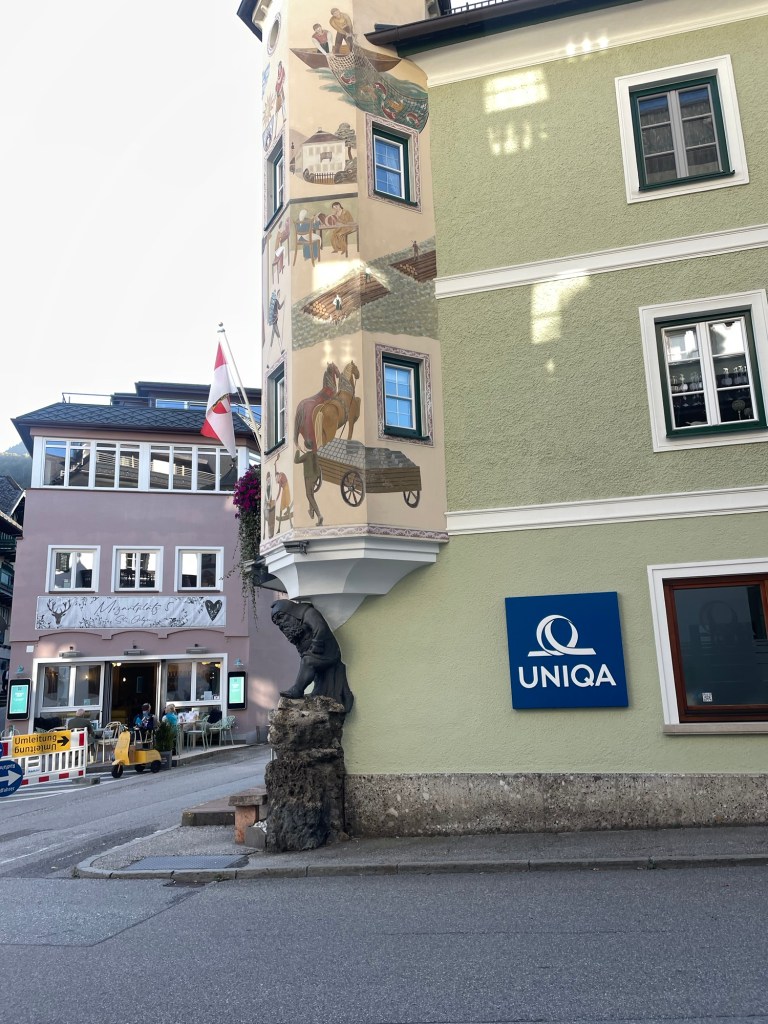
After some good scrambling and beautiful views from Mozartblik, we descended into St. Gilgen, which is on Lake Wolfgang. It’s a very wealthy summer town, but many places were closed for the season, which had ended a couple of weeks before. It was almost too quaint, painted buildings and Austrian architecture.
We had lunch by the lake, followed by a power nap, since we still weren’t exactly on the right time zone. After a long walk through town, we capped off the day with a drink at a bar across the street, which featured someone wearing lederhosen along with many tattooed bikers. That theme continued at dinner – again, the restaurant was practically empty by 7 – where we enjoyed watching four very elderly men, clearly on their weekly outing, each wearing lederhosen with the appropriate jackets.
J and I retired early. The next day was going to introduce yet a new mode of transportation – a lake ferry.
As I sit here on a cold, dreary Central Florida winter day, battling the same annoying case of Covid that half the population seems to have, nothing seems as pleasurable as revisiting our six weeks in Europe that made up the third phase of our sabbatical. You’ll recall J and I started our six months off in the UK and Northern Spain, followed by a multi thousand mile road trip that took us from Florida to Yellowstone National Park and back again, with multiple sights along the way.
On October 7, having barely slept, we finished last minute packing into two backpacks and carry on suitcases, and started our journey. Uber to MCO (for those of you not versed in Central Florida lingo, Orlando International Airport is actually the former McCoy Airforce Base, whose initials it still uses). After a flight to Newark, we boarded our Air Austria flight to Venice. All the flight attendants wore red, down to their stockings, and despite some bumpiness there were free drinks and good food, albeit little sleep.
We arrived in Vienna very early on Sunday morning and managed to find the train to take us to the Prater station, which, to our surprise, was at the edge of a very large and old fashioned amusement park. Ferris wheel, roller coasters, fun houses, and games of chance…it reminded me of Tivoli Gardens in Copenhagen, which informed Walt’s ideas for Disney….I guess I just can’t escape! Pulling our suitcases through a deserted carnival the day after the last day of Oktoberfest was a little eerie.
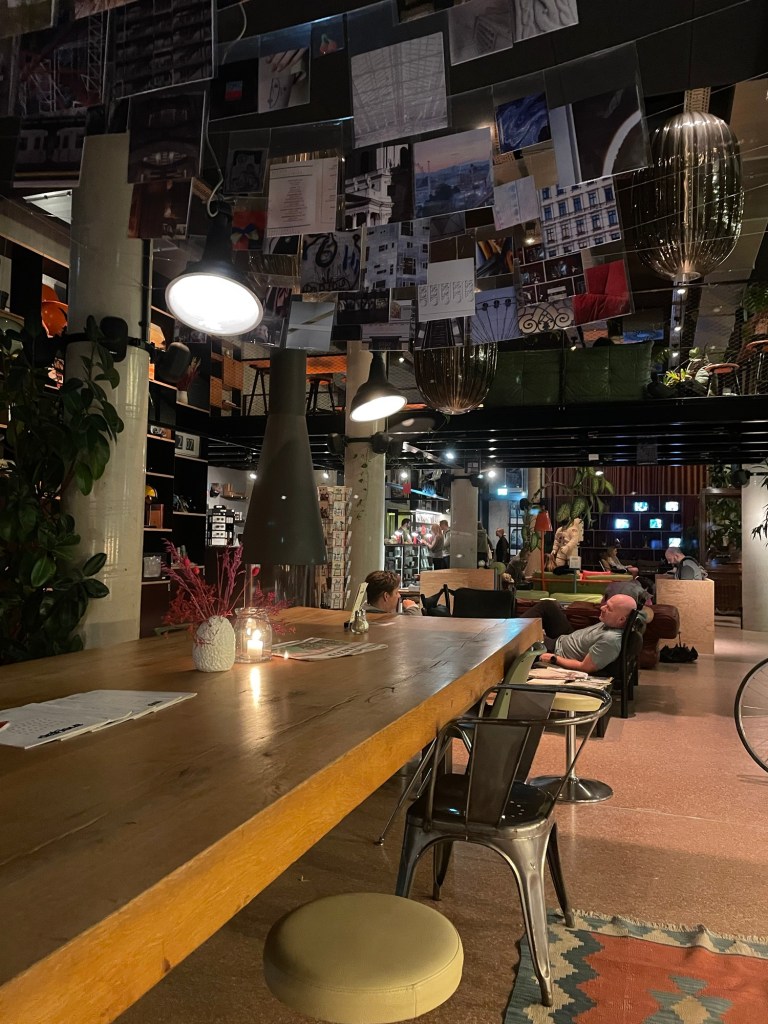
Lobby of the Superbude
The Superbude Hotel, recommended by one of J’s colleagues, was just on the far side of the park. A very hipster style place, with lots of retro, mid century modern stuff in the lobby, including an astronaut space suit. Our room, which fortunately was ready by 10 am, was perhaps modeled after a tent? How appropriate. A pattern of mushrooms on the wallpaper, net hanging from the ceiling to mimic tent walls (?), folding chairs attached to the wall.
After a brief rest we decided to wander toward the city center via the canal. We’d been told there were lots of bars and establishments on the canal – we could see signs of that but they certainly weren’t open on a cold and rainy fall Sunday.
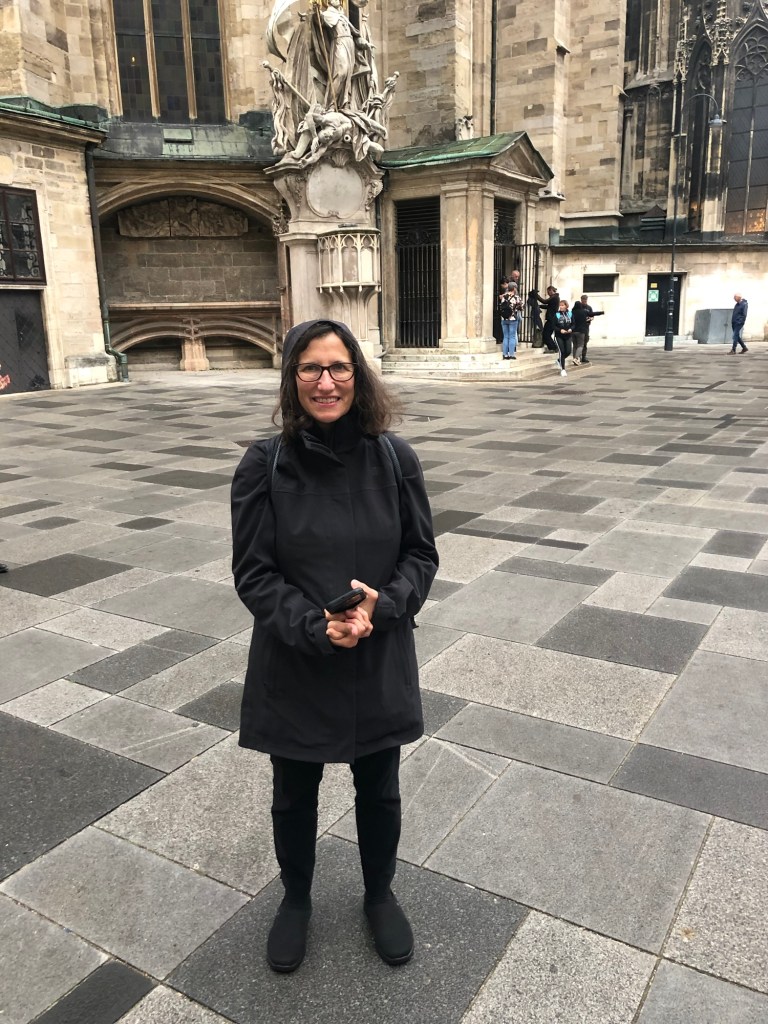
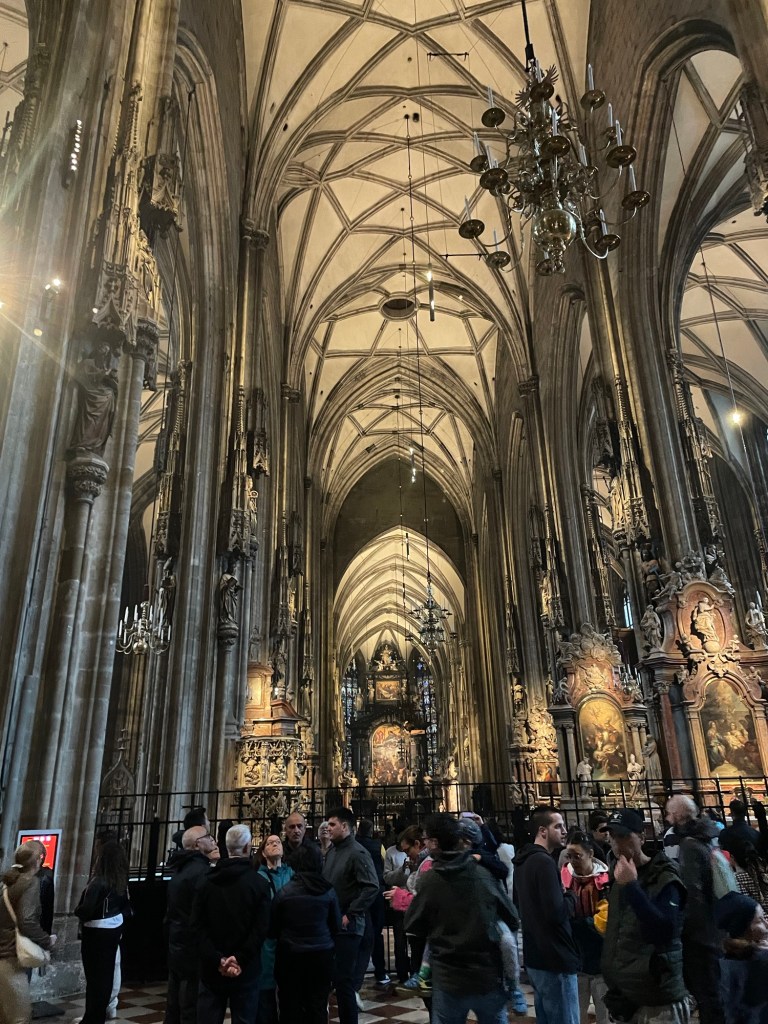
Eventually we made our way to the old city center. Lots of grand, ornate buildings situated next to utilitarian structures clearly built after the war. We ventured into St. Stephen’s, the main cathedral in Vienna. Highly decorated, multiple altars, and a Virgin Mary icon that is supposed to have wept…and to whom many were lighting candles.
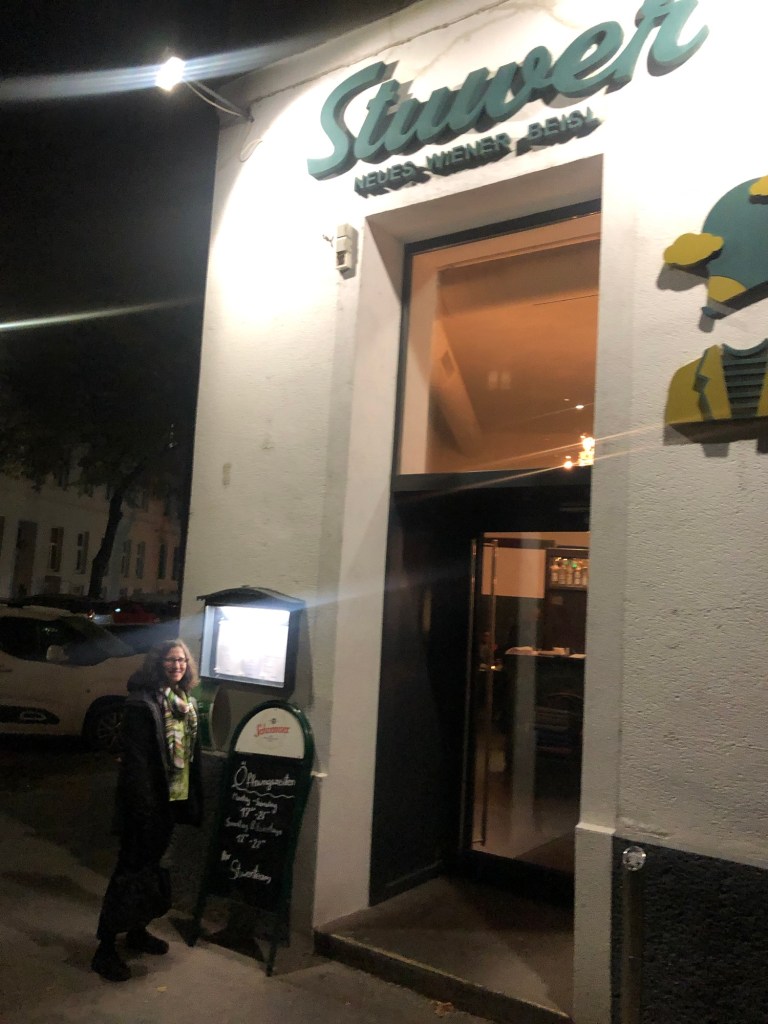
It was now raining even more so we headed back to the hotel in a slightly more direct fashion. We hadn’t yet mastered the subway system. After a little more napping, we went to a nearby restaurant in the non carnival side of the Prater, which is dominated by the Sigmund Freud University and the Messe Vien (a conference center) and home to lots of small shops and cafes. The restaurant, Stuwer, was great and local. J had wild boar schnitzel (we were later informed that wild boar are farmed domestically and not actually being hunted in the wild!), and I had fried carp served over carrots and leeks. Two things I learned – (a) carp is an edible fish and (b) Weiner means Viennese style. Also discovered that spritzes (red or white wine or Aperol mixed with seltzer) are huge in Austria. And they are good – with none of the nasty sweeteners that tend to be added in the states.
The next day was our one full day in Venice before heading toward the Salzburg Lakes for a week of hiking. My diary reflects that I was fighting off an upper respiratory infection but felt ok. How appropriate, given my current circumstances.
Breakfast for me was something called “eggs in a glass.” Medium boiled eggs in a small bowl, liberally sprinkled with chives, and bread and butter. Chives are also very popular.
I had done a lot of work by then to figure out the underground, so we walked to the nearby Messe station, took the U2 one stop to the U1, which took us to the main train station from which we’d be leaving tomorrow.
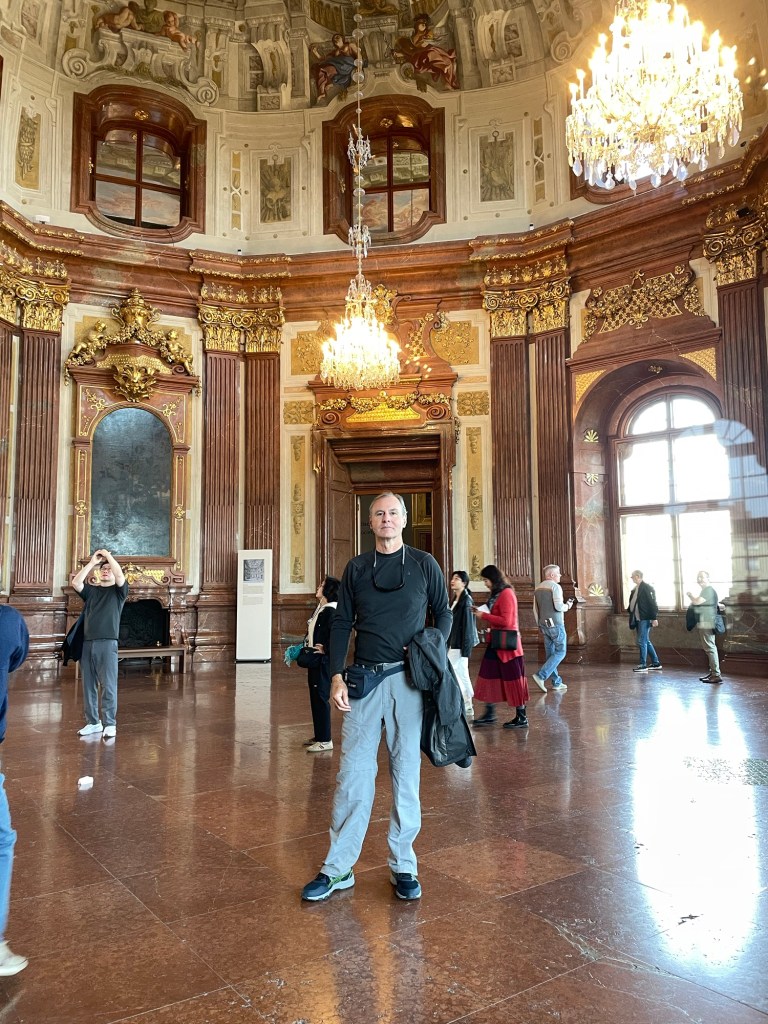
Then, using GPS (thank God for GPS which connects even without Wi-Fi) we walked ten minutes to the Belvedere Palace, one of the huge Hapsburg palaces. It was originally the summer residence of Prince Eugene of Savoy. There are two palaces, upper and lower, surrounded by formal gardens. The museum is in the upper palace, so that’s what we explored. Built in 1723, the ceilings are painted, highly ornate, and the signs did a good job of explaining the function of each room.
There’s an enormous collection of Klimt, including the famous “The Kiss,” which even has its own signs posting its location. The Messerschmidt character heads also reside here.
It was very interesting to view the Expressionist and Modernist works against the backdrop of 18th century baroque rooms. And it’s a manageable size museum.
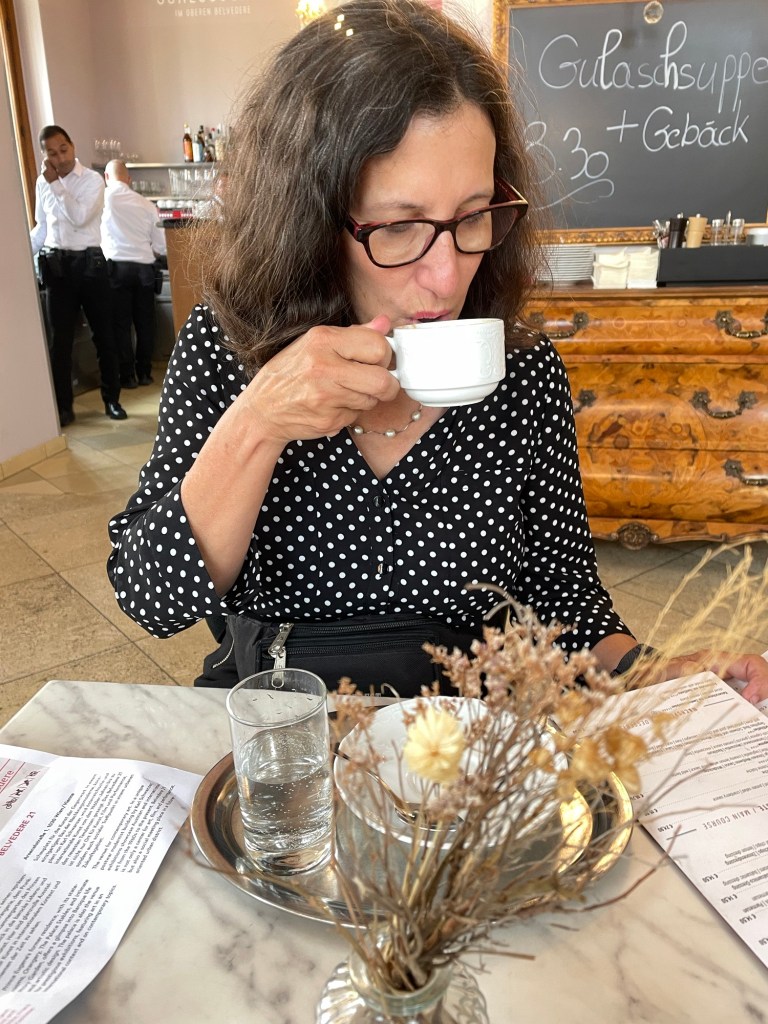
After Viennese coffee and chocolate torte at the cafe (how could we not) we walked another thirty or so minutes to the Museum Quartier. This took us past the Secession Building, the headquarters for an iconoclastic group of artists led by Klimt (and whose members seemed to come and go based on personal and other conflicts). The building is ornately painted and has a golden globe on top; designs harkening back to the English Arts and Crafts movement, at least to my eye.
The Museum Quartier is a collection of art museums and event spaces, and also home to the Vienna University of Technology (architecture and design), and is full of pedestrian walkways and lots of trees.
After a quick lunch we went to the Leopold Museum, which has an amazing collection of Vienna 1900. See the film, Portrait of Wally, for more background on the museum’s less than salubrious history. The museum is constructed of white travertine marble, and is light and airy. There are numerous references throughout to settlements reached with the original owners of a number of the paintings.
We saw lots more Klimts, and rooms of Egon Schiel’s paintings. He died at age 28, in 1918 of the Spanish flu, only three days after his pregnant wife- and the same year that his mentor, the much older Klimt, died. It was also the year he had his first successful show.
It turns out that I was so enamored with the various print and graphic styles and their potential use in future projects most of my photos are of various posters and not of the great Klimts and Schiels!
I had never really before focused on the immensity of Vienna as a cultural and intellectual capital in the early 20th century- Klimt, Schiller, Freud, Mahler, Wittgenstein- you name it. And then along came the world wars and isolation for some decades.
By this time we were pretty museumed out, and took the train back to the hotel. Dinner that night was at L’Osteria, a nearby Italian restaurant that’s part of a chain but clearly a local student hang out and quite inexpensive.
It was time to try to get some sleep. Some real Austrian adventuring was about to begin the next day.




















 FromSwamptoSummit