
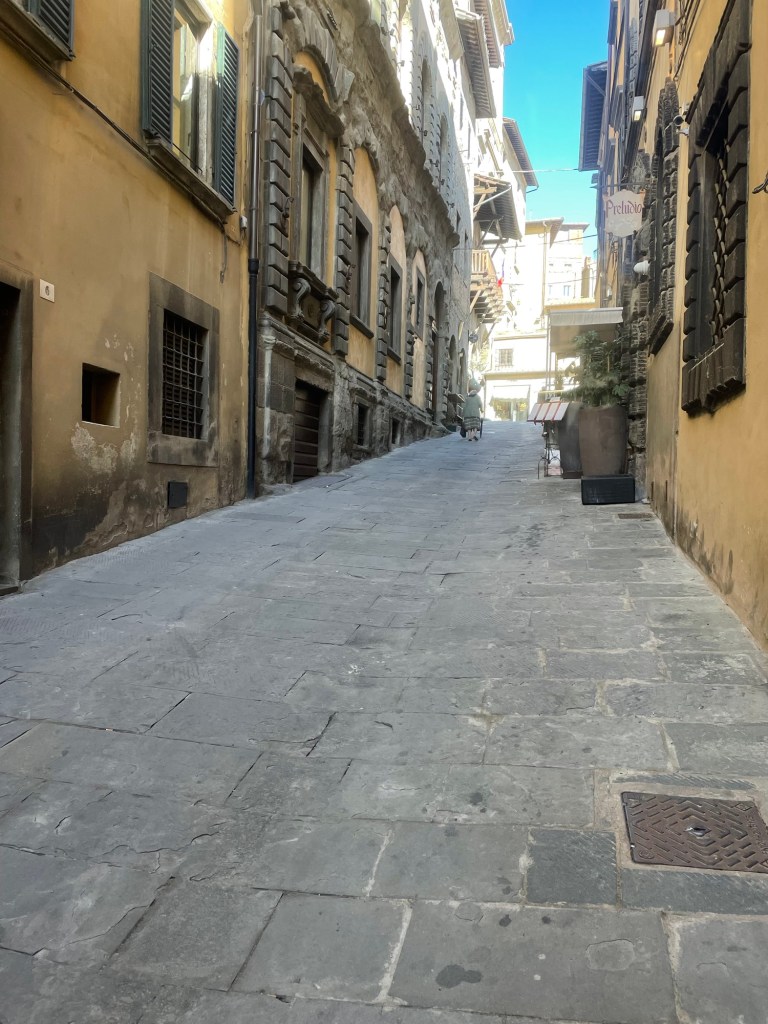
Our last day at our Tuscan farmhouse (I only wish it really were ours) was slotted for an exploration of Cortona itself. It was a beautiful, sunny, and finally not so windy November day in 2023.
We started by finding the very steep, narrow, both stone and dirt paths that led up the hills to the lower part of Cortona. There weren’t many people on the street and hardly any tourists.

We finally located the famous Etruscan barrel vault, dating back to the 4th Century BC, then wandered through town, especially enjoying the public bulletin boards on which were posted funeral and other announcements. A visit to the Cathedral on the main square was next up, followed by the Church of San Francesco, which supposedly houses a relic of the Holy Cross.
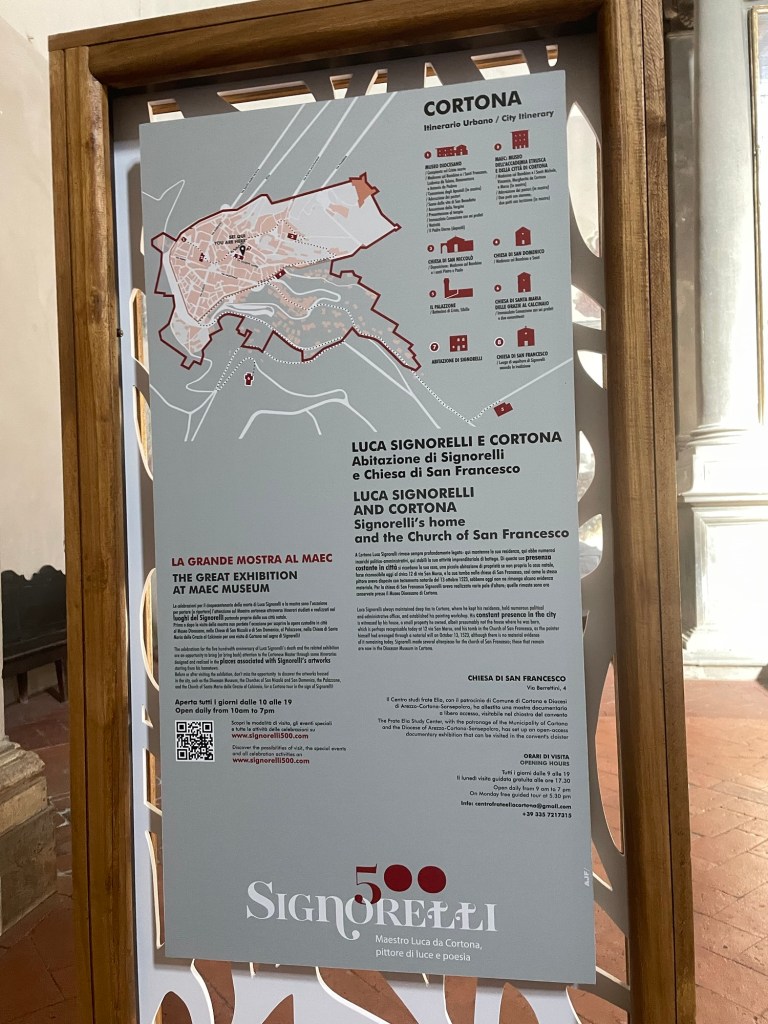
Luca Signorelli was a native of Cortona, an influencer of Michelangelo, Raphael and other great Renaissance artists, and his 500th anniversary (of death? Of birth?) had just happened – hence, many festivals had apparently just been held in his honor and we saw a lot of his art throughout Cortona.

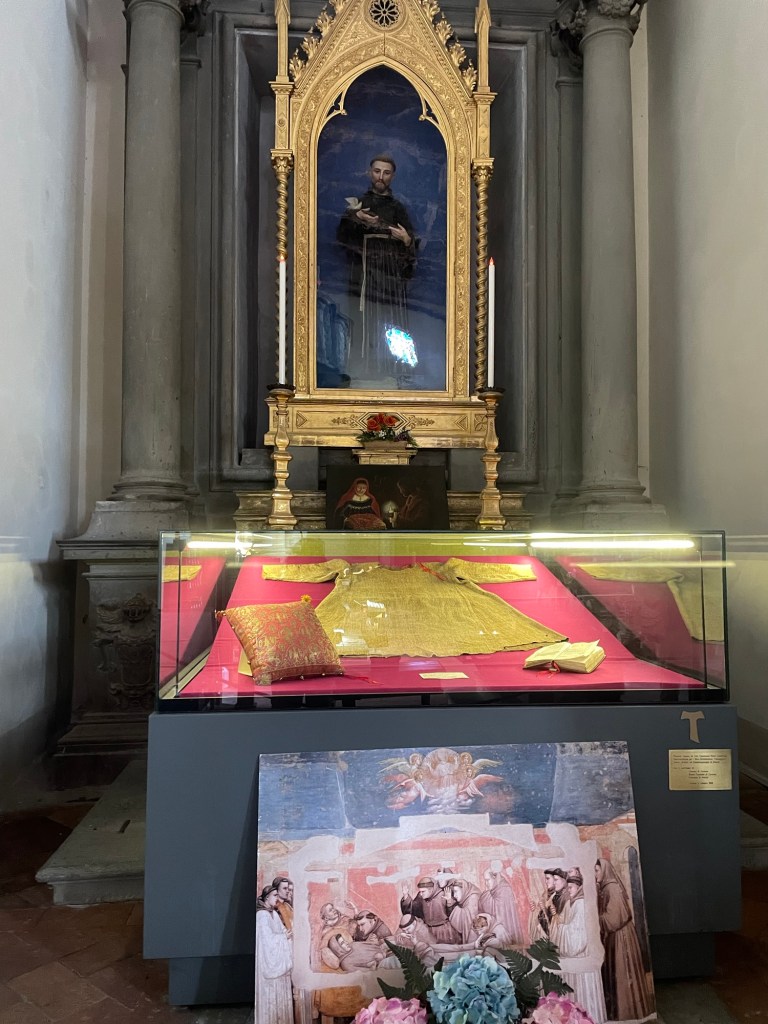
The Church of San Francesco, where Signorelli is thought to be buried, was very empty and austere. It dates back to 1247, and was started on orders of Brother Elias, a close companion of St. Francis. It is home to more relics of St. Francis – his tunic, a New Testament, and a cushion he used, all dating back 750 years. It was touching to see these, and as they supposed to have come to the church directly from his compatriot Fra. Elias, I like to believe a more genuine provenance.
After lunch at one of the few open cafes, we stopped at wine shop where the salesperson told us about the Basilica of St. Margaret at what turned out to be the top of Cortona. We walked up and up a steep stone path, designed for pilgrims, and lined with the Stations of the Cross. At least J and I didn’t do it on our knees, as they would have.


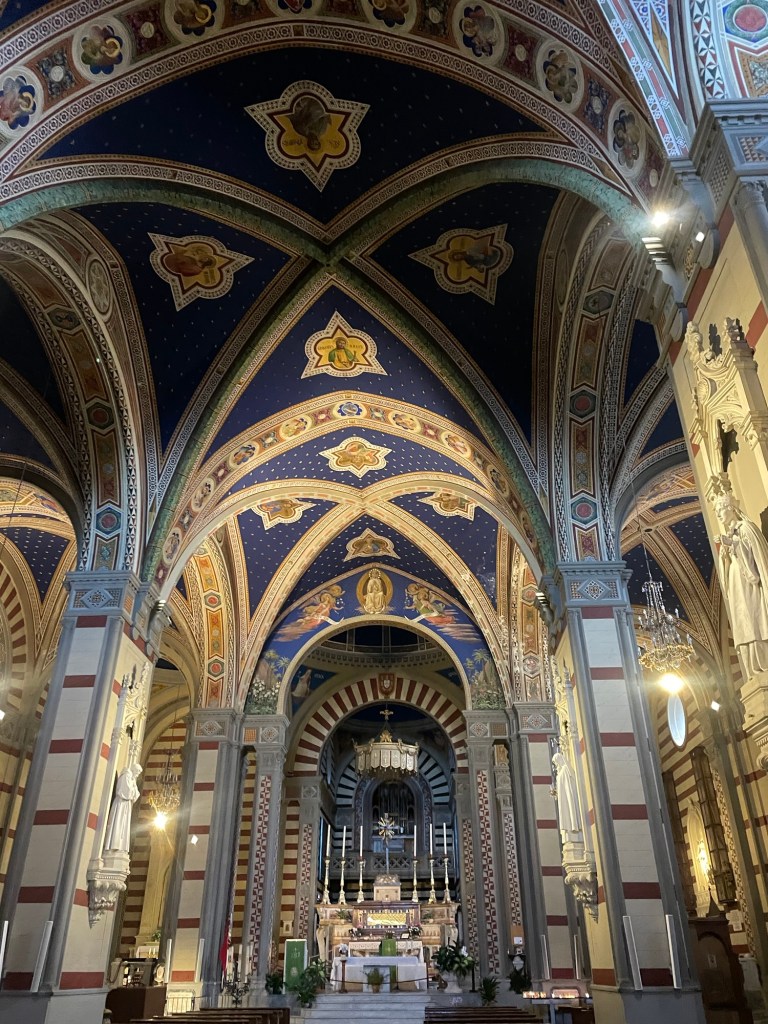
We saw even more churches along the path – the Chiesa Inferiore di S. Marco, with another ornate ceiling – and also completely empty of either pilgrims or people. We finally made it to the top, where we were awarded with amazing views.

The church itself dates back to 13th/14th century, but its typical duomo front was added much later. In keeping with the theme of the day, the only people there were J, me, and some people working on restoration of some of the walls. The ceiling was reminiscent of the church in Assisi – blue sky illuminated by stars. It appears that the body of St. Margaret is entombed right on the alter itself, which added a certain bizarreness to the entire place.

Just above the church, higher up on the hill, is a Medici fort and castle. It was closed, of course, but still interesting from the outside – very storybook like.
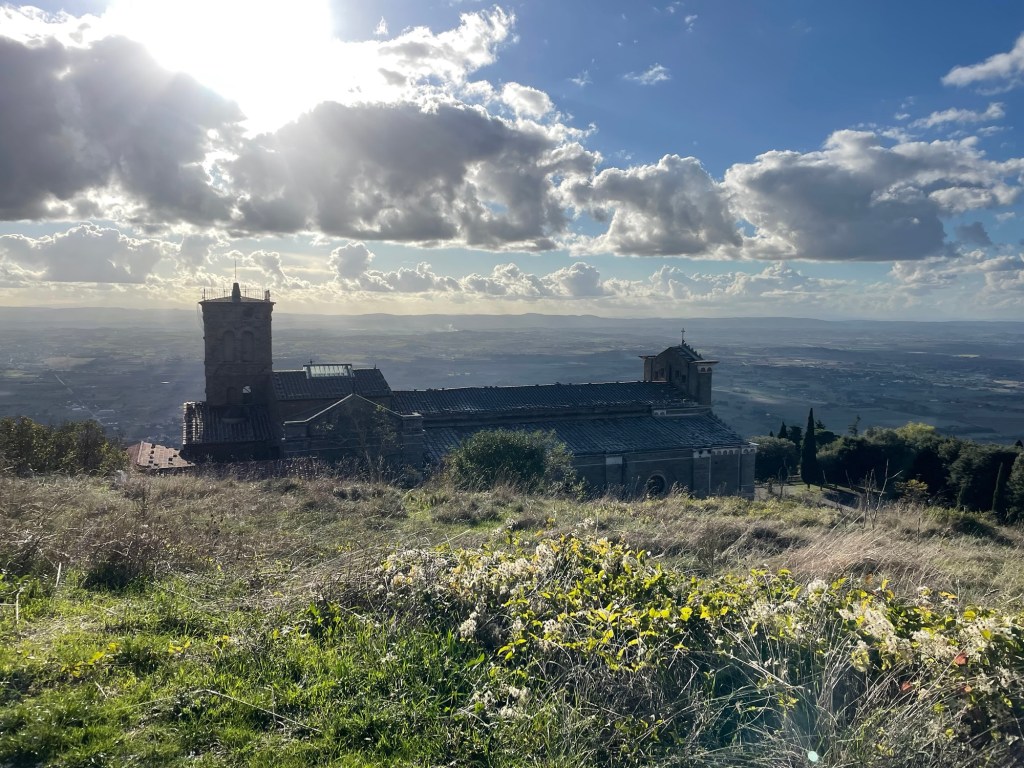
We made our way back down by the serene Chiesa di S. Nicole, a very small church perched behind a grassy area. It was one of the few churches we saw that was actually not open for visitors.

The next day we departed our idyllic Tuscan retreat. Time to get back on the road. We woke up early to see clouds below us in the valley and lots of ground fog, which made for quite a dramatic drive into Siena to return our rental car. After encountering a few navigational glitches, mostly due to road construction (which seemed to be the story of our entire sabbatical), we took a taxi to the train station. After a fairly long wait, we were on our way to Orvieto, our last stop before Rome.

 FromSwamptoSummit